
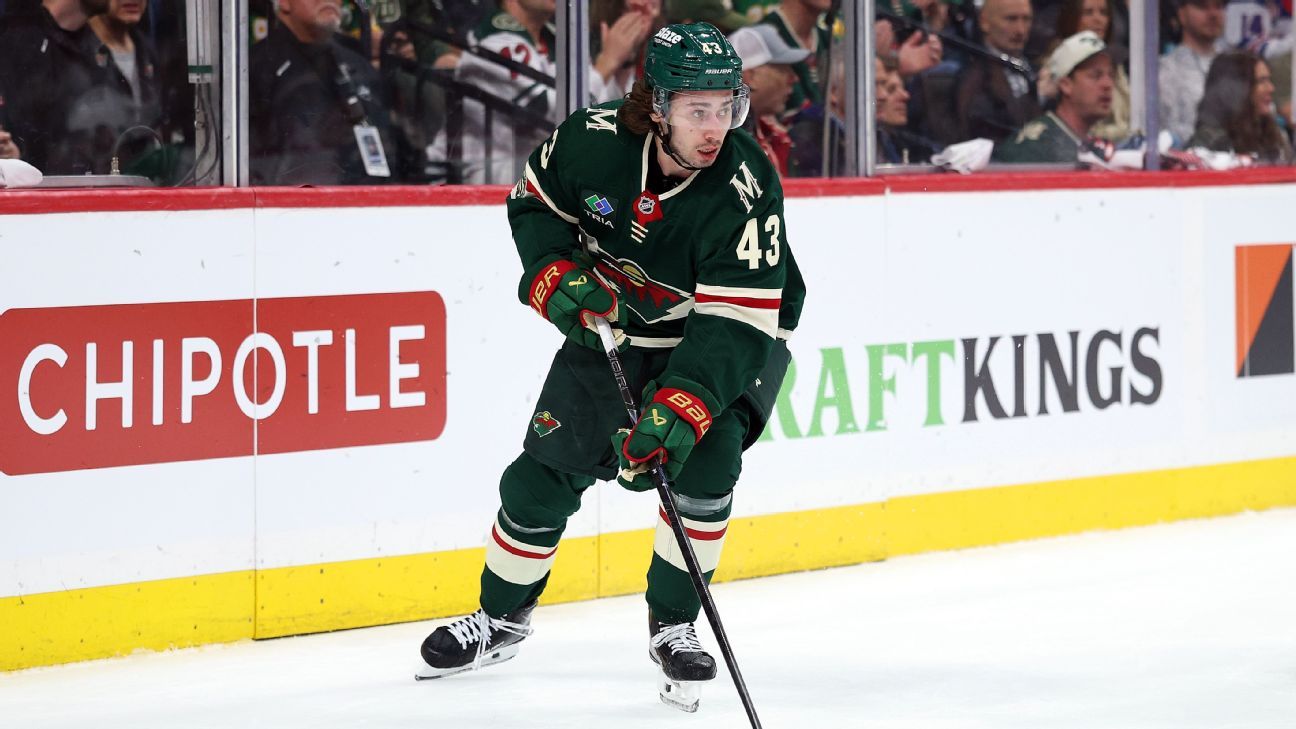
EmailPrintOpen Extended ReactionsDALLAS -- The most succinct way to describe what makes Quinn Hughes so dangerous: He doesn't require a lot of time to do a lot of damage."When you're playing against him, the game is just so fast, you're reacting," Minnesota Wild captain Jared Spurgeon said. "But when you're on the bench and you get a chance to watch him, that's when you realize how smart he is. There are plays he makes, and they're not always the most fancy ones but they're the subtle ones that make a huge difference for us."Like what he did on the Wild's first goal in Game 1 against the Dallas Stars.A box score from the Wild's 6-1 win shows Mats Zuccarello and Matt Boldy got the assists on Joel Eriksson Ek's first of two goals.The stats are accurate, but they tell an incomplete story.Boldy carried the puck into the Stars' zone before passing to Kirill Kaprizov. He fed the puck to Hughes, who touched it for a second. That still was enough time for him to draw pressure that created the opening for Zuccarello and Boldy to execute those tic-tac-toe passes that found an extremely open Eriksson Ek to score from the low slot.Quick moment, big impact."For sure," Spurgeon smiled. "Absolutely."The Dec. 12 trade for Hughes -- who won the Norris Trophy as the NHL's top defenseman in 2024 -- signaled a shift for the Wild. Previously, they spent salary cap dollars carefully. They deftly added around the edges, while developing one of the league's strongest prospect pipelines. General manager Bill Guerin developed this system, and his rosters advanced to the playoffs five times in his first six seasons.The Wild finished with the eighth-most points in the NHL since Dec. 13, the day after Hughes was added. They finished five points behind the Colorado Avalanche, who had the NHL's best regular-season record, and had the same point total as the Stars during that time.In February, the oldest Hughes brother played a critical role in helping the United States win its first Olympic gold medal in men's hockey since 1980, further igniting the notion that he could be just as important in a Stanley Cup playoff run. There's an argument that Hughes was the best player for Team USA, leading in average ice time, scoring the winning goal against Sweden in the quarterfinal and making the Olympic All-Star team with eight points in six games.Hughes' previous postseason exploits suggest that he can deliver in the playoffs, with the 26-year-old entering the 2026 postseason with 26 points in 30 games played with the Vancouver Canucks. The Canucks came within one win of the Western Conference finals in 2024. The Wild are seeking their first playoff series win since 2015, when they advanced to the second round. Their lone conference finals appearance came in their third year of existence in 2003.One way to quantify Hughes' impact is that the Wild have now entered the stratosphere of Western Conference teams in a legitimate championship window. Another is by hearing from his teammates, who explained what Hughes has done to help them go from a perennial wild-card team to one that could play for a Stanley Cup."There's a lot of excitement that comes with seeing him play," Wild winger Vladimir Tarasenko said. "I think obviously everybody knows about his skating, his vision and stuff like that. I think he has really good timing. He knows when to do something or when to just skate away. It has boosted our happiness a lot, and we really like it a lot to have a guy like that on our team."AN OFFENSIVE DEMON. That's how Wild goaltender Filip Gustavsson describes Hughes when asked about the difference he has made since the trade."We were kind of more of a hard, grinding team before Quinn got in here," Gustavsson said. "We always dumped the puck into the zone and chased after it. He came here, he brought the puck into the zone and built the offense from here. Then, when he's in the zone, he goes low, he goes high. It takes a lot for a guy to do all that and it allows the other D's to be like, 'Whoa, we can do a little bit more of this.'"Gustavsson said that Hughes' arrival meant the forwards began trusting the defense more when they were in the offensive zone."It was like a good spiral that started creating more offense for us," Gustavsson said. "It got us a little more swagger in a way."According to Natural Stat Trick, the Wild had the fifth-lowest shot-share in 5-on-5 play, at 46.86%, prior to the trade. That meant they were spending more time defending in their own zone rather than controlling possession against their opponents.Minnesota was still 11th in scoring chances and 13th in high-danger scoring chances at 5-on-5. The Wild averaged the 17th most shots per game, but had the eighth-lowest goals per game output, at 2.81. They had the NHL's No. 11 power play, with a 21.8% success rate.With Hughes, the Wild saw an increase. Their shot-share saw a slight bump, rising to 49.07% at 5-on-5, and finished in the top 10 in scoring chances and high-danger scoring chances at 5-on-5.The scoring chances were parlayed into sustainable scoring. The Wild were sixth in shots per game and averaged the fifth-most goals per game (3.55) in Hughes' time with the team. That goals-per-game rate was tops among Western Conference teams in that span.Their power play also got better, becoming the NHL's No. 4 unit, with 27.8% success rate."It became the new normal because there were times as a goalie, it felt like you weren't getting any shots," Gustavsson said. "You were standing there and they were in the offensive zone. It created different opportunities."Spurgeon, who has six seasons of more than 10 goals on his resume, said that watching how Hughes controlled possession had an influence on the Wild's blueliners. Minnesota had five defenseman finish with more than 18 points. They accounted for 32 goals and 128 assists. Hughes led the charge with 53 points, while Brock Faber had 51.A year earlier? The Wild's top-five defensemen scored 33 goals combined, but accounted for only 85 points; Spurgeon led the group with 32 points, while Faber was second with 29."You sort of watch what he does and try and put a little bit of that into your game as well, obviously not to the extent that he does," Spurgeon said. "But that's why he's so special. I think it just opens up a new space for everyone out there with the way he can move and get up the ice and get the puck out of the zone."Rookie goaltender Jesper Wallstedt said that the shift toward becoming a more offensive team meant there needed to be a higher awareness in goal."There are plays that you think are going to do something and maybe their team ends up interrupting the play," Wallstedt said. "Now they're coming the other way. I think when you're a team that can get the puck in deep or more of a territory team, there aren't as many of those odd-man rushes coming our way."When we're a possession team, we're the ones that are supposed to maybe control the game or lead the game. But that's where if you play against a skilled team that maybe doesn't have as much precision, they come the other way."VETERAN FORWARD Marcus Johansson says that Hughes is the sort of player that every team wants, because of his creativity, his understanding of the game and how he can be trusted to play heavy minutes.Hughes made his debut in the 2018-19 season, leaving the University of Michigan after his sophomore season to play five games down the stretch with the Canucks. His first full NHL campaign was the 2019-20 season.In that time, he has the most assists of any NHL defenseman, with 416. His 482 points over those 502 games are second only to two-time Norris Trophy winner Cale Makar, as they are considered to be the two best defensemen in the NHL. Hughes has more power-play points than Makar, who is second. Makar has more even-strength points than Hughes, who is second.Although Hughes is 18th in goals among defenseman in that span, his 1,106 shots rank 13th, showing how he finds ways to get the puck on net.Perhaps the statistic that speaks to his value is average ice time. He's fifth among defensemen with more than 400 games played since his debut, with an average ice time of 24 minutes, 55 seconds.That means Hughes is on the ice longer than the average runtime for a sitcom without the commercials."He's hard to play against, and I think defensively, we've added another layer which is always good," Johansson said. "He's been unbelievable to watch."Johansson added that Hughes, who has a 53.1% career shot-share, keeps the puck so much that it does make it easier to defend, because the Wild aren't having to chase the game."He's someone that can slow it down but can also speed it up when he has to," Johansson said.Tarasenko, who is in his first season with the team, shared what it meant for the team to have another player such as Hughes in their dressing room who has leadership experience.The Wild have three players -- Nick Foligno, Hughes and Spurgeon -- that have been captains of NHL teams. Altogether, they've had at least nine players who have worn a letter at some stage of their respective careers."I think if you wear the letter or not, it doesn't stop you from being a leader," Tarasenko said. "It comes from people being good human beings. I think all of our guys are very good people and are willing to help others when they need help. That goes a long way."There are some guys he knows from before and they've helped him adapt faster. But he's a nice person that's very easy to communicate with and it's been very easy to get to know him."Spurgeon, who has captained the Wild since the 2020-21 season, said Hughes' voice already carries quite a bit of impact, in addition to all of his contributions on the ice."He's been around some playoff pushes," Spurgeon said. "He's been in this position. We're very receptive here and we're open to hearing everyone's voices. It doesn't matter if you've been there one day or 10 years, you can speak up as soon as you're here."