
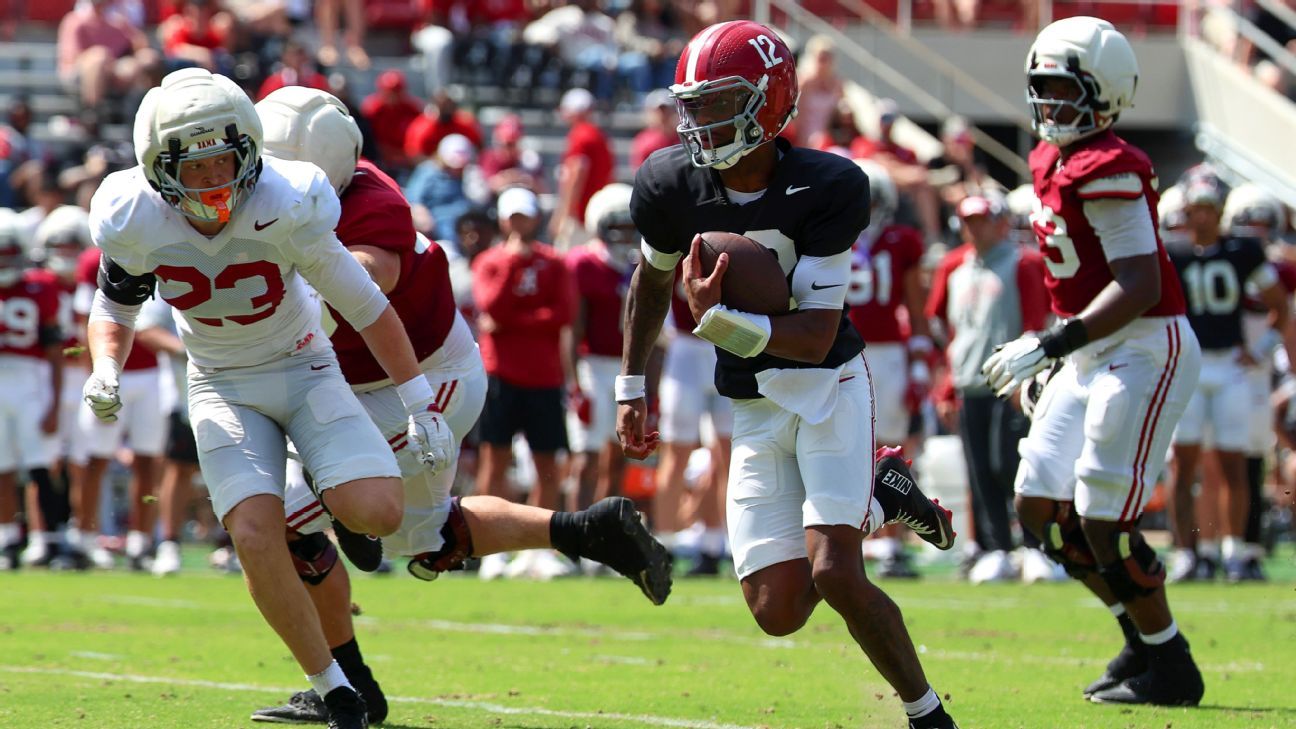
EmailPrintOpen Extended ReactionsSpring football is wrapping up, the Way Too Early Top 25 has been updated, the SP+ projections are up, and we don't have to wait on a May transfer window this time. That can only mean one thing: My annual preview series is about to begin!I love the way the preview series allows me to touch on every FBS team (we're up to 138 this time around) and hunt for trends and sleeper teams. But in any given year, certain teams pique a particular amount of my interest, and for reasons other than "I like their transfer class." (You can find my favorite portal hauls here.) So before we dive headfirst into next week's MAC preview, below are some questions I have for 10 teams I'm spending an inordinate amount thinking about as spring ball concludes.Is Alabama's Keelon Russell the most important player of 2026?Oh man, will Alabama need a lot from the QB position this fall.Last season, quarterback Ty Simpson had to carry a massive load for the Crimson Tide. They had their worst run game in a generation -- 97th in rushing success rate, 127th in yards per carry (not including sacks) -- and star receiver Ryan Coleman-Williams battled a severe case of the yips, suffering a dismal 13.0% drop rate, easily the worst in the nation among players with at least 75 targets. Simpson got banged up and wore down as the year went on, and Bama averaged just 18.7 points in its last six games against FBS opponents. Strong defense and a run of close wins allowed Alabama to eke out a College Football Playoff bid, but poor late performances resulted in its worst SP+ ranking (20th) in 18 years. The defense should be excellent again, but now Simpson and almost the entire starting offensive line are gone.Kalen DeBoer didn't load up on line experience in the portal either: Even with six incoming transfers, the O-line returns only 21 total starts from last season, and the offense could end up starting between five and seven freshman or sophomores overall. Yikes.One of those youngsters, however, is Keelon Russell. The No. 2 prospect in the 2025 recruiting class, Russell was an understudy for both Simpson and Austin Mack last season but shined in the spring. The battle for the starting job isn't over, and Mack certainly still has a chance to win the job. But to overcome the massive uncertainty and inexperience on the depth chart, Bama might need the raw upside that Russell supposedly brings to the table. If he's the real deal -- and we've seen plenty of redshirt freshmen absolutely explode onto the scene in recent seasons -- that would paper over some cracks. And Bama has more cracks than we're used to seeing.Does Oregon have whatever it lacked in 2024 and 2025?Oregon has been absolutely awesome the past two seasons. Dan Lanning's Ducks are 26-3 with losses only to eventual national champions (Ohio State in 2024, Indiana twice in 2025). If the Big Ten is to continue its unique national title streak in 2026 and make it four straight titles from four different teams, the Ducks are obviously at the front of the line.Quarterback Dante Moore returns, as do sophomore running backs Jordon Davison and Dierre Hill Jr. (combined: 1,323 yards, 7.0 per carry), quite a few stars from a banged up receiving corps, All-American center Iapani Laloulu, edge rusher Matayo Uiagalelei, defensive tackles A'Mauri Washington and Bear Alexander, linebacker Teitum Tuioti and an incredible set of sophomore DBs led by corner Brandon Finney Jr. And while Lanning didn't have to do much in the transfer portal, he still grabbed some extremely high-upside players such as safety Koi Perich (Minnesota), receiver Iverson Hooks (UAB) and nickel back Carl Williams IV (Baylor).This is easily one of the most proven rosters in the country, maybe the most proven. But it's hard to shake the taste of a couple of blowout losses. Oregon's 2024 season ended when the Ducks fell behind Ohio State 34-0 in the Rose Bowl quarterfinal and lost 41-21. Last season ended when they fell behind Indiana 42-7 in the Peach Bowl semifinal and lost 56-22. Two games don't overrule all the brilliance they otherwise showed, but when it counted the most, they were overwhelmed at the line of scrimmage and didn't have enough playmakers to make up for it.There are plenty of caveats you can add here. Oregon had a pair of coordinators who had taken head coaching jobs and were working double-duty during Peach Bowl prep, for instance. But it's easy for unfair narratives to form and take on a life of their own, and the Ducks will have to navigate a tricky schedule, with road trips to USC and Ohio State and visits from Michigan and Washington, while also knowing that they need to save fifth gear for December and January, especially in the trenches. Can they stick the landing this time?It seemed like USC was building for 2026. Now it's 2026.When I was writing the USC section of last year's Big Ten preview, I couldn't shake the impression that Lincoln Riley, with job security (via his enormous buyout) and the makings of a spectacular recruiting class, was building toward something big in 2026. "Riley should have enough to field another top-20 offense, develop further, win another seven or eight games and buy time for the cavalry to arrive in 2026," I wrote.The Trojans actually had a top-10 offense and won nine games, and Riley indeed locked down the top-ranked recruiting class, too. Big year coming, then? I can't decide.The offense was good enough that it lost its top two receivers, Biletnikoff Award-winning Makai Lemon and Ja'Kobi Lane, to the pros, and the only wideouts who caught more than three passes last season are sophomore Tanook Hines and NC State transfer Terrell Anderson. An all-world freshman such as Kayden Dixon-Wyatt or Ethan Feaster will need to come through quickly. But quarterback Jayden Maiava returns, and Riley almost never has anything but an awesome offense. The major questions, as always, will come on defense.In two years under D'Anton Lynn, the Trojans jumped from 105th in defensive SP+ in 2023 to 36th last season, and they improved in 2025 despite only one guy starting all 13 games and despite lots of freshmen and sophomores in the rotation.Lynn moved to Penn State, however, and Riley replaced him with an old hand: Gary Patterson. The proprietor of the modern 4-2-5 defense, Patterson stopped seeing as much success when everyone else began copying his innovations -- in his last seven years as TCU head coach, his Horned Frogs averaged just a 47.3 defensive SP+ ranking with only two top-25 finishes. This will be his first truly hands-on coaching gig in half a decade, too. That doesn't overwhelm me with confidence, but he'll have a pretty experienced depth chart (and quite a few elite freshmen), at least.Does Georgia have playmakers, or is this another "blue-chip service academy" offense?Georgia might be the most trustworthy team in the country. Even if the effects of the transfer portal era have siphoned away some of its depth and left it less experienced overall, we know it is going to brawl its way to results. It has reached five straight SEC championship games, winning three, and it has won the past two despite defensive inexperience and a lack of big plays on offense.There has still been a bit of a drop-off, however. After going 42-2 from 2021 to 23, it merely went 23-5 in 2024-25, finishing sixth in SP+ both years. That isn't exactly an embarrassment, but in both seasons the Dawgs suffered from a lack of big plays and easy points.The company they kept on this efficiency/explosiveness chart tells quite a story.Last year's run game was solid and efficient, and in wideout Zachariah Branch, Gunner Stockton had an excellent, quick-pitch efficiency option. But Stockton averaged just 10.8 yards per completion, and while leading rusher Nate Frazier almost never lost yardage, he didn't break long gainers either. Statistically, this was basically a service academy offense -- or a blue-chip Iowa -- with its countless ways of gaining five yards but almost no chunk plays.With Frazier, Chauncey Bowens, Kentucky transfer Dante Dowdell and three starters returning up front, the Dawgs should be able to grind away between the tackles again. The defensive front seven could be UGA's best in years, too. But of the seven players with more than 15 receptions, six are gone, including Branch. Stockton will still have receiver London Humphreys and tight end Lawson Luckie, and Georgia Tech transfer Isiah Canion averaged 14.6 yards per catch last year (though with fewer than three catches per game). If the 6-foot-4 Canion becomes a go-to performer, he could be exactly what the Dawgs missed in 2025. But he's one of the most important transfers in the SEC because if he's not a big-time acquisition, the passing game might be even less threatening in 2026.What does Pete Golding's Ole Miss actually look like?New LSU coach Lane Kiffin was one of the main characters in the 2025-26 College Football Playoff even though he elected not to actually coach in it. The former Ole Miss coach hovered everywhere during the Rebels' CFP run, almost openly threatening to take lots of his former stars (especially QB Trinidad Chambliss and RB Kewan Lacy) when their season ended. But after new head coach (and incumbent defensive coordinator) Pete Golding led them to the semifinals, Ole Miss held onto Chambliss and Lacy and mostly kept portal vultures away. With Chambliss winning an extra year of eligibility, Ole Miss returns players responsible for 143 of its starts last season, a solid 19th overall.Golding wasn't quiet in the portal, either. (Just ask Dabo Swinney.) His defensive depth took a hit -- 13 of his 20 players with 200-plus snaps are gone, though five key starters return -- so he added 13 transfers, including seven power-conference starters. That was likely a heavy expense, so he searched for distressed assets on offense, high-upside players coming from flawed-to-terrible offenses such as Syracuse (WRs Johntay Cook and Darrell Gill Jr.), Michigan State (RB Makhi Frazier), Virginia Tech (WR Isaiah Spencer), Kentucky (WR Cameron Miller) and LSU (LT Carius Curne). The most proven offensive piece came from the FCS ranks (Southern Utah RB Joshua Dye).Did Golding get Chambliss, Lacy and new offensive coordinator John David Baker enough fun toys? Will a remodeled secondary hold up? Fourth downs and aggression were big parts of the Kiffin model; how will Golding tinker with that formula? There's still massive upside here, but I don't feel either a semifinal repeat or a stumble to 7-5 would be a huge surprise. The Rebels could be the biggest wild card in the SEC.Am I underestimating BYU again? Overestimating?I like to think I get more things right than wrong -- not sure if that's actually true or not, but I like to believe it. But there are certain teams I never, ever get right. I expected a huge drop-off from BYU in 2021 following 2020's breakthrough success, but instead the Cougars won 10 games. I therefore concluded that they were permanently strong and trustworthy, and they proceeded to fall out of the SP+ top 60 and go 13-12 over two seasons. Things had fallen apart? Nope! They won 11 games in 2024. Quarterback Jake Retzlaff left unexpectedly and was replaced by a true freshman, so a 2025 drop-off was coming? Nope! They won 12 games.Whatever I assume is going to be wrong, but if the Cougars were excellent last year, there's really no reason to think anything less of them this time around. Bear Bachmeier might be a top-15 QB (or top-10) this year, and while he'll have to get to know some new receivers this year, senior running back LJ Martin and three returning starting linemen should assure that BYU has the same ruthlessly physical identity it had last year. And though the defense has a new coordinator -- former defensive ends coach Kelly Poppinga took over for Michigan-bound Jay Hill -- it returns nine of the 14 players who saw at least 300 snaps last year and adds a sideline-to-sideline menace in linebacker Cade Uluave (Cal).BYU avoids Texas Tech in conference play and plays only three of the Big 12's other six projected top-40 teams. It's hard not to envision the Cougars as serious contenders for a return to the conference title game. Does that mean they'll stink?Jaden Craig and Lincoln Kienholz might be the two most interesting power-conference QBsUnder Gordon Sammis at UConn last season, quarterback Joe Fagnano threw for 3,448 yards, rushed for a first down or two per game and somehow threw just one interception with no fumbles lost. TCU's Sonny Dykes saw that and wanted it, bringing both Sammis and Harvard quarterback Jaden Craig to Fort Worth in response to the departures of quarterback Josh Hoover (Indiana) and coordinator Kendal Briles (South Carolina). Granted, his comments on turnovers led to Hoover's new coach, Curt Cignetti, delivering a pretty good spring zinger, but Dykes is staking his hopes of a Big 12 title run on this new duo.On paper, Craig has everything you want. He's experienced, big, athletic and not particularly error-prone (only seven picks last season). We don't see many quarterbacks making the jump straight from FCS to a potential top-25 team, though, and Craig will have to carry solid weight with TCU's receiving corps replacing three of last year's top four and the offensive line losing four of last year's top six. This feels like a gamble, but the upside is obvious, and the TCU defense should be quite solid, too.Jeff Brohm, meanwhile, looked in both directions for an answer at QB. He brought in former West Georgia quarterback Davin Wydner, a 6-foot-5 former Ole Miss signee who evidently looked great in the spring game. But most hopes are pinned on former blue-chipper Lincoln Kienholz, a career backup at Ohio State. Kienholz was perfectly solid in a tiny sample in Columbus, and both he and Wydner bring a level of mobility to the table that last year's primary QB, Miller Moss, most certainly did not.Miami will start out as the ACC's clear favorite, but any of five or six teams could become the obvious No. 2, and Louisville, having won 28 games in Brohm's first three seasons, is a clear candidate if the roll of the dice on Kienholz (or, technically, Wydner) pays off.Can Brian Hartline build a power-conference type of roster at South Florida?Has he already? My conference previews will once again feature what I call Continuity Tables, in which I list out not only each team's returning production figures but also its total 2025 starts returning and incoming (FBS only) and its total number of redshirt freshmen. (Example here.) Some of this information isn't overtly predictive, but it's a little bit of extra information on how each roster has been put together.At this point, building continuity is infinitely easier at the power-conference level.Power-conference average: 107.5 returning starts, 89.8 incoming starts, 12.9 redshirt freshmenGroup of 6 conference average: 93.2 returning starts, 20.1 incoming FBS starts, 11.4 redshirt freshmenAs you would expect, power-conference teams have a bit more beef, too: They average 4.2 300-pound defensive linemen on their roster compared with 2.5 for the G6.A few mid-major teams, however, have managed to put together rosters with a lot of power-conference characteristics. Nine, in fact, combined at least 120 returning and incoming FBS starts, 10 redshirt freshmen and three 300-pounders on D: Boise State, Colorado State, Eastern Michigan, Kennesaw State, Memphis, Miami (Ohio), San Diego State, Temple and USF.A majority of those teams enter 2026 as favorites or contenders within their conferences, while a couple (Eastern Michigan and Temple) could be intriguing underdogs. But USF's name caught my eye for two reasons. The Bulls lost a ton of last year's production after head coach Alex Golesh left for Auburn, so the fact that they still boast solid roster characteristics is intriguing. But beyond that, Brian Hartline's greatest known trait is his recruiting ability, and one assumes his success in Tampa will be derived primarily from that.That he was able to bring in players who started 104 FBS games last year, 24th in FBS and second (behind only Memphis) in the Group of 6 ranks, was a good sign, and his Bulls roster has a nice base of 14 redshirt freshmen, plus four 300-pound defensive tackles and four incoming offensive linemen listed at 310 or higher. You still have to deploy guys in a favorable way, but USF will look like a power-conference team in 2026. I assume that will remain the case for as long as Hartline is there.Does North Dakota State have what it needs?Recent times have been kind to teams transitioning up from FCS. James Madison went 8-3 in its first season (2022), then won 32 games over the next three seasons. Jacksonville State has won nine games in each of its first three seasons. Delaware and Missouri State each went 7-6 in their FBS debuts in 2025, and the two schools that didn't hit the ground running (Kennesaw State and Sam Houston went a combined 5-19 in their respective first seasons) nailed it on the second try (a combined 20-7 in their second seasons).If they can do it, surely North Dakota State can, too, right? The Bison were the behemoths of FCS for most of 15 seasons, winning 10 national titles between 2011 and 2024 and leaving FCS after a 2025 season that was, on paper, one of their most dominant yet. They were upset by eventual finalist Illinois State early in their final FCS playoff appearance, but they finished the year 65th among all college football teams in SP+.Tim Polasek's Bison start their first FBS season projected 72nd in SP+, and they bring back plenty of good players, including running back Barika Kpeenu, right guard Griffin Empey and super active defensive tackle Keenan Wilson. But a lot of the players who made them particularly dominant in 2025 are gone. Quarterback Cole Payton produced better stats than storied former Bison QBs like Trey Lance or Carson Wentz, receiver Bryce Lance (Trey's brother) was the most explosive receiver in all of FCS, and most of last year's most disruptive defenders -- end Toby Anene, linebacker Logan Kopp, corner Jaquise Alexander -- are gone.This program always produces more stars and seems ready to invest massively to make this FBS move work. For as good as Payton turned out to be, he was relatively unknown at this point last season, and senior Nathan Hayes certainly looked solid as an understudy. So maybe NDSU just keeps NDSU'ing right into the FBS.But I'd love to have seen them make the jump with last year's team.Has Old Dominion reloaded again?All things considered, Ricky Rahne is doing a pretty incredible job at ODU. From an NIL standpoint, the Monarchs don't appear incredibly well-equipped to hold on to their star players, and he has suffered more losses than most on average. And yet, after averaging five wins and an SP+ ranking of 106.3 over his first three seasons in charge, he engineered a little bit of improvement in 2024 (95th in SP+), then loads of it in 2025. The Monarchs surged to 50th in SP+, with a top-50 offense and defense, and they won 10 games for the first time in nine years. Their offense was creative and uniquely explosive, and the defense was decent against the run and among the best in the mid-major universe against the pass.Rahne and his staff seem to do as well as anyone when it comes to identifying hidden talent and getting it onto the field. And their reward for this prowess, of course, is having to do it again in bulk. The offense returns basically 0.5 starters (RB Devin Roche started six games) and lost longtime offensive coordinator Kevin Decker to Memphis. The defense is in better shape (eight of 14 players with 300-plus snaps are back) but still lost its best havoc creators in lineman Kris Trinidad, edge rusher Jahleel Culbreath and nickel Jeremy Mack Jr. So in come 15 transfers, 11 juco transfers and 19 freshmen to try to stem the tide. Rahne brought in a few power-conference backups but leaned primarily on smaller-school acquisitions -- I particularly like running back Hunter Patterson (West Liberty), receiver Zion Agnew (Lenoir-Rhyne) and linebacker Ja'Mez Drummer (Towson) -- and tapping that heavily into the juco ranks is an intriguing strategy. Rahne gets heavy benefit of the doubt at this point, but damn did his roster get hit hard.