
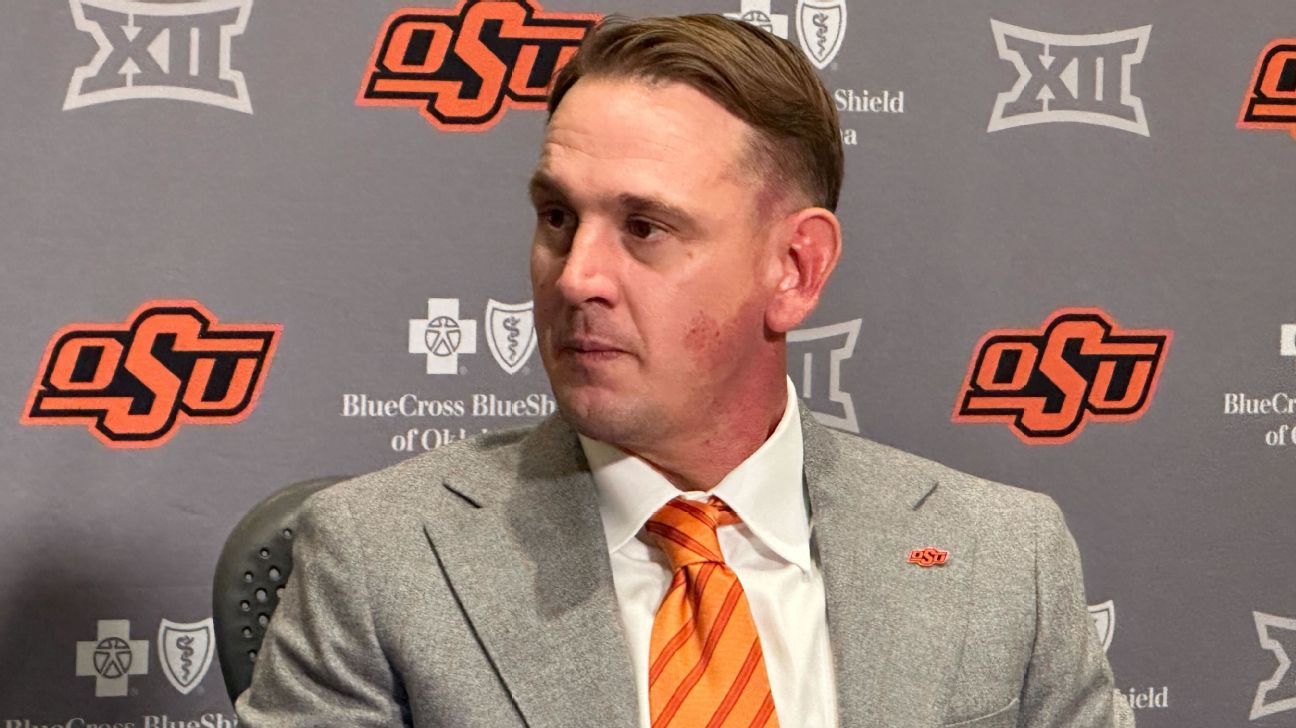
EmailPrintOpen Extended ReactionsIn soccer analytics, they've long had the Messi Rule, which basically states that if you create a player rating or any sort of new attacking stat and Leo Messi doesn't rank first in it, you probably didn't do it right.We now have something similar in college football. If you're evaluating coaching performances in any way, and Curt Cignetti's 2025 performance with Indiana doesn't rank first, start over.We're still only a couple of months removed from what will forever go down as one of the most unlikely and, frankly, awe-inspiring national title runs of our lifetimes. Taking over the sport's losingest program, one that had never won more than nine games in a season and had won nine total over the three previous seasons, Cignetti immediately engineered a surge to 11-2 and an out-of-nowhere College Football Playoff berth in 2024. That alone was monumental. But then he and his Hoosiers took things even further last fall. Indiana went 16-0, beating six teams ranked 11th or higher (four by double digits), finishing first in SP+ and winning the school's first national title and, through Fernando Mendoza, its first Heisman Trophy. In a few more weeks, Mendoza will likely become the school's first No. 1 overall NFL draft pick in 88 years as well.Was Lady Luck on the Hoosiers' side in 2025? Absolutely. But it's always going to take some good fortune to win 16 games. What Cignetti and his staff have proved over the past couple of seasons -- in terms of scouting, recruiting and development (not to mention plain old confidence building and proper tactics) -- cannot be overstated. And as it turns out, I can prove it with stats.Last summer, I fiddled with a concept for statistically evaluating coaches by comparing their output -- using SP+ ratings -- to what their employers had accomplished over the 20 years prior. Considering this approach named Nick Saban, Chris Petersen and Kirby Smart as the best coaches of the past 20 years, I figured I was probably getting somewhere. But Indiana's 2025 performance gave us something new to look at with this approach. As it turns out, looking at a team's recent performances compared to that same 20-year baseline also provides a nice input to add to my offseason SP+ projections. Let's dive in.The best coaching performances of the past 20 seasonsThe coach rating is derived 60% from a team's performance against that 20-year baseline (so, if your SP+ rating is 10.0 in a given season, and your school's 20-year average rating was 5.0, that's a +5.0) and 40% from the raw SP+ rating. As you might expect, Indiana's performance in 2025 nearly broke the scale.Indiana produced a 32.4 SP+ rating, not the most dominant in recent history but very good. But that was also 32.6 points higher than Indiana's average over the past 20 seasons. That's good for a 32.5 rating, easily the best of 2025.Top 20 coach ratings of 2025:Curt Cignetti (Indiana): 32.5Joey McGuire (Texas Tech): 23.9Clark Lea (Vanderbilt): 20.3Eric Morris (North Texas): 20.3Lane Kiffin (Ole Miss): 19.9Ryan Day (Ohio State): 19.5Dan Lanning (Oregon): 18.8Marcus Freeman (Notre Dame): 18.5Kyle Whittingham (Utah): 17.4Mario Cristobal (Miami): 16.9Rhett Lashlee (SMU): 16.1Jedd Fisch (Washington): 15.2Mike Elko (Texas A&M): 14.9Kirby Smart (Georgia): 14.6Kirk Ferentz (Iowa): 14.4Bret Bielema (Illinois): 13.1Alex Golesh (USF): 12.1Tony Elliott (Virginia): 11.8Kalani Sitake (BYU): 11.7Ricky Rahne (Old Dominion): 11.6The 60-40 mix is relatively arbitrary, but I like the way this approach mixes raw quality with the degree of difficulty you get from working at a given school. And the results above pair pretty well with my own opinions -- if I'd ranked the top five coaching performances of the season right after it ended, I'd have absolutely included Cignetti, McGuire, Lea and Morris.Cignetti's performance was obviously going to rank the highest for 2025. But where does it rank looking at the past 20 years? Still first. It's a pretty tight competition, though.Top 20 ratings since 2006:2025 Indiana (Curt Cignetti): 32.52012 Alabama (Nick Saban): 32.42013 Florida State (Jimbo Fisher): 30.82019 Ohio State (Ryan Day): 30.72010 Stanford (Jim Harbaugh): 29.22006 Louisville (Bobby Petrino): 28.92008 Florida (Urban Meyer): 28.42011 LSU (Les Miles): 28.22013 Baylor (Art Briles): 28.12009 Alabama (Nick Saban): 27.92007 Kansas (Mark Mangino): 27.62011 Alabama (Nick Saban): 27.52008 Texas (Mack Brown): 27.42013 Alabama (Nick Saban): 27.42022 Georgia (Kirby Smart): 26.82014 Baylor (Art Briles): 26.82007 LSU (Les Miles): 26.62007 Missouri (Gary Pinkel): 26.52022 Michigan (Jim Harbaugh): 26.42021 Georgia (Kirby Smart): 26.3A list that includes Cignetti at the top, followed by four appearances from Nick Saban, two each from Kirby Smart and Jim Harbaugh and appearances from the coaches of both 2007 Kansas and Missouri? That feels like a pretty damn good list to me.The best coaches of the 2020sIn last summer's piece, I used coaches' average ratings to create a Best Coaches of the Last 20 Years list that I liked quite a bit. That list won't change all that much year-to-year, so I won't feel the need to update it too frequently, but I thought it might be fun to look at a more recent sample. With the profession itself -- specifically, nearly every component of roster management -- changing so drastically in recent times, whose performances stand out the most if we look only at the 2020s?This is a pretty fun mix of predictable and unpredictable. Obviously Cignetti was going to lead the way, and Harbaugh, Smart, Saban and Ryan Day were always going to rank highly because of their consistently excellent work. But mixed among these names are some surprises.Rhett Lashlee ranks second overall thanks to his stellar run at SMU. Even with a slight step backward in 2025, his Mustangs have ranked between 12th and 24th in SP+ for the past three seasons, a mammoth achievement for a school that hadn't pulled off a top-25 rating since 1984 and had averaged an 88.0 ranking since returning from the death penalty in 1989. Seeing him in second might feel shocking, but it shouldn't.Jon Sumrall coming in ninth is interesting, considering he just took the Florida job. Obviously a jump to the SEC -- and to that job in particular -- comes with its own set of challenges. Billy Napier certainly would have graded out really high on a list like this before he moved to Gainesville, too. Still, pulling off what he did at Troy and Tulane (43 wins and an average SP+ ranking of 41.5 over four years) was spectacular.Hello, GJ Kinne! That one caught me off guard, but it makes sense with a glance at the numbers. Texas State doesn't have a full 20-year sample in FBS, but the Bobcats' average SP+ ranking over their first 11 FBS seasons was 113.5; their average win total: 3.6. In three years in San Marcos, Kinne has averaged a 61.0 ranking and 7.7 wins. (And that's with a dire run of poor close-game fortune last season)What coaching changes mean for 2026I've really enjoyed this approach to coach ratings as it pertains to looking backwards at recent performances, but as it turns out, looking at schools' performance versus long-term baseline averages can tell us quite a bit looking forward, too.I'm not to a point where I feel comfortable plugging a specific coach's name into SP+ projections -- for instance, applying a certain bump to any school coached by Cignetti, Sumrall, et cetera. But this year's SP+ projections will feature adjustments for teams that made coaching changes after either over- or underachieving against its historical baseline by a solid amount. Who might that affect? Let's take a look.Teams with first-year head coaches: Most likely to improve1. Oklahoma StateNew coach: Eric MorrisLast year's SP+ rating vs. 20-year average: -28.2Again, I won't be applying an Eric Morris Bump to the numbers even though he ranks 14th on the list above. But Oklahoma State underachieved against its historic baseline to an almost unfathomable degree last year, and any coaching change was likely to bring with it a solid boost. OSU's average SP+ ranking was a solid 28.6 over the previous 20 years before Pokes collapsed to 121st.2. Virginia TechNew coach: James FranklinLast year's SP+ rating vs. 20-year average: -19.1Nothing compares to OSU's underachievement, but ranking 106th after producing a 20-year average ranking of 35.8 still hints at progression, too, especially since Tech also hired one of the 2020s' better coaches (who also pulled off a pretty impressive and immediate roster upgrade).3. StanfordNew coach: Tavita PritchardLast year's SP+ rating vs. 20-year average: -17.5The Cardinal make the list because their 20-year average still includes the eight-year run of awesomeness (2008-15) produced by Jim Harbaugh and David Shaw. They've ranked 93rd or worse in SP+ for five straight years, so I'm a little more skeptical of a jump here.4. Oregon StateNew coach: JaMarcus ShephardLast year's SP+ rating vs. 20-year average: -16.8In 2023, the Beavers ranked 19th in SP+. Last fall they were 126th. They were both bad and spectacularly unlucky, and at least the latter is likely to reverse itself somewhat.5. FloridaNew coach: Jon SumrallLast year's SP+ rating vs. 20-year average: -14.1Sumrall has been one of the best mid-major coaches in the country of late, and he has as good a chance at anybody of turning this barge around.Teams with first-year head coaches: Most likely to regress1. North TexasNew coach: Neal BrownLast year's SP+ rating vs. 20-year average: +28.0The Mean Green averaged a 101.3 SP+ ranking over the 20 years before erupting for 12 wins with the No. 1 offense in the country last fall. But that offense, and its head coach, moved to Stillwater, and there's almost nothing remaining from last year's team. UNT is starting over.2. TulaneNew coach: Will HallLast year's SP+ rating vs. 20-year average: +17.6Tulane is the reverse of Stanford -- its 20-year average is still very much dragged down by dreadful performances before the 2020s. But since Willie Fritz began to build traction there, this has been a different job. Fritz and Sumrall combined to win 43 games from 2022-25, so Hall takes over a pretty sturdy job, even if he didn't fare particularly well in his last head coaching stint at Southern Miss.3. UConnNew coach: Jason CandleLast year's SP+ rating vs. 20-year average: +14.9After a 10-year run in which UConn's average SP+ rating was a dire 116.8, Jim Mora engineered back-to-back nine-win seasons, then left for Colorado State. Candle had plenty of success at Toledo, but this feels like a nowhere-to-go-but-down season.4. South FloridaNew coach: Brian HartlineLast year's SP+ rating vs. 20-year average: +12.7Over the past 14 seasons, USF has won at least nine games three times and lost at least nine games four times. This is a volatile program, and every coaching change has the potential to create a huge shift.5. Ole MissNew coach: Pete GoldingLast year's SP+ rating vs. 20-year average: +12.1The only power conference team on this list is a strange case. As you'll recall, Golding famously took over for LSU-bound Lane Kiffin before Ole Miss' playoff run ended, and he was Kiffin's defensive coordinator for three seasons. Maybe that stems some potential regression? Maybe not?Teams with first-year offensive coordinators: Most likely to improveThere's some solid predictive potential in looking at teams that make coordinator changes, too -- offenses or defenses that dramatically over- or underachieved compared to their historic baselines and changed coordinators will likely shift back toward their historic means. Here are the most likely candidates.1. North CarolinaNew offensive coordinator: Bobby PetrinoLast year's off. SP+ rating vs. 20-year average: -13.2Hiring Bobby Petrino as your offensive coordinator in the 2020s has basically meant two things: Your offense will improve, and you will be out of a job soon. That's how it played out for Jimbo Fisher at Texas A&M and Sam Pittman at Arkansas, at least. UNC plummeted to 124th last year with Freddie Kitchens calling plays for Bill Belichick; Petrino will almost certainly improve off of that.2. NevadaNew offensive coordinator: Brett BartoloneLast year's off. SP+ rating vs. 20-year average: -11.8The inventor of the Pistol offense hasn't scored many points of late -- average offensive SP+ ranking over the past 12 seasons: 97.7 -- but it was so egregiously bad under David Gilbertson last fall that Bartolone is likely to oversee improvement no matter what.3. UMassNew offensive coordinator: Max WarnerLast year's off. SP+ rating vs. 20-year average: -8.8Speaking of having nowhere to go but up ... UMass, everybody! The Minutemen finished 136th out of 136 teams in SP+ last season, but that doesn't actually tell the whole story: They were dead last in offense and defense. You can't actually get worse than that. (OK, that's technically untrue -- there are 138 teams now.)4. App StateNew offensive coordinator: Mike AnthonyLast year's off. SP+ rating vs. 20-year average: -7.4Over the past two seasons, App State has tumbled from 24th to 68th to 101st in offensive SP+. Head coach Dowell Loggains called plays last year, and it obviously didn't work out, so Loggains handed the reins to Anthony, a former Kendal Briles protg.5. ClemsonNew offensive coordinator: Chad MorrisLast year's off. SP+ rating vs. 20-year average: -7.2Hiring an old friend, as Dabo Swinney has done here, frequently fails to generate the success of the first go-round, and Morris hasn't pulled the strings for a good college offense since 2017. But after Clemson stumbled from 16th to 65th in offensive SP+ last season, odds still favor Morris overseeing improvement.Teams with first-year offensive coordinators: Most likely to regress1. UTSANew offensive coordinator: Rick BowieLast year's off. SP+ rating vs. 20-year average: +9.3UTSA has ranked between 28th and 36th in offensive SP+ for five straight years, the last three of which were led by coordinator Justin Burke. With Burke off to Kentucky, Jeff Traylor brought Rick Bowie in from Western Kentucky. He inherits a solid QB in Owen McCown, so there's a chance the Roadrunners avoid regression here.2. Old DominionNew offensive coordinator: Kody CookLast year's off. SP+ rating vs. 20-year average: +7.9With coordinator Kevin Decker leaving for Memphis and basically every starter gone from last year's delightfully explosive offense, Ricky Rahne has another rebuild to attempt. But Kody Cook was Colton Joseph's QBs coach last year, at least, and Rahne's recrafted depth charts before.3. East CarolinaNew offensive coordinator: Jordan DavisLast year's off. SP+ rating vs. 20-year average: +6.4It's a similar story in Greenville: Coordinator John David Baker left (for Ole Miss), and the Pirates basically return one offensive starter. I like Blake Harrell's transfer portal additions, but he had to make a lot of them.4. SMUNew offensive coordinators: Rob Likens, Garin Justice and D'Eriq KingLast year's off. SP+ rating vs. 20-year average: +4.7We'll talk about SMU more below.5. Western KentuckyNew offensive coordinator: Bodie ReederLast year's off. SP+ rating vs. 20-year average: +4.2Tyson Helton has run quite the transient program in Bowling Green -- Reeder is his sixth offensive coordinator in seven years, and he has had a number of D-coordinators too. And yet, WKU wins eight to nine games each season like clockwork.Teams with first-year defensive coordinators: Most likely to improve1. Boston CollegeNew defensive coordinator: Ted RoofLast year's def. SP+ rating vs. 20-year average: +10.6 (since we're talking about defense, a positive point total is bad)Roof, a nearly 40-year veteran, hasn't overseen a top-30 defense since 2012 at Penn State, and the last time he led a lower-resource, power-conference defense was Vanderbilt in 2020. The Commodores ranked 106th. But hey, 106th would technically be an improvement for a BC defense that ranked 108th in 2025!2. Mississippi State BulldogsNew defensive coordinator: Zach ArnettLast year's def. SP+ rating vs. 20-year average: +8.4MSU has ranked 98th and 85th in defensive SP+, respectively, over Jeff Lebby's first two seasons as head coach, so he went with a unique move, bringing back Arnett two years after he was fired as head coach. He was good as Mike Leach's defensive coordinator in Starkville.3. Rutgers Scarlet KnightsNew defensive coordinator: Travis JohansenLast year's def. SP+ rating vs. 20-year average: +7.1From 2021-24, Rutgers averaged a 34.8 defensive SP+ ranking, but losing Joe Harasymiak to UMass and losing a ton of talent to the portal rendered the Scarlet Knights unable to stop anyone last fall. At 95th, they had their worst defensive SP+ ranking since 1999, and Greg Schiano went to the small schools for an answer: Johansen comes to Piscataway after a strong stint at South Dakota, where he served six years as DC and one as head coach.4. Georgia SouthernNew defensive coordinator: Mike MutzLast year's def. SP+ rating vs. 20-year average: +5.4The Eagles' defense has been wobbly for a while, but it bottomed out at 130th in defensive SP+ last season. Mutz led a top-five FCS defense last season, per SP+, and once again: Expectations are low.5. TennesseeNew defensive coordinator: Jim KnowlesLast year's def. SP+ rating vs. 20-year average: +5.3The Vols collapsed from sixth to 63rd in defensive SP+ last season, so Josh Heupel called in a ringer. Knowles has produced seven top-25 defenses in 12 years, but his first season in a given location doesn't usually produce improvement -- it usually takes him a year to get his footing. With a brand-new quarterback and potentially questionable offense, Heupel needs the defense to rebound immediately.Teams with first-year defensive coordinators: Most likely to regress1. SMUNew defensive coordinators: Maurice Crum Jr. and Rickey Hunley Jr.Last year's def. SP+ rating vs. 20-year average: -14.2Rhett Lashlee's SMU tenure grades out beautifully, but he had Casey Woods and Scott Symons leading his offense and defense, respectively, for all four seasons. Both are gone, and Lashlee went with co-coordinators on both sides of the ball.2. Western MichiganNew defensive coordinator: Greer MartiniLast year's def. SP+ rating vs. 20-year average: -11.4WMU surged from 120th to 42nd in defensive SP+ in Chris O'Leary's only season as coordinator, but he left to rejoin Jim Harbaugh's Los Angeles Chargers staff, and head coach Lance Taylor promoted Martini from linebackers coach. With a new coordinator and totally revamped front six, it's hard to see anything but regression here.3. East CarolinaNew defensive coordinator: Jordon HankinsLast year's def. SP+ rating vs. 20-year average: -8.6Like Lashlee, Blake Harrell was rewarded for his success at ECU with the loss of both coordinators. The defense didn't grade out quite as well as the offense, but with Josh Aldridge off to USF, and nine starters gone, it's a restart for the ECU defense.4. OregonNew defensive coordinator: Chris HamptonLast year's def. SP+ rating vs. 20-year average: -8.4Dan Lanning is also replacing both coordinators after last year's duo both took head coaching jobs. Drew Mehringer was promoted to take over the offense. The Oregon offense has a spectacular historical baseline, but the defense jumped to fifth last year after averaging a 42.7 ranking over the previous 20 years. That means Hampton, Tosh Lupoi's co-coordinator over the previous three seasons, faces a high bar.5. San Diego StateNew defensive coordinator: Demetrius SumlerLast year's def. SP+ rating vs. 20-year average: -6.4Former head coach Rocky Long typically had awesome defenses at SDSU, but it crumbled to 93rd in 2023 and 105th in 2024 before surging all the way back to 28th under Rob Aurich last year. Aurich left for the Nebraska Cornhuskers, and Sumler, a longtime SDSU assistant, takes the reins for Sean Lewis.