
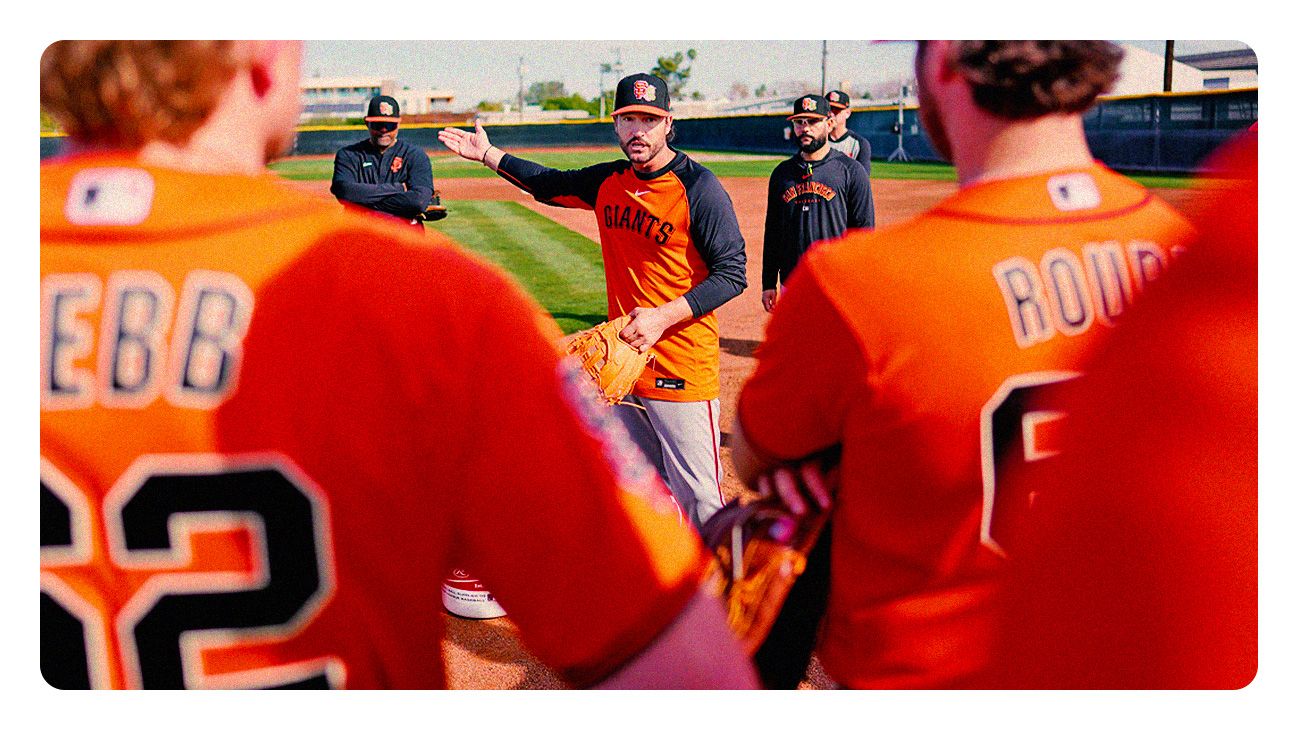
EmailPrintOpen Extended ReactionsTHE FATHER HAD seen this look many times before: the jaw set, the dark eyes narrowing, the posture tense. This is the transformation the son undergoes every time he loses: the optimism, usually about three feet thick, is replaced with a brittle sulk, as if the moment he is less than completely consumed by losing is the moment he will become forever defined by it.Greg Vitello watched his son, Tony, manage the San Francisco Giants against Team USA on a perfectly fine March Tuesday afternoon at Scottsdale Stadium in Arizona. All spring training games are exhibitions, but this game, an exhibition within the exhibition season, contained multiple layers of insignificance. There was a group of big league superstars in the third-base dugout. On the first-base side, a Giants roster depleted by seven of its own World Baseball Classic players. But as the score got worse and worse, as 5-1 become 7-1 became 13-1 on its way to 15-1, Greg kept looking down at the dugout, watching his son's bearing tighten as if cranked by an invisible wrench. He noticed Giants players inching their way to the far end of the dugout, a tide ebbing from the pull of his son's intensity."They don't know what he's all about yet," Greg says. "It's going to take them a while, probably until they start playing real games, but that showed me they're starting to figure it out."The father laughs a little as he finishes saying this. He knows his son, the first person to jump directly from college head coach to major league manager, has never been content to be a character in someone else's script. Tennessee had not been to a College World Series in 12 years when Vitello was hired as the head coach in 2017; the Volunteers made it three times in his eight seasons and won it in 2024. His teams were brash and loud and often willing to cross the permeable barrier that separates sportsmanship from its opposite. And the father laughs because he can see the thunderheads forming in the distance and knows before anyone that it's time to prepare for what's coming."Yep, they better be ready," he says. The laugh again.The list of nevers is long. Tony Vitello never played professional baseball, never coached professionally, never wore the uniform of any professional team in any capacity, never coached a player from a Latin country, never so much as attended a spring training game before he managed one on Feb. 21. As an assistant at TCU more than a decade ago, he spent 36 hours with the Texas Rangers at spring training, but he doesn't remember much about it except that he couldn't even stay for an entire workout.Vitello is as close to a tabula rasa as exists in professional sports. The scouting report is thin: intense, competitive, energetic. Beyond that, who knows? A wiry and youthful 47, he styles his longish curly hair in a way that seems perfectly, and intentionally, suited for a baseball cap. His beard is country-singer manicured, his eyes never rest, and his teeth are white enough to read by. Before the first full-squad workout, with anticipation colliding in the air with uncertainty -- "First day of school," reliever Tristan Beck termed it -- Vitello stood in front of his players in the clubhouse and gave a speech that stressed the value of being a good teammate. Later that morning, he took the field wearing an infielder's glove that looked pristine, straight out of the box, as if he'd heard the sounds of baseball inside Scottsdale Stadium and decided to see if they'd let him play. ("Always ready," pitcher Robbie Ray says, laughing.) Vitello made his way around the field, repeatedly smacking his right fist into the palm of the glove, a water bottle in each back pocket, followed by a documentary film crew led by Colin Hanks. It was a big day, and before it was over, he hopped in line and took ground balls at first base during PFP drills. Managers traditionally cover less ground, content to lean on the batting cage. But there was Vitello, darting around like a fish in a tank."It's like he's everywhere at once," shortstop Willy Adames says. "He's at the cages, and then you look around and he's at the backfield looking at guys taking ground balls, and then 10 minutes later he's watching guys running the bases. It's not something a lot of managers do."The father describes it this way: "A new era of manager for a new era of player." But the man who hired Vitello, Giants president of baseball operations Buster Posey, says, "That's an interesting take. It's not something I considered going through the process."Greg coached soccer and baseball at De Smet Jesuit High School in St. Louis, and he did it well enough and long enough to be inducted into the Missouri Sports Hall of Fame. He coached Tony in both sports -- "He was a much better baseball player," Greg says -- and mostly they would talk about game strategy and lineup construction, but occasionally the drives home would be tumultuous. The team didn't have a bus, so Greg and Tony would travel to and from road games together in the family car. Once, when he was a senior, Tony barked at an umpire after a game, within earshot of his father. Greg let his son know that the coach was the only person authorized to address the umpires, and he punctuated his message by slamming his fist on the dashboard so hard the radio popped out of its console and hung by its wires, like a tongue."The rest of the ride was quiet, as I recall," Greg says.Which is to say these two have been through it all before, and as Greg tried to coax his son out of the primordial darkness that engulfed him after the loss to Team USA, he emphasized the wildly unequal talent level in the respective dugouts."I get that you're upset," he said, "but that was a baseball dream team over there."Tony stared at his father, his brown eyes nearly black, the pupils like darts, and said:"So what?"HE WILL LOSE again. He will lose many, many times. He will lose games because his team played poorly, and he will lose games because he made the wrong decision at the wrong time, and he will lose games for no detectable reason at all. He will lose because the season is 162 games long and that's just what happens in baseball, and the only way to survive is to figure out which losses are worth worming their way into your psyche, and which aren't.Vitello doesn't know what a regular-season game looks like from the dugout, so he doesn't know which losses will carve a groove in his brain. It is mid-February, before his team would go 19-9 in Cactus League games, and he is sitting in a small, windowless office in the Giants' spring training facility, genially discussing all the things that await him. "Each day comes with its own story, and you have to handle it as you see fit," he says. "I don't have an answer for people who want to know what it's going to look like in August. I don't even know what time I'm leaving the ballpark today. Probably grab some beef jerky for dinner and stay late. That's what I did last night."He has built his brand on charisma and energy, and on an ability to read a room and each of its disparate parts. But the room and the parts are now different. College baseball occupies a uniquely purgatorial place in the athletic firmament. Bad teams are mostly ignored, and the really good ones -- and their coaches -- are exalted. The media landscape is an adjustment; Vitello admits to being unfamiliar with close scrutiny, saying the media in Knoxville "were like teammates," an assessment a reporter who covered him there says "sounds about right."After Tennessee won the College World Series, other big league clubs -- ones Vitello won't name -- inquired about his interest in managing. His agent, Jimmy Sexton, fielded most of their questions, and the idea began to take hold. Vitello told Sexton, "I don't want my baseball career to end without being a manager if somebody will have me in that role." Posey, looking to reset his team's stagnant culture, was impressed during a casual meeting with Vitello at a Giants-Rockies game in Colorado last year, and when Bob Melvin was fired last fall after consecutive 81-81 seasons, Vitello became a candidate."In a short amount of time, I went from never thinking about it to some people saying, 'Dream come true,'" Vitello says. "I'm not being abrasive, but it was never a dream."Vitello was richly compensated at Tennessee -- $3 million a year -- which created the leverage to become baseball's highest-paid first-time manager at $3.5 million. (The Giants also paid the university $3 million to buy out his contract.) Reporting at the time indicated Posey was considering Vitello and former Giants catcher Nick Hundley, who took a job in the Rangers' front office."One thing Tony told me early on was, 'I'm not telling these guys to be this way. I'm just trying to get who they are to come out, whatever that looks like,'" Posey says. "That's an attribute Bruce Bochy had. You're not trying to mold people a certain way. You want their personality and their abilities to come out and give them the freedom to play fearless."The hiring was a shock on many levels, one being the two men at the center of it. Posey, the future Hall of Famer who played in San Francisco with unassuming and emotionless excellence for 12 seasons and three world championships, and Vitello, the fiery college guy who faced the challenge of imbuing that fire into adults, many of whom have multimillion-dollar guaranteed contracts. Hunger levels vary.And so, as Vitello pondered the Giants' offer for four fraught days alone in his Knoxville condo, he had questions. He called friends who played in the big leagues, including Max Scherzer, whom he coached at Missouri. "I needed answers to things I couldn't see on TV," Vitello says. What does it sound like? What does it feel like? He wanted to know what kind of conversations took place after games, and how a group of grown men would react to his sometimes goofy sense of humor.He asked Shawn Kelley, a former big league reliever, "Some of my jokes are pretty bad, like dad jokes, are these guys going to want to punch me in the face?" Kelley apparently gave Vitello the go-ahead to proceed, because Vitello says, "I think my jokes have worked out about as well as in the past. I'm definitely starting to figure out who the good teammates are, because a couple of guys have had my back. I told one joke that fell on deaf ears, and [reliever Matt] Gage gave me a sly smile, and maybe just a noise. I don't know if it was a chuckle, but anything to let you know they're listening is good."He made some changes. Spring training was quicker and louder. Melvin was a successful manager who trusted the old-school playbook. Vitello, with his glove and his questions, wouldn't even know where to find it. He believes that he can swing a few games through the force of his personality, that keeping the energy and commitment level high for 162 games can serve as a firewall against losing streaks and sagging morale. "He will teach them there are no days off," Greg Vitello says. Tony used 81-81 as motivation throughout the spring, insisting that attention to detail, and sometimes merely attention, can turn three or four of those 81 losses into wins, and bring with it a spot in the playoffs."I saw that guy bring it every single day -- fall, winter, spring, summer -- over three straight years," says Giants outfielder Drew Gilbert, who played for Vitello at Tennessee. "So if he can bring even a percentage of that over the course of 162, look out."Gilbert was the symbol of the brash Tennessee/Vitello style, running around like an overcaffeinated Labrador, occasionally raging at umpires, flipping back his hair at every turn. Vitello joked that he might have to resort to a shock collar to manage Gilbert this time around, and that he was hired to be "Drew Gilbert's babysitter.""There's a certain standard that he expects you to play to, and practice to," Gilbert says, "and if you don't bring it every time he'll get someone else who will."Vitello's new-school approach quickly became a topic in the Giants' clubhouse; if a drill scheduled for 20 minutes was completed mistake-free in five, it was over. "Up-tempo, fast-paced, get it done right and you're done," Gage says. Vitello held video study sessions that broke down individual plays into their smallest increments, inspecting them like sacred texts. To the naked eye, a runner scoring from second base on a single is a pretty straightforward proposition. On Vitello's screen, though, the details come alive. He breaks down the runner's primary and secondary leads, then highlights the read he gets off the bat. Without any one of those elements, the runner might have been thrown out at the plate or held up at third."I can't think of any other time in my career when we did that," says Ray, in his 13th season and fifth organization. "It's probably something he did at Tennessee, but I like it because it's positive reinforcement. Usually coaching revolves around what someone did wrong, but here it's, 'Hey, this happened because we did this small thing right.' It creates a whole different energy."Posey says, "I thought Tony was going to eat, sleep and breathe this, and he is. I knew hiring Tony was going to be a headline, or headlines, but I thought it was going to be fun, too. Ultimately, the reason I have a job is that we're in the entertainment business. Did we hire Tony strictly for entertainment value? Of course not, but there's some value in that as well."Back in the windowless office, Vitello downloads the audiobook of "The Anxious Generation" after a discussion about the rise of social media addiction among young people since the introduction of the smartphone. It's the generation he dealt with every day in Tennessee, and that generation of kids who were teenagers in the 2010s now occupy nearly every stool in the Giants' clubhouse. The societal implications of technology have been a source of endless curiosity to Vitello; instead of surrendering, he sees the competition for attention like he sees everything else: a game to win."I don't know whether it was COVID or not, but there's definitely been a change in the way people communicate," Vitello says. The book investigates, in part, how parents, out of an exaggerated fear of dangers such as childhood abduction, have ignored the very real risks of a screen-based childhood. "An easy example might be you let a kid go out in the yard and play stickball," Vitello says, "and they might get hit in the head or the arm with the ball, but that's not going to be as bad as getting hurt inside your brain or your soul."Giants players use the word "feel" to describe Vitello's ability to understand and relate to each player on a personal level. It's a decidedly new-agey -- and dare we say collegiate -- quality for a big league manager, and it was exemplified late in spring training when a reporter innocently used the word "bodies" to describe the team's roster predicament when it came to the decision on whether to keep prized prospect Bryce Eldridge on the Opening Day roster. Vitello quickly interrupted. "It's a body," he said, "but it's also a person."A human-centric philosophy is a dramatic departure from the perception of the Giants under Farhan Zaidi, the president of baseball operations before Posey. Although the team won a franchise-record 107 games in 2021, the theme of Zaidi's tenure became machines over people. The reliance on analytics often meant a different lineup every day, crafted in large part by the front office, a tough sell to a fan base that grew comfortable with the day-to-day simplicity of seeing the exact same core of players take the field for the better part of a decade -- and three World Series titles. The autonomy of the field manager is one of the enduring subplots of every franchise, and Posey is banking on Vitello's familiarity with advanced metrics -- Tennessee was among the first adoptees in college baseball -- and his ability to connect with players to create an angle of repose."I'm a big believer, since I got to live this life as a player, that the structure between the front office and the coaching staff is one of teamwork," Posey says. "I hope we disagree on things; we're going to need to disagree at times. If I see something that I really think is backwards, I'll say something."Vitello's coaching staff, in addition to front office assistants Dusty Baker and Bochy, might spin Vitello forward before the need for a confrontation. He will be flanked, figuratively at least, by two former managers, bench coach and former Missouri teammate Jayce Tingler, and infield coach Ron Washington. Former Kansas State head coach Frank Anderson, Vitello's pitching coach at Tennessee and director of major league pitching with the Giants, says, "One of the best things Tony did was embrace it. If you were insecure, you danged sure wouldn't want all those guys around."Tingler and Vitello are longtime friends, and Vitello says, "I guess if I could get vulnerable for a second: You need co-workers, and you've got to lean on people, but you also need a friend. I think having somebody who's lived out just about every scenario in this game is valuable on the work side, but also on the personal side."Vitello won more than 72% of his games in Knoxville. No team in Major League Baseball won 60% last season. His competitiveness, by necessity, will be tested. He is not married or otherwise attached, and he deflects questions about his personal life by saying he is "married to baseball." But there will be pressure, eight solid months of it, and the look he gave his father after the Team USA game carried a bit of a warning in its own right."I do worry that he goes home to an empty house every night," Greg says. "And I do think there are things he's missing, but that's coming from my perspective: married 57 years and raised four kids. To me, that's the ideal. He comes home to nobody, so who does he talk to? Who does he vent with? Those are the things he's had to learn to deal with by himself."Before Posey decided to hire Vitello, to drop the rock in the water and stand back to watch the ripples, Vitello made a confession:"I don't know how I'm going to handle losing 60 games a year."Posey, with his characteristic placidity, looked across at Vitello and said, "Trust me: If we lose 60 games, we'll all be doing backflips."VITELLO'S ANSWERS ARE sometimes cryptic, withholding just enough to keep himself clear of grand proclamations. He can be folksy when he wants to deflect, and goofy -- invoking Lil Wayne one day, explaining the difficulty of conducting a news conference with System of a Down banging through the ballpark speakers the next. "I'm always going to be a little guarded," he says. "I don't like being phony, but I'm not going to go off the rails and say what I really want to say. At the same time, I don't want to be boring." There are times when a childlike wonder at his circumstances bubbles forth, like when, on the first day of live batting practice, Ray faced Rafael Devers and Vitello said, "If someone came up to me outside the ballpark and said those two were about to go at it, I don't know how much I'd pay to come in, but I'd probably go up to 50 bucks."Still, there are few public examples of the brash, swaggering guy who often raged at umpires and celebrated the 2024 College World Series title like a one-man Mardi Gras. He has been deferential to those who came before him, even making a point to praise ex-Cubs manager Joe Maddon despite Maddon's description of Vitello's hiring as "insulting.""We had a loud group at Tennessee," Vitello says, "but I think I was labeled by a lot of opposing fans as being cocky, which is an attribute that I wish I had. Believing in yourself is important; I struggled with that as a player. I think I'm better at it as a coach, but at the very least I don't think I'm cocky. But let's be honest: Guys are running around wearing costumes, trying to have some fun and do their best, and when you've got a lot going on, you're going to see some crazy stuff." Reminded that he, as a big league manager, runs a team in the only sport where the on-field leader also dresses in costume, Vitello laughs and says, "Yep, and you see some crazy stuff.""I didn't know Tony before the interview process," Posey says. "I just watched him and his teams and the way they played. It wasn't my style as a player. I was more of an internal psychopath than outwardly a psychopath. But I loved the energy."Giants pitching prospect Blade Tidwell, one of the final cuts of spring, was pitching against Georgia State his freshman year at Tennessee. Bases loaded, two out, full count on the hitter. Allowed to call his own pitches, Tidwell threw a sharp slider and got a called third strike to end the inning. As he roared off the mound, he was met near the foul line by an unrestrained Vitello, screaming and pumping his arms, his body primed for physical contact."He ran over and shoved me," Tidwell says, "and then he punched me in the stomach and rubbed my head until it knocked my hat off."Tidwell says when he heard the rumors about Vitello once again becoming his boss, he thought, "That'll never happen. They won't hire someone right from college." And when they did, Tidwell says several days passed before he got a text from Vitello. "What -- you're not even going to text me?" Vitello wrote, and Tidwell responded, "I'm fired up. Sound the trumpets."Vitello is working to wring all the self-deprecatory value out of his own playing career. After a miserable season as a freshman at Division II Spring Hill College in Mobile, Alabama -- where the team started 0-12 and included Vitello's least-favorite attribute: dissension -- he decided to walk on at Missouri, where he was guaranteed nothing but an opportunity. He vowed to take one thousand swings off a tee every day that summer to get ready. "He didn't get all the way to a thousand every day," his father says, "but I bet he came close." A shortstop, Vitello made the team on the strength of his attitude and his fielding, and despite his bat. Anderson, the major league pitching director, says, "When we played Missouri, it was always a bad day if Vitello got a hit." Vitello distinguished himself in other ways, though: by always being the first guy to hop out of the dugout to warm up the corner outfielders between innings; by always sitting close enough to head coach Tim Jamieson to absorb the game's finer points; by priding himself on being hit by pitches -- three seasons, 16 base hits, seven hit by pitches, a stat that completes the rsum of any college-baseball try-hard. "He says he was an All-American," Greg says. "An All-American team player."He didn't have the gift, but that didn't mean he couldn't help those who do. He would learn every aspect of the game, working as a pitching coach at Missouri and an infield coach at TCU and a hitting coach at Arkansas. He would demand the same amount of energy and commitment from his players that he sent back at them. Not having something you want the most can become a power unto itself. Was it too much to ask they not squander the chance he would have done anything to have?"He's probably the most competitive person you've ever been around in your life," Gilbert says. "He's a guy you want to go compete with every day. He's the best motivator you'll ever be around. People think it's an act, it's fake. No, he gets you in the mindset of taking the head off whoever you're playing against. That's his superpower."CAN IGNORANCE BE a gift? Can it be his gift? Not ignorance in terms of intelligence, of course, but in terms of newness, and a lack of preconception, and a set of dark, brooding eyes that see everything in front of them like it's the first day of creation?So far, so good. Nothing matters until the games count, but there's been progress. Without the burdens of history, he has asked questions and challenged existing ideas. He doesn't care about tradition or ritual or how we've always done it. If he wants to wear his glove and call himself "coach," as he did, repeatedly and unapologetically this spring, he can be reassured by the fact that Posey hired him to teach and coach and be his authentic self."If it works, it might cause everyone to revisit some things," Vitello says. "Sometimes you go through the motions and walk through the thought process rather than diving into it and explaining why we're doing it. And sometimes you go through the motions and never think to ask why. We're trying to ask why."Can he persuade them to want it as much as he does, to treat every game like it's a nine-inning siege? And if he does, will it be enough to sway those four or five games to the preferred side of 81?Vitello considers himself more of a guinea pig than a pioneer, but there's no denying this is an experiment, a big and fascinating and risky one. It's all new: tomorrow, his first road trip, August. He can't tell you about any of them. This experiment has 162 steps, starting now, and he'll take them as they come, telling his corny jokes and seething in the dugout and searching for peace in the inevitable losses. He'll let everyone else sort out what it all means.