
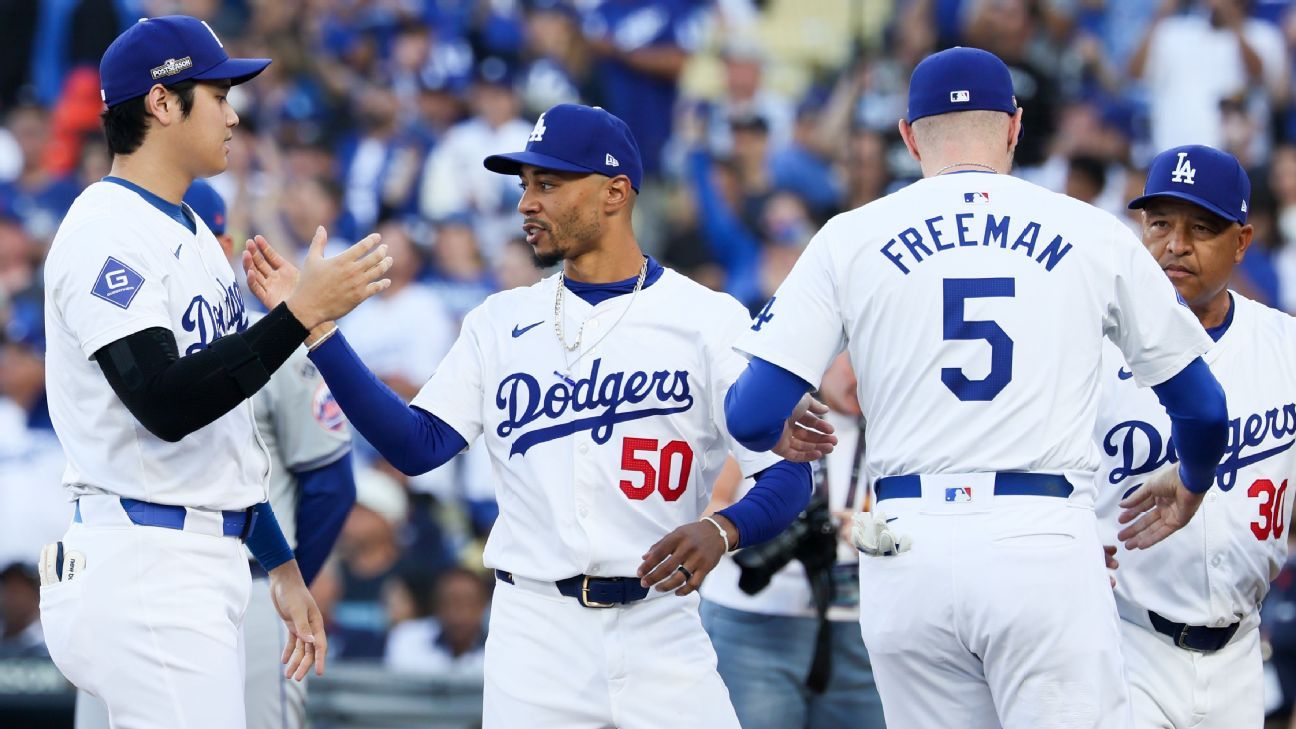
EmailPrintOpen Extended ReactionsLET'S TAKE A tour of the Los Angeles Dodgers' spring training clubhouse. Walk in the front door and within five steps sits Mookie Betts, a future first-ballot Hall of Famer. A quick glance left and it's Kyle Tucker, the newest Dodger, signed for the low, low price of $60 million a year. Look back to the right, a few lockers down from Betts', and there stands Shohei Ohtani, the greatest individual talent ever to wear a baseball uniform. A couple more strides and it's Edwin Diaz, another new Dodger, a three-time Reliever of the Year. Keep pacing about the room and it doesn't stop: Freddie Freeman (Hall of Famer-to-be), Yoshinobu Yamamoto (World Series MVP), Will Smith (three-time All-Star), Blake Snell (two-time Cy Young Award winner). The names, the bona fides, the money, the sheer magnitude of it all. It is, in a word, overwhelming.Come to think of it, that applies to all facets of the Dodgers, the axis around which the baseball world spins. Over the past two years, as they have captured a pair of World Series championships, grown their annual revenue to more than $1 billion a year, signed free agent after consequential free agent, spent money like few had ever before, and completed their hostile takeover of the sport, those left in the Dodgers' wake -- the other 29 teams and their tens of millions of fans tired of this behemoth running roughshod through the game -- find themselves overwhelmed by the notion of another season defined by a single team. Were it to show any signs of abating, perhaps it would not chap everyone in the manner it does. Alas, it is not receding. It's only growing.Which leaves Major League Baseball, as the 2026 season opens with the New York Yankees visiting the San Francisco Giants, fixated on one franchise in a fashion unseen in more than a quarter-century, an all-encompassing preoccupation. That, too, is overwhelming, the stranglehold the Dodgers have on the game's collective consciousness, the ability for one team to operate within the same boundaries that govern the rest of the league and still so clearly separate itself, like a nugget of gold amid a pan of gangue.The cognitive dissonance the Dodgers have created could well reach its apex this year, because it's the reasoning being peddled for owners' preparations to shut down the sport when the current collective bargaining agreement expires in December should the players not agree to a salary cap. It is simultaneously a convenient excuse to shield the owners' real motivation -- control costs, juice franchise values -- and a fair assessment of their fears that payroll disparity today is greater than at any point in the game's history.It is, too, a stunning indictment of the short-sightedness of the game's stewards, a willingness to potentially squander a moment of popularity unseen in decades in service of putting to a stop an organization that does everything an organization is supposed to. Ownership willing to spend? Check (a blank one, seemingly). Stars aplenty? Indeed. Well-oiled infrastructure? Absolutely. Draft well, develop from the low minor leagues through the big leagues, crush international amateur acquisition, seize control of the Japanese market? (E) for all of the above.When we last saw the Dodgers, they were about to lose the World Series to the Toronto Blue Jays. Then utility man Miguel Rojas hit a game-tying ninth-inning home run, Smith pushed them ahead with his own homer, Yamamoto went god mode, and L.A. became the sport's first repeat champion this century. More than the spending, than the deferred money that sends social media into a frenzy, than anything, that's what perturbs the masses: The Dodgers win. The New York Mets have spent multiples more than half the league, and nobody cares because they haven't. What the Dodgers are chasing this season happens once every quarter-century or so -- the Yankees in the late 1990s, the A's in the early 1970s and the Yankees twice more prior to that with five straight titles from 1949 to 1953 and four in a row from 1936 to 1939. And their quest is a poison pill for the sport. Make history -- real, impressive history -- and it only serves to confirm every negative, cynical perspective of the Dodgers and the state of the sport.Baseball's sport-wide renaissance -- in television ratings, new-and-old fan interest and the World Baseball Classic -- is fragile, all because one team sought to answer the question of what happens when money buys talent and talent catches up to long-held, sound processes. As easy as it is to cast the Dodgers as villains, this blinkered single-mindedness was a long time coming. And it's why manager Dave Roberts, another future Hall of Famer, relaxes in his office a few steps from that clubhouse teeming with talent and wears a smile when asked what he thinks about the ire trained squarely on Los Angeles."I like it," Roberts said.No, no. That's not right."I love it."OVER A 15-YEAR stretch between 1999 and 2013, the New York Yankees entered every Opening Day with the highest payroll in baseball. Some years the gap between them and the next-highest team was minimal. Most years were comically imbalanced. In 2005, the Yankees went into the season with $208,306,817 worth of contracts on their books. The second-highest payroll, belonging to the Boston Red Sox, was $123,505,125. Only the New York Mets joined them over $100 million. At the bottom, the Tampa Bay Devil Rays spent just $29,679,067 on payroll.It's easy to say, with the Dodgers' luxury-tax payroll currently over $400 million and their total outlay with penalties set to exceed $500 million, that baseball has been here before. They were less complicated times, two decades before the Dodgers made "deferrals" a slur, but it's instructive to remember that baseball really doesn't change, just the characters in its stories. And with the Yankees over the past decade evolving into their austerity era, the role of big bad villain was there for the taking, something the Dodgers gladly snatched and aren't inclined to relinquish anytime soon.It's not that they particularly enjoy being seen as the embodiment of exorbitance. That's just the price of greatness in 2026. And that, more than anything, is what infuriates the legions that want Los Angeles to fail almost as much as they want their team to succeed: Everything the Dodgers do is specifically trained on finding, securing and unleashing greatness.Take the signing of Daz. He opted out of his contract with the Mets to test free agency. He could have found a four- or five-year contract. The Dodgers refused to budge beyond three. They would give him a fat signing bonus and the all-time highest per-year salary for a closer. He weighed this, consulted with his brother Alexis and countryman Kik Hernndez -- both played for Los Angeles last year -- and emerged unable to shake the thought that the Dodgers have now implanted into any discussion of them."They've won back-to-back World Series, and they keep adding players," Daz said. "That tells us they want to win. If any player had the chance to come here, I think they would because they show everyone they want to keep winning."Kyle could've gone to other teams, too, like me. He decided to come here. This team got better when I signed here and with him got even better. I think if everybody stays healthy, we've got a really good chance to win again."They do, and not just because of the stars. The Dodgers' depth is Cousteauvian. They will start this season with Snell on the injured list, a litany of relievers sidelined for months (Evan Phillips, Brusdar Graterol, Brock Stewart) and their two best utility men coming off offseason surgery (Tommy Edman and Hernndez). And yet they find themselves with an embarrassment of starting pitching, a bullpen still loaded with powerful arms and a cache of every-day players so voluminous that Hyeseong Kim, whom they guaranteed $12.5 million last winter, will start the season at Triple-A.Every advantage imaginable resides in the Dodgers' laps, and though plenty are of their own making through superior baseball operations skill, it's easier -- it's more satisfying -- to bemoan the monetary might they wield. Those advantages are real, and to ignore them would be whitewashing a fundamental part of this Dodgers era.The penalties in the collective bargaining agreement designed to keep teams from spending excessively compared with their peers are almost all monetary. The Dodgers, with a wellspring of cash flow in a game where owners regularly lament their lack of it, found that spending money to improve their major league roster made them even more. With money no impediment -- buoyed by a local-television deal that because of a bankruptcy-court agreement allows them to keep a higher proportion of revenue than other large-market teams and larded with revenue streams from Japan alone bigger than some teams domestically -- they are untethered, unbound and unapologetic.It is the most overwhelming part of the Dodgers. Everything about them is big and here and now, like a black hole inviting all that dare enter its orbit. In the National League, the Phillies, Cubs, Mets, Braves and Brewers all enter the season hoping that they can be the one to dethrone Los Angeles. In the American League, the Blue Jays are back, the Yankees still potent, the Mariners finally ready to make -- and win -- a World Series for the first time in their existence, the Red Sox thirsty to add to their tally of the most championships this century. Everyone is coming for the Dodgers. And that's what Roberts loves most."Because it forces you to bring out your best every night," he said. "Whether we face a young team or a veteran-laden team, a young pitcher or a veteran pitcher, they're bringing their best to beat us. And so for us to not get embarrassed, we've got to bring our best. We're used to people coming after us every single night, and it prepares us to sustain this through the whole season. We're the beneficiaries of people coming after us every single night, because it makes us tougher."The Dodgers' success in balancing the vagaries of a 162-game slog with the urgency of an October sprint is one of their greatest successes. Money gives them stars, yes, but just as much it offers options. If a player is not playing well, or is hurt, or needs to spend time working out kinks, he can with limited interruption to the rest of the team. Starter Roki Sasaki, the Dodgers' bonanza signing out of Japan in January 2025, spent most of last season figuring out his mechanical deficiencies before returning in the postseason to spend a month moonlighting as a dominant closer. It was quintessential Dodgers. And it's why even as Sasaki has regressed again and enters the season with questions about his ability to remain in the Dodgers' rotation, there isn't panic. They've got six months to get him right.NOBODY EMBODIES WHAT the Dodgers are more than Ohtani. He is 31 now, still firmly in his prime, ready to pitch a full season for the first time since 2022, when he finished fourth in Cy Young voting. He will continue to DH every day he doesn't pitch, and as long as he's healthy, he will win his third consecutive NL Most Valuable Player Award and his fifth in nine major league seasons, and that's not a guess or prediction as much as it is an acknowledgment that he does things nobody else has, can or will.The world sees Ohtani through these accomplishments because it's all he allows. He offers his talent, and that suffices. As much as anybody wants to loathe the Dodgers, an objective view of Ohtani reveals the sort of marvel that's impossible to dislike. The things he does, the ways he does them -- they are undeniable, inimitable, baseball apotheosis."I think he enjoyed baseball because he wanted to be the best player to ever play," Roberts said. "I think now he's having fun playing the game. The skill set, the intentional work, the ability to kind of compartmentalize like no one I've ever seen before -- all that stuff is still in play. But I'm telling you, he's just -- even like this one example. He wins the MVP in the NLCS, and he gives it to the team."Coming off a sweep-clinching victory in which he threw six innings, struck out 10 and went 3-for-3 with three home runs, Ohtani took his NLCS MVP trophy and added a bootleg placard to the front. TEAM EFFORT, it read, an acknowledgment from the man himself that the Dodgers aren't just Shohei Ohtani or Mookie Betts or Freddie Freeman or Yoshinobu Yamamoto or Will Smith or Blake Snell -- or, now, Kyle Tucker and Edwin Daz. As unlikely a math equation as this might be, the whole really has been greater than the sum of its parts.And with the total of the Dodgers' roster adding up to so much more than their competitors that they can coast into the playoffs as they did last year, the regular season, so meaningful for the rest of the league, feels like little more than a precursor to answering the question of will they or won't they make history this fall.There is something exciting about that -- about every October series forcing Los Angeles to draw from those challenges other teams posed during the regular season. The Dodgers were favorites in 2023, too, and got swept by the Diamondbacks. And winners of 111 games in 2022, only for the Padres to spoil their coronation. The Braves did it a year before that, sending home a 106-win squad. As did the Nationals to another 106-win team in 2019 and the Red Sox in dominant fashion in 2018 and even the cheating Astros in 2017. Before Ohtani arrived and spurred the construction of the machine, the Dodgers were those mid-2000s Yankees teams: expensive and ringless, outside of a 2020 championship even they side-eye today."What I'm proudest of is the consistency of winning and how we go about it," Roberts said. "There's not a person that's familiar with baseball or successful businesses that says we're not doing things the right way. To do something over a long period of time -- that's stuff that I appreciate. It's what keeps the fire burning to sustain it. Knowing everyone is chasing you, wants to knock you off. How can you be honest with yourself and the organization on what your shortcomings might be to continue to keep that competitive advantage? That's what I'm obsessed with, what our front office and our players are obsessed with."The obsession commences anew this week, with the beginning of one of the most anticipated seasons in years. The coming labor war gives it even more exigency, because if things break bad -- and they certainly could -- it will be the last Major League Baseball for an indeterminate chunk of time. Rather than ruminate on that, it's best to appreciate the year ahead and not get overwhelmed by the Dodgers' place at the center of it. The game sorts itself out, and regardless of how good they are, dominance always has an expiration date. The next seven months will tell whether that's now or later.