
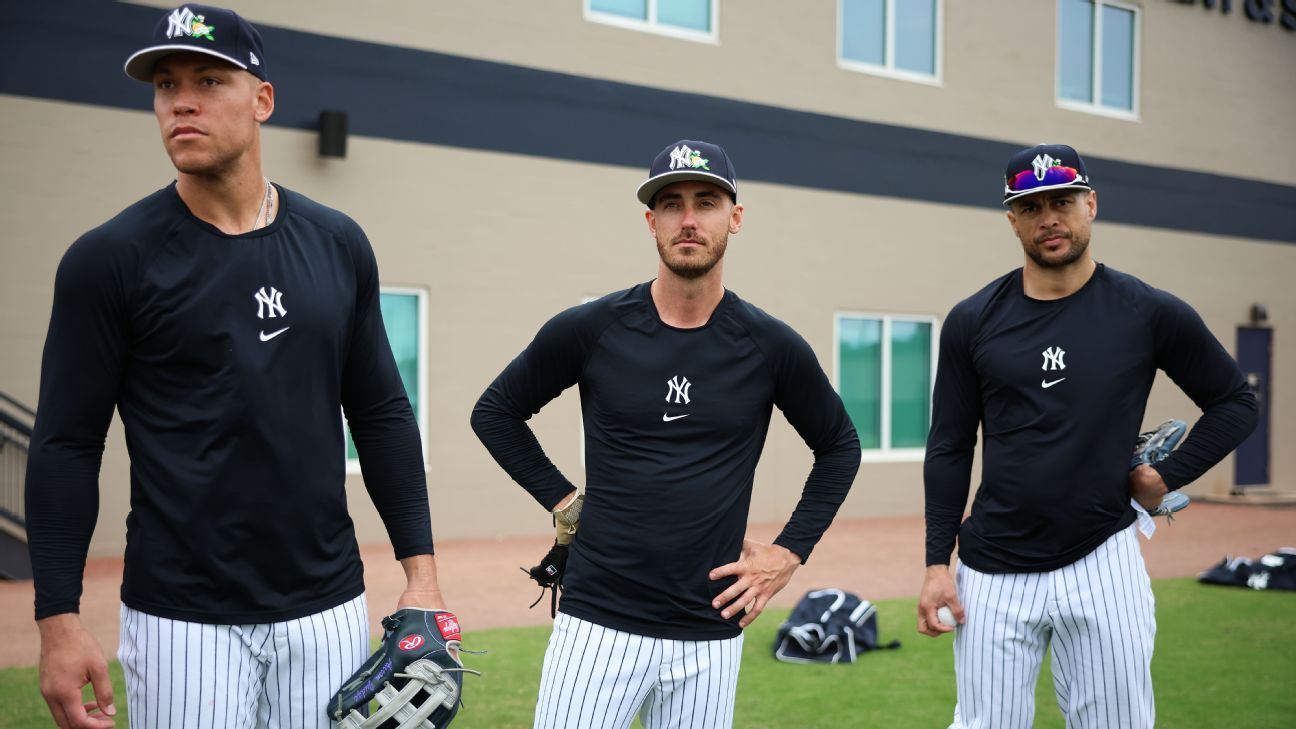
EmailPrintOpen Extended ReactionsIs New York Yankees general manager Brian Cashman a sage, a bad messenger or something else entirely?The context for the question dates to a news conference from late January, which you probably heard about, especially if you're a Yankees devotee. That was when Cashman said the words that caused something of a maelstrom in New York."I'm excited to run it back with those guys," Cashman said, defending his club's offseason approach.The "run it back" part of the discussion rankled many who were uneasy with the Yankees' late-starting offseason which, in the end, left them with a very similar team to the one that finished last season.In the objective realm, there are many questions related to what you might call the "run it back" strategy. What does it look like? Can it work? Does it work? What does work even mean in this regard?Let's look at the 2025-26 MLB hot stove season through the rubric that Cashman's words suggest. How do we classify a team's offseason approach? And what strategies work best, given a team's spot on the contention cycle?Finally, what do these observations say about the Yankees' offseason ... and that of the other 29 teams?Below, we've broken up baseball into three tiers -- teams who were good, mid or bad last season. For each tier, we've listed six types of offseasons, based on level of aggression in free agency and trades. Here's what history tell us about what we can expect in 2026. (Click here for the full methodology.)Tier 1: Already good teamsPassive offseason with a major splashDescription: We're a contender and we like our team up and down the roster. But we would not thumb our nose at an elite free agent, whether it's someone from a competitor or one of our own whom we want to keep in the fold. We're good. Let's run it back.2026 teams: Chicago Cubs, Detroit Tigers, Los Angeles Dodgers, New York Yankees, Philadelphia PhilliesWhat it means: The first two groups in this tier feature eight playoff teams from last season. All of them were measured in terms of their overall work on their rosters. But there is one key distinction between them: those who signed a splashy free agent -- this group -- and those who didn't.The Yankees indeed ended up with a passive classification based on their continuity score. But a lot of Cashman's rhetoric is spot on. His team does still project to be very good even though most of the activity over the winter was to lock down a similar roster.He's also correct in that the roster that ended 2025 varied a lot from the one on Opening Day.New York's overall continuity score (76%) ranked ninth in MLB. So it's a similar group, but the carryover isn't extreme. But the continuity score comprises two measurements: one from the beginning of last season and one from the end. The Yankees rank second (85%) in the measure from the end of season, behind the Dodgers. That's the passivity that irks some fans.Still, the Yankees' continuity score from the beginning of last season (69%) ranks 16th, indicating a healthy amount of turnover, especially for a contending team. So Cashman is right to point out that his team has evolved and that process will continue even after the hot stove season ends. No team had a larger disparity between its continuity scores from the beginning of last season compared with the end.(Note: There is no good way to account for players who sit out entire seasons because of injury, so in this system they register as de facto acquisitions in the data. Thus the Yankees register as passive even though Gerrit Cole counts as a new player, which is kind of how many see it anyway.)The Phillies and Yankees had similar offseasons. Both were solid contenders who have a lot of retention from the end-of-season rosters and committed much of their offseason work (and spending) in keeping the same group mostly together.The difference between the two is that the Phillies have been at this longer. In terms of three-year continuity scores, the Phillies (78%) far outstrip the second-place Guardians (71%). The Yankees (64%) are in the bottom half of this measure. Love or hate Cashman's comments, but over the long haul, his club has actively iterated its roster. That hasn't been as true for the Phillies, whose window to win appears to be narrowing. These things are related.All teams have differences, but as a group, this is a good one in which to be. Those that "run it back" but do so while being willing to go big for the right free agent have been the most successful at mitigating the regression that plagues the good tier as a whole. And championship teams do come out of this bucket.So was the Yankees' approach appealing? Maybe not. Was it defensible? Absolutely.The numbers say: As a general rule of thumb, bad teams tend to get a little better the following season. Conversely, good teams tend to get a little worse. Teams in the middle tend to say in the middle. This is what Bill James referred to as the Plexiglass Principle, and statisticians call regression to the mean. What we're looking at here is how various roster strategies affect how well they tend to work in the context of a team's performance tier.In the free agent era, 4% of teams end up in this bucket, averaging a loss of 2.4 wins the next season. This is the smallest regression of the six classifications in the good teams tier. Six have won titles, including three Yankees clubs (1978, 1999, 2000). The last was the 2018 Red Sox. When you're already good, more often than not, passivity is a feature, not a bug.Passive offseason without a major splashDescription: This is the stand-pat group. Good and counting on more of the same from a similar roster.2026 teams: Milwaukee Brewers, Seattle Mariners, Toronto Blue JaysWhat it means: These were the three teams closest to the 2025 title without winning it. All of them are attempting to take that last step on the strength of minor tweaks.The Brewers, who traded starter Freddy Peralta, were the most active of the three but will nevertheless mostly be running it back in 2026. The Blue Jays don't get credit for a splash signing for landing Kazuma Okamoto, who doesn't have an MLB track record yet, and Dylan Cease doesn't qualify, but the Blue Jays aren't that different overall. Same for the usually aggressive Mariners, who were very targeted in their offseason work.No team is exactly the same from one season to the next, but these clubs will all look familiar. Can it work?Well, the 10 World Series-winning teams from this bucket are by far the most of any of the 18 classifications. The 2022 Astros are the most recent example; another is the 2020 Dodgers. But seven of the 10 champs in the group won titles before 2000 -- and five of them came before 1990.Clearly, winning it all with this approach is less common than it once was, and the Brewers, Mariners and Blue Jays will be jockeying for title contention with fellow teams from the elite tier who landed premier free agents. The dynamic between these groups will be interesting to follow in the season to come.The numbers say: Overall, 12% of teams fall into this bucket, suggesting a tendency for good teams to sit on their laurels. These teams drop an average of 4.8 additional games the subsequent season, the second-smallest amount of regression on the good tier. So teams that want to truly let it ride are often justified in making that call.Active offseason with no major splashDescription: We're good but, what the heck, we're going to turn over the roster anyway. We don't need to get into the star level of free agency, but there will be plenty of new faces in our clubhouse.2026 team: Boston Red SoxWhat it means: Historically, there are a lot of teardown teams in this group. In other words, they register with a low continuity score not because they are going all-in, but because they are waving the white flag, probably for what they say are money reasons.That makes the overall performance of the group the worst of any of the classifications. And while the tankers might drag down the numbers for everyone, no team from this bucket has won a World Series during the free agent era, either.Which brings us to the 2026 Red Sox. The no-major-splash part of the descriptor is a just-barely trait -- despite the Ranger Suarez signing, Boston comes just under the bar for a splash. The Red Sox were also active in trades, which doesn't play into the splash classification, though it's there in the active/passive dichotomy.So Boston is here, in a bucket of its own, and the rule of thumb for this class is that too much tinkering with a good roster is an often tricky maneuver. Teams that try get burned more often than not if they don't secure some additional star production, which the Red Sox hope to get from maturing in-house players.The numbers say: A solid sample of 5% of teams since 1977 are in this leaky bucket. They've lost an average of 10.9 wins from one season to the next, by far the most of our 18 buckets. None have won titles.Moderate offseason with no major splashDescription: The roster is mostly sound after last year's solid performance. So we're plugging holes but not worrying about elite free agents and the contracts they will demand.2026 teams: San Diego Padres, Texas RangersWhat it means: The typically manic Padres played it a little cooler this winter, possibly because of budget limitations. Moves were made but none of them were at the star level.The Rangers are an interesting bunch. Texas has a different look from an offensive style standpoint, and a new manager in Skip Schumaker. But the turnover overall wasn't that heavy and the Rangers didn't spend big in free agency.The thing to keep in mind about the Rangers is that even though they finished a disappointing 81-81 last season, they had the run differential of a 90-win team. They did that despite a spate of offensive underperformances and inconsistencies.If the Rangers are closer to that 90-win talent level than the break-even club they were in the standings, this low-key pursuit of marginal wins could pay off big time over the next few months.The numbers say: 7% of teams end up here and drop an average of 6.7 wins the next season. Five of them have won titles, including the 1977 Yankees. The most recent was the 2021 Braves.Combinations with no 2026 representationActive offseason with major splash: We're good, but we want to be even better. We're attacking the whole roster and adding to our foundation with elite free agents. From a fan perspective, it's a perfect stew. There will be no stew in 2026. About 2% of teams since 1977 fall into this class. They averaged a 5.4 loss in wins and produced two title teams -- the 1996 Yankees and 2024 Dodgers.Moderate offseason with a major splash: Five fairly recent title teams have taken this approach, including the last World Series winner from the Bronx, the 2009 Yankees. Also following this path were the 2011 Cardinals, 2016 Cubs, 2019 Nationals and the reigning champs, last year's Dodgers. The 1993 champion Blue Jays also won from this group, which accounts for 4% of teams in the free agent era and lost an average of 5.3 wins in the subsequent season.Tier 2: Middle of the pack teamsActive offseason with no major splashesDescription: Not great but not bad. The roster has been turned over aggressively, but whether it's a retool or a reset, we're avoiding the most expensive tier of free agency.2026 teams: New York MetsWhat it means: Though no one would argue the aggression of the Mets' approach over the winter, the no-splash part of it is a key distinction. You can quibble with that, as many would see the Bo Bichette signing as splashy, even if his bWAR figures don't qualify him as such.Still, generally speaking, this works to describe the Mets. Their approach was less about changing the talent level of the roster than it was remaking the kind of team they wanted to be, at least in the position group. But the history of this kind of approach for teams on this tier isn't great.The numbers say: 8% of teams in the free agency era land in this group. Those clubs averaged a loss of 2.8 wins by Pythagorean record. Two title teams emerged from this bucket -- the 2005 White Sox and 2015 Royals.Moderate offseason with no major splashDescription: We're on the treadmill of mediocrity. We tweaked the edges trying to raise the floor, but we're not going big on a free agent.2026 teams: San Francisco Giants, Tampa Bay RaysWhat it means: The Giants (81-81) and Rays (77-85) both had non-winning seasons despite positive run differentials. Thus, they had reason to attack the roster with the idea that marginal gains would go a long way toward a wild-card slot in 2026.For the Rays, this is how they operate and it often has worked. For the Giants, any offseason that doesn't include a splash signing feels like a lost opportunity. And they had nothing approaching a splash signing this winter. It's a hard team to read.The numbers say: Teams in this bucket account for 9% of all teams during the free agent era, averaging a modest gain of 0.5 wins in the subsequent season. But four such teams have won the World Series, with the 2023 Rangers being the most recent.Passive offseason with no major splashesDescription: We believe in our squad, based either on a longer-term track record or the progress of a young group that's maturing. Despite a so-so season, we're riding with these guys.2026 teams: Arizona Diamondbacks, Atlanta Braves, Cleveland Guardians, Cincinnati Reds, Houston Astros, Kansas City RoyalsWhat it means: The most successful teams from this group have been clubs that have knocked on the door for several seasons before breaking through. This includes the 1979 Pirates, 1980 Phillies, 1985 Royals and, to a lesser extent, the 2010 Giants.Whether that describes any of the 2026 teams in this group is a matter of opinion. The Braves slipped into this class because of an injury-riddled 2025 season. Still believing in the ceiling of its core, Atlanta took a modest approach to the offseason, knowing their biggest boost would be better health. We'll see how that works out, but it already has been a rough spring in the injury department for the Braves.The Astros are post-elite, but the others in the group have had some recent success without following it up with ceiling-altering offseason aggressiveness. But title teams do come out of this grouping, so if you believe in your team and you're right, it can work.The numbers say: This group accounts for 10% of all teams in the free agent era. They have gained an average of 1.2 wins the following season. Five have won titles, the most recent being the 2017 Astros.Combinations with no 2026 representationActive offseason with a major splash: Last season was middling. That's boring. So we'll turn over much of the roster and go big in the free agent market. No one likes being stuck in the middle. Just 2% of teams in the free agent era end up in this group, but the double-barreled aggression resulted in an average gain of 6.7 Pythagorean wins. The 1997 Marlins are the lone title team in this bucket.Moderate offseason with a major splash: Really, for all the teams in this grouping, the approach largely depends on how you see your trajectory. That's why there is more disparity among the average gains/losses within the group here than in the good and bad regions. The 1988 Dodgers and 2007 Red Sox won World Series coming out of this bucket, which features just 2% of our free agent era teams. Those teams added an average of 3.3 wins the following season.Moderate offseason with a major splash: Only 2% of teams end up in this group, which have added an average of 4.7 wins. No champions have come out of this bucket, the only classification in this tier to be shut out of the title chase over the last half-century.Tier 3: Bad teamsActive offseason without any big splashesDescription: Our team suffered through a poor season and aggressively turned over the roster over the winter. Keep in mind that this doesn't necessarily mean signing a lot of new players -- it might (and likely is for this group) a matter of tearing down. Teams in this group did not sign splashy free agents.2026 teams: Chicago White Sox, Washington NationalsWhat it means: The "active" part of it for these struggling teams often means the offloading of veteran talent (Nationals), but it can also mean the introduction of a wave of young talent from the minor leagues (White Sox), though in both cases there are other factors.This might be a good place to mention that "splash" signings in the data set don't include players signing from overseas, as they don't have MLB track records that serve as the basis for that label. So depending on how you view Chicago's Munetaka Murakami, you might want to think about them as a splash team, which would put them in the preceding bucket.It is perhaps a bit surprising that the Rockies, under new management, don't land in this bucket, but the incoming brass was neither busy nor passive with the roster it inherited.The numbers say: This is the most common grouping, comprising 15% of the teams in the data set. These teams improved by an average of 4.2 wins the following season, which was the lowest figure of the six bad-team classifications. This group has not produced a champion during the free agent era.Moderate offseason without a big splashDescription: We lost a lot of games. We worked the roster but didn't tear it down or go wild with additions. We stayed away from (or whiffed on) the top of the free agent class.2026 teams: Baltimore Orioles, Colorado Rockies, Miami Marlins, Minnesota Twins, Pittsburgh Pirates, St. Louis CardinalsWhat it means: To me, this group is the "we just had a bad year" group. (Along with the "we've been rebuilding for a long time" teams.) Management tweaked some things but are mostly relying on players coming off down seasons to rebound. Incredibly, this approach paid off in World Series crowns for the Twins twice in a five-year period from 1987 to 1991. Well, don't look now, but this year's Twins fall into this class again.But the most likely Twins-like team here is clearly the Orioles, a leading contender entering last season that as a group suffered through a shockingly poor season. Mike Elias & Co. made changes, including a new manager, but the core of the Orioles remains similar to what it was a couple of years ago.As for why the Orioles didn't get a "splash" label ... that's just how bWAR sees the past three seasons of Pete Alonso, so Baltimore fell just short.Finally, the Pirates, who I and others have lauded for their offseason work end up in this group. That a moderate/no-splash approach to the offseason would earn so much attention shows you how much of our reactions are based on subjectivity. Compared to how the Pirates usually operate, Pittsburgh's winter felt super splashy and super busy.The numbers say: The Twins were the only two champs from this group, which makes up 10% of all teams in the free agent era. These clubs added an average of six Pythagorean wins the following season.Passive offseason with no big splashDescription: We're bad but we've already done the hard work of tearing down the roster. But we're not at the point where we want to target top free agents. Let's see how what we've got develops.2026 teams: Athletics, Los Angeles AngelsWhat it means: This is not an approach that is going to win you much backslapping on sports radio. Sometimes patience is warranted, sometimes it is not. I'd lean toward the "not" for both the current teams that ended here. The Angels strike me as a directionless organization right now, and this approach does little to clarify that confusion.For the Athletics, it's a different story. Their hitters, as a group, could emerge as one of baseball's best, sooner than later. While I'd like to see that upside augmented with more aggressive spending on free agent pitching, the A's might simply like who they have developing on that side of the ball.Though I wouldn't go planning a Fall Classic trip to West Sacramento just yet, there amazingly have been two teams from this group to emerge as champions. One was the 2014 Giants, whose every-other-year pattern of high-level winning is a historical unicorn. The other was the 1990 Reds, who made a few tweaks from a 1989 season that just barely classified as bad by our standard here. Cincinnati then mostly stood pat, with one key exception: Lou Piniella took over in the dugout.The numbers say: 5% of teams during the free agent era fall into this bucket. They added an average of 4.7 wins the following season, with the two champs already mentioned.Combinations with no 2026 representationActive offseason with a big splash: These are teams that go all-in despite suffering through a losing season. Only 2% of teams since 1977 fall in this bucket, but they improved by an average of 10 Pythagorean wins per 162 games the following season. The group produced two World Series champs: the 2003 Marlins and the 2013 Red Sox.Moderate offseason with a big splash: Just 1% of all teams in the group. Those clubs added an average of 8.2 wins the following season and have produced no champions during the free agent era to date.Passive offseason with a big splash: No one did it this winter, but such teams have existed -- clubs that struggled and took a major swing in free agency anyway. The 1993 Giants are a perfect example, going from 72 to 103 wins after signing Barry Bonds. Teams don't generally fall into this group, which comprises only six of 1,444 clubs in the era. But GMs who have made this bold choice have seen an average improvement of 15.6 wins. The Rockies should have sprung for Kyle Tucker.MethodologyThe goal was to calculate a continuity score for each team during the free agent era, beginning with the 1977 season. The steps to get there are as follows: How many plate appearances did the team get from players who made their debut the previous season with the team? How about innings pitched? What are the similar calculations based on the team with which players made their last appearance of the previous season, which would reflect on-the-fly maneuvering as the season played out? The continuity score reflects the harmonic mean of these four measurements. The average continuity score for teams from 1977 to 2026 (measures for the upcoming season is based on projected numbers) is 65%. The range is 98% (1988 Mets) down to 21% (2015 Braves, starring a very lonely Freddie Freeman).Using the continuity scores, we were able to classify the aggressiveness of a team's approach to its roster in three ways: busy, moderate and passive.Teams were also classified based on previous season performance, as measured by their expected 162-game record based on run differential, or Pythagorean. Those three groups: good (86.4 Pythagorean wins or more), bad (75.8 or fewer), middle of the pack (between 75.8 and 86.4). Teams in their expansion seasons did not receive a continuity score.Finally, teams were classified based on whether or not they made a free agent "splash" or came out of free agency without one. Splash free agents were those with three-year bWAR totals at least 2.5 standard deviations better than average for the era. Splash teams were those who signed players accounting for at least 10 bWAR in splash players.These classifications yielded 18 different "buckets" in which to describe teams. For example, a good team with an aggressive offseason that features the signing of a star free agent would be put in the "good, aggressive, splash" bucket.All data was taken from baseball-reference.com.