
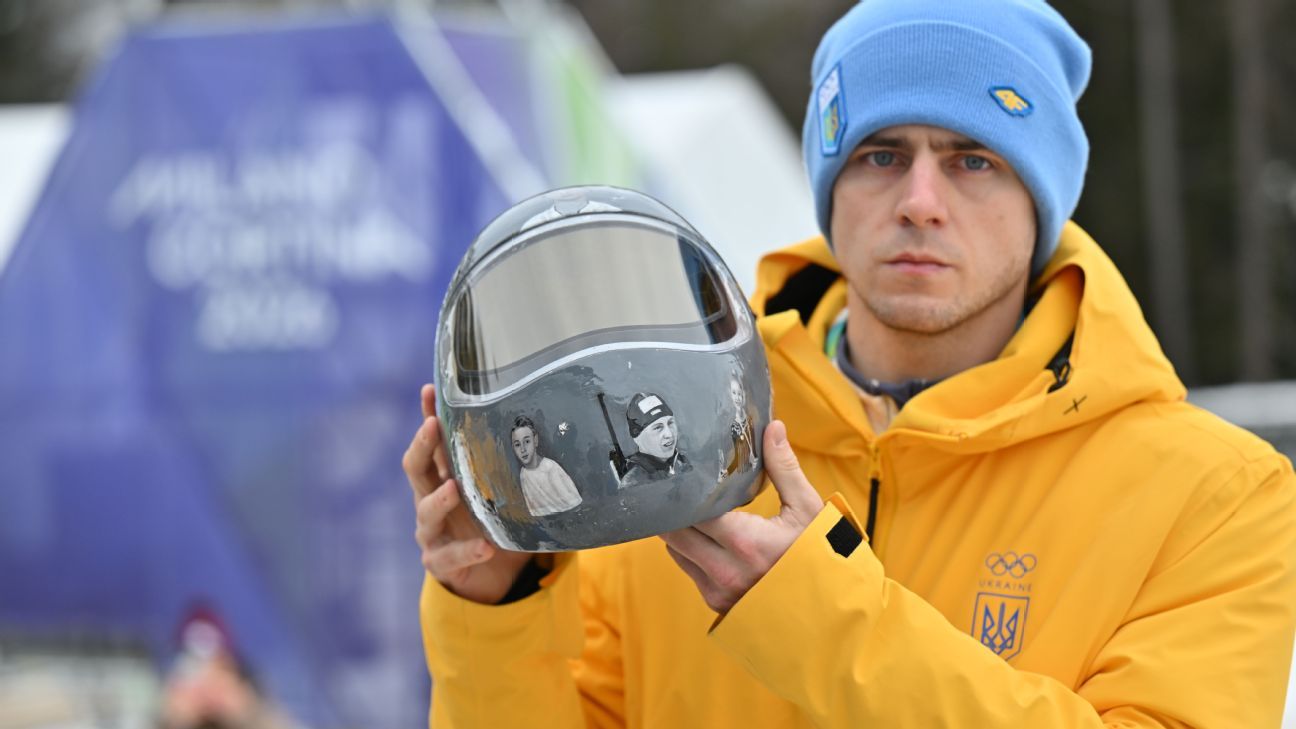
EmailPrintOpen Extended ReactionsCORTINA D'AMPEZZO, Italy -- The Court of Arbitration for Sport heard the appeal of Ukrainian skeleton athlete Vladyslav Heraskevych surrounding his disqualification from the Milan Cortina Games on Friday, though the slider knows he won't be competing in these Olympics even if he wins his case."Looks like this train has left," Heraskevych said in Milan on Friday.His appeal lasted for about 2 hours. Heraskevych, draped in a Ukrainian flag, left the hearing smiling and saying he believes that CAS will rule in his favor. But he has left Cortina d'Ampezzo's Olympic Village, has no plans to return to the mountains during the Games and still believes he did the right thing."From Day 1, I told you that I think I'm right," Heraskevych said. "I don't have any regrets."Meanwhile, International Olympic Committee president Kirsty Coventry reiterated that Heraskevych's disqualification was justified because he insisted on bringing his messaging -- a tribute helmet -- onto the field of play.Heraskevych planned to wear a helmet displaying the images of more than 20 Ukrainian athletes and coaches who have been killed since Russia invaded their country in 2022. He feels the helmet was not in violation of the Olympic Charter."I never expected it to be such a big scandal," Heraskevych said, adding that the story only became big when the IOC ruled he could not wear what he calls "the memory helmet."Speaking in Milan, a day after she visited with Heraskevych in Cortina d'Ampezzo moments before he was told that he could not participate in his Olympic race, Coventry repeated what the IOC has been pointing to for several days about the need to control how messages from athletes can be shared with the world."I think that he in some ways understood that but was very committed to his beliefs, which I can respect," Coventry said. "But sadly, it doesn't change the rules."Coventry was moved to tears Thursday after the meeting with Heraskevych and his father. "I respect her feelings. She respects my feelings," Heraskevych said. But the Ukrainian slider also said he found his accreditation for the Games being taken away then returned in what seemed like a goodwill gesture puzzling."A mockery," he said.Heraskevych has already missed the first two runs of his competition, with the final two runs set to take place Friday evening -- so there never was a possibility for him to get into the race after missing his first run.IOC spokesman Mark Adams said he believes the CAS ruling will come quickly, but neither he nor Coventry would speculate what happens if Heraskevych wins his appeal.CAS director general Matthieu Reeb said the tribunal will try to render its decision quickly.Heraskevych said he felt his disqualification was unfair and fed into Russian propaganda, noting that he and other Ukrainian athletes have seen Russian flags at events at these Games even though they are not allowed.He cited other tributes from these Olympics, such as a U.S. figure skater displaying a photo of his late parents, an Italian snowboarder having a small Russian flag image on the back of his helmet and an Israeli skeleton athlete wearing a kippah at the opening ceremony with the names of the 11 people who were killed representing that country during the 1972 Munich Games.The IOC said each of those cases was not in violation of any rules or the Olympic Charter.The IOC offered Heraskevych the chance to bring his helmet through the interview area, called a mixed zone, after he got off the ice for his runs or make other tributes such as wearing a black armband. It just didn't want him making a statement by competing in the helmet or wearing it on the field of play."I think it's the wrong side of history for the IOC," Heraskevych said.