
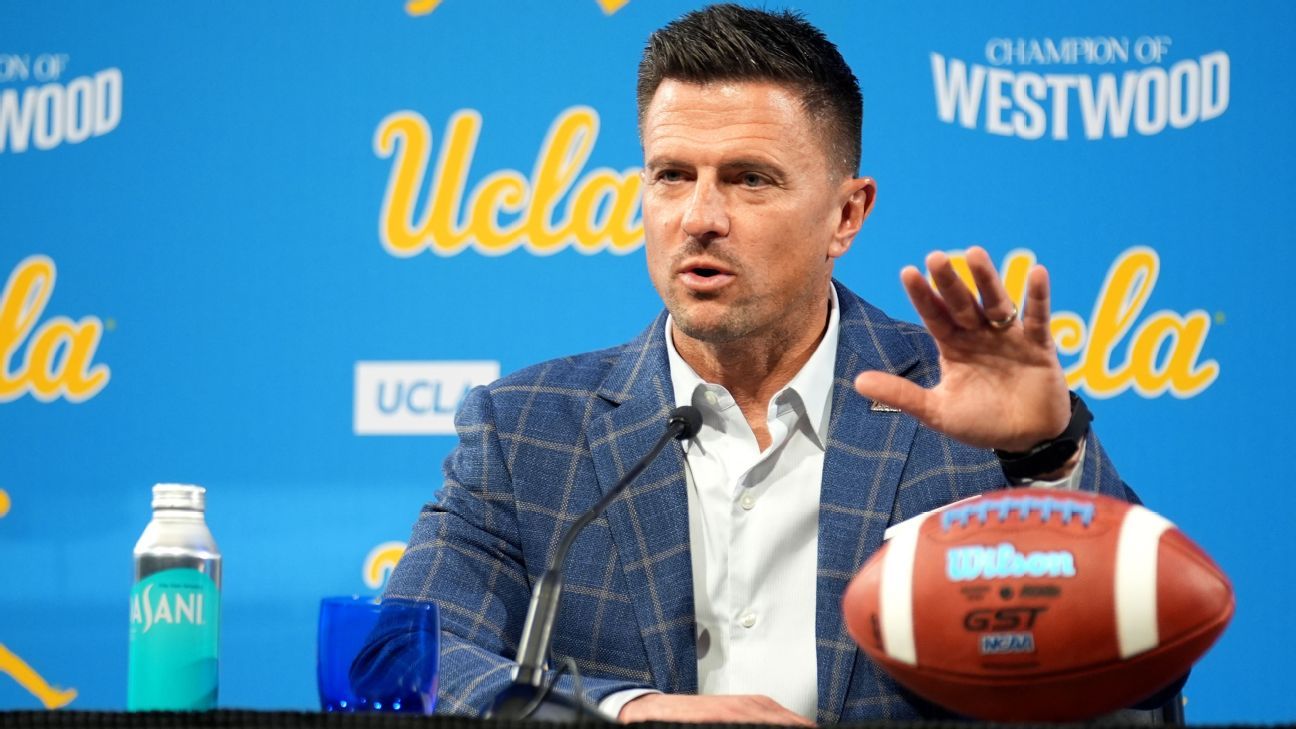
LOS ANGELES -- New UCLA football coach Bob Chesney has mined coal in his hometown, slung Red Bull and vodkas behind a Baltimore bar, and worked every on-field job from strength coach to special teams coach. Chesney arrives in Westwood in the wake of a program in spiral after DeShaun Foster's coaching tenure lasted just 15 games.
He brings a reputation as a turnaround artist, flipping places like Salve Regina (Division III), Assumption (Division II) and Holy Cross (FCS) into big winners. He arrived at James Madison and had them in the College Football Playoff within two years.
"He's the kind of guy I want to get in the foxhole with," UCLA athletic director Martin Jarmond told ESPN. "He's seen things. He's done it. Everywhere he's been, he's turned it around."
How will he turn it around at UCLA? He'll bring a blueprint from past rebuilds and lessons learned from his dad, Bob Chesney Sr., who he watched coach in high school. Chesney started his coaching career in Vermont making $5,000 year and worked his way up every step of the ladder. "I knew that this wasn't a profession," he told ESPN, "it was a way of life."
What will that life look like at UCLA? He shared his early vision with ESPN.
Q. UCLA athletic director Martin Jarmond told me that you saw an overstuffed equipment shed the other day and said, 'You can't win with a cluttered shed.' Why?
A. [Gets up and points out window to two workers decluttering the shed.] When I looked out there, to me, there's some things in there that I know we probably don't use. There's a couple things that look dated. Let's get that all out, and let's figure out what we actually use. If you can't clean a weight room, or you walk over a piece of garbage, you can't win a game. Little things matter. And I think the by-product of what's on the field is an accumulation of what you've done all year, or what you've done even in game week all week. And if you don't pay attention to little things, obviously they amount to something big somewhere down the line. There are no little things when you understand the cost of not paying attention to the little things.
Q. Growing up in Kulpmont, Pennsylvania, you had your dad, uncle and grandfather all on your high school coaching staff at your high school, Our Lady of the Lourdes. What was that like?
A. It wasn't just in high school. It was my whole life. When I was 2, 3, 4, I was the ball boy. Same town, same school, all of it. After their game was over, we played on Saturday afternoons ... and we would end up back at my Uncle Bill's house watching Notre Dame. That's what he wanted on a TV, and there'd be another TV with Penn State on it. And that's how it would be spent. They'd be talking about the game, all families coming together from the coaching staffs, all families from the community, because other people were involved in it too. Our equipment manager, our filmer, there were a lot of other people that were part of this program that were doing it for free, that were just influential people within the community, but within that football team.
Q. What did you learn from that?
A. So it was this kind of cool thing that when the game was over, you watched this collection of people that were all brought together for a common cause with the wives and the children, the grandparents, and the cousins that came to ... whatever it might have been, it was just a really wholesome, special feeling, win or lose after those games, because that was the one moment you got to spend with those people that you probably abandoned throughout the week because of just what the job entailed. So my mother did a lot on her own. And it was just cool to see everybody, collected together, at the end of the week's work.
Q. Your dad, Bob Chesney Sr., has come and spent the season with you at all your coaching stops -- Salve Regina, Assumption, Holy Cross and James Madison. Will he be coming to LA?
A. Every place he would come out for August, stay in the dorms, like the players and coaches did, too. And then by the time September, October, November and December came, he would rent a place for those four months.
Q. Little more expensive here?
A. Well, Newport [R.I.] was expensive. But this is a little more for sure. I'll be able to help him a little more. [Smiles.]
Q. How foundational was having your whole family coach you as you grew up in Kulpmont.
A. That was everything. There was never a doubt in my mind growing up what I was going to do. I knew that this wasn't a profession, it was a way of life. I think that was the biggest thing. And when I was in New England, in Newport, you'd watch fishermen go out at four in the morning and come home whenever and be smelly and work hard. And you're like, man, these people just work hard. Well, they don't make a lot. ... Who wants that job?
Q. You'd think no one, right?
A. You'd think. But their sons are probably going to do that job. Sure. When I got to Harrisonburg [Virginia], farmers were similar. It's not an easy job. The hours don't make sense. The money doesn't make sense. ... None of it makes sense. So who's going to take over? Probably the son. You see it in many different scenarios, and that was it because your whole life was dedicated to that.
My father [Bob Chesney Sr.] is a strong member of that community that would take in kids that didn't have rides, and make sure their families were OK. And many times, people would be at my house or staying at my house, whatever it would be. And that was just that communal feeling that that was just my calling and my purpose. It had nothing to do with a profession. I didn't know it was a profession.
Q. How did you start?
A. When it was time for me to realize it and get a job, I went to Norwich University [in Vermont] for two years for $5,000 each year. And then I'd go home over the summer and do landscaping or mine coal or do whatever I had to do to make a couple more bucks to help sustain me through the $5,000 year that I was about to have because my father and mother didn't have means to help me. You were on your own.
Q. You played at Dickinson, were a graduate assistant at Norwich and then went on to Delaware Valley, Kings College [Pennsylvania] and Johns Hopkins before becoming a head coach. Not a blue-blood path, exactly. What do you consider your big break on your way up?
A. There was a realization of who I was as a coach when I worked at Johns Hopkins with Jim Margraff. Everywhere else I had been, there were different coaches with different personalities, and I just didn't see myself as any of them. And I was like, 'I don't know if this is really for me based on the way I'm seeing these different guys do different things.' And then I got there with him and I'm like, 'Oh, you could connect with these kids.' You could be humble. You could be these different things that are personable, approachable, like have your door in the office open.
That was the first time I was like, oh damn, that's possible to do in this environment where it's not what I was seeing from other ways. And then I guess the first break was that first time being a head coach at Salve. And that was the moment where for me, through Hopkins, through anywhere I'd been, I always tried to look at it, and I don't know if I was purposefully doing it, but I was always looking at it through the lens of the head coach. I wanted to be the best assistant coach in the world that I could. I wanted to dominate my job. And I think that goes back to, again, mining coal or working construction. I remember people saying to my dad, 'Man, he's one of the hardest workers we've ever had as a younger kid.' And I took great pride in that.
Q. Give me an example of learning to be a head coach from Margraff? [He died at 58 in 2019 and coached at Johns Hopkins from 1990 to 2018, going 221-89-3. This month, he was elected to the College Football Hall of Fame.]
A. I put myself in a situation where I wanted to understand what it was like to be a head coach. I remember being with Margraff, and he had a freshman parent meeting. I remember the other coaches being like, 'We don't have to go to that, right?' He's like, 'No, this is just for the freshmen.' I was like, 'Can I go to that?'
He's like, 'Why would you want to go to the freshman parent welcome meeting?' I'm like, 'Because someday, I think I'm going to have a freshman parent welcome meeting, and I want to know what that's going to be like.' And to this day, a lot of things that happened in that meeting, I used the same exact words that he used because it was just that impactful.
Q. I remember listening to you on a podcast when you were at Holy Cross talking in depth about special teams, like way in the weeds. I know you have a defensive background, but there's also a strong special teams background. How did that shape you as a coach?
A. When I got to Norwich University, I'll never forget, we spent a full week on offense. I think there was the head coach and another guy on offense and then two guys on defense. Then the rest of us were young kids. So we went through every single thing of the playbook, the offensive coordinator would go through it and say, this is the play where these are the first plays we're running. The next week was an entire defensive week. So we got to Friday, and on Friday we're ready to be done and camp starts on Monday and someone goes, 'Well, what about special teams?' And the coach is like, 'Oh shoot, yeah, here's your assignments. We'll be good.'
And I was like, 'Well, I'm coaching the punters and kickers.' I was like, 'I don't really know anything about punters.' I go, 'Coach, I don't know anything about punters.' He goes, 'Nobody does. Just tell him to kick the ball, you'll be fine.' And I remember thinking, 'Oh, that doesn't sound right.' I think I got to do a little more research. And I remember like it was yesterday, the internet was relatively fresh. It was 2000, right? So I went on and bought a book by Bill Renner ['Teaching and Coaching Football Punting Mechanics']. I read this book like you wouldn't believe. And I would read it at night, and I would highlight two or three things that I needed to grab and then I would go before our staff meeting in the morning the next day and before camp and I'd go actually do these things, like punt the ball or try to figure it out on my own, teach myself.
Q. How'd that go?
A. Eventually, I got pretty good at punting. I got decent at least understanding the field goal kick, knowing how to fix them. Basically, I taught myself to teach them. ... So then fast forward to getting down to King's College, I was the special teams coordinator, and I remember punt protections and all the stuff that came with it. And then we had another really good kicker and I think there was a game or two we won that I was like, oh damn, this you can actually win a game on this stuff.
And then when I go to Hopkins, I was a special teams coordinator, defensive coordinator, recruiting coordinator, all the things that came with it, and then we really started to win some games. And Salve, we blocked more punts than anybody in the world, and at Assumption we returned more kicks than anybody with Deonte Harty [who went on to a strong NFL career].
Q. A powerful lesson, huh?
A. At some point, I was like, this is like the third side of the coin. Heads or tails, but there's this other side that the world doesn't know about. I was also a strength and conditioning coach at one point. And nobody came to college to lift weights or play on special teams. So when you're in charge of those two things, you realize pretty quickly they're important. How do I get people to do the hard things and to understand that this helps you win games, right? So nobody came to college to run down as the K2 on kickoff. I think it shaped me a lot to understand this -- How do you get people to do things that they may not see value in, but are important? How do you make them special?
Q. What was your most memorable side hustle as you climbed the coaching ladder?
A. Well, the toughest one was mining coal. Back in Kulpmont, that's what you did. It sounds weird on the outside world.
Q. How many people in Kulpmont?
A. Right now, the population was 2,758 in the 2020 consensus.
Q. How many bars?
A. Oh, growing up. Hundreds. In these little coal mining towns, it all starts with the coal mine. And then my great-grandmother in her house had a house, and half of it was a convenience store. She had a cooler for me, then she had stuff. There was still stuff on the shelves when she was older. And then up above, those rooms would be rented to people or whatever when the kids would leave. So every block had a corner store. Every block had a bar, and a bar was like that in someone's house. And then most of it was the Knights of Columbus, the VFW, the American Legion, and then you had the Polish club, you had the Irish club. And then there was other regular bars. So there was just a million bars.
Q. What was the glamourous side hustle?
A. When I was in Baltimore, me and Andrea, my wife were not married yet. But we moved down to Baltimore. We were in a four-bedroom house. She and I had a room. The assistant SID [sports information director] at Hopkins had a room. A student that was going to Towson and played rugby had a room. And then an engineer guy that worked at [a local company] had a room. So four of us were in this house, but that's really what we could afford. I was making, I think, $28,000.
One day we were walking around, and we walked by this place that was getting gutted out and it looked awesome, like a nice place. And they were building this club in there. So I eventually was like, 'Hey, I'd love to bartend here.' And then eventually they're like, 'Yeah, we have our bartenders.' And then they called me back. They're like, 'We actually need some help.' So I started to bartend at this club called Kamp.
Nobody would show up till 10 or 11 o'clock at night and then it'd stay open 'til 2 a.m. They'd close the doors, and everybody would stay later. But I'll never forget, one day there'd be the actors from 'The Wire' in there. I just stood there, just whipping drinks. And I'd leave there making $400 or $500 bucks a night. It was phenomenal. But I remember one time at the end, Bernie Williams is in there and he's hanging out and the guy's like, 'I got a guitar. You want to play?' He's like, 'I'm lefty.' The guy is like, 'I'm lefty too.' I turn around and Bernie Williams is playing guitar.
Q. What's your specialty cocktail?
A. Back then, all everybody wanted was Red Bull and vodkas... We were just spinning those things all over the place, four in a hand. And it was like four deep for like three hours of the night and everything else was quiet. We would close down and he'd hang out and save a lot of money, not drinking. And then made a lot of money. So that got me through those years.
Q. The tent pole hires for modern coaching are the two coordinators, the GM and the strength coach. You have those here in the building, walk me through why it was so important to have OC Dean Kennedy, DC Colin Hitschler, strength coach Chris Grautski and GM Darrick Yray.
A. We had our first staff meeting. I'm sitting in a room with 30 people, and what does this need to look like? We can't get to all the details yet because we had to go pretty quickly, but having Dean and having Colin and having Grautski with me, and the amount of time I spent with [Yray] over the phone over the past month is significant. I know we're all speaking the same language. So when I'm not with them right now, I know that that same message is getting spread amongst the staff.
We also brought other guys with us from JMU [including special teams coordinator/tight end coach Drew Canan] ... and keeping the continuity is one of the best things you can do, especially when you know the roster is going to change quite a bit, knowing that your coordinators are speaking your language, and I don't have to teach them. On top of the way I want it to look, they know how it should look, I think that is very important.
Q. Nico Iamaleava is the defining star here, and he has already signed for next year. What have your early impressions of him been, and what do you hope he can become?
A. I thought he did a really good job last year. The one game that stands out is that Penn State game. He almost single-handedly took that game over, not only by his ability to throw and get the ball out quickly, but with his legs. Then he battled a little bit of injury. So I think he's the most important part of this, like any program, on the front end of it. And his ability to help us now on the recruiting side is also a big deal as we move forward here. So to have him on board, I think is a big deal.
He's been calm, confident and poised. I believe that will translate to the field. I don't see his heart rate get too high. I don't see it get too low. I think he does a really good job of keeping himself even-keeled, trusting himself. And he's a smart football player. He's very capable, and he needs to be a leader. And I'm excited for him to get a chance to do that.