
In mid-January 1996, Premier League leaders Newcastle United and second-place Manchester United had both played 23 games but, with Newcastle's 12-point lead at the top, the race for the title appeared to a matter of when, not if, the trophy ended up at St James' Park.
Thirty years on, the history books tell us that Newcastle didn't win the league -- their title drought is now 99 years, dating back to 1927 -- and that Man United overturned the deficit to eventually win the title by four points in what remains one of the Premier League's classic run-ins.
Two years later, in the 1997-98 season, Arsne Wenger's Arsenal side were 12 points behind Sir Alex Ferguson's Man United as late as February, but still managed to win the league by a point. So when the United supporters celebrated Sunday's 3-2 win against the Gunners at the Emirates by singing "we're gonna win the league," they might not have been joking.
United's victory moved them into fourth place -- 12 points behind Mikel Arteta's faltering league leaders; eight behind Man City and Aston Villa in second and third, respectively; one ahead of Chelsea and two of Liverpool -- but nobody really expects Michael Carrick's team to mount a title challenge over the final four months of the season, do they?
Even Carrick, a five-time title winner as a player with United, was quick to dampen any over-optimistic euphoria afterward by saying his side has "bigger games ahead" in the more realistic pursuit of a top-four spot and Champions League qualification. But this has been such an unpredictable season that even an unthinkable United title charge can't be ruled out.
It seems a ridiculous prospect considering that United were in turmoil less than a month ago following the dismissal of coach Ruben Amorim after just 14 months in charge, but the shortcomings of the top three have opened the door for anything to happen between now and the final round of games on May 24.
So who will win the 2025-26 Premier League title? Right now, it is impossible to identify a clear favorite because Arsenal's recent form has shown them to be vulnerable to title jitters well before most challengers begin to feel the heat of the run-in.
On Friday, City manager Pep Guardiola declared Arsenal to be the "best team in the world" at this moment. It may have been an attempt at mind games by Guardiola, but Arsenal have a 100% record with seven wins from seven at the top of the Champions League table and still hold a four-point lead in the Premier League, so it's hard to find a team in a better position anywhere in Europe right now.
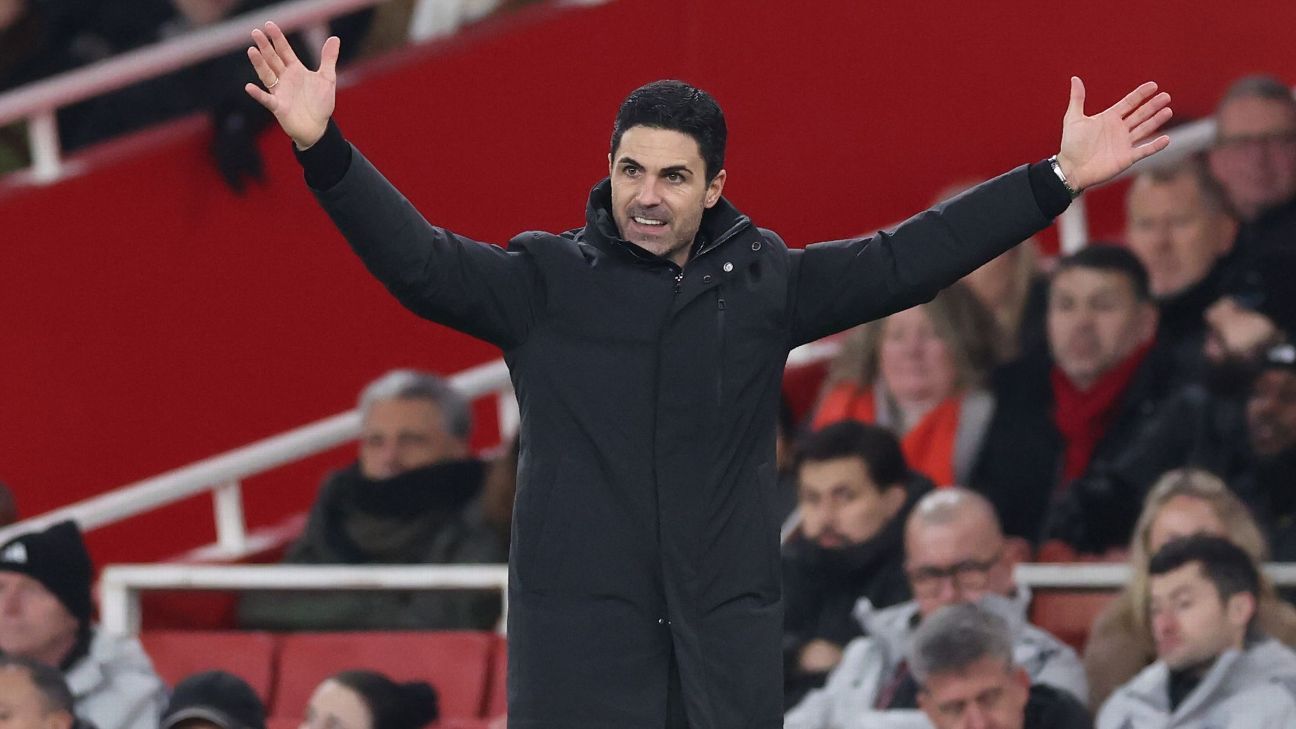
Yet they have claimed just two points and scored only two goals in their last three league games, and the anxiety among the supporters was palpable inside the Emirates against United on Sunday.
The fear of failure appears to be suffocating Arteta's side and their lack of a reliable goal scorer should also be a concern. It's tough to win a title without a 20-goal-a-season striker, but their leading Premier League scorers are Leandro Trossard and Viktor Gykeres with five apiece.
Star winger Bukayo Saka hasn't scored in his last 13 games in all competitions; striker Gykeres hasn't scored from open play in his last 11 league appearances; while forwards Gabriel Martinelli (0 goals in last 13 league games) and Noni Madueke (0 goals in last 26 league games) are also conspicuously failing to deliver.
City, now only four points behind, ended a four-game winless run in the Premier League with a 2-0 victory against bottom side Wolverhampton Wanderers on Saturday. But, having already suffered five defeats by mid-January, Guardiola's side should really be out of the running by now.
They have had defensive problems all season, although added the �20 million signing of defender Marc Guhi from Crystal Palace to help this month, and Guardiola has struggled to field a midfield that can compete with the top teams in the Premier League. Meanwhile, striker Erling Haaland has registered 20 goals in 23 league games this season but has scored just one goal -- a penalty -- in his last nine games in all competitions, and City appear vulnerable when playing against sides who are prepared to take the game to them.
So can Villa capitalize on the frailties of the top two and clinch the most unlikely title success since Leicester City in 2015-16?
Unai Emery's team sit third, also four points behind Arsenal, and have proved their big-game credentials by beating Arsenal (2-1), City (1-0), United (2-1) and Chelsea (2-1) already this season. In fact, Villa have won 15 of their last 18 games in all competitions, including an 11-game winning streak, but just as they were beginning to look like serious contenders, they suffered a shock 1-0 defeat at home against Everton last week.
That was a real chance to show they meant business, but Villa blew it. The seven-time English champions last won the league in 1981, but if they are going to make it eight in 2026 then they need to build on their incredible recent run, despite having the smallest squad among the top sides. It won't be easy, though, as Villa face tough tests against United, Chelsea and Liverpool in the final 10 games of the season, while their last match is against City at the Etihad.
Recent title races have all been about a team building early momentum and maintaining it, often under the pressure of being chased by a formidable rival. But that's not the case this time around.
Rather than pull clear of the pack, the top sides have stumbled when they had a chance to open a commanding lead. And that's why United, 12 points back in fourth, might somehow sneak their way into the title race after transforming the mood at Old Trafford with back-to-back wins against City and Arsenal under Carrick.
A United title triumph is an incredibly unlikely scenario, but unless one of the top three start performing like champions, this crazy season might yet have another incredible twist in the tale.