
When Miami was putting together its shocking first national title under Howard Schnellenberger in 1983, Indiana was going 3-8. The Hoosiers would go 0-11 the next season.
When Nebraska was wrapping up a second straight national title with an all-time great team in 1995, Indiana was going 2-9 with wins over only Western Michigan and Southern Miss.
When Ohio State was pulling a classic upset of Miami in 2002's BCS championship game, Indiana was sitting at home, having gone 3-9 in Gerry DiNardo's first season. The Hoosiers would go 5-18 over the rest of the DiNardo tenure.
When Nick Saban's Alabama was battling LSU for national rock-fight supremacy in 2011, Indiana was picking up the pieces after a 1-11 campaign.
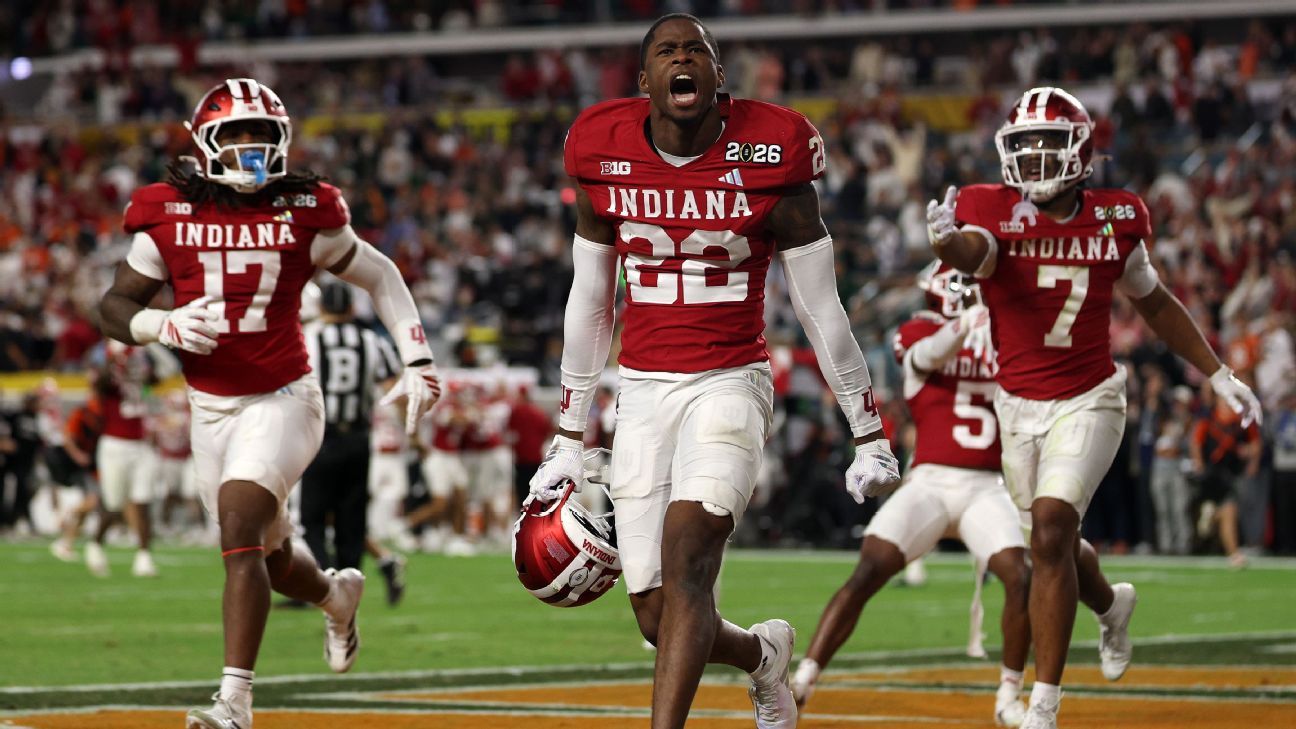
For virtually all of college football's history, Indiana has been an also-ran at best. But in a sport long defined by the haves, the ultimate have-not has become its national champion. Indiana was the losingest program in the history of major college football heading into 2025, but the Hoosiers won their first title with guts, a glorious Fernando Mendoza touchdown run and a late interception from Jamari Sharpe. In this new era of college football, literally anything is possible.
Indiana's 27-21 win over Miami in the College Football Playoff title game on Monday night locked up the least likely national title since either 1996 (the last time a team won its first national title), 1984 (when BYU won an unassuming crown) or ever. The Hoosiers became the sport's behemoth when no one was looking, beat six top-10-at-the-time teams and took the title in the second year of the 12-team CFP.
College sports has produced an infinite number of wild and unexpected national titles, but considering the influence that football holds, and considering how much the ruling class really likes to rule this sport, this might be the biggest story in the history of college sports. Pretty much any other title-winning historic underdog remained an underdog to the end -- the U.S. over the USSR. in the Miracle on Ice in 1980, Bill Snyder's Kansas State in the late-1990s, Villanova or NC State in men's college basketball in the mid-1980s -- but Curt Cignetti's Indiana Hoosiers became a Goliath, survived a title-game upset bid, and made history in the most unique possible way. The only thing that could have possibly topped it might have been if Gordon Hayward's buzzer-beater for Butler had banked in against Duke in 2010.
The most important plays of the national title game
History can turn out to be awfully poetic, but not in the way we originally envision. In 2002's national title game, Miami's Glenn Sharpe was flagged for a very late (but not necessarily incorrect) pass interference penalty against Ohio State in the first of two overtimes. The Buckeyes would win in double-overtime, and Miami has spent the past 23 seasons searching for some combination of justice and absolution.
Jamari Sharpe, Glenn's nephew -- and a product of Miami's Northwestern Senior High School (didn't have a Miami offer when he committed to Tom Allen's IU program late in 2021) -- provided that absolution ... for Indiana. He intercepted an underthrown pass by Carson Beck as Miami was trying to position itself for a late, game-winning touchdown.
Sharpe's pick clinched the title, but it created the latest in a series of pretty big second-half swings.
In order, here are the five biggest plays of the national title game according to win probability added.
1. Mark Fletcher Jr.'s 57-yard touchdown run (11:06 left in Q3, +15.0% for Miami). Miami trailed 10-0 after a relatively one-sided first half that included three straight Hurricane three-and-outs and a dreadful sequence of decision-making from head coach Mario Cristobal. Miami finally moved the ball late in the half, but facing a fourth-and-2 with over a minute left, Cristobal decided to let the clock run down and attempt a 50-yard field goal instead of actually trying to score real points. Kicker Carter Davis, shaky for the entire CFP, doinked it off the upright.
After forcing a quick Indiana punt with a pair of sacks to start the third quarter, however, the Hurricanes got the ball back and immediately changed the game.
Fletcher would finish with 112 rushing yards and two touchdowns on Monday night, giving him 507 rushing yards in four playoff games.
2. Malachi Toney's 22-yard catch-and-run (6:37 left in Q4, +13.7% for Miami). Indiana still led by 10 points when Toney, having snagged a 41-yard catch-and-run out of a no-huddle attack two plays earlier, took a jet sweep to the house to keep the Hurricanes within shouting distance.
3-4. Fernando Mendoza's 12-yard run on fourth down (9:18 left in Q4, +13.2% for Indiana); Charlie Becker's 19-yard catch on fourth-and-5 (11:18 left in Q4, +11.9% for Indiana). Indiana was only 8-for-16 for the season on fourth downs heading into the title game, but the Hoosiers converted a pair of fourth downs on this game-defining drive early in the fourth quarter. Becker's back-shoulder catch kept the drive alive, and after originally leaning toward attempting a field goal, Cignetti called timeout and put the game in Mendoza's hands. He delivered.
5. Mikail Kamara's blocked punt, recovered by Isaiah Jones for a touchdown (5:04 left in Q3, +11.0% for Indiana). Indiana's offense labored to start the second half, gaining just 11 yards in 13 third-quarter snaps. But Kamara's perfect block, which settled nicely in the end zone for Jones to recover extended the Hoosiers' lead back to 10 points.
More than anything else, this touchdown bought the Hoosiers time. They outgained the Hurricanes in the first, second and fourth quarters, but they were flailing in the third (total yards: Miami 150, IU 11), and Kamara's block assured that the Hurricanes couldn't take full advantage of the sudden domination. IU's offense got its footing again in the final 15 minutes.
In terms of win probability added, Sharpe's interception (+8.3% for IU) was actually only the seventh-most-important play of the game. (The sixth: Another Mendoza-to-Becker connection as the Hoosiers were running the clock late. Becker, Indiana's best receiving threat late in the season, caught four passes for 65 yards.)
Miami did The U's legacy proud
It wouldn't have been the most surprising thing in the world if Miami had laid a bit of an egg in the finale. After three straight road trips, two upsets and an exhausting semifinal win over Ole Miss in Arizona, the Hurricanes had to face the expectations of a home crowd; while the defense was decent enough in the first half, the Hurricanes were outgained by 100 yards and were on pace to lose by 20.
A team that had to get off the mat and rally just to reach the CFP at all, did so again after halftime. The Hurricanes outgained the Hoosiers, the best team in the country, by 125 yards in the second half, and all their stars shined. Fletcher's 57-yard burst got the party started, while Toney finished with 10 catches for 122 yards, and the pass-rush duo of Rueben Bain Jr. and Akheem Mesidor, so vital to this CFP run, finished with three sacks (all after halftime) and 4.5 tackles for loss. In 13 second-half pass attempts from Mendoza, the Heisman Trophy winner, Miami allowed just four completions and 47 net yards (including sacks).
Cristobal threw away a scoring chance at the end of the first half, and that certainly looms rather large in a six-point defeat, but he also had his team playing its best ball for most of the final 30 minutes. It just wasn't quite enough. And Beck's legacy as a one-year starter will end up rather conflicted: He had some fantastic moments -- most notably an all-timer of a go-ahead touchdown drive to beat Ole Miss in the semifinals -- but in all three of the Canes' losses this season, their last offensive play was a Beck interception.
Miami will have an awfully different team in 2026. Losing Bain and Mesidor -- not to mention punishing linebackers Mohamed Toure and Wesley Bissainthe -- will mean that defensive coordinator Corey Hetherman will need to find a new center of gravity around which to build. The Canes will need to find a new quarterback, too, though it's pretty clear who that will likely be. But Toney and Fletcher will return, and Cristobal's recruiting success hasn't abated. The Miami football program has reawakened, and The U is thinking big.
There was only one way this story could end
A season that began with a huge Lee Corso tribute kind of ended with one, too. A former IU coach, Corso has been one of the Hoosiers' more public admirers in recent years; as it turns out, there were lots of rather dormant admirers, too. With payments to the program and its players now both legal and tax-deductible, the nation's largest alumni base came to life with the hiring of Cignetti and his initial 2024 success. IU isn't suddenly the biggest-spending program in the country, but its initial investments immediately reaped the ultimate reward.
I have enjoyed how unique the program was, with Hep's Rock in one end zone (it's now outside the stadium) and a full academic support facility under the Memorial Stadium stands. But it was never a program built to do this.
Cignetti has pulled off quite possibly the greatest turnaround in college football's history -- and college football has quite the lengthy history -- and it remains shocking how easy he made it look. He didn't even need to wait for steady growth and improved recruiting; he just did it with the guys he came with (or brought in within a year of his hiring).
IU's best defensive players in the title game -- cornerback D'Angelo Ponds (five solo tackles and three pass breakups) and end Mikail Kamara (four tackles and a blocked punt) -- were part of the JMU crew that came with Cignetti from Harrisonburg,Virginia. Mendoza began college life as a low-three-star prospect from Miami who chose Cal over offers from Florida International and Yale (and, now famously, not Miami). Running backs Kaelon Black and Roman Hemby, who ground out 139 ultra-tough rushing yards on Monday night, came from JMU and Maryland, respectively. Charlie Becker, who had two enormous fourth-quarter catches, was a mid-three-star Nashville prospect who committed to Cignetti's predecessor, Tom Allen.
Cignetti brought reasonably unheralded players to town and, with help from assistants he was very familiar with -- starting with offensive coordinator Mike Shanahan (whose Cignetti connection began when he became IUP's receivers coach in 2016) and defensive coordinator Bryant Haines (who became IUP's defensive line and strength coach in 2014) -- made every player on the roster better and better. I loved the Cignetti hire at IU, but I was envisioning regular bowl appearances for the Hoosiers; nothing in this sport's history suggested something like this was possible. But here it is.
Watching the Indiana fans I know going along breathlessly for this ride has been a thrill. As is always the case (and I promise I'm saying this with love), they'll become entitled and insufferable soon enough; the Golden State Warriors and New England Patriots were also once exciting underdogs, after all. But IU's rise is a signal to almost any major school in college sports: If you can ramp up your investment levels and make smart hires, you can win big. You probably won't win it all -- as far as we know, Cignetti is one of one -- but you can think big. And for as choppy as the college football waters may be off the field at the moment, more programs than ever can now dream of success they never thought possible. I can't think of anything better for the future of the sport than that.