
Reaching age 30 can inspire reflection. That holds true for athletes, too. It can prompt them to look back on their career -- while starting to think about how much longer they have to play.
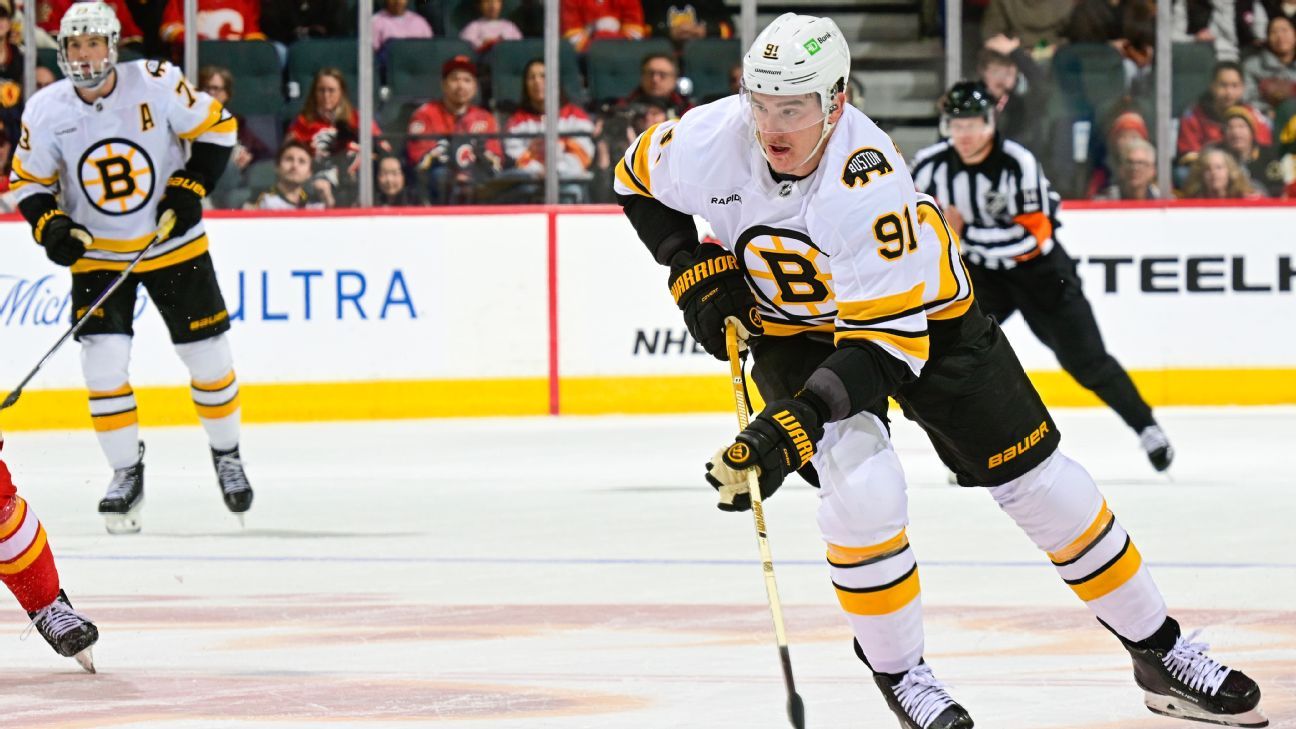
That's where Boston Bruins defenseman Nikita Zadorov is at right now. He has played 13 NHL seasons, has become a top-four defenseman in that time and has had many experiences throughout his career.
One experience he has not had is to play for his nation, Russia, at the Olympics. He's starting to wonder if it will ever happen.
"[NHL players] have missed the last three Olympics. We were hoping for this year, but I guess not and it's tough," Zadorov said. "But from the other side, I understand where they're coming from, right? You know what I mean? The war's going on and everything, and there are the sanctions."
Being a hockey player in the best league in the world comes with certain expectations. Among them is having an opportunity to play at the Olympics and represent their nation. For some, it's on the same level or even greater than playing in the Stanley Cup Final.
That's what makes the discussion for Russian players about the upcoming Milan Cortina Olympics rather complicated. There are those who want the chance to play in what would have been the first true best-on-best Olympics in more than a decade.
Those same players also understand the dynamics behind why that won't be happening.
"I know it's tough right now. Everyone is excited about the Olympics but us," Columbus Blue Jackets winger Kirill Marchenko said. "And of course we would love to be at the Olympics. Russia would have a great team because our roster would have looked so nice."
RUSSIA'S OLYMPIC COMMITTEE remains suspended by the International Olympic Committee with the latter imposing sanctions stating that Russia violated the Olympic Charter when it invaded Ukraine in 2022. It has since led to a select group of individual Russian and Belarusian athletes that were allowed to participate at the 2024 Summer Olympics in Paris under a neutral flag.
The International Ice Hockey Federation, the governing body for international men's and women's ice hockey, has continued to ban Russia and Belarus, having stated in February 2025 that it "believes it is not yet safe to reintegrate" both nations.
That, in turn, is why Russia will not be sending a men's hockey team to the Olympics in what has become a complex discussion during the past four years.
Sport is competitive in nature. It's what made going through 12 years and three Olympic cycles without NHL players competing in the men's hockey tournament feel incomplete. The Olympics still had flagship nations that have become staples on the world stage. But it came with the caveat that those same countries were also not fielding their strongest talent.
It's what led to a gradual outcry from fans and players, among others, about the need for true best-on-best international competition in men's hockey. The other senior-level international tournament -- the IIHF Men's World Championships -- is held at the same time as the Stanley Cup playoffs, which means many players opt for starting their offseason rather than delay it to represent their nation, while others are still vying for the Cup.
The NHL and NHLPA agreed to have its players return to the Olympics, which was then followed by the creation of the 4 Nations Face-Off 2025 and the eventual revival of the World Cup of Hockey. It creates a calendar that now allows for more frequent best-on-best international tournaments (outside of the world championships).
Canada, Finland, Sweden and the United States faced each other in the 4 Nations Face-Off, in what was a precursor to the Olympics. It generated more excitement about Olympic hockey over the past year, which has led to questions about roster construction in addition to who could win.
It has also led to questions about Russia, its absence and what could have been for those who believe that the omission of one of the most successful nations in the sport is glaring.
"I feel like if the NHL would have run their own tournament like they did last February and if they invited Russia to it and told us, 'You guys can play. But you cannot use your flag or you cannot use your anthem,' I would say 99% of the guys in the league would agree. OK, sure," Zadorov said. "At the end of the day, we know who we are. We know we are Russians. We know where we come from. Our anthem is something we can sing in the [dressing] room.
"But we want to play best-on-best. You want to prove it to the world if you have that opportunity."
Zadorov said he understands that there may be Russian players whose situations would have prevented them from playing under his proposed scenario for the 4 Nations.
"But I think most of the guys I know would have done it for sure," Zadorov said.
Zadorov added that he heard there were concerns from other nations about having a Russian team at the 4 Nations. But he has also had conversations with players of different nationalities who told him they would have wanted to face a Russian team.
PLAYERS INTERVIEWED FOR THIS STORY acknowledged the complicated situation beyond their control preventing them from joining their NHL teammates in Italy.
"I mean, it's politics and sports," San Jose Sharks defenseman Dmitry Orlov said. "I cannot say anything, you know? It is just, it is what it is. It's not our decision. So we just take it how it is and keep living.
"We're lucky we're still playing in the NHL and it's important. We like our jobs and you just try not to overthink anything. You just hope that with the next Olympics that we'll have a chance to play."
Orlov, 34, is the sixth-oldest active Russian player in the NHL and part of a generation with a distinct view of the national team. He was 5 months old when the Soviet Union dissolved and the nation became Russia.
Hockey, along with sports as a whole, was part of the Soviet Union's identity. The Soviet Union's men's national team won 81% of its games, captured seven Olympic gold medals and won 22 gold medals at the IIHF Men's World Championships that included a run of nine straight tournament titles between 1963 and 1971.
While the nation was in search of a new, post-U.S.S.R. identity, more Russian players were heading to the NHL, now that they could live and play in North America with more freedom than before.
Orlov was 7 when Russia, which initially sent only its domestic players to the Olympics in 1994, used NHL players at the 1998 Games in Nagano, Japan. A group that featured stars like captain Pavel Bure, Sergei Fedorov, Sergei Gonchar and Alexei Yashin finished second.
As a teenager, Orlov was good enough to represent Russia. He would represent his nation 35 times in junior competitions and 31 times at the senior level. Orlov has won a world junior championship and a world championship. Even the Stanley Cup he won in 2018 as part of the Washington Capitals was captained by arguably the greatest Russian player of all time in Alex Ovechkin, the NHL's all-time leader in goals.
And yet? Orlov has never played in the Olympics.
"Growing up, we used to watch the Russian national team," Orlov said. "That was always fun. You used to play with each other back home when you were younger. You play against each other [in the NHL] and then you're on the same team speaking the same language. You just think about how everybody says it's great to be a part of that with the whole country cheering for you.
"That's how you felt about it when you were a kid. It's kind of tough that we're not able to play."
ADDING TO THE FRUSTRATION for the Russian players who are missing the Olympics is the belief that their team could have challenged for a medal -- and possibly even the nation's second gold medal since the Soviet Union dissolved. The team designated as "Olympic Athletes from Russia" won gold in 2018 while the Russian Olympic Committee was serving a ban for a doping scandal.
ESPN recently projected what a potential Russian men's Olympic hockey team roster would look like if it were heading to Milan Cortina. Marchenko was part of a group of forwards that featured Kirill Kaprizov, Nikita Kucherov, Evgeni Malkin, Artemi Panarin and Ovechkin.
Seeing that he made the roster made Marchenko smile, while adding he should have been on the second line in place of Colorado Avalanche winger Valeri Nichushkin (instead of the third line). Orlov and Zadorov were part of a defense group that also had Vladislav Gavrikov, Ivan Provorov and Mikhail Sergachev.
Then there's the goaltending dilemma that would have been facing Russia, knowing it would have had to choose between Sergei Bobrovsky, Igor Shesterkin, Ilya Sorokin and Andrei Vasilevskiy for its three available roster spots.
"Obviously, we would have a great team with the greatest goal scorer of all time," Sergachev said when asked about a potential Russian Olympic team roster. "We also would have had the best goalies in the league. Bobrovsky's phenomenal and probably a Hall of Famer. Shesterkin is the same thing. Sorokin. They're all great. I love them all. They're all my good friends. But, to me, Vasy's just something different.
"We'd have a great team. It'd be fun to get together again. But it's also tough to speak."
Reviewing all the reasons why Sergachev, a defenseman for the Utah Mammoth, believes that Russia would have done well at the Olympics also provides him the opportunity to stress how this was likely the last chance for fans to see players like Bobrovsky, Malkin and Ovechkin play at the Olympics.
Bobrovsky was part of the Russian Olympic team in 2014, while Malkin and Ovechkin are both three-time Olympians who have won world championships but never an Olympic medal.
"It's sad ... but it is what it is," Sergachev said. "You can't really dwell on it or really think about it too much now. We have [NHL] games every day. There's still a lot of political stuff that needs to get done. I don't, at least, think about it much. But it would be great if [a return] happened."
Speaking about that older generation of Russian players is what made Zadorov think about the possibility his generation of Russian players could possibly miss out on the chance to ever represent their nation at the Olympics.
Nearly half of the Russians playing in the NHL season are at least 30. That group has players such as Dmitry Kulikov and Vladimir Tarasenko, along with Panarin, Gavrikov, Kucherov, Nichushkin, Shesterkin, Sorokin and Zadorov.
"Kuch has played in the World Cup [of Hockey], but he hasn't played in the Olympics," Zadorov said of the Tampa Bay Lightning winger and two-time Ted Lindsay Award winner. "He's going to be arguably, when he retires, one of the best Russian players to ever play this game. He's in that conversation. Panarin, he's getting older too."
Zadorov acknowledged he will be 34 when the next Olympics cycle arrives, with the understanding that his age, among other factors, could see him get passed over. The hulking defenseman has been open about criticizing Russian President Vladimir Putin and his policies.
In 2019, Zadorov did an interview with The Athletic in which he spoke in opposition to Russia's internet bill and how "actual patriotic people should speak up." In 2023, he did an interview with Russian YouTuber Yury Dud in which he spoke out in opposition against the war in Ukraine and stated, "I'm sorry. Instead of raising the new generation, we sent them to die."
Zadorov has also previously said he likely wouldn't return to Russia until Putin is no longer the president or "that regime is still there."
"With my political views and political situation, I don't know if I would have even made this team," Zadorov said. "Because I'm the guy who, when I speak, I break the internet with my quotes."
EVEN WITH THE DYNAMICS that are preventing them from participating, there will be Russian players who will follow what happens at the Olympics.
"I love hockey, and it's the best-on-best," Sergachev said. "Obviously, Russia isn't there but it's still best-on-best. I still want to watch Sidney Crosby go against Auston Matthews or [Connor] McDavid and [Jack] Hughes. You want to watch them. You want to learn what that situation is about with the Olympics."
Sergachev said he was like that with the 4 Nations Face-Off, in that he wanted to watch because the tournament still featured the best players in the world and he saw it as a chance to learn even more about them.
Marchenko echoed a similar sentiment, saying he also watched the 4 Nations and will watch some of the Olympics because of how much he loves hockey -- while using it as a chance to see what he can pick up from watching the game at the fastest possible level.
He admitted that he won't watch every game. The goal is to "go to a beach somewhere" that also has a nearby rink so he can find a way to get in his workouts and stay sharp, while also finding time to disconnect before the season resumes.
There is one team he might follow more closely than others, however.
"I want to support Zach Werenski and watch all his games," Marchenko said of his Blue Jackets teammate. "He's one of my friends and he's going to be playing."