
AMBER GLENN NEVER dreamed of being an Olympian.
From an early age, she loved everything about figure skating -- the crafting of a routine, the challenge of learning a new skill and even the long hours at the rink in the mall near her home in Plano, Texas. But Glenn was a practical child. She knew skating would be part of her life for a long time. She had talent, but she recognized how few skaters made each Olympic team.
And the women who competed for Team USA on the sport's grandest stage? Well, they were something else entirely. An "untouchable" group. Glenn couldn't see herself ever being part of it.
She could not, and would not, dream that big.
Glenn instead had more attainable goals: She wanted the chance to skate in a televised competition someday. And when she achieved that at age 14 while competing at the U.S. junior national championships, those around her in the skating community began to believe she was capable of a lot more.
"She immediately stood out from the rest with her power, her speed and her tenacity," Damon Allen, a former-skater-turned-coach, told ESPN about his first time watching Glenn skate. "She just had such great potential."
But while others could see how special Glenn was, it would take another seven years -- and a lengthy mental health break from the sport -- for her to believe what she had thought was impossible.
Now, as the 2026 U.S. figure skating championships begin in St. Louis, Glenn looks to defend her back-to-back titles and make her first Olympic team, all while challenging long-held conventions in the sport. At 26, she would be the oldest U.S. Olympic women's singles skater in nearly a century, and the first openly queer woman to make the U.S. figure skating team. She has also become a mental health advocate, and talks candidly about her own journey.
While there have been challenges along the way -- including an unsuccessful bid for the 2022 team -- Glenn is ready for her Olympic moment, and a chance to win the first Olympic medal for the American women since 2006.
"It would mean everything," Glenn told ESPN. "I had a bit of a shot at it in '22, but I just was not prepared. I didn't have the accomplishments under my belt and I didn't have the confidence.
"And since then, it couldn't be more different. Now I have accomplished so much in the last four years, both personally and on the ice, and I have a great group of people surrounding me, both back at home and just on Team USA overall."
GLENN STARTED IN the sport alongside her sister Brooke and their three cousins, taking a skating lesson at Stonebriar Centre in Frisco in an effort to get the girls out of the oppressive Texas heat. She loved it right away -- and her talent was quickly evident.
"I think I was about 8-ish when people started to notice," Glenn said. "A lot of times with skaters, you get to working on the double axel and it's kind of a make-or-break moment. I started working on that before I turned 9, and it took a long time to get it, but the fact that I was trying it and learning it at such a young age showed like, 'Hey, she's got something here.'"
By 14, Glenn had emerged as one of the country's brightest new talents, winning the 2014 junior national championships with a free skate score higher than all but three of the senior women competitors.
Suddenly, she was the one to watch, and with that, came all of the expectations so often pinned on prodigious young skaters. Glenn said she wasn't ready for it.
In her words, she spiraled.
"The external and internal pressure was just a lot, and I had already been struggling with my mental health," Glenn said. "I was just latching onto any way to feel in control of myself and my own environments, and it just manifested in disordered eating and depressive episodes, and it was just a lot. And it got to a point to where it could not be sustained as an athlete or even just as a human."
While she continued to train and compete, she knew she was not OK. Glenn didn't even need to say anything. A close friend noticed how she was struggling and reached out to Glenn's parents out of concern. Glenn entered an inpatient mental health facility for six days.
She doesn't recall much from her time at the facility, but she does remember that she never saw the sun.
"I was sad about figure skating and my environment, and then I see some of the people in there and their stories and what's going on in their lives, and I always say, 'You can drown in an ocean or you can drown in a puddle face down,'" Glenn said. "But either way you're drowning and it sucks."
Glenn said she knew, no matter what happened with skating, she was going to make some changes when she left. The next several months were a blur. She continued intensive outpatient therapy and focused on learning to function again. She didn't skate.
In her 10-year career she had never been away from the ice for more than two or three weeks. Her love for the sport never wavered, and the break felt like an eternity. But she kept focused on getting healthy.
She still felt far from 100 percent, but after about five or six months, the lure of skating was too much. She returned, gradually, and without much expectation.
"It was a couple of years, a lot of hard work and several steps forward and backwards," she said, before she truly felt whole again. She continues to prioritize her mental health and is open about what she's gone through.
"I wish there were [well-known athletes] out there when I was younger that talked about their experience and shared that not everything was sunshine and rainbows trying to make it to the top," Glenn said. "Healing isn't linear, it isn't just an overnight thing. I'm still making progress."
SUCCESS ON THE ice wasn't immediate either.
Glenn returned to training in 2016, and finished in eighth place at the U.S. championships at the end of that season. She was solidly "middle of the pack," in her mind, for the next several years.
But things began to change in 2019. American ice dancer Karina Manta had come out publicly as bisexual the year before, and the announcement had a huge impact on Glenn. She decided to publicly share that she was bisexual and pansexual and did an interview with the Dallas Voice, a local magazine. She was unsure how many people would see it -- but was floored by the immediate and overwhelming support she received.
"I did not expect it to blow up in the way that it did," she said. "But I'm grateful because they got my message out there. I was able to represent a lot of people that are in skating, especially queer women."
And Glenn realized if that was the impact she was making as someone with "midrange" results, her reach could be so much further if she could make it to the top level of the sport. The appeal of having a larger platform was the motivation she didn't know she needed.
While her powerful jumping had always been one of her trademarks, she never had time to work on the tantalizing but difficult triple axel. She hadn't learned a new jump since she was 11 years old. But by 2019, and with just a few women competing capable of the jump, Glenn saw the benefit of adding it to her repertoire. When the pandemic hit in 2020, essentially shutting down everything from competitions to indoor training facilities, Glenn hunkered down at home in Texas, working out twice a day outdoors and watching all of the YouTube clips she could find.
"I couldn't skate but I could get stronger," Glenn said. "And I thought, if I'm going to keep going, I want to give it my all and try and really do what I can with the limited resources that I had there in Texas. I was constantly doing the math to try and get a triple axel because I was thinking, 'Well, if I'm going to do this, might as well try and accomplish something new.'"
Like the double axel she had conquered all those years earlier, the triple axel was another make-or-break moment. It ultimately changed everything.
At the 2021 U.S. championships, Glenn attempted the triple axel but was unable to land it. Still, she had what was then one of the best competitions of her senior career, finishing as the runner-up. She was left off the U.S. team for worlds -- and instead named first alternate -- but suddenly she was a legitimate Olympic hopeful for the 2022 Beijing Games.
And perhaps most importantly, it was the first time Glenn truly believed she could one day be an Olympian. "I thought, 'Oh dang, if I do really well, I really might have a shot at it," Glenn remembered thinking.
But after a disappointing 14th-place finish in the short program at the 2022 U.S. championships, Glenn tested positive for COVID-19. She was forced to withdraw from competition and was not named to the Olympic team.
While it was devastating, it made Glenn realize how close she was -- and what she would need to do to make the 2026 Olympic team.
"It gave me a taste of what could happen if I really, really committed myself to this," Glenn said. "I then went on a completely different path."
Glenn parted ways with her longtime coaches Darlene and Peter Cain and moved her home base to the U.S. Olympic & Paralympic Training Center in Colorado Springs, Colorado. It was her first time living outside of Texas and away from her parents, and she relished the opportunity to grow as a skater and as a person living on her own. She didn't know how long her journey would continue but she knew she owed it to herself to give it at least another season.
She began working with Damon Allen, the coach she had impressed all those years earlier at junior nationals. She was candid with Allen that she was uncertain about how long she wanted to continue skating -- and Allen told her he would help her make it the best year ever for her. They then added Tammy Gambill as another coach, and choreographers Katherine Hill and Kaitlyn Weaver.
For Hill, who had worked previously with Glenn at various gala performances at competitions, the decision was easy.
"Soon after Amber moved out here, Damon kind of sidled up to me one day and said, 'I have a new student,'" Hill said to ESPN. "You could tell how excited he was about it. He then said he was wondering if I could choreograph for her. When he said it was Amber, I said, 'Of course' immediately. It wasn't even a conversation, it was an absolute count-me-in moment. Amber can perform -- she can really, really perform -- and from the start, we just worked so seamlessly together."
Glenn also brought a work ethic and commitment to improving every day -- she was the first to arrive to the rink and the first to look for feedback after a performance. Success quickly followed. She won the first Grand Prix medal of her career at the 2022 Skate America competition, came in third at the 2023 U.S. championships and ended the season by helping the U.S. team win the gold at the World Team Trophy.
"She said, 'All right, we're going to keep going. Let's do it. Let's go,'" Allen said about a conversation they had at the time. "That was really the moment where she verbally put it out there and said, 'Yep, we're going to try and get to the Olympics.'"
She also added neurotherapy during the summer of 2023, at the suggestion of her sports psychologist, Dr. Caroline Silby. It helped quell her anxiety on the ice and aided with symptoms of ADHD, which she had been diagnosed with as a teenager.
The practice connects sensors to Glenn's head and monitors her brain activity while she does various breathing and focus exercises, using sounds to help redirect her if abnormalities are detected. Allen said one such exercise involved Glenn, typically sitting rinkside, mentally driving a car down a road in a straight line. He called neurotherapy "the game changer" for Glenn.
"She's always been well-trained and capable of great programs, but before she would make a mistake [in competition] and then get into this high-anxiety setting and then not be able to get off of the hamster wheel [the rest of the performance]," Allen said. "But this has helped her focus. Now if she makes a mistake, she knows it's not the end of the world. She's able to just get right back in it and not let it ruin the rest of the program."
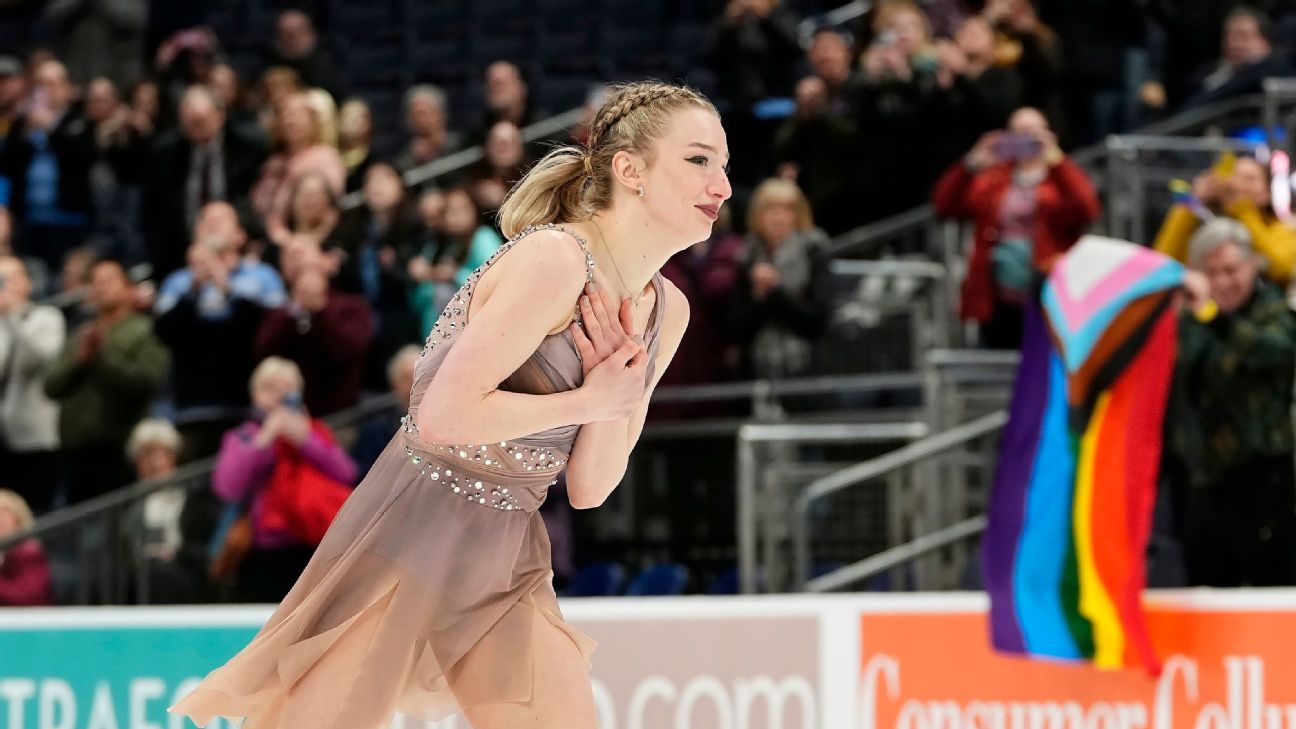
She successfully landed a triple axel for the first time in competition at Skate America in 2023 -- becoming just the sixth American woman to do so -- and won another Grand Prix medal soon after. In January of 2024, she won the national title, becoming the first openly queer woman to win. She displayed the Progress Pride flag on the ice during her victory laps -- and many in the crowd simultaneously displayed their own. Since then, the flag is often seen at events when Glenn competes.
She made history yet again during the 2024-25 season as she won the first Grand Prix title of her career -- recording the highest-ever score for an American woman in the short program and becoming the oldest American to claim her first Grand Prix gold. Then last January, she won her second consecutive U.S. championship, narrowly defeating 2022 Olympian Alysa Liu for the title. While she finished fifth at the world championships in March after a fall on her triple axel in the short program, Glenn's season put her Olympic dreams squarely in her grasp.
THE JOURNEY HAS been transformative -- on and off the ice -- for Glenn.
"[Before coming out], I was always trying to be more delicate or more feminine or try and be what a typical ice princess figure skater is, and that just isn't me," Glenn said. "And funny enough, when I came out, I actually let myself kind of do those things a bit more because I felt comfortable enough to play into my strengths and those got even stronger. So I was able to work on trying to be more graceful without worrying about, 'Oh, but what if I look stupid doing it?' Everything became easier."
With a short program set to Madonna's "Like a Prayer" this season, Glenn is known for her artistry and high-performance quality, as well as her technical abilities. While Liu has also successfully landed a triple axel in competition, it remains rare on the women's side. Glenn was the only woman to successfully perform the skill (in her free skate) at the 2025 world championships.
For Hill, that elusive combination sets Glenn apart from not just her peers, but those who have come before her as well.
"Amber [is] pushing the figure skating sport, specifically the female discipline of figure skating, forward with her commitment to the triple axel and her commitment to the choreography and keeping the performance strong, and still doing the big split jumps and all of these interesting maneuvers," Hill said. "I think there's something special added there. So not to take away from what everyone else has done, but with Amber, she's pushing us all forward."
While the stakes will be high for Glenn as she first takes the ice on Wednesday night, and a third straight national title is certainly among her goals, the competition may also be a celebration. The team selection criteria is based on a skater's body of work from the past two seasons, and not just the result this week, so it's hard to envision a scenario in which Glenn doesn't make the team.
Liu, the defending world and Grand Prix Final champion, has positioned herself as the American front-runner, but there are three Olympic berths up for grabs in St. Louis, and Liu and Glenn are both legitimate medal hopes to end the 20-year Olympic drought.
But Glenn doesn't want to get ahead of herself. Instead, she's trying to appreciate every moment along her improbable journey to the top.
"I don't need to be anything more than what I am and what I'm capable of, and that is enough," Glenn said. "I just want to reach my own potential and that's all. I don't need to reach anyone else's expectations for me, but my own."