
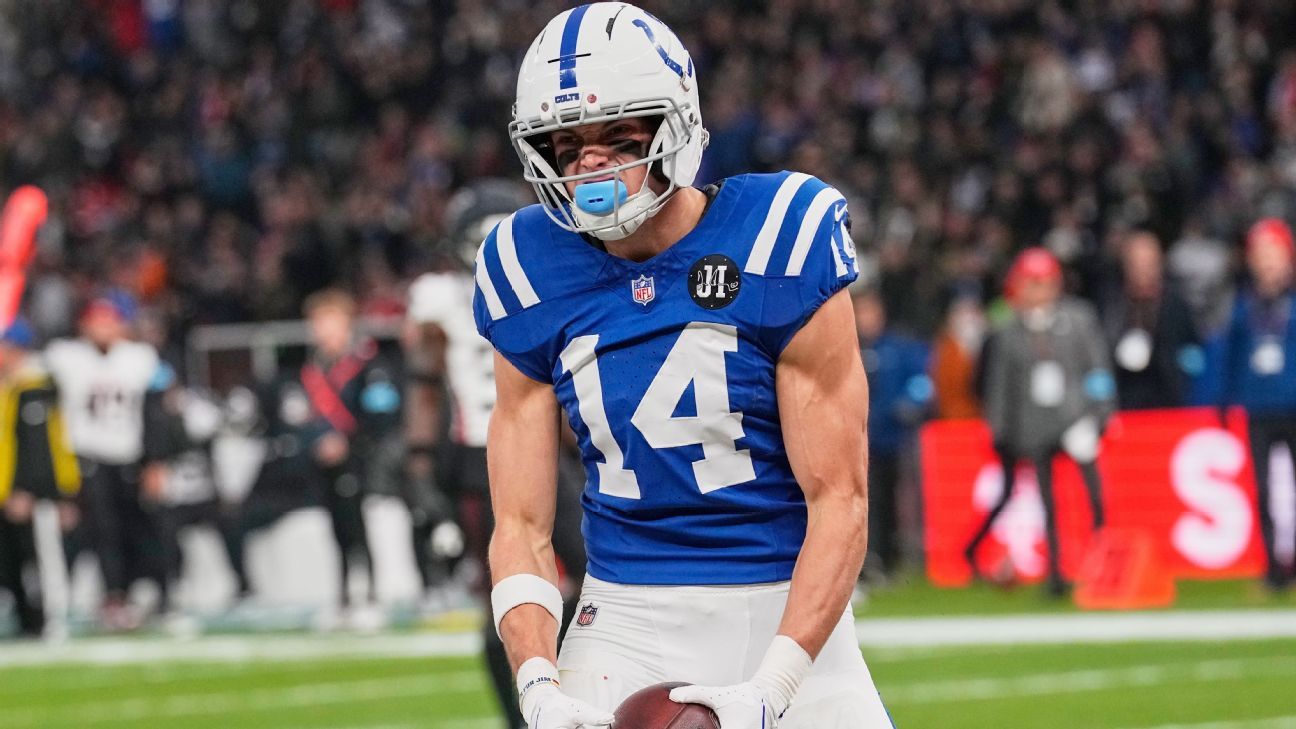
On the final day of the NFL regular season, Tristan H. Cockcroft and I wrote up a final fantasy winners and losers column for the season. There's a lot to check out in there -- fantasy MVPs, busts, breakout games of the year and more -- but looking back on the entirety of the season, there's more analysis to carry into 2026 fantasy draft preparation. Some of it is based on my own philosophies with player evaluations and roster construction, while other takeaways are simply lessons learned from the 2025 season. There are always teaching points... if you look close enough.
Coaching and scheme matter
I view the game through a coaching and deployment lens. It means everything when evaluating talent, while also projecting a player's role in a specific offense. We saw some great examples this season with players finding the right offensive fit through free agency, trades and even a coaching change. Here are my top three:
George Pickens, WR, Dallas Cowboys
The trade to Dallas unlocked the potential (or the upside) of Pickens. With Dak Prescott throwing the ball, in an offense that catered to Pickens' physical tools, the wide receiver was a three-level playmaker this season. He had 291.9 points this season (WR5), catching 93 passes for 1,429 yards and nine touchdowns. Pickens is scheduled to hit free agency this spring, so stay tuned.
Trevor Lawrence, QB, Jacksonville Jaguars
Lawrence played his best football as a pro this season under new head coach Liam Coen. The scheme and dual-threat usage worked in his favor. The tape shows that Lawrence delivered the ball with much more rhythm. Coen's strategy created open voids in the coverage. See it, throw it. And Lawrence was more willing to create as a runner on both designed carries and scrambles. He finished as QB4 in total points (338.18), thanks in part to rushing for nine touchdowns. Lawrence should be mentioned as a fantasy playoff MVP, especially in 2QB and superflex formats, as he was QB1 in scoring (117.94) from Weeks 14 through 17.
Davante Adams, WR, Los Angeles Rams
I was all in on the Rams' addition of Adams via free agency as the No. 2 opposite Puka Nacua in Sean McVay's route tree. Play as the "X" receiver, isolate to win one-on-ones and get loose (consistently) versus press coverage in the red zone. His motions were too sudden, too quick. Adams was a key part of an explosive Rams pass game, leading the league with 14 touchdown receptions (12 in the red zone), and averaging 15.9 PPG (WR9).
A change in my fantasy draft philosophy at QB?
Maybe.
I tend to target quarterbacks with a dual-threat traits, as do most fantasy managers. We want the rushing totals in our lineups, right? It creates a higher ceiling at the position. When healthy, that's Josh Allen, Jalen Hurts, Patrick Mahomes, Lamar Jackson and Jayden Daniels at the top of the list. Seven of the top 10 scorers among quarterbacks this season rushed for at least 300 yards.
But we also saw a group of pocket throwers put up some impressive numbers this season. While the floor is lowered here due to a lack of rushing numbers, the ability to throw for high-level yards and touchdowns can still help you win your league. And these quarterbacks also provide really strong value in drafts if you wait on a signal-caller.
Here are three QBs who played old-school football from the pocket and still finished in the top 12 in scoring at the position:
Matthew Stafford, Rams
Stafford led the NFL with 46 touchdown passes, racking up 20.6 PPG and 350.38 total points (QB3) -- despite rushing for one yard. Yes, one. He's a pure passer with a rocket arm and the pocket mobility to find a new throwing window when the walls start to close around him. Add in McVay's scheme, plus two big-time targets in Nacua and Adams, and Stafford was set up to produce. Stafford's ADP? It was 159.9 (20th among QBs), so he most likely wasn't even drafted in your league.
Dak Prescott, Cowboys
Prescott, who had an ADP of 113.4 (100th overall and 12th among QBs), will still use his legs -- when necessary. He had 177 yards rushing and two scores, but at this stage of his career, Prescott is operating from the pocket and extending plays to throw. The eyes are always up. Prescott delivered the ball with consistent location, throwing for more than 4,500 yards and 30 touchdowns, finishing as QB6 in total scoring (313.78).
Jared Goff, Lions
We can put Goff in this discussion, too. A platform thrower, Goff had six games of 19 or more points this season, finishing with 297.06 total points (QB9). Sure, there is a lower level of upside, but if you play in a deeper league, getting around 18 PPG from your quarterback is a win, and Goff checked in at 17.5. Plus, with an ADP of 138.4 (18th among QBs), Goff was a waiver add or a late-round pick in deep leagues.
Beware of the rookie hype
When I was a rookie with the Rams -- in St. Louis -- I knew only one way to get from my apartment in Creve Coeur, Missouri to the facility. Take I-270 North, then merge onto I-70 for bit before taking the one exit that led me to Rams Park. The end. No short cuts. No faster routes. I always went to the same gas station, too, because I really didn't know the area for the first month of the season. Sure, the vets helped me out, and I eventually started to use some different routes to avoid I-270 during rush hour. It made a difference, too.
So, what's my point? There is a lot going on for rookies outside of just football. They are consistently adjusting to a new environment, a new way of coaching, living, etc. And this league? It's tough. There is a real transition period, one we also need to account for in fantasy football.
I study the tape and write up the rookies every spring, but even I fall for the hype at times. We see the traits and big-play ability. Plus, it just feels right to draft a rookie with the high-end physical tools over that fifth-year vet who tops out as a WR3, right?
But as we look back on the 2025 rookie class, there are some lessons to take into our draft prep for next season.
Only one quarterback, the Giants' Jaxson Dart, finished in the top 15 in PPG at the position. New Orleans' Tyler Shough (12.2) really showed positive development late in the season, while Cam Ward (11.1) started all 17 games for a very poor Titans team, one that went through a midseason coaching transition. But the numbers still tell a story.
The hype we put on this running back class was justifiable. This was a really solid group when focusing on traits and NFL fit. But the Chargers' Omarion Hampton was the only rook to finish top 12 in PPG (15.1), while Ashton Jeanty (14.4), RJ Harvey (12.2), TreVeyon Henderson (12.1) and Quinshon Judkins (12.1) all finished in the RB15-30 range.
At wide receiver, Carolina's Tetairoa McMillan averaged 12.2 PPG (WR22). There were flashes of big-time ability here. Bucs rookie Emeka Egbuka, who got off to a fast start, checked in at 11.5 PPG (WR34).
We did see more juice this season from rookie tight ends Harold Fannin Jr. (11.7 PPG), Tyler Warren (11.1 PPG) and Colston Loveland (10.3 PPG), but all three finished in the TE8-15 range on a per-game basis.
Of course, I'd take all of these rookies in various dynasty formats. There's a lot of future upside with this class. But when focusing on redraft formats, we must understand that immediate results -- and more importantly, consistent results -- aren't guaranteed with first-year pros, even if the fit and opportunity look perfect.
It takes time on Sundays.
Don't follow past narratives
These player narratives, especially the negative ones, can really cloud your judgment at draft time. And if you buy into it, you could miss out on an opportunity to land a solid player. Trust me, I've done it, too, for multiple reasons. However, there were three players this season who altered their perception, changing the narrative, based on a higher level of production.
Kyle Pitts Sr., TE, Atlanta Falcons
Pitts was a late-round pick in most drafts (144.2, 16th at TE). Those who drafted him took a flier on the talent, because we convinced ourselves Pitts would never reach his potential. However, he averaged 12.4 PPG (TE5) and finished as TE2 in total points (210.8) this season. Plus, we all remember the 45.6 points he dropped on the Tampa defense in the Week 15 Thursday night game.
Javonte Williams, RB, Cowboys
Even with the move to Dallas, in a No. 1 role, Williams wasn't among the top 100 players selected in average ESPN drafts. Sure, he finished as RB30 with the Broncos in 2024, and he had the previous knee injury, too. I get it. But we chased more upside with other backs instead of focusing on a healthy Williams in a volume role. He looked explosive and violent with the ball this season, producing 242.80 points (RB12).
Kenneth Gainwell, RB, Pittsburgh Steelers
Gainwell was simply a change-of-pace runner for the Eagles in 2024 (behind Saquon Barkley), and his receiving skill set wasn't utilized in the Philly offense. However, with the Steelers this season, Gainwell surged past rookie Kaleb Johnson (one of my major misses), producing numbers in the pass game as an outlet for Aaron Rodgers. Gainwell finished with 221.30 points (RB16).
Upside targets for the 2026 season
Three players I've studied who have the traits and opportunity to elevate in the 2026 draft ranks. Put these guys on your radar now.
Tyler Shough, QB, New Orleans Saints
From Week 13 to Week 18, Shough had 117.50 points (QB4), and he scored at least 17 in each game during that stretch. He's a timing-and-location thrower in Kellen Moore's system, plus he can create as a runner (186 yards rushing, three touchdowns). While the Saints need to add more offensive pieces this offseason, Shough has the skill set -- and the playcaller -- to jump into the QB1 discussion next season.
Luther Burden III, WR, Chicago Bears
Burden had double-digit points in three of his final four games, including his breakout night in the Week 17 matchup against the 49ers (27.8 points). An easy fit for Ben Johnson's system in Chicago, Burden has shown development as a multilevel route runner with the speed to stretch defenses down the field. Plus, he is an electric mover after the catch. He'll have WR2 upside in an explosive Bears offense next season.
Alec Pierce, WR, Indianapolis Colts
Pierce, who is scheduled to hit free agency this spring, averaged a league best 21.3 YPC. Plus, he had five games with 17 or more fantasy points. A vertical glider with big-play juice, Pierce could benefit from more opportunity/volume and an expanded route tree in 2026 (depending on his landing spot). And I think he has the ceiling to post WR2 numbers.