
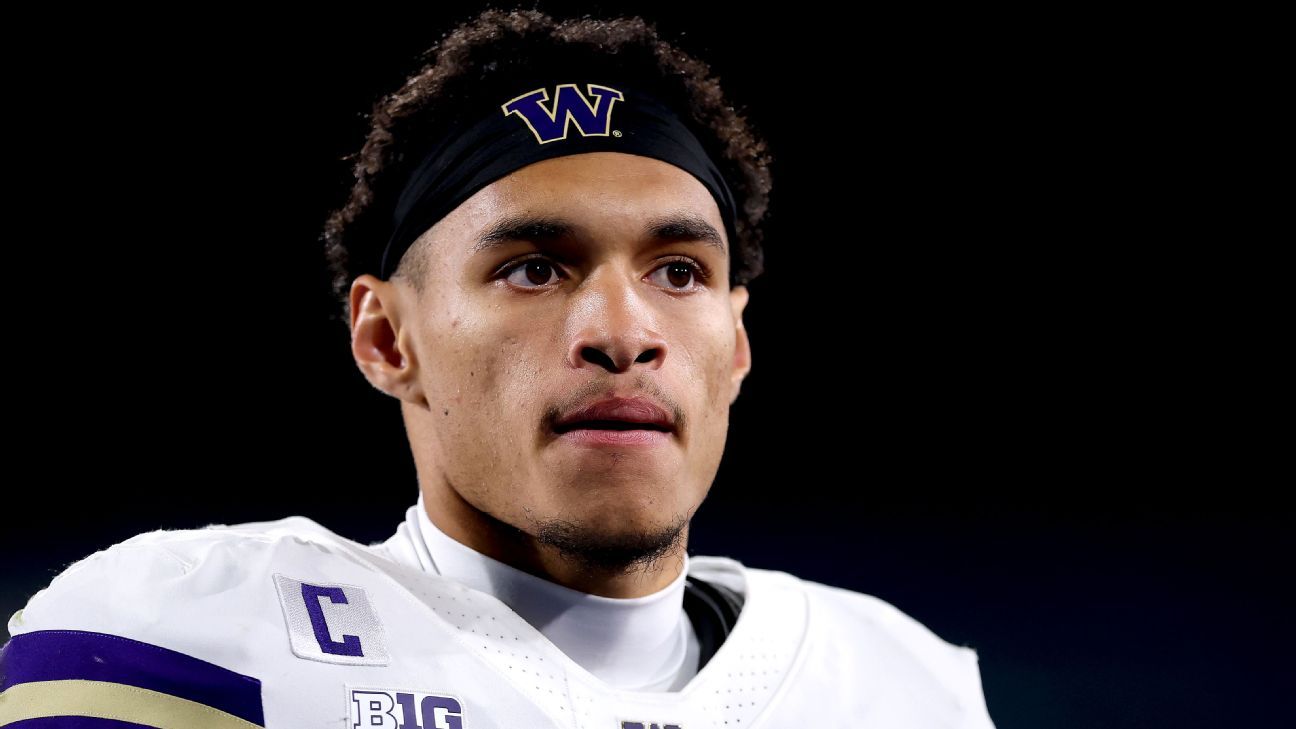
Washington quarterback Demond Williams Jr.'s announcement on Tuesday night that he plans to enter the NCAA transfer portal sent shockwaves through college sports.
Four days earlier, he'd signed a contract to return to Washington, which was set to pay him in the mid-$4 million range and put him near the top the market for college football. Washington continues to pursue legal action, per sources, to enforce the signed contract.
His declaration online to leave became a touchstone for a sport and system where there's already significant skepticism over the viability of signed contracts.
What happens next with Williams will speak volumes over the future of college football, the enforceability of contracts and, in general, provide a bellwether for this new era of college sports.
"This is a very bright line," said a high-ranking college official. "Are we going to respect each other's contracts? This is a very simple thing. If we can't protect this, nothing else matters."
If Demond Williams follows through on his desire to leave Washington -- LSU is the presumptive favorite for his services but others are expected to be involved -- his case will be a litmus test for the rules of a new era. And it will likely end up in court.
The whole situation gets boiled down to a simple point that's been a running issue and embarrassment for college sports: Can contracts actually be enforced?
"This situation is a product of 2026 football," a prominent athletic director told ESPN. "Where the story ends, this is one of the big moments in college football -- or really college sports -- and what we do next."
When initially reached for comment, Demond Williams Sr. -- the QB's father -- declined.
If Williams attempts to leave -- for LSU or another school -- it projects to be a bigger saga than former Tennessee quarterback Nico Iamaleava's departure from Tennessee to UCLA last year.
It's a potentially much higher profile version of the legal fallout -- still unresolved -- from the departure last fall of Wisconsin defensive back Xavier Lucas to Miami.
Wisconsin filed suit against Miami this summer claiming Miami committed tortious interference by knowingly compelling a player to break the terms of his deal with Wisconsin.
Williams is a household name in the Big Ten and among college sports fans, as he threw for 3,065 yards this year and 25 touchdowns. He ran for 611 yards and six touchdowns. Williams was originally committed to coach Lane Kiffin and Ole Miss before flipping to Jedd Fisch and Arizona. He followed Fisch to Washington when Fisch took the head coaching job there in 2024.
"This wouldn't happen in professional sports," said another high-ranking college official. "Things like this seem to show that people think that they can do anything."
The college sports world is watching intently. One general manager at a top program told ESPN on Wednesday: "It's extremely embarrassing the system allows this. There's no stability at all. How are people sitting around watching everything crumble? What are the leaders doing? What are the commissioners doing? How do we not get everyone in a room and not leave until there's a solution."
One veteran head coach added with a chuckle on the lack of oversight: "I don't even know who we turn complaints into."
Washington sources say they are prepared to pursue all legal avenues to enforce Demond Williams' signed contract. The Big Ten has also been engaged on the issue, and the league has been vocal in the past about how critical it is that "agreed-to obligations be respected, honored and enforced." Williams used a traditional agency to do his deal. Sources said that there'd been outreach for more than two weeks from people outside the agency to schools. The agency who did his deal was blindsided by Williams' portal entry.
Per sources, one person who has contacted schools about Williams was Cordell Landers, who generally refers to himself as an advisor and loomed as one of the central figures in Iamaleavea's departure from Tennessee. Landers denied to ESPN he is involved with Williams.
ESPN obtained some details of Williams' Washington contract on Wednesday. There's two items in Williams' signed deal that loom here, as there's a buyout to leave the deal that's at the "sole discretion" of Washington.
The contract also specifically states that "the institution is not obligated to enter the Student-Athlete into the transfer portal or otherwise assist or facilitate the Student-Athlete's transfer to another college or university."
Lucas' move to Miami shows that the portal is not a necessity to move players, but it's another complicating factor.
Williams' case speaks to a larger issue in which contracts around the sport - binding schools to leagues, coaches to schools and players to programs -- are largely ignored.
Generally, Williams' situation illuminates a system with bigger issues, including not having any single entity in charge of the inter-workings of the contracts in a multi-billion-dollar business. The Williams contract issue does not fall under the purview of the new College Sports Commission, which handles third party NIL deals to meet settlement rules, revenue share from schools in relation to the cap and roster limits.
The NCAA deals with tampering, which could be at play here. The issue with tampering is it has become mainstream in college athletics and so prevalent it's nearly impossible to enforce. Modern legalities have complicated that enforcement, as a federal judge's ruling in Tennessee in February of 2024 made the NCAA's role in enforcing tampering more complex.
The cries for rules are even more complicated. The lawsuit that led to that ruling was filed Jan. 31, one day after Tennessee chancellor Donde Plowman revealed in a letter to the NCAA that the school's was being investigated.
The cries for rules are even more complicated. The lawsuit that led to that ruling was filed Jan. 31, one day after Tennessee chancellor Donde Plowman revealed in a letter to the NCAA that the school's was being investigated.
While there's cries for reform, there's inherent resistance when the rules land on a school's doorstep.
Suddenly, Williams' situation has emerged as a flashpoint for a system that's flawed.
"This is very important moment in our space," said one high ranking official, "about how we're going to behave."
ESPN's Max Olson contributed to this report.