
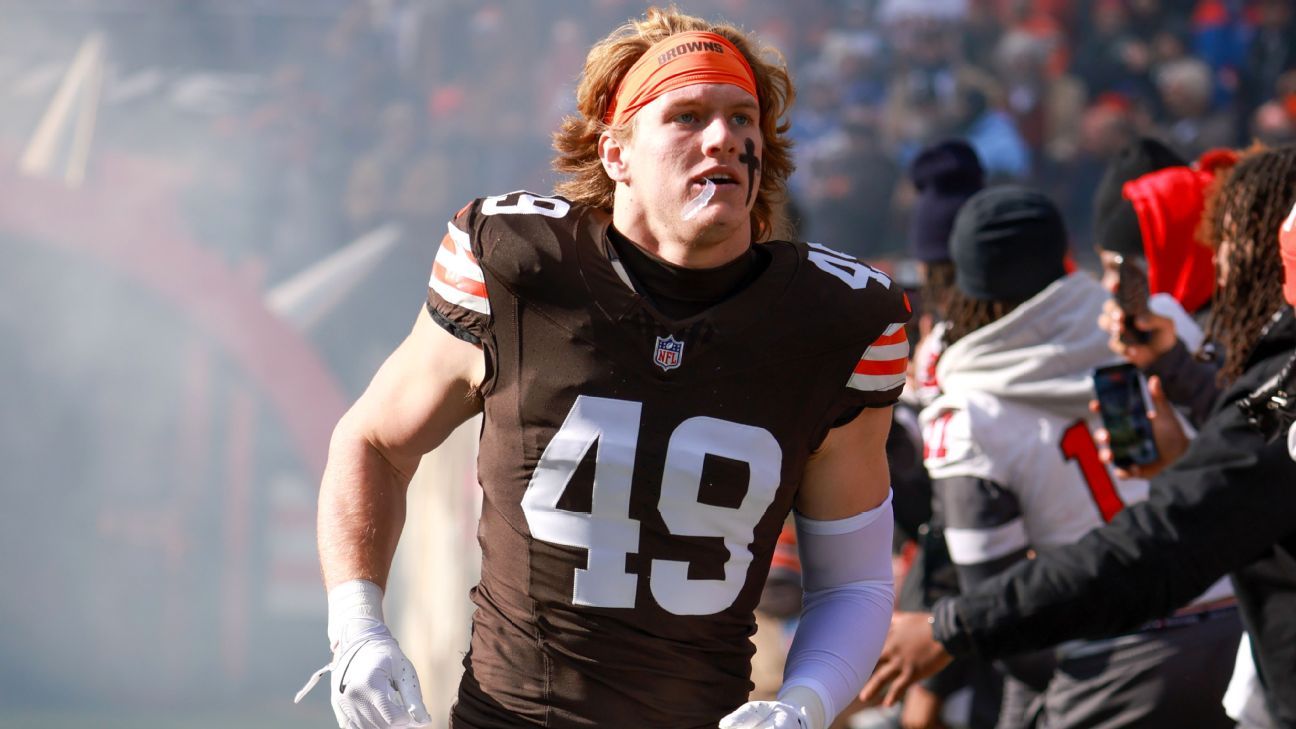
With one week and only a few meaningful regular-season games left in the 2025 NFL regular season, it's the right time to summarize some seasonlong performances. MVPs and All-Pro lists will be debated for the next month, but I wanted to build first- and second-team All-Rookie rosters to highlight standout debut seasons before the playoff field is set and we turn our eyes to the race to Super Bowl LX.
Before we get into the picks, a few considerations:
All rookies make bad plays. Every single player on this list has made massive mistakes this season. You could easily cut up a lowlight montage that would make me look like an idiot for calling Carson Schwesinger the no-brainer Defensive Rookie of the Year. This list is largely based on the bulk of positive plays, and peak performances are weighed fairly heavily. Optimism is fun with rookies. Believe a little bit!
Late-season production is weighted heavier, but early-season performance is not discarded. Should Tyler Shough be penalized for failing to beat out Spencer Rattler in camp, or for quieter performances before his recent surge in production? Probably not. Should Emeka Egbuka be docked for dominating early but losing his starting job to Jalen McMillan over the past month? Still probably not. It's easy to trick ourselves into thinking development is linear, and that the past three games we've seen from a rookie are predictive of his next three (and rest of his career). Anyone who woke up from a coma on Thanksgiving would put Shough above Cam Ward on their list and would have Egbuka as a third-team rookie receiver. I did neither, because September and October still matter to me.
Snap counts matter (kind of). The most productive rookie pass rusher at defensive tackle this season was the Cardinals' Walter Nolen III, who had 13 pressures on just 93 pass-rush snaps before being placed on the PUP list before Week 17. Are 93 pass-rush snaps enough to confidently put Nolen on this list over players with more than twice as many reps? I don't really know the answer. Earning snaps is a skill, though it's more significant for some teams (such as the loaded Eagles) than others (such as the Browns, who are handing out rookie snaps like there's no tomorrow). Being healthy and available is critical for rookies -- it is the best predictor of future development. So I tried to acknowledge and credit Week 1 starters while also giving nods to players with smaller roles, whether for depth chart concerns or injury absences.
With that out of the way, here are my first- and second-team All-Rookie rosters.
Jump to a position:
QB | RB | WR | TE | OL
Edge | DT | LB | CB | S
Quarterback
Cam Ward, Tennessee Titans
2025 stats: 320-for-537 passing (59.6%), 3,117 passing yards, 15 touchdowns and 7 interceptions; 148 rushing yards, 1 touchdown
Drafted: Round 1, No. 1
Shough finished the season strong for the Saints, but in terms of quality of film, Ward still has him in seasonlong excellence. Ward's advanced metrics, such as EPA or success rate, all show a passing game suffering league-worst levels. But the Titans' wide receivers room has dealt with injuries, drops and general dysfunction -- and the same is true of their offensive line. Ward has demonstrated tremendous resiliency and creativity through it all.
A supercut of Ward's best throws stands up with those of Drake Maye, Caleb Williams, Jayden Daniels, C.J. Stroud and a slew of other quarterbacks during their own rookie seasons. All of those passers' peak plays foretold strong ensuing seasons. Ward is at his best pushing the ball down the field aggressively, and he has the arm talent, post-snap processing and sharp timing to access high-difficulty throws in the structure of the offense. Undeterred by safeties, Ward will rip throws to the seam with Dak Prescott-esque accuracy and boldness.
Now, Ward will put the ball in danger and must become more willing to find his checkdown and live for another play, but it is far preferable to have a quarterback capable of such throws and dial him down than it is to draw such throws out of a QB naturally averse to them. Ward's rookie season has been clear proof of concept for his potential as an above-average NFL starting quarterback.
Second team: Tyler Shough, New Orleans Saints. Shough became the betting favorite to win Offensive Rookie of the Year after leading the Saints' come-from-behind win over Ward and Tennessee in Week 17. I kind of get it -- the Saints have won their past four games, and Shough has looked better with each passing week. But while I see quality play from Shough, I don't see the sort of jaw-dropping, math-changing potential I see in Ward.
Shough has checked every box you could hope for out of a rookie: poise, creativity, execution of the offense, a short memory for mistakes. He needs to cut down on the sacks and sprays, but he looks like a clear hit for general manager Mickey Loomis and a Saints team in need of a rookie contract starter at quarterback.
Running back
TreVeyon Henderson, New England Patriots
2025 stats: 168 carries for 858 rushing yards (5.1 yards per carry) and 7 touchdowns; 35 receptions for 221 yards and 1 touchdown
Drafted: Round 2, No. 38
On a down-to-down basis, Henderson has not been as consistent as several other rookie backs this season. He misses lanes as a runner, and despite his reputation as an elite pass protector, he has some errors in that capacity. With that said, the way he creates yardage with the ball in his hands is simply impossible to ignore. Henderson is a walking home run in both the handoff and checkdown game, and that profile of missed tackles and hidden yardage created tends to expand a player's role over his career. For the peaks, Henderson gets my nod.
Second team: Quinshon Judkins, Cleveland Browns. It is agonizing to decide between Judkins, Kyle Monangai, Ashton Jeanty, Omarion Hampton, RJ Harvey, Cam Skattebo and Woody Marks for one second-team spot. Each of them was solid in some ways and disappointing in others. I gave the nod to Henderson's college teammate, Judkins, because he ran tough and minimized negatives behind a floundering offensive line and without any supporting passing game to create space for him.
Judkins, Skattebo and Hampton are the three who stand out on film with consistent positive plays. Still, this is a tough pick.
Wide receiver
Tetairoa McMillan, Carolina Panthers
2025 stats: 66 receptions for 922 yards (14.1 yards per reception) and 7 touchdowns
Drafted: Round 1, No. 8
The favorite for Offensive Rookie of the Year before he was held to just one catch against the Seahawks, McMillan needs 71 yards in Week 18 to clear 1,000 on the season -- an impressive milestone for any rookie receiver, and doubly so with Carolina's inconsistent quarterback play. McMillan is showing the physicality and catch radius that was promised of him when he was coming out of Arizona, and his route running has really shined as NFL-caliber despite his supersized frame. He looks the part of a three-level X receiver who can win over the middle of the field just as frequently as he wins jump balls against the sideline -- a Courtland Sutton-type of pass catcher.
Emeka Egbuka, Tampa Bay Buccaneers
2025 stats: 62 receptions for 930 yards (15.0 yards per receiver) and 6 touchdowns
Drafted: Round 1, No. 19
Egbuka was far more productive in the first half of the season (34 catches, 562 yards, five touchdowns) than in the second (28 catches, 268 yards, 1 touchdown). But the entire Buccaneers offense experienced a downswing, and Egbuka still looks as detailed and smooth as ever on film. An ideal do-it-all receiver who can provide value as a blocker, a downfield threat and everything in between, Egbuka is the lone rookie to stand next to McMillan as a potential No. 1 receiver after one pro season.
Luther Burden III, Chicago Bears
2025 stats: 44 receptions for 617 yards (14.0 yards per reception) and 2 touchdowns
Drafted: Round 2, No. 39
It took time for Burden to get a foothold in Ben Johnson's thick and detailed playbook, but as the game has slowed down for him, he has cashed in on his opportunities and carved out a bigger role, culminating with his career-best 138-yard performance Sunday night against the 49ers. Burden has run at least 16 routes in every game since the Bears' Week 5 bye after never running more than 12 before it. In seven games post-bye, he has snagged 31 of 41 targets for 446 yards -- that's a 17-game pace of 75 catches on 100 targets for 1,083 yards.
Burden is a sudden movement player who can win on the outside, in the slot and with designed touches behind the line of scrimmage. He's still more of a screen/checkdown option than a downfield target, but that part of his game will come as he improves his play strength. With only two drops this season, Burden has earned more downfield opportunities entering Year 2.
Second team: Chimere Dike, Tennessee Titans; Pat Bryant, Denver Broncos; and Jayden Higgins, Houston Texans. Dike gets an additional boost for his return ability -- he set a record for all-purpose yards in a rookie season! Higgins has come along late and wonderfully so for an ascending Texans offense, while Bryant's contested catch and blocking abilities shine -- two traits in which rookie receivers often struggle.
Tight end
Harold Fannin Jr., Cleveland Browns
2025 stats: 72 receptions for 731 yards (10.2 yards per reception) and 6 touchdowns; 1 rushing touchdown
Drafted: Round 3, No. 67
You're forgiven if you haven't been dialed in to the season Fannin is having in Cleveland. He has emerged as a unique threat as a movement piece in Cleveland's offense by creating huge hidden yardage with broken tackles on screens and jump balls over the middle of the field. Fannin is only the ninth tight end since the merger with 700-plus receiving yards in his rookie season.
Fannin already has some of the best change-of-direction skills at the position, and his instincts as a tackle breaker are excellent. It's fair to expect him to become a Sam LaPorta-esque producer, and his ceiling is in the range of Trey McBride and prime Travis Kelce as team-leading target-getters who can be used at all three levels of the field.
Second team: Colston Loveland, Chicago Bears. I had the Colts' Tyler Warren in this spot until Sunday night, when Loveland posted a quality six-catch, 94-yard performance. It's razor thin between the two first-rounders. Were it not for Warren's quarterbacking situation going down the drain, he'd likely still take this spot. Loveland has the edge as a blocker and catcher outside of his frame, while Warren wins as a tackle breaker and has a greater variety of routes in his bag. Both look like bona fide No. 1 tight ends and game-plan-worthy playmakers.
Left tackle
Kelvin Banks Jr., New Orleans Saints
2025 stats: 16 starts, 87.7% pass block win rate, 76.1% run block win rate
Drafted: Round 1, No. 9
One of the quieter first-round picks, Banks has slid easily into New Orleans' left tackle spot and taken on a veteran's workload with aplomb. Rarely given tight end or chip help, Banks has been an above-average pass protector and has the quickness and flexibility that elite pass protectors often have. Those movement skills translate into the running game, where Banks has been a high-impact blocker as a puller and climber. The Saints got a good one.
Second team: Josh Simmons, Kansas City Chiefs. I don't think Simmons would have knocked Banks out of the first-team spot if he had been healthy the whole season, but it sure would have been close.
Left guard
Grey Zabel, Seattle Seahawks
2025 stats: 16 starts, 89.2% pass block win rate, 83.1% run block win rate
Drafted: Round 1, No. 18
Zabel would be the overall No. 1 offensive lineman on this All-Rookie team if positions were removed from the equation. He has been a little less consistent since his Week 11 knee injury, but his steadiness in pass protection before the injury looked like that of a 10-year veteran. Zabel has rarely been beat clean this season, and when it has happened, it has been by some of the league's best. If Zabel had the name recognition of a vet, he would have been a Pro Bowler this season.
Second team: Dylan Fairchild, Cincinnati Bengals. One of the least-known rookies on this list, Fairchild has gotten better each week and makes splash blocks with impressive quickness and core strength for his size. He was a developmental player coming out of Georgia and looks to be ahead of his curve. He's a nice middle-round find for the Bengals.
Center
Jonah Monheim, Jacksonville Jaguars
2025 stats: Two starts, 95.1% pass block win rate, 77.8% run block win rate
Drafted: Round 7, No. 221
Haven't heard of Monheim? I don't blame you. The seventh-round pick has played 187 snaps at center this season, which is ... 162 more than second place. For those 187 snaps, he is our first-team center. (The film against the Colts this past Sunday was ... not great!)
Second team: Drew Kendall, Philadelphia Eagles. Kendall has played 25 snaps at center, which gives him the slight edge for No. 2 center on the All-Rookie team over Seahawks rookie Bryce Cabeldue, who has played ... six snaps.
Right guard
Tyler Booker, Dallas Cowboys
2025 stats: 13 starts, 93.7% pass block win rate, 76.0% run block win rate
Drafted: Round 1, No. 12
Booker moves people. It's a sight to see. He's already one of the most imposing guards in the downhill running game, and while his sheer size will always create some disadvantages on the move or against quick pass rushers, he's much better in pass protection than expected for a rookie of his heavy-footedness. In Booker's best games, he has been a key engine of the Cowboys' offensive success, and that will continue for years to come.
Second team: Tate Ratledge, Detroit Lions. Ratledge has been about as good as you'd expect for a second-round offensive lineman. The shaky play around him has limited his ceiling, but he's a clear starter for the duration of his rookie contract.
Right tackle
Armand Membou, New York Jets
2025 stats: 16 starts, 91.7% pass block win rate, 79.6% run block win rate
Drafted: Round 1, No. 7
It hasn't been perfect for Membou, who occasionally gets beat clean or suffers a rookie mental lapse. But snap to snap, there's a solid floor and a high ceiling in pass protection for Membou, who has tremendous grip strength and the reach to catch and control speedy rushers. The Jets' best runs and screens have often come to the offensive right on the back of Membou's ability to uproot defensive linemen and carve out running lanes. He's an impactful player.
Second team: Josh Conerly Jr., Washington Commanders. Conerly was getting worked in the first month of the season but found his sea legs as of late. If he can continue this developmental arc into Year 2, the Commanders will be set at right tackle throughout his rookie deal.
Edge rusher
Abdul Carter, New York Giants
2025 stats: 43 tackles, 4 sacks, 2 forced fumbles, 2 fumble recoveries
Drafted: Round 1, No. 3
My All-Rookie team is not particularly concerned with attending team meetings on time or paying attention while in them; we just like good players on the football field, and Carter sure is one. He is first among all defensive linemen in quick pressures with 44, and his time to pressure of 2.41 seconds is leaps and bounds above second place (2.57 seconds) among edge rushers. Carter must learn how to convert his incredible first step into more targeted rushes that end with sacks, but the bones of his play are tremendous. He looks like a future double-digit sack artist.
Jalon Walker, Atlanta Falcons
2025 stats: 33 tackles, 5.5 sacks, 2 forced fumbles, 1 fumble recovery
Drafted: Round 1, No. 15
Walker was a tweener coming out of Georgia but has spent 90% of his snaps on the edge -- and to great effect. His football IQ leaps off the film, as he regularly sees blocks developing fast enough to slip, shed and create havoc in the defensive backfield. Pound for pound, the 6-foot-2, 245-pound Walker is tough to uproot and has more power as a pass rusher than expected. His ability to drop into coverage is also integral to defensive coordinator Jeff Ulbrich's pressure packages. Walker is a high-impact player for his dirty work in the margins.
Second team: Donovan Ezeiruaku, Dallas Cowboys; and James Pearce Jr., Atlanta Falcons. Ezeiruaku looked a bit like a luxury pick in April, but once Micah Parsons was traded to Green Bay in August, he suddenly became a key part of Dallas' rotation. Ezeiruaku has the tools of a productive outside pass rusher, but it's his play against the run at 6-foot-2, 248 pounds that really impresses. Ezeiruaku is behind only Carter among rookie edge rushers in run stop EPA and has eight tackles for zero yards or negative gain on the season.
Pearce is the sack artist he was billed to be in the leadup to the 2025 draft, leading all rookies with 8.5 sacks. His blistering 2.66-second time to pressure is ninth among all edges and third among all rookie edges, and he creates immediate opportunities for sacks with that wicked first step. Pearce is almost purely a pass-rush-down player at this point and struggles to hold the point of attack in the running game, so an offseason in the weight room is needed for him to become an every-down performer.
Defensive tackle
Deone Walker, Buffalo Bills
2025 stats: 39 tackles, 1 sack, 1 forced fumble, 12.5 run stuffs
Drafted: Round 4, No. 109
Once a prospective first-rounder thanks to his truly elite size (and great movement skills at 6-foot-7, 331 pounds), Walker fell in the draft after a poor final season at Kentucky. Buffalo struck gold when it took the risk in Round 4. Walker regularly takes on two blockers at the line of scrimmage, creates tackle-for-loss opportunities and makes high-effort pursuit plays into the boundary. He has also found more quick wins as a pass rusher than I expected. He'll get his hands into passing lanes, too -- and at his size, that's a big impediment for opponent QBs.
Elijah Roberts, Tampa Bay Buccaneers
2025 stats: 13 tackles, 2 sacks, 1 fumble recovery, 3 passes defensed
Drafted: Round 5, No. 157
A fifth-rounder out of SMU, Roberts was not a big part of the rotation until Calijah Kancey went down with a torn pectoral in Week 2. Roberts has answered the call wonderfully. A college defensive end who is transitioning to defensive tackle, Roberts sometimes loses ground in the running game and needs some weight room work in the offseason. But he's slippery, with active hands and good lateral quickness. For a fifth-round rookie undergoing a positional switch, he has been very impressive.
Second team: Mason Graham, Cleveland Browns; and Walter Nolen III, Arizona Cardinals. If I did this list at the midway point of the season, Graham would not have made it. He was getting moved with ease in the running game and was providing little impact as a pass rusher. He overcame the rookie hump in the second half of the season, collecting 19 pressures in eight games after the Browns' bye relative to 11 pressures in the eight games before it. Graham still needs to be better when engaged -- he struggles to shed blocks without giving up ground -- but he is creating more quick wins, which is what the Browns drafted him to do.
Several defensive tackles played more snaps and had flashier plays than Nolen (such as the Steelers' Derrick Harmon, Dolphins' Kenneth Grant, Chargers' Jamaree Caldwell and Dolphins' Jordan Phillips). But Nolen's limited film is so good and so disruptive that I have to give him the nod over the field. A healthy sophomore season from Nolen could lead to eye-popping tackle-for-loss and pressure numbers given how naturally he won as a penetrator as a rookie.
Linebacker
Carson Schwesinger, Cleveland Browns
2025 stats: 159 tackles, 2.5 sacks, 2 interceptions, 13 run stuffs
Drafted: Round 2, No. 33
The easy pick for Defensive Rookie of the Year, Schwesinger is all that and a bag of chips. He is fast, physical, slippery, quick to see plays unfold, nimble, savvy before the snap, a great tackler on the move, improving as a zone dropper, productive around the football, aggressive in seeking splash plays and overall just really instinctive. He was dropped in an ideal run-and-chase system in Cleveland, but the alacrity with which he got up to NFL speed was something to see. Tackle stats are generally unreliable, but Schwesinger is one of five rookie linebackers this century with 150-plus tackles, 10-plus tackles for loss and 2-plus passes defensed. The other four are Kiko Alonso, Luke Kuechly, Shaquille Leonard and DeMeco Ryans. Good group.
Jihaad Campbell, Philadelphia Eagles
2025 stats: 70 tackles, 2 passes defensed, 2 run stuffs
Drafted: Round 1, No. 31
It's a little tricky to give a first-team nod to Campbell, who was pretty resoundingly removed from the starting lineup once Nakobe Dean returned from injury and regained his old form. From Weeks 12 to 15, Campbell played 26 total defensive snaps. But his film is still pretty good! And now that Dean is hurt again, Campbell is back to a full menu of snaps. Campbell makes bad rookie mistakes against misdirection and in coverage, but his peak plays of explosive speed, stopping power and turnover creation are a sight to see. He just ekes out the first-team selection ahead of the second-team picks below.
Second team: Teddye Buchanan, Baltimore Ravens; and Cody Simon, Arizona Cardinals. Buchanan wrested the starting job from incumbent Trenton Simpson early in the season and proved an impactful coverage player before a Week 15 ACL tear ended his rookie year prematurely. Buchanan could struggle against the league's more complex running games, but he was playing faster as the season went on, and his ability to cover ground in space minimized easy yardage for opposing offenses.
Simon is a bit of a "best of the rest" nod. He has been up and down when thrust into the starting lineup because of injuries ahead of him on the depth chart, but the rest of the field has been a lot more down than up. The Bengals, who are starting two rookie linebackers, would do anything to have a player like Simon in their building right now.
Cornerback
Will Johnson, Arizona Cardinals
2025 stats: 37 tackles, 10 passes defensed, 1 forced fumble
Drafted: Round 2, No. 47
Johnson's advanced metrics aren't great, and he has gotten cooked by some top receivers, but that's the reality of playing corner in the NFL. The body of work on film is still quite good. Johnson is an impressively fluid mover at his length and would benefit from a scheme that allows him to play closer to the line of scrimmage when tasked with man-coverage responsibilities. Johnson needs to stay healthy, but I'm willing to bet on his physical profile on a healthier defense for seasons to come.
Quincy Riley, New Orleans Saints
2025 stats: 31 tackles, 1 interception, 8 passes defensed
Drafted: Round 4, No. 131
A fourth-round pick out of Louisville, Riley got his first significant action in Week 3 and his first start in Week 5. But he took the starting job with both hands and refused to give it back. A sticky downfield corner with surprising physicality, Riley has impressive production at the catch point despite his size (5-foot-11, 195 pounds), detailing a highly encouraging future. Riley was only the No. 3 corner for the Saints this season and had some classic rookie mental snafus, but with Alontae Taylor being a rising free agent in 2026, Riley might end up a starter in all packages next season. He has earned it.
Second team: Denzel Burke, Arizona Cardinals; and Maxwell Hairston, Buffalo Bills. Burke has provided the ball production for the Cardinals' rookie cornerback duo, with three interceptions and 11 passes defensed on 52 targets. His ballhawk rate of 21.2% is 11th among all corners this season, rookie or otherwise, per NFL Next Gen Stats. Some of Burke's ball production has been fortuitous, and he did give up a 20-yard completion to an offensive lineman this week. But even with the warts in run support and issues tackling in space, Burke's production at the catch point is too valuable to ignore.
Hairston has 156 coverage snaps this season, which is just enough to qualify (it's a made-up list, there are no real rules). Hairston has the speed, ball-tracking ability and ball skills of a true No. 1 cornerback with shadow ability, though his play is predictably up and down for a rookie who missed training camp. His lack of bulk will also be exposed by physical receivers and in run defense. Hairston barely beats out two more physical corners -- Nohl Williams (Chiefs) and Azareye'h Thomas (Jets) -- who have fewer splash plays. But man, both of those guys looked great, too. This is a good cornerback class.
Nickel
Jacob Parrish, Tampa Bay Buccaneers
2025 stats: 73 tackles, 1 interception, 6 passes defensed, 2 sacks, 5 run stuffs
Drafted: Round 3, No. 84
Parrish has had a prototypical rookie season: a splash play here, a brutal rep there and a whole lot of vacillation in between. His film shows quickness, physicality and willingness to make plays against the run when facing bigger bodies. Parrish has the Bucs' nickel job secured and should see his play smooth out over time, but for a third-round pick thrust into immediate starting action, his season was far more good than bad.
Second team: Upton Stout, San Francisco 49ers. Stout is a perfect fit in the 49ers' secondary under Robert Saleh. Ferocious and undeterred, Stout will stick his nose into the fan with reckless abandon, regularly creating splash plays along with solo tackles in run support. Stout needs to play with faster eyes and feel in coverage, but he did well to minimize yards after catch with his tackling ability. The peaks are very impressive, and if the game slows down for him, he'll generate a lot more forced incompletions
Safety
Jonas Sanker, New Orleans Saints
2025 stats: 78 tackles, 2 interceptions, 6 passes defensed
Drafted: Round 3, No. 93
One of my favorite rookies independent of position or draft capital, Sanker has shined in Brandon Staley's defense as a premier communicator and coverage player. He takes great angles, rarely false steps and doesn't get fooled by route distributions. Sanker looks like a 10-year vet but has the spry legs of a rookie, which allows him to make plays sideline to sideline. Sanker is also a reliable tackler at the third level and prevents explosive runs from becoming house calls. He is a rising star to watch.
Nick Emmanwori, Seattle Seahawks
2025 stats: 74 tackles, 1 interception, 11 passes defensed, 2.5 sacks, 5.5 run stuffs
Drafted: Round 2, No. 35
For as fun of a debut season as it has been, Emmanwori gets billed as a fusion between Kam Chancellor and Kyle Hamilton, which is a little too rich for my blood. But he is a highly disruptive player with length, closing speed and a nose for the football. He rarely misses tackles given his length and play strength, and he can rip through blocks to produce behind the line of scrimmage as well. On blitzes, Emmanwori is a true playmaker who must be accounted for at all times. Another offseason of work on coverage instincts and play recognition is needed for a player mostly operating on feel right now, but his ceiling is through the roof in that regard.
Second team: Xavier Watts, Atlanta Falcons; and Malaki Starks, Baltimore Ravens. There were three great safety seasons from rookies, and only two first-team spots. Watts was easier to slot into the second team before his two-interception performance on "Monday Night Football" -- he now leads all rookies with five interceptions. Watts has tremendous feel for route combinations and spacing, which allows him to anticipate route breaks with unreal quickness. Doubly impressive is Watts' ability to play on the roof and in the box. He also has a sky-high ceiling.
It has been a great safety year, and Starks would be a first-teamer in many other seasons. A true center fielder, he doesn't see the ball often but tracks it well and addresses it at the highest point when it's in the air. He doesn't experience mental lapses as often as expected for a rookie, especially in the Ravens' tricky defense. Starks barely gets the nod over Malachi Moore, a fourth-rounder who has brought impressive physicality to the box for a Jets defense in need of tone-setters. Moore is one to watch as well.