
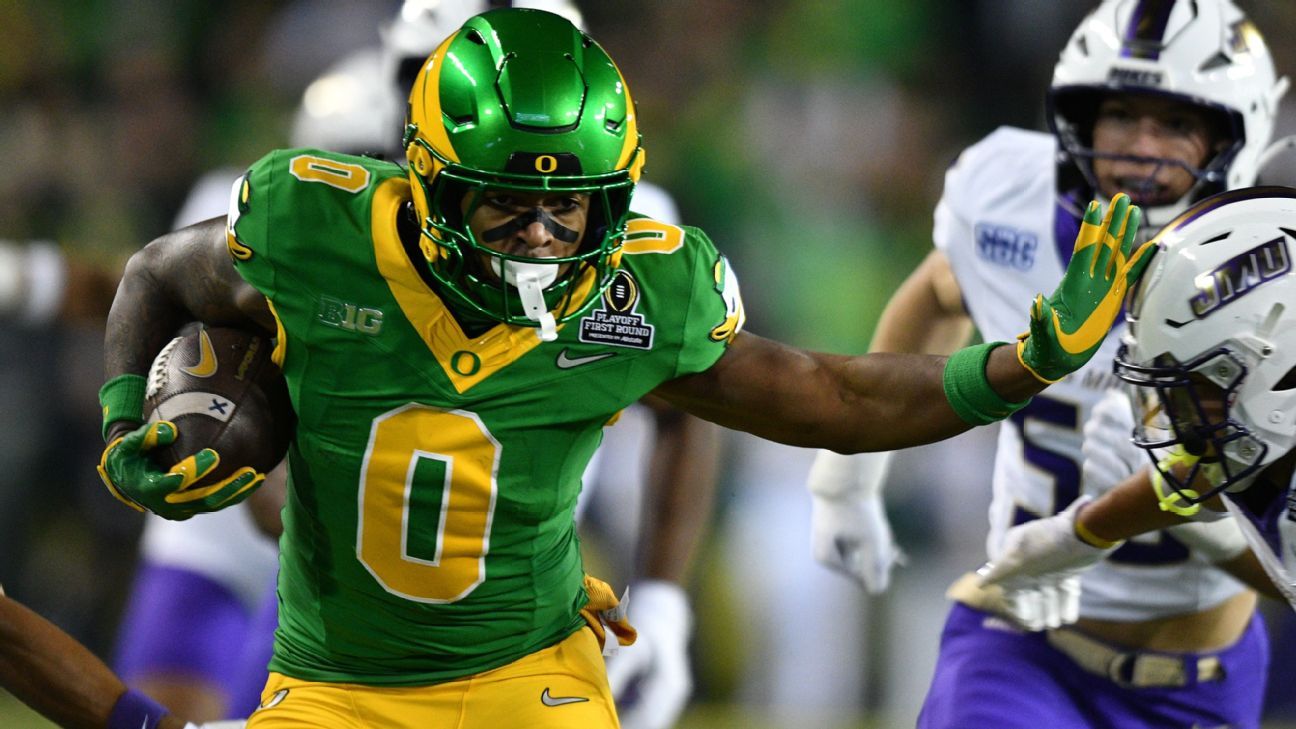
A rematch of one of the most contentious national title games of the 2000s (Miami-Ohio State). A rematch of a fun October track meet (Georgia-Ole Miss). A battle between new-ish money (Oregon) and new money (Texas Tech). A classic matchup between a proven, unbeaten powerhouse (Indiana) and a scrappy close-game-winning underdog (Alabama, somehow).
The quarterfinals of the College Football Playoff kick off Wednesday evening in Arlington, Texas, and they feature something for everyone. They could produce semifinals between four of the sport's biggest brands or they could give us a huge dose of new-brand energy. They should give us at least a couple of classics.
Here's everything you need to follow for what sure looks like a dynamite round of games.
Updated CFP projections
We had two minor upsets in the first round, with two road teams (Miami and Alabama) advancing for the first time. But the overall title odds didn't change all that much from an SP+ perspective.
Ohio State and Indiana still lead the way, and the Texas Tech-Oregon winner will be the No. 3 favorite, barring an upset in Arlington or Pasadena.
No. 2 Ohio State vs. No. 10 Miami
Goodyear Cotton Bowl Classic: Wednesday, 7:30 p.m. ET, ESPN
The 2003 Fiesta Bowl was the first classic title game of the BCS era. Miami, a 12-point favorite, was looking for both its second straight national title and 35th straight win, but Ohio State ripped off a 17-0 midgame run, benefited from maybe the most talked-about pass interference penalty in the sport's history and won a shocking two-overtime thriller.
This time, Ohio State is the defending champ and a nearly double-digit favorite. Will we remember this one for the 23-year revenge, or will it end up simply as a step in another Buckeyes title march?
Ohio State's 3 biggest plays of 2025
As we did with the first-round preview, let's look at the biggest plays of the season for each team -- in terms of win probability added -- this time, for the teams that had first-round byes.
1. Week 14 vs. Michigan: Julian Sayin's 35-yard touchdown pass to Jeremiah Smith on fourth-and-5 (11:51 left in the second quarter). Win probability added: 16.4%.
2. Week 5 vs. Washington: Sayin's 18-yard touchdown pass to Smith (1:14 left in the second quarter). Win probability added: 15.2%.
Ohio State began the season with a tight win over Texas and finished with a tight loss to Indiana. In between, the Buckeyes won 11 games by an average of 39-8. They haven't faced many close-and-late situations, as exemplified by the fact that the first two plays on this list happened in the second quarter.
Still, these were a couple of good "When in doubt, throw to Jeremiah" moments. In the former, Ohio State trailed 6-3 after a slow start, but Smith's TD -- a little controversial, as it looked as if he might have fumbled -- gave the Buckeyes a lead they wouldn't relinquish in a 27-9 win. In the latter, the Buckeyes again had to work past a slow start in Seattle. They trailed 3-0 near halftime, but Smith came open on a little drag route and burst into the end zone.
The Buckeyes cruised 24-6.
3. Week 15 vs. Indiana: Brandon Inniss' 6-yard pass to Bo Jackson, with a 15-yard Indiana personal foul penalty (4:43 left in the fourth quarter). Win probability added: 13.1%.
Trailing Indiana 13-10 in the Big Ten championship game, Ohio State had two chances to tie or take the lead, and after the first opportunity was thwarted by a fourth-and-1 stop of Sayin, the Buckeyes ended up playing things far too conservatively. After this gadget play (and penalty) spiked the Buckeyes' win probability to 54.8%, they ended up attempting a fourth-and-1 field goal attempt and missed it.
Can Ohio State remove the guardrails?
Ryan Day and his staff had all the perfect ingredients for easing Sayin in at quarterback. The redshirt freshman, a former top-10 recruit, has already shown preternatural accuracy and solid decision-making, but with both the best defense and best receiver duo in the country (Smith and Carnell Tate), plus high-efficiency tight end Max Klare at his disposal, he was able to work at the slowest possible tempo, throwing mostly short and controlled passes, tossing the ball away at the first sign of trouble and knowing someone would eventually make a play.
Sayin's trait radar chart hints at just how controlled his play has been.
He doesn't throw a ton of downfield passes, and he's good at leaving the pocket and finding an open safety-valve option before pressure gets to him. And his seasonlong numbers are dynamite: 78.4% completion rate (first in the nation), 3,323 passing yards (15th) and 31 touchdowns (second). Sayin was brought up to become a big-time quarterback, and he knows all of the if/then decisions. But instead of quick throwaways, he might have to force the issue more for Ohio State to win three playoff games, and Day and his staff might have to put more trust in him -- no more fourth-and-1 field goal tries.
Though the Hoosiers allowed Sayin some easy completions on first and second downs, they were able to frustrate him quite a bit on third down.
First and second down: 16-for-20 for 178 yards, 1 touchdown, 3 sacks, 6.8 yards per dropback
Third down (not including a game-ending Hail Mary): 4-for-8 for 34 yards, 1 interception, 2 sacks, 2.6 yards per dropback
Even with an entire starting offensive line of all-Big Ten performers (two second-team, three third-team), Ohio State struggled to keep pressure off of Sayin against Indiana, and in Arlington the Buckeyes will face a Hurricanes defense that held an explosive Texas A&M attack to three points and 4.4 yards per play. It was a drastically wind-aided effort, to be sure, but the Canes held A&M backs to 2.8 yards per carry and sacked Marcel Reed seven times. Star ends Rueben Bain Jr. and Akheem Mesidor combined for 4.5 of them.
The Ohio State run game has become more reliable, with freshman Jackson averaging 100.3 yards per game and 6.0 per carry (4.0 after contact) over his last six games. A strong performance from him might muffle the Miami pass rush, and Sayin still has Smith and Tate at his disposal. But corner Keionte Scott and the Miami secondary are strong, and Sayin hasn't proved everything he needs to just yet.
(Plus, there's a chance Smith goes absolutely ballistic in the CFP, to the point that nothing else matters. Ohio State managed his workload pretty well throughout the season, well enough that his stats didn't earn him the Biletnikoff Award as expected. He noticed.)
Can Carson Beck make the plays?
The windy conditions in College Station made things particularly untenable for both offenses: Miami's Carson Beck threw for only 103 yards and averaged 4.0 yards per dropback with only four passes thrown more than 10 yards downfield. And he won. Safe to say, that isn't going to cut it this week.
Beck completed 80% of his passes and averaged 281.3 yards in his past four games before A&M. At his best, he combines safe decision-making with a willingness to try big-time throws in big moments. But when the interceptions start, sometimes they don't stop. He threw six in Miami's two losses.
Wind won't be a factor indoors, at least, but Ohio State's defense will be. The Buckeyes boast basically half of the first-team All-Big Ten starting defense in edge rusher Caden Curry (11 sacks, 11 run stops), tackle Kayden McDonald (16 run stops), linebackers Arvell Reese and Sonny Styles, corner Davison Igbinosun (31% completion rate allowed) and safety Caleb Downs. They haven't given up more than 16 points in a game; Indiana's Fernando Mendoza became the overwhelming Heisman favorite after manufacturing just 13 on them.
Miami's run game is efficient, especially when first-round MVP Mark Fletcher Jr. is running behind right guard Anez Cooper and right tackle Francis Mauigoa. Wideouts Keelan Marion and CJ Daniels are solid role players, too, but in Malachi Toney, Miami might have a cheat code. He does a little bit of everything: He has gained 353 yards from scrimmage on either carries or passes thrown at/behind the line of scrimmage, 342 on passes thrown between 1 and 10 yards downfield and 395 on passes thrown farther downfield. And he lines up almost anywhere from snap to snap.
Toney has only begun his progression as an actual route runner, but if there's space (or a favorable matchup) available anywhere on the field, offensive coordinator Shannon Dawson will send Toney there to exploit it.
Ohio State doesn't blitz much and is happy to react and swarm to the ball, knowing it has the superior athletes it needs. Miami might be able to carve out some efficiency with Toney and Fletcher. But Beck probably will still have to come up big if the Canes are to break the 17-point barrier.
Projections
DraftKings: Ohio State 26.0, Miami 16.5 (OSU -9.5, over/under 42.5)
SP+: Ohio State 29.1, Miami 18.6
By college football standards, this game could go by in a blink. Miami averages 30.1 seconds per snap (ninth highest in the nation), and Ohio State averages 31.7 (second highest), and neither team should expect more than 10 or 11 possessions. That could both keep the game close and magnify mistakes and missed opportunities. Ohio State is favored for a reason, but Miami has some tantalizing playmakers.
No. 4 Texas Tech vs. No. 5 Oregon
Capital One Orange Bowl: Thursday, noon ET, ESPN
After years of trying to devise ways to surpass the Ohio States and Georgias of the world, Oregon suddenly got passed by Indiana. Now the Ducks have to fend off a West Texas outlier as well. Texas Tech made headlines by putting together a particularly expensive transfer class last winter, but the Red Raiders spent money on the perfect guys, getting huge contributions from known stars, journeymen and contributors from both the SEC and FCS. Tech has zipped up the college football ladder quickly, but no one knows better than Oregon that this next step is the hardest of all.
Texas Tech's 3 biggest plays of 2025
1. Week 8 vs. Arizona State: Will Hammond's 12-yard touchdown pass to Reggie Virgil (2:05 left in the fourth quarter). Win probability added: 30.6%.
Tech hasn't left much doubt in 2025. The Red Raiders have won 12 games -- including three against SP+ top-20 opponents (BYU twice, Utah once) -- by an average of 44-10, and neither the sportsbooks nor the algorithms have caught up to their level. They're 12-1 against the spread, and they topped SP+ projections in 11 games, including 10 straight with quarterback Behren Morton healthy. Their only blemish came against Arizona State without Morton; Hammond led a late comeback, but for virtually the only time all season, the defense blinked, giving up a touchdown drive in the last two minutes. This was the only Tech game decided by fewer than 22 points.
2. Week 6 vs. Houston: Morton's 69-yard touchdown pass to Cameron Dickey (1:07 left in the first quarter). Win probability added: 12.4%.
3. Week 4 vs. Utah: Hammond's 24-yard touchdown pass to Terrance Carter Jr. (8:36 left in the fourth quarter). Win probability added: 12.3%.
There haven't been many opportunities for Tech to prove its late-game fortitude, but the Red Raiders certainly proved something at Utah. Morton was injured in the first half, but the Tech defense shut down an otherwise brilliant Utah offense, and the dam eventually burst. Carter's touchdown put Tech up 20-10, and it quickly piled on two more scores to win 34-10.
Oregon's offense vs. Texas Tech's defense: the best matchup of the quarterfinals
In terms of pure speed and playmaking, it's hard for college football to get better than what we'll see when Oregon has the ball.
In the first round at home, Oregon basically told James Madison, "We are faster than you, and you will not stop us." Against a defense that hadn't given up more than 28 points all season, the Ducks scored 48 in three quarters, with Dante Moore averaging 20.5 yards per completion (three players had 40-yard catches) and backs Jordon Davison and Dierre Hill Jr. averaging 12.8 yards per carry. All-Big Ten tight end Kenyon Sadiq, a key figure in late-season wins over Minnesota and USC, barely even got involved, and the Ducks still did whatever they wanted.
Oregon ranks fifth nationally in success rate* and first in percentage of plays gaining at least 20 yards (10.8%). That's a good combination.
(*Success rate: how frequently an offense gains 50% of necessary yardage on first down, 70% on second and 100% on third or fourth.)
But Tech's defense ranks third in both categories. The Red Raiders are also third in defensive SP+, and against three top-15 defenses (Indiana, Iowa and Washington), Oregon averaged a mortal 21.3 points and 5.4 yards per play. The run game was still nicely efficient, but the big plays vanished. Moore averaged just 10.8 yards per completion, and the Ducks scored TDs on only two of 10 red zone trips. If the Ducks don't have a clear athleticism advantage, the attack can get gummed up, and they can't count on many mismatches against Tech.
Tech is first in yards allowed per carry (not including sacks) and third in yards allowed per dropback. Jacob Rodriguez is the Havoc King of 2025, and star transfer David Bailey is nearly the sacks king (he has 13.5). In Romello Height and 330-pound tackle Lee Hunter, the Red Raiders have two other 10-TFL guys, and corners Brice Pollock and Amier Boyd have allowed a 39% completion rate with seven interceptions and eight breakups. Tech forced at least two turnovers in 10 games, made at least seven tackles for loss in eight, and no opponent produced even a 40% success rate (the national average in all FBS games was 42.7%). The quarterfinals are loaded with excellent defenses, but Tech's grades out as well as any.
Of course, Tech has played against only one top-15 offense. In fact, Utah and BYU are the only two top-40 offenses the Red Raiders have faced. They controlled an excellent Utah offensive line, but Oregon's is as good or better -- four linemen earned at least third-team All-Big Ten status, led by left guard Emmanuel Pregnon -- and Moore will be the best QB they've encountered. Oregon will probably need to work that point total into at least the mid-20s, and Tech makes you earn every yard. I cannot wait for this matchup.
Can we trust Texas Tech's offense?
At first glance, the Tech offense seems pretty dynamite: The Red Raiders have scored 34 or more points 11 times, backs Dickey and J'Koby Williams have combined for 2,469 yards from scrimmage and 24 touchdowns, and Morton has raised his game to set career highs in completion rate and yards per dropback and a career low in interception rate. And Morton's receiving corps boasts five potential go-to options in big-play Caleb Douglas (54 catches), Virgil (55), Coy Eakin (47), tight end Carter (46) and the combo of Williams and Dickey (54). Plus, big-legged kicker Stone Harrington's range stretches past the mid-50s.
The defense really has driven everything for Tech, though. The Red Raiders have the best average starting field position in the country, which papers over some cracks in the offense. They're 27th in turnover rate (worst among quarterfinalists despite playing a comparatively lighter schedule), 35th in success rate (second worst), 51st in percentage of plays gaining zero or less yards (second worst), 98th in red zone TD rate (worst), 107th in stuff rate allowed (worst) and 134th in offensive line penalties per game (worst). And though Morton ranks a career-best 29th in Total QBR, that's still the worst ranking of any quarterfinal quarterback.
Despite the garbage-time masterpiece James Madison painted in the first round, Oregon will be the best defense Tech has faced. The Ducks have played against five top-20 offenses (per SP+), but they're still sixth in yards allowed per play, 16th in success rate allowed and, perhaps most disconcerting for a Tech offense built around random explosions, third in yards allowed per successful play. Dillon Thieneman is one of the best safeties in the country, corner Brandon Finney Jr. has given up only nine completions in 33 targets, linebacker Bryce Boettcher is a sure and prolific tackler, and edge rusher Teitum Tuioti has 7.5 sacks but is even better against the run.
There is a weakness-versus-weakness component to this matchup, as Tech gives up too many negative plays, but Oregon doesn't create a ton of them (97th in TFLs per game). And though Tech's offense is poor in the red zone, Oregon's defense is strangely even worse (117th in red zone TD rate allowed). But the Ducks could turn this into more of a rock fight than Tech has encountered this season. Of course, Tech's defense might enjoy that just fine.
Projections
DraftKings: Oregon 27.5, Texas Tech 25.0 (Oregon -2.5, over/under 52.5)
SP+: Texas Tech 28.1, Oregon 25.6
The line has moved toward Oregon despite the computers favoring Tech (FPI has Tech by 0.3 points). If there's any sort of "Go with the team that's been here before" factor, that makes sense. But again, the sportsbooks (and their bettors) have drastically underestimated Tech all season. No one should be surprised if the Red Raiders advance; they've been pretty loudly demonstrating how good they are all season.
No. 1 Indiana vs. No. 9 Alabama
Rose Bowl Presented by Prudential: Thursday, 4 p.m. ET, ESPN
I haven't hidden my disdain for CFP quarterfinals being neutral-site games at major bowl sites, but while we're missing out on the chance to watch Alabama play in the biggest game in the history of Bloomington's Memorial Stadium, I'm betting IU fans are at least partially OK with it, if only because they have another box to check. Now that the Hoosiers have won their first Big Ten title in 58 years, it's also time for them to make their first Rose Bowl trip in 58 years. That's pretty cool, even if rare, rainy conditions await, and even if last year's unbeaten top seed didn't enjoy its Pasadena trip much.
Indiana's 3 biggest plays of 2025
1. Week 11 vs. Penn State: Fernando Mendoza's 7-yard touchdown pass to Omar Cooper Jr. (41 seconds left in the fourth quarter). Win probability added: 52.5%.
You might remember this one.
I love it when the best play of the season is also one of the biggest.
2. Week 5 vs. Iowa: Mendoza's 49-yard touchdown pass to Elijah Sarratt (1:36 left in the fourth quarter). Win probability added: 41.4%.
A week after humiliating No. 9 Illinois, Indiana had to battle both a hangover and an underrated Iowa team at Kinnick Stadium. The score was tied at 13-13 when Iowa's Zach Lutmer snagged a deflected Mendoza pass and returned it into field goal range. But Drew Stevens missed a 42-yard try. Given a second chance, Mendoza hit Sarratt on a slant, and Sarratt took it from there. IU survived 20-15.
3. Week 11 vs. Penn State: Mendoza's 29-yard pass to Riley Nowakowski (1:13 left in the fourth quarter). Win probability added: 24.2%.
Granted, IU would have still reached the Big Ten championship game had it lost to Penn State, but no single drive proved the Hoosiers' fortitude more than the one that set up Cooper's game-winner. IU had watched a 20-7 lead turn into a sudden, late 24-20 deficit, but a nearly perfect 10-play, 80-yard drive -- complemented by this huge catch from the second-team all-conference tight end -- saved the day.
What can an upstart like Bama do to slay a behemoth like Indiana?
Sorry, I needed to see what that header looked like in print. But it's not particularly inaccurate.
Indiana is second in SP+ and has scored maybe the two most impressive wins of the season, beating Oregon in Eugene and Ohio State in Indianapolis. Curt Cignetti's Hoosiers are third in both points and points allowed per drive. They're first in third-down conversion rate and third in third-down conversion rate allowed. They have the Heisman winner (Mendoza) and a receiver duo (Sarratt and Cooper) that might be the nation's best outside of Columbus. Left tackle Carter Smith has given up one sack all season. The Hoosiers have four first-team All-Big Ten defenders in tackle Tyrique Tucker, linebacker Aiden Fisher, corner D'Angelo Ponds and safety Louis Moore. They force turnovers and commit almost none.
Alabama, meanwhile, is a battle-tested, close-game winner with a strong defense and few absolute stars. Kalen DeBoer's Tide had only two first-team All-SEC performers: left tackle Kadyn Proctor and safety Bray Hubbard, the only Bama player in the top 40 of our CFP player rankings. The Crimson Tide's run game has been shockingly mediocre (127th in yards per carry, not including sacks). But they've gone 4-1 in one-score finishes. They've won four games in which they were outgained, and they were outgained by more than 100 yards in each of their past two wins. They play like scrappy, well-coached underdogs, winning on the margins.
You have to sacrifice any knowledge of either team's history for any of this to make sense.
Like Oregon, Alabama seems to be getting a familiarity discount from the oddsmakers. SP+ projects Indiana as a 13.2-point favorite, almost a touchdown's disagreement with the spread. If these teams play like average versions of themselves, the Hoosiers win. But the closer it remains, the more the pressure builds on the favorites.
So let's walk through the potential warning signs the Goliath from Bloomington must watch out for against the scrappy David from Tuscaloosa. (Sorry again, I'll stop.)
1. The IU run game isn't gaining much. Offensive coordinator Mike Shanahan entrusts Mendoza with a high degree of difficulty passing attack. Only 21% of Mendoza's passes have targeted players at or behind the line (111th in the country), and only 24% of IU's targets were deemed as "wide open" by Sports Info Solutions (122nd). Mendoza is blitzed a lot, and he throws loads of contested passes. He has completed a high percentage of these contested balls, but you want as many easy yards as possible, and IU typically gets those from the run game. Backs Roman Hemby, Kaelon Black and Khobie Martin combine for 166.8 yards per game, and the Hoosiers rank fourth in rushing success rate. They do a great job of avoiding third-and-long, which is a big step toward having the nation's best third-down conversion rate.
But Alabama's defense ranks 10th in rushing success rate allowed. The Tide are strong up front, tackle LT Overton is returning from injury, and linebacker Deontae Lawson's production has ramped up -- he has three TFLs and five run stops in his past three games (plus a sack, a forced fumble and a breakup against Oklahoma). The Tide held Georgia backs to 3.9 yards per carry in the SEC championship game. They could render the Hoosiers one-dimensional.
Now, this isn't a defense built to contest loads of passes. The Tide play an effective but not incredibly disruptive zone defense.
Still, corners Zabien Brown and Dijon Lee Jr. are strong playmakers, and forcing Mendoza to make lots of plays on passing downs would be step one toward an upset.
2. Ty Simpson has time. Alabama's quarterback knows about high degrees of difficulty. He hasn't had a run game to lean on, but he has still thrown for 3,500 yards with a TD-to-INT ratio of 28-to-5. He has shown signs of wobbliness, though: Against Auburn and Georgia late in the season, he completed just 51% of his passes and averaged 3.7 yards per dropback. And as the Tide were falling behind 17-0 to Oklahoma in the first round, his first seven dropbacks generated 4 yards. Simpson rebounded, with help from some lovely catches by Lotzeir Brooks and Germie Bernard, but he also took four sacks, and his footwork betrayed him at times.
Indiana's pass rush is dynamite (seventh in sack rate) despite a low blitz rate, and if the Hoosiers can stress Simpson and keep his feet shaky, they'll be in control. If he has time to plant his feet and make plays, he and his receivers might just do so.
3. Fourth downs become a problem. Indiana owns third downs. Fourth downs, not so much. The Hoosiers go for it just 34% of the time in opposition territory (100th in FBS), and they're just 8-for-16 on fourth-down attempts for the season (50%, 91st).
Alabama, on the other hand, goes for it 49% of the time in opposition territory (29th), converting 65% of the time overall (23rd). The Tide average 6.4 points after fourth-down conversions (15th), which is a good step toward winning close games.
How much will Daley's injury hurt the Hoosiers?
For some reason, Stephen Daley was merely honorable mention all-Big Ten, but the Kent State defensive end transfer might have been the most important player on the IU defense. His 19 TFLs trailed only Texas Tech's David Bailey among CFP defenders, and he led the team in run stops. I'm using the past tense because Daley was lost for the season against Ohio State. When you almost never have to take risks to generate pressure, that's a huge plus. We'll see if IU's risk profile changes without Daley and, in case it does, if Bama can punish the Hoosiers with counterpunches.
Projections
DraftKings: Indiana 27.0, Alabama 20.5 (Indiana -6.5, over/under 47.5)
SP+: Indiana 31.4, Alabama 18.2
To me, this one's all about the Hoosiers. They're the unbeaten top seed, and they've already scored a couple of huge wins, but we've seen plenty of upstarts falter when they get near the mountaintop. Alabama is a well-coached and formidable foe, but IU's A-game should be too much. It's up to the Hoosiers to bring that A-game to Pasadena.
No. 3 Georgia vs. No. 6 Ole Miss
Allstate Sugar Bowl: Thursday, 8 p.m. ET, ESPN
Back in mid-October, Kirby Smart's Bulldogs unleashed a late 17-0 run to turn a 35-26 deficit into a 43-35 win over Lane Kiffin's Rebels in Athens. About 11 weeks later, with Kiffin off to LSU, UGA will try to do it again against Pete Golding's Rebels. Ole Miss was excellent in dispatching Tulane in the first round; now comes a chance to retake the only regular-season exam it failed.
Georgia's 3 biggest plays of 2025
1. Week 3 vs. Tennessee: Josh McCray's 1-yard touchdown (overtime). Win probability added: 22.7%.
2. Week 3 vs. Tennessee: Gunner Stockton's 28-yard touchdown pass to London Humphreys on fourth-and-6 (2:40 left in the fourth quarter). Win probability added: 22.4%.
Georgia came awfully close to losing twice in September. Two weeks before a home loss to Alabama, the Dawgs spotted Tennessee a 21-7 lead -- and trailed two other times -- but Stockton-to-Humphreys tied the score late. Tennessee's Max Gilbert missed a 42-yard field goal attempt at the end of regulation, and you can't ever give a Smart team second life. McCray's overtime TD gave the Dawgs an unlikely win. "I feel almost like we have to apologize," Smart said after the game. "I don't think that we should have won that game."
3. Week 10 vs. Florida: Chauncey Bowens' 36-yard touchdown run (4:43 left in the fourth quarter). Win probability added: 19.9%.
The Dawgs had to work full shifts to get past Auburn, Ole Miss and Florida as well before finally shifting into gear. They trailed Florida with five minutes left, in fact, until Bowens' TD run bailed them out. Something always does.
What has changed since Oct. 18?
In these teams' first go-round, Ole Miss used a speedy tempo and precise passing from Trinidad Chambliss to score touchdowns on its first five possessions. Georgia, meanwhile, moved at a plodding tempo but played with relentless physicality and efficiency, and eventually the defense solved its puzzle. The Dawgs played a nearly perfect fourth quarter, gaining 143 yards to the Rebels' 13. Stockton went 6-for-6 passing for 71 yards and two TDs in the fourth quarter, and Chambliss went 1-for-10 for 1 yard.
This was a resounding statement to end an otherwise nip-and-tuck game, but the good news for Ole Miss is that rematches don't usually follow the same script as the original. Including two rematches in the CFP first round, the scoring margin changed by an average of 16.0 points in this season's eight rematches.
Granted, a shift in 16 points could mean either an Ole Miss win or a Georgia blowout, but either way, things do change.
The biggest thing that has changed since Oct. 18 is that Georgia's defense has ignited. It is younger than usual, with less proven star power, and it continued to battle bursts of inconsistency for a couple of weeks after the Ole Miss game. But putting faith in less experienced players eventually paid off for Smart and coordinator Glenn Schumann.
Sophomore Chris Cole filled in for injured all-conference linebacker CJ Allen and thrived. Versatile junior Gabe Harris Jr., in his first year of heavy action, began lining up everywhere, from defensive tackle to inside linebacker, and after recording 2.5 TFLs in his first nine games, he made four in his last four. (But he's out for this one because of a turf toe injury.) Redshirt freshman corners Ellis Robinson IV and Demello Jones, lining up opposite all-conference corner Daylen Everette, were targeted 22 times in the past four games and gave up only 116 yards with two interceptions and three breakups. (Robinson hasn't given up a touchdown since the first Bama game.) Even freshman Zayden Walker has carved out a pass-rushing niche on third-and-long.
The Dawgs finished the regular season playing their best defense since the 2021-22 national title runs. They gave up 7.3 points per game and a paltry 33.0% success rate over their past four games. They went from giving up 6.3 yards per dropback to 4.9 and supercharged both their pressure rate (from 31.2% to 39.2%) and interception rate (from 1.4% to 3.7%). That defense we saw in the fourth quarter against Ole Miss is basically what we saw down the stretch, though we'll see how much of a difference Harris' absence makes.
Granted, Ole Miss' offense hasn't exactly been chopped liver: The Rebels have averaged 37.7 points since the Georgia loss. Chambliss torched Oklahoma for 315 passing yards and 58 non-sack rushing yards, and after a glitchy performance against South Carolina, he completed 77% of his passes, with nine TDs to one INT, over his past four games. The Ferris State transfer has just been so strong and well rounded this season.
Kewan Lacy has helped. The sophomore rushed for only 31 yards against Georgia -- he had only one carry in the fourth quarter as the game was slipping away -- but he ran angry in November. In his past five games, he has averaged 134.0 yards and 6.2 yards per carry (a whopping 4.3 after contact). Both Lacy and Chambliss briefly exited the Tulane game because of injuries, and Lacy seemed to be battling quite a bit of shoulder pain. It would obviously be a huge deal if Lacy is limited at all Thursday, but he's listed as probable, at least.
Can the Georgia offense flip the switch again?
As Georgia's defense caught fire, the offense faltered a bit. The Dawgs averaged just 4.2 yards per play, with a 35.1% success rate and just three gains of 20-plus yards, against Georgia Tech and Alabama. Part of this was a conscious shift once the defense became impenetrable -- Stockton went from averaging 7.1 air yards per pass in his first nine games to 5.0 in his past four, with 49% of his passes targeting players at or behind the line. But an offense that hasn't shown much explosiveness all season showed even less.
Smart is a defense-minded coach who won't dial up risks if he doesn't feel the need, but Georgia played with fire in a 16-9 rock-fight win over Georgia Tech, then allowed seven TFLs against Alabama. Risk or no risk, they still need to be sharper, and they'll have to find this sharpness despite going nearly a month between games.
But Georgia was utterly punishing in the first meeting with Ole Miss. Stockton was 26-for-31 with a heavy dose of tight ends Lawson Luckie and Oscar Delp (combined: nine catches for 85 yards), while Nate Frazier and Bowens combined for 27 carries and 133 yards. Ole Miss has allowed a success rate over 41% just twice all season, but Georgia was at 61% in Athens, 67% when running behind left guard Micah Morris and left tackle Monroe Freeling. The Rebels paid the price for never knocking the Dawgs off schedule.
The Rebels defend the pass pretty well, but they're 67th in rushing success rate allowed and 77th in yards allowed per carry (no sacks). Tackles Will Echoles and Zxavian Harris have taken part in 26 run stops, but the Rebels forced only two negative rushes against Georgia. And even while dominating Tulane in the first round, they gave up 84 yards in 15 carries to the Green Wave's Jamauri McClure. If Georgia is able to gain 4 or 5 yards on every first-down rush, and if Stockton doesn't have to do much besides throwing screens to electric slot man Zachariah Branch, nothing else will matter.
Projections
DraftKings: Georgia 31.0, Ole Miss 24.5 (UGA -6.5, over/under 55.5)
SP+: Georgia 27.1, Ole Miss 26.8
After the first game between the teams, Ole Miss ranked 12th in SP+ and Georgia ranked 10th. Now they're sixth and fifth, respectively. Even with Ole Miss' coaching change (and run defense) and UGA's suddenly stodgy offense, both were in excellent form the last we saw them. Once again, the betting line favors the familiar playoff entity over the newcomer, but Ole Miss has built toward this moment for a while. The Rebels will give themselves a chance if they can knock the Dawgs off schedule every now and then.