
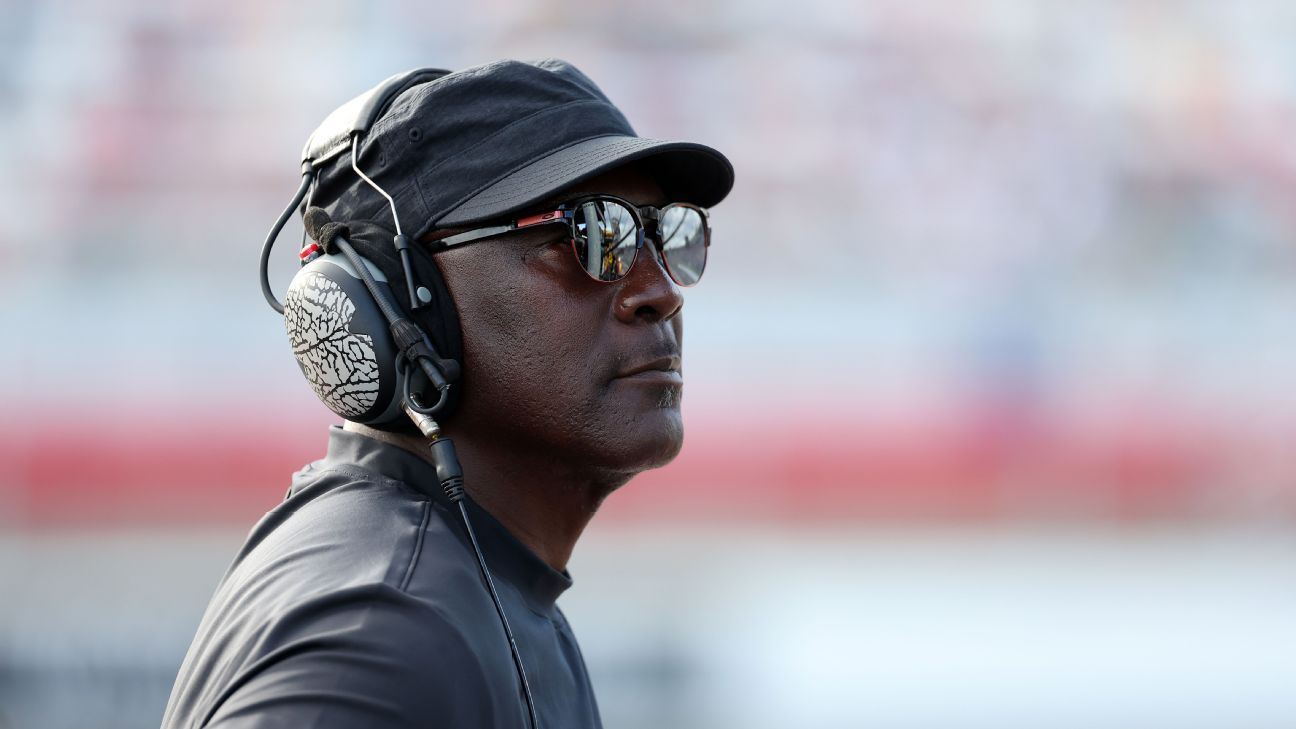
CHARLOTTE, N.C. -- Retired NBA great Michael Jordan took the stand at the landmark NASCAR antitrust case and testified Friday that he has been a fan of the stock car series since he was a child but felt he had little choice but to sue to force changes in a business model he sees shortchanging teams and drivers risking their lives to keep the sport going.
Jordan testified before a packed courtroom for an hour. His celebrity drew quips from the judge and even a defense attorney as he outlined why the team he co-owns, 23XI, had joined Front Row Motorsports in going to court against the top auto racing series in the United States.
"Someone had to step forward and challenge the entity," the soft-spoken Jordan told the jury. "I sat in those meetings with longtime owners who were brow-beaten for so many years trying to make change. I was a new person, I wasn't afraid. I felt I could challenge NASCAR as a whole. I felt as far as the sport, it needed to be looked at from a different view."
Jordan's highy anticipated appearance followed dramatic testimony from Heather Gibbs, the daughter-in-law of race team owner Joe Gibbs, about the chaotic six-hour period in which teams had to sign an extension or forfeit the charters that guarantee revenue week to week throughout NASCAR's 38-race season.
"The document was something in business you would never sign," said Heather Gibbs, who is also a licensed real estate agent. "It was like a gun to your head: if you don't sign, you have nothing."
Charters are the equivalent of the franchise model used in other sports and in NASCAR it guarantees every chartered car a spot in every race, plus a defined payout from the series. The system was created in 2016, and during the two-plus years of bitter negotiations on an extension teams begged for the renewable charters to be made permanent for revenue stability.
When NASCAR refused to make them permanent and gave the teams six hours in September 2024 to sign the 112-page extension, 23XI and Front Row Motorsports were the only two organizations out of 15 to refuse. They instead filed the antitrust suit and the trial opened Monday to hear their allegations that NASCAR is a monopolistic bully. 23XI is co-owned by Jordan and three-time Daytona 500 winner Denny Hamlin, and Front Row is owned by fast food franchiser Bob Jenkins.
Jordan testified that 23XI bought a third charter late in 2024 for $28 million even with all the uncertainty.
"I'm pretty sure they know I love to win," the six-time NBA champion said. "Denny convinced me getting a third driver improved our chances to win, so I dove in."
Like other witnesses this week, Jordan described a NASCAR that refused to discuss options or potential changes to the charter system, which he supports. He was asked why 23XI didn't sign the extensions last fall.
"One, I didn't think it was economically viable. Two, it said you could not sue NASCAR, that was an antitrust violation, I felt. Three, they gave us an ultimatum I didn't think was fair to 23XI," Jordan said, adding: "I wanted a partnership and permanent charters wasn't even a consideration. The pillars that the teams wanted, no one on the NASCAR side even negotiated or compromised. They were not even open-minded to welcome those conversations, so this is where we ended up."
Jordan referred to the NBA business model, which shares approximately half its revenue with players, far more than NASCAR.
"The revenue split was far less than any business I've ever been a part of. We didn't think we'd ever get to what basketball was getting but we wanted to move in that direction," he said. "The thing I see in NASCAR that I think is absent is a shared responsibility of growth as well as loss."
Jordan said he owns 60% of 23XI and has invested $35 millioin to $40 million in the team. Jenkins testified earlier this week that has never turned a profit since launching his NASCAR team in the early 2000s and estimates he's lost $100 million even while winning the Daytona 500 in 2021.
Heather Gibbs earlier told the jury how she became co-owner of Joe Gibbs Racing the day after her husband, Coy, unexpectedly died in his sleep the same night their son, Ty, won NASCAR's second-tier Xfinity Series championship in 2022. Coy Gibbs had moved into a leadership role with JGR following the death of his older brother, J.D., in 2019.
Because Gibbs had lost both his sons and had built the team as a legacy for his family, his daughter-in-law took an active role in the organization and personally participated in negotiations for the charter extensions. When NASCAR made its final offer at 6 p.m. on a Friday night with just hours to sign, the agreement did not include permanent charters. Gibbs testified the organization was devastated.
"Everything was going so fast, the legacy of Coy, the legacy of J.D., everyone at JGR was very upset," she told the jury. She said her father-in-law called NASCAR chairman Jim France pleading for a resolution.
"Joe said, 'Jim, you can't do this,'" she said. "And Jim was done with the conversation."
Heather Gibbs said she had to leave to take her son to a baseball game in Chapel Hill and left worried about her father-in-law, who was 84 at the time.
"I left him sitting in the dark, listening to his blood sugar monitors going off," she testified. "We decided we had to sign. We can't lose everything. I did not think it was a fair deal to the teams."
Joe Gibbs is both a Hall of Fame NASCAR owner and NFL Hall of Fame coach. He led the Washington football team to three Super Bowl titles and JGR has won five Cup Series championships. JGR has 450 employees, charters for four Cup cars and relies solely on outside sponsorship and investors to keep the team afloat. The team will mark its 35th season next year and Gibbs told the jury that JGR needs permanent charters to protect its investment in NASCAR.
"It's the most important point, a permanent place in their history books," she testified. "It is absolutely vital to the teams for us to know we have security, it can't be taken away, to know what we've invested in is ours."