
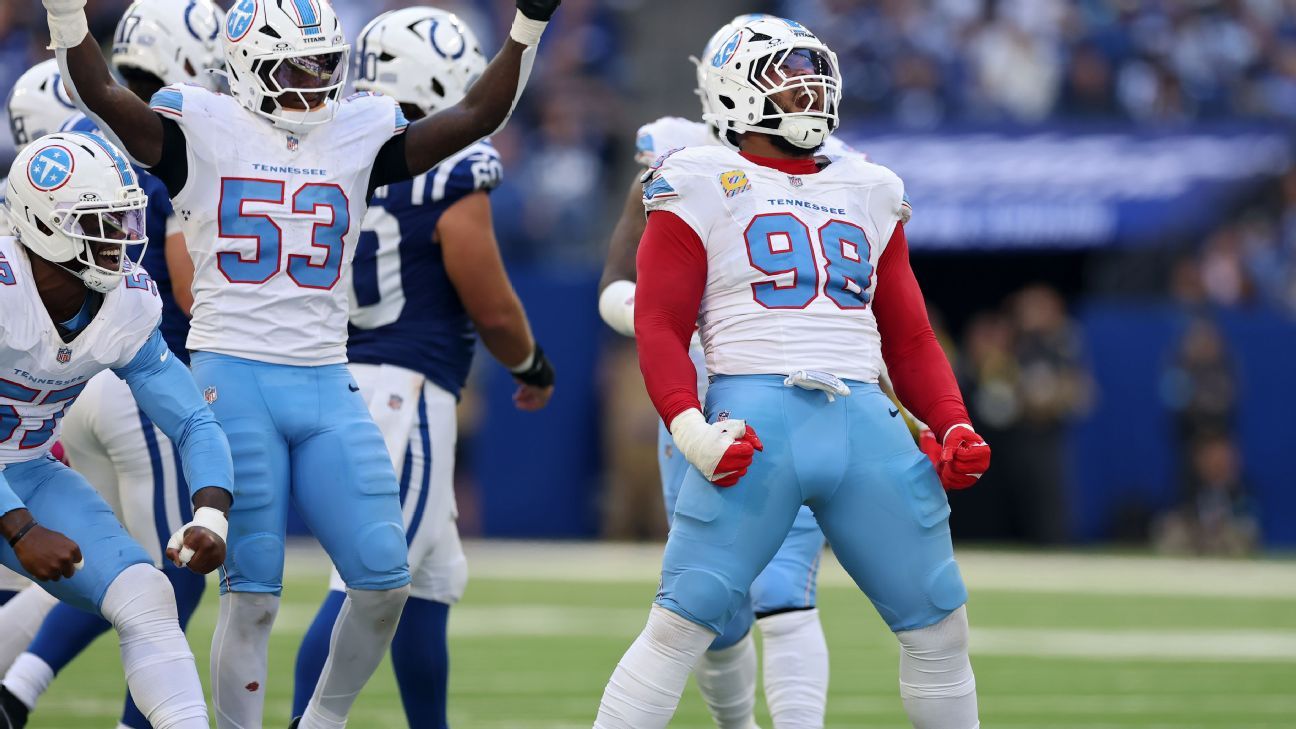
EmailPrintOpen Extended ReactionsIn a high-stakes game of poker before the NFL trade deadline on Nov. 10, Chicago Bears general manager Ryan Poles went all-in on Thursday after seeing two other NFC teams with legitimate Super Bowl aspirations make their moves.Poles sent first-round picks in 2027 and '28 and a fourth-rounder in '27 to the Tennessee Titans for first-team All-Pro defensive tackle Jeffery Simmons and a 2028 fifth-rounder. It's the first time in the common draft era (since 1967) a DT has been traded for multiple first-round picks, per ESPN Research.The Bears now have the second-best percentage to win the NFC at 13%, per ESPN Analytics. The San Francisco 49ers hold the best percentage at 39% after trading for DT DeForest Buckner, and the Seattle Seahawks have the third-best number at 11% after trading for guard Quenton Nelson; both of those trades happened Tuesday. All three players are former first-round All-Pros.Since coming into the NFL in 2019, Simmons' 46.5 sacks are second most among defensive tackles behind Buckner. He should be a huge help for a Bears team that ranks 23rd in pass rush win rate from interior defenders this season (13% per ESPN Analytics/NFL Next Gen Stats).For the Titans, it's a huge haul of draft capital as they plan for the years ahead. But will that future include the 2025 first overall pick, QB Cam Ward?Bears reporter Courtney Cronin, Titans reporter Turron Davenport, and national analysts Ben Solak and Jordan Reid break down the trade from all angles.Does this signal the Bears believe it's Super Bowl or bust this season?Chicago is 5-2 and entering a pivotal road matchup against the defending-champion Seahawks. The team now has the game-wrecking type of defender it had been lacking.Poles has been aggressive throughout his tenure at the trade deadline, shipping off Roquan Smith and Robert Quinn to complete the full tear-down of the roster in 2022 before aggressively adding at future deadlines, like when he acquired Montez Sweat for a second-round pick in 2023.But this move is unlike any we've seen the Bears pull off over the last five seasons. Adding Simmons indicates the Bears are aiming to elevate themselves from a top-five team in the NFC into a franchise that can win a Lombardi Trophy with quarterback Caleb Williams still on his rookie contract. The Bears' offensive core is getting expensive. The team made Darnell Wright the highest-paid right tackle in NFL history (4 years, $116 million) in August and will soon have to pay Williams, who is eligible for an extension following the 2026 season.Chicago has one of the NFL's best offenses (first in rushing, third in yards, eighth in scoring) and believes it can take a defense that, despite ranking ninth in scoring and eighth in yards allowed, has struggled to pressure opposing quarterbacks. This turns a weak link into one of the best units in the league.This trade is reflective of an all-in approach to build a consistent winner that coach Ben Johnson said was occurring behind the scenes ahead of Nov. 10. "We have constant dialogue of what this team needs and where we can impact ourselves, not just this year but years in the future as well," Johnson said Wednesday. "So [Poles is] turning over every stone that he possibly can to improve this football team just like he has ever since I've gotten in this building and feel really good about our process and we'll see what happens, never know." -- CroninHow does Simmons change the Bears' defense?Through seven weeks, the Bears are the best third-down defense in football, allowing a third-down conversion rate of 26.1%. But on early downs, when Dennis Allen can't get to his exotic blitz packages, his unit is 32nd in defensive EPA per play, 32nd in explosive play allowed and 27th in defensive success rate. Not great.The Bears needed more talent on defense, plain and simple -- that's how they can start winning on early downs and get to the schemed-up excellence of their third-down defense. Simmons is a true three-down defensive tackle with elite play against both the run and the pass. He has played more snaps (399) than any other defensive tackle in the league. He leads all defensive tackles in total pressures (and he's seventh in pressure rate to boot). He also leads all defensive tackles in run stop EPA (and he's 19th in run stop rate to boot). There is no individual defensive tackle with a higher total impact for his defense -- all three downs, run and pass -- than Simmons this season. And it's not close.Simmons will create the splash plays on early downs that get the Bears' defense to more third downs altogether. He will also force protection plans to account for him on third downs -- few guards in the league can match Simmons one-on-one. That will make Allen's blitzes all the easier to scheme up and all the more effective when they land. The Bears' defense is far from perfect, but Simmons should provide an immediate jolt that raises their floor and perhaps takes them over the bar of "playoff liability" and into the realm of "good enough to win a Super Bowl." -- SolakWhat led the Titans to part ways with their best player?At 1-6, things were heading in this direction for the Titans. Trading Simmons is strictly for stocking draft picks, signaling the team is in full rebuild mode.Titans coach Robert Saleh recently called Simmons the best defensive tackle in the league and said he'd never seen another defensive lineman have such a large role in the front four rotation before -- so it clearly had nothing to do with fit.There were no issues in the locker room, either. Simmons was a player Titans defensive line coach Aaron Whitecotton would point to as an example of giving full effort on every play. Simmons said he hadn't heard anything from his agent or the organization when he spoke to the media in the locker room before practice on Wednesday. One day later, he's headed to Chicago. -- DavenportThe Titans now have two first-round picks in 2027 and 2028. What are their biggest long-term needs?ESPN's Football Power Index has the Titans projected to pick No. 1 right now, and the inbound 2027 Bears first-round pick is projected at No. 26. Offensive tackle and defensive line are two obvious areas of need for the Titans, but Ohio State's Jeremiah Smith is a realistic option for them at the top of the draft. Smith could possibly become the first WR to be selected with the No. 1 overall pick since Keyshawn Johnson in 1996. He's atop my board, and he has terrific hands, physicality and route running.Trading back could also be an option here, too, putting them in territory to add to a lackluster pass rush. South Carolina's Dylan Stewart and Texas' Colin Simmons are the top options in this class. But keep an eye on LSU's Jordan Seaton and Utah's Zereoue Williams at offensive tackle if Tennessee does end up a little further down in the top 10.There are options for Tennessee with that second first-rounder, too. If the team waits to add a pass rusher until the Chicago pick, Alabama's Yhonzae Pierre, Notre Dame's Boubacar Traore and Clemson's Will Heldt could make sense in the back end of Round 1. This trade gives the Titans some options. -- ReidWhat are the salary-cap ramifications of this deal for each team?Assuming none of the remaining salary is being paid by Tennessee, the Bears will take on the remaining $7,944,444 of Simmons' 2026 compensation, and that will be their cap charge for him for 2026.The Titans have already paid Simmons $5,055,555 in salary for this year, plus a $20.25 million signing bonus when they renegotiated his deal in June. They have to count only $4.05 million of that signing bonus against this year's cap, and the remaining $16.2 million will go against next year's cap. They also have $5,010,843 in remaining bonus proration from his previous contract to account for this year and next year. So the Titans' cap charge for Simmons in 2026 should be $14,116,398, and their dead-money cap charge for 2027 should be $21,210,843.The Bears will owe Simmons a $21.45 million salary and a $5.5 million option bonus in 2027, for a total of $26.95 million that is already fully guaranteed. Since that option bonus can be split up over five years for cap accounting purposes, Chicago's cap charge for Simmons for 2027 should be $22.55 million.Assuming Simmons is still on Chicago's roster on the fifth day of the 2027 league year this coming March, another $29.8 million in 2028 compensation will become fully guaranteed, meaning Simmons' 2028 cap number would be $30.9 million if the Bears don't renegotiate before then. If Simmons is still on Chicago's roster on the fifth day of the 2028 league year, then $10 million of his $28.001 million in 2029 compensation would become guaranteed. So if, hypothetically, the Bears were to release him after 2027 and before the fifth day of the 2028 league year, their dead-money cap charge for him in 2028 would be $34.2 million. If they were to cut him after the 2028 season, their dead-money cap charge for him in 2029 would be $13.3 million. Again ... all of that assumes the contract doesn't get restructured again, which it likely would be if they decide to keep him around a while. -- Graziano