
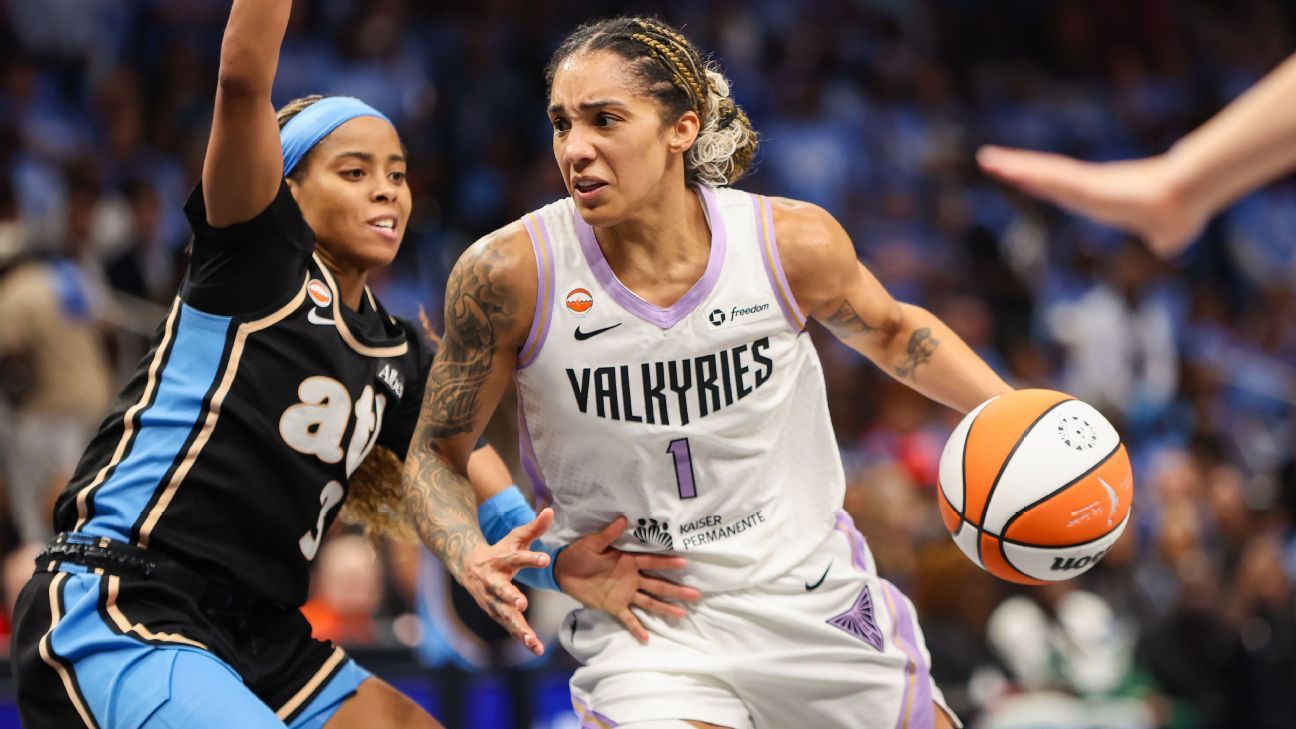
EmailPrintOpen Extended ReactionsATLANTA -- The most consequential 40 minutes of the WNBA season arrives Saturday (1 p.m. ET) as the Atlanta Dream host the Golden State Valkyries in Game 4 of the Finals. The Dream lead the series 2-1, and a victory heavily tips the scales in their favor to secure the first championship in franchise history. A Valkyries win sends the series back to San Francisco all tied up in a scenario where anything could happen.Golden State coach Natalie Nakase has remained upbeat despite her team struggling in areas that have been a strength all season. Coming off their best game of the Finals, the Dream get to host another game in Atlanta in front of a raucous crowd that was an unquestioned advantage Wednesday in Game 3."You want to finish the job," Dream coach Karl Smesko said. "You want to finish it. These are two great teams going at it, competing at a high level, and only one of us get to be champions. So that should be enough motivation for everybody."Ahead of Saturday's pivotal meeting, ESPN evaluates what's on the line, how each team got here and what changes to expect when the series continues.Is Game 4 a must-win for the Valkyries?Kendra Andrews: Yes. It's as much of a must-win as a non-elimination game can be. With this being only the second year of a best-of-seven series in the WNBA Finals, there isn't any history to look at regarding coming back from a 3-1 deficit (the Aces swept the Mercury last year). However, even when it was a best-of-five series, no team in league history has ever trailed by multiple games and come back to win. In the NBA, only one team has come back from a 3-1 deficit in the Finals (2016 Cleveland Cavaliers). It is critical that Golden State wins Game 4 to tie the series as it shifts back to Ballhalla, which could provide an opportunity for the Valkyries to take back control. With how strong the Dream looked in Game 3, it's hard to imagine the Valkyries beating Atlanta three times in a row, so they must try to regain control of home-court advantage.Kareem Copeland: Essentially. Kendra broke down the 3-1 history above, and that would put Golden State in a massive hole to climb out of. Not only is that a tough ask, but the Valkyries have yet to show they can score enough points to win three consecutive games against the Dream. They've averaged just 68 points per game and have yet to shoot 35% from the field in any of the Finals contests. That's an extremely hard way to win three in a row.Alexa Philippou: While it feels like the pressure is on the Valkyries to win and avoid going down 3-1, Golden State guard Veronica Burton told reporters on Thursday that "it would be silly to overreact right now." Still, the Valkyries understand what's at stake heading into Saturday. "We continue to point out the things where we lack discipline and where we lack maybe paying attention to their personnel," Burton said. "We address that and not overreact but also understand that there is a major sense of urgency, and we can't necessarily wait for anything to change."Luckily, as Nakase pointed out, Golden State has been great this season with its back against the wall, so the Valkyries will derive some confidence from that.What is the biggest adjustment Golden State must make?Copeland: Cleaning up turnovers. The Valkyries cannot continue to give up the ball at the rate they have in the past two games. They turned it over 19 times in Game 2 and 17 times in Game 3. The Dream promptly scored 24 and 22 points, respectively, off those turnovers. Atlanta's Rhyne Howard became the first player in league history to record five steals in consecutive Finals games. Golden State hasn't been able to produce enough offense to have so many empty possessions. Not only are they empty possessions, but they also spark a Dream offense that struggled itself in Games 1 and 2.Andrews: I get that defense will always be Golden State's motor, and the Valkyries shouldn't change. They say their offense thrives off their defense because of how good they are in transition. However, they aren't stopping the Dream nearly enough. If they aren't making stops, they must find a way to generate more offense. After leading the league in points per possession in transition in the regular season, they are struggling mightily in this area.The Valkyries have also always been isolation-heavy in how they like to score -- beating their defenders one-on-one -- and led the league in isolations during the regular season although their efficiency on those plays ranked in the middle of the pack. But in the Finals, they are averaging less than one point on their isolations. Gabby Williams has particularly struggled one-on-one (defended mostly by Jordin Canada). With their two main offensive tactics ineffective, the Valkyries need to find another way to get going.Philippou: Since Game 3 ended, the Valkyries have spoken a lot about not being consistently disciplined but also about needing to operate more connectedly as a unit. Nakase has taken accountability in needing to come up with a more efficient, aggressive and clear game plan, and said she'd be seeking input from players in individual conversations.While Cecilia Zandalasini and Janelle Salaun were much more impactful in Game 3, and Golden State had some success from beyond the arc with 12 triples, to Kendra's point, it'll be worth seeing whether the Valkyries can help Williams get going offensively. After her Game 1 heroics, she shot 30% or worse from the field in the next two games. Golden State needs her to snatch back the momentum and lead in this series.Has the Valkyries' No. 1-rated defense sputtered or has Atlanta's offense just been too good?Copeland: That defense didn't sputter until Wednesday, when the Dream shot 49.3% from the field and scored the second-most points the Valkyries have allowed in regulation this postseason. Game 3 was certainly ugly as Angel Reese continued to dominate and Rhyne Howard and Naz Hillmon started knocking down 3-pointers. But Atlanta shot just 33.9% in Game 2 and 32.8% in Game 1. The Golden State defense has been stout in two of three games, but those aforementioned turnovers gifted the Dream a ton of free points that have been the difference in the two Valkyries losses.Philippou: It's not a great sign for Golden State that the Dream have scored progressively more points in each game of this series: 64 in Game 1, 79 in Game 2 and 97 in Game 3. And that's all without Howard having a great postseason shootingwise -- she has shot above 40% from the floor in only one playoff game and went sub-30% from the field in Games 1 and 2 of the Finals.The Valkyries have allowed Atlanta to thrive in transition the past two games, and they haven't done a great job of generating Dream turnovers that they could score off. But they've had no real answer for Reese across Games 2 and 3. She's averaging 21.7 points -- on 56.4% shooting -- 13.3 rebounds, 2.0 assists, 2.0 steals and 1.0 blocks in the series. The Dream go as she goes.What has been the biggest difference in Angel Reese's game since the start of the season?Copeland: Her determination. Reese not only believes there isn't anyone on the Valkyries who can slow her down, but she's forcing the issue -- in a good way. Her confidence level is sky high at the moment and she knows her teammates feed off it. You see it when Reese snatches a rebound and goes coast-to-coast in her 6-foot-4 frame against the league's No. 1 defense without a care in the world.The biggest example might have been when she had the ball at the top of the arc, gave a jab step and then rose up to knock down a triple without hesitation. That's supreme confidence for someone who had a combined seven 3-pointers in her first two WNBA seasons. Reese said it herself: That mindset and approach has been contagious for her teammates.Philippou: Much has been made about Reese's will to win, but Smesko also credited Reese's hard work during the season, saying "she very well might be the most improved player from the beginning of the season to right now." Reese has been working on improving her outside shot with Smesko and refining her post work with assistant coach LaToya Sanders. Reese shot 42.5% from the field before the All-Star break versus 48.4% afterward, and now 48.1% in the postseason. Per GeniusIQ, Reese's qSI -- a stat measuring effective field goal percentage minus the expected effective field goal percentage on the shot -- has jumped from minus-3.6 before the FIBA break (meaning her effective field goal percentage was 4.1% worse than expected) to 6.0 since.She has also made 8 of 17 (47.1%) 3-pointers in the playoffs versus 3 of 25 (12%) pre-All-Star break and 8 of 32 (25%) post-All-Star break.