
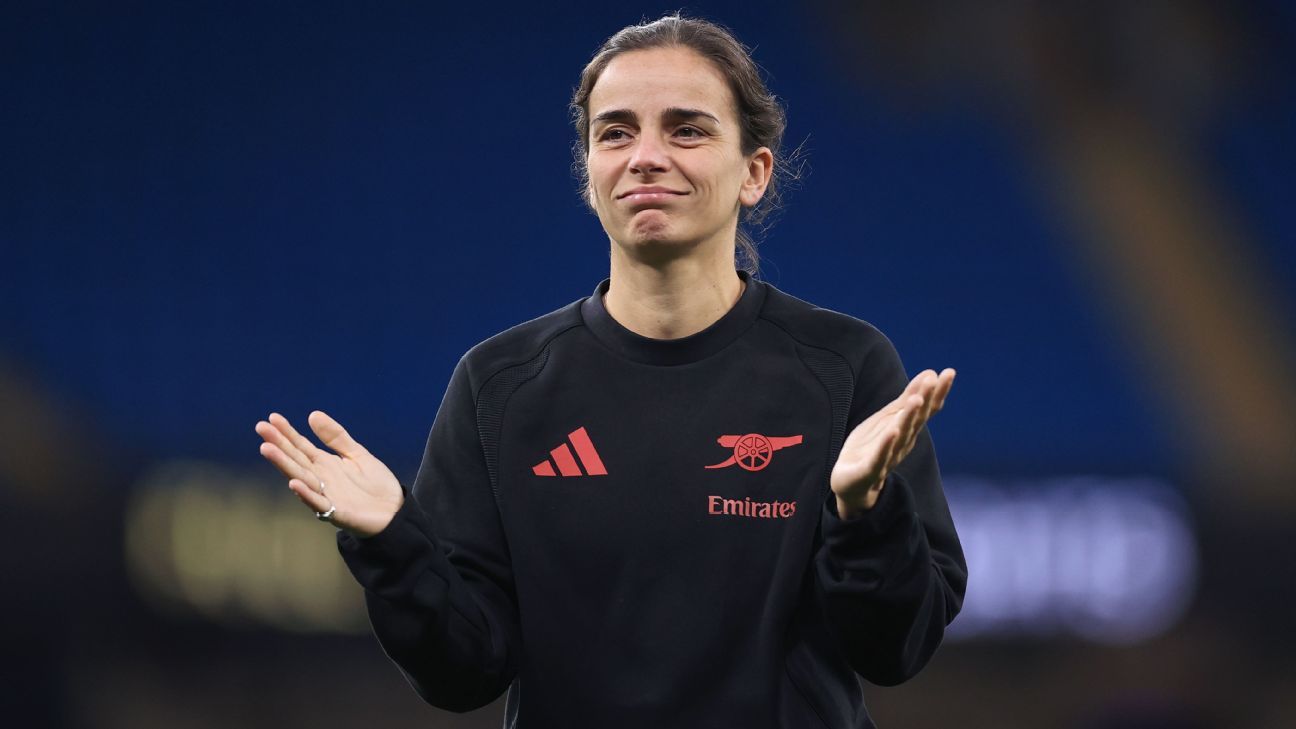
EmailPrintOpen Extended ReactionsArsenal are a month into the Women's Super League (WSL) season and already find their title hopes in tatters. After four games, they are 10th in the table, 10 points behind leaders Manchester City, and are enduring their worst league start to a season since 2014."At the moment, we're not in the [title] conversation, no," manager Renee Slegers confessed recently -- an extraordinary concession this early in a campaign for a club whose ambitions extend far beyond merely competing for the top four.Arsenal's season has been underwhelming on multiple fronts. They earned a 1-0 win over Brighton in their WSL opener, but they followed that up with back-to-back draws against Crystal Palace and Manchester United, during which they scored just a single goal. Slegers was already under pressure, and further defeats to Chelsea (2-0) and Manchester City (4-2) have now sparked the need for a comprehensive review.The UEFA Women's Champions League (UWCL) hasn't provided much of a reprieve either: The Gunners needed a stoppage-time penalty to edge lowly KB Hoge 1-0 before throwing away a two-goal lead against Paris FC to draw 2-2. After that draw, which included a bizarre mistake from captain Leah Williamson that resulted in a penalty, sources told ESPN that both players and Slegers were in tears, and the coach was too upset with the refereeing decision to fulfil her post-match duties.The truth is, Arsenal have form for this kind of run. They have been slow starters before and eventually, after an internal audit, managed to spark into life, although it has cost them the WSL title each time -- it's been seven years since they lifted the league title.After such a dismal start, fingers are starting to be pointed. The question is simple: Who is really to blame for Arsenal's early season woes?Is Slegers to blame?As manager, Slegers is the first to face scrutiny. Rightly or wrongly, she is employed to take ultimate responsibility for the results and performances, and that is the case in this instance, too.Perhaps her biggest mistake is to remain overly loyal to players, tactics, and structures that have not been producing results.She has rewarded out-of-form stars such as Ona Batlle, Mariona Caldentey, Alessia Russo and Williamson with consecutive starts. There is an argument for maintaining a settled side, particularly when trying to establish cohesion, but there also has to be jeopardy.A team can't become complacent if poor individual performances have consequences. A more ruthless manager might have been willing to drop one or more established players, if only to send a message to the rest of the squad that reputations do not guarantee selection.Her substitutions have also called her managerial term into question. Slegers has arguably become predictable in that regard, calling upon the services of Caitlin Foord, Chloe Kelly and Stina Blackstenius, forcing Russo into midfield after playing an hour as a striker, and taking off two of the side's most productive players in Lisa Baum and Georgia Stanway when Arsenal have needed to conjure answers. She often waits until the last 25 minutes to make changes, and it has left the team both exposed and vulnerable.New signings Selina Cerci and Graldine Reuteler have barely seen the bench, let alone the pitch, and it appears that the squad is simply too big to be cohesive.Some ESPN sources have suggested that Slegers has too many options and does not have the experience to determine how best to combine them. Arsenal's depth was intended to make them capable of mounting a serious challenge both domestically and in Europe, but Slegers' management of the squad has made it seem more of a curse.Slegers got her first senior job in 2021 when she took over from Jonas Eidevall at Swedish side Rosengard. If that sounds familiar, it is: She later took over from Eidevall at Arsenal following his departure in 2024. But it appears she could be following in his footsteps once again.Eidevall lost the dressing room during the 2024-25 season and, after a 5-2 defeat to Bayern Munich and a 2-0 loss to Chelsea, the situation had become untenable, leading to the Swede handing in his resignation.This season, there is an uncomfortable sense of history repeating itself. Sources have told ESPN that Slegers has the backing of the club and the players, for now, but there is no guarantee that she will remain in charge if she feels she can no longer guide the team to success.Are Arsenal's coaching staff to blame?If Slegers were to tender her resignation, there would be a line of clubs itching to land her signature. Make no mistake: Slegers is a good coach. She is a good tactician, a well-liked manager who has earned the praise and respect of those who have worked with her, and is a Champions League-winning coach, after all.When asked if Slegers felt she is the right person to continue Arsenal's journey, her response was "it's not about me anyway."The manager had just been asked about her future following the 4-2 loss to Manchester City, to which she responded with: "of course, this result is disappointing. But I'm here, I'm full of energy," insinuating she was not planning on going anywhere. Sources told ESPN that this was the case, that Slegers had not been planning to resign."I care a lot for the club, for the players. And I see perspective. Of course, it's good, I think, with the international break coming up," she added. "I think we're going through a really difficult time, but we also see perspective, and we look forward, and we see solutions, and we see the closeness. It's not that we're totally away from it or off it. It's about the club, and I care for the club."After the 2-2 draw to Paris FC, according to sources, Slegers was visibly emotional. She was in tears, hugging players and was uttering words that to some players sounded like a goodbye. She was then too angry to fulfil her post-match duties, however, Slegers offered another explanation for her absence, saying she chose to spend time with the team instead of speaking to the media.If the she does leave, Arsenal should examine the wider coaching structure around her.It is convenient to place the blame entirely on the head coach because she is the most visible person in the dugout, but some members of Arsenal's coaching infrastructure predate Slegers; some even predate Eidevall, having been appointed during Joe Montemurro's tenure, which ended in 2021.A lot of the issues Slegers faces have predated her. The team started slowly, tactics became predictable, and the squad management became too much for the manager to weather. All this has been the case over the past four seasons and were visible even during Montemurro's last seasons in charge.Slegers is responsible for the team's tactical approach, but she is not solely responsible for the environment in which those tactics are developed. If she ultimately pays for Arsenal's failures with her job, it is reasonable to ask whether those who have helped shape the football operation around her should face the same scrutiny.Changing a manager without addressing the wider structure risks simply repeating the cycle again with somebody else.There is also a question of the senior leadership at the club. To draw a comparison, former player Clare Wheatley was appointed a general manager in 2014; Paul Green -- the mastermind behind Chelsea's longstanding dominance -- moved to the other side of London in 2013.During Green's time at Chelsea, the club amassed 19 trophies, including eight league titles and six FA Cups. Arsenal, meanwhile, have won one league title, one FA Cup, four League Cups and one Champions League during Wheatley's 12-year tenure.Green helped build a winning machine, assembling a squad capable of competing year after year while providing then-manager Emma Hayes -- who spent 12 years at the club -- and later her replacement, Sonia Bompastor, with the support and resources required to navigate the inevitable ups and downs. Crucially, the close relationship between Green, who oversaw recruitment and day-to-day operations, and Hayes/Bompastor was vital to the success of the club.ESPN sources outside the club have questioned whether there is a disconnect between Arsenal's technical staff and recruitment operation. Some of the club's summer signings have been limited to only a handful of minutes from the bench, while out-of-form but trusted players have continued to serve as the default options. Slegers has herself admitted she is not involved in the direct communication around transfers and contracts, leaving those responsibilities to Wheatley and technical director Jodie Taylor.Another ESPN source close to the club insisted there is a good working relationship between the areas, but suggested there is less clarity over how the club's tactical vision is ultimately supposed to be realized.Green parted ways with Chelsea in February 2026 after the club suffered successive defeats for the first time since 2015; despite managerial turnover and recurring issues, there has been comparatively little change to Arsenal's senior leadership.If the same problems keep resurfacing, can the club realistically expect a different outcome without changing the people and structures responsible for addressing them?How much are the players responsible?Ultimately, responsibility for winning a football match rests with the 11 players on the pitch.A club can provide the best coaching, the best facilities, the best recruitment and the best preparation possible, but once the whistle blows, it is the players who have to execute. They have to make the right decisions in the final third, take their chances when they come, win their individual battles, and defend well enough to preserve a result.More than anything, taking chances has been a particular obstacle. Heading into their 4-2 defeat to Manchester City, Arsenal had scored just two of their 78 shots on goal.A manager can establish attacking patterns and put forwards into positions where they can score, but they can't take the final shot for them. When a player is presented with a chance and fails to convert it, that responsibility ultimately belongs to the player.Confidence is contagious in football; so is a lack of it. The longer Arsenal go without scoring, the greater the pressure becomes on the next chance.Summer signing Stanway suggested a lack of confidence is "a bit of a myth," instead saying that Arsenal's setbacks are based on fine margins. This was before the 2-2 draw with Paris FC and 4-2 loss to City."I would say [a lack of confidence] is a bit of a myth," she said before the Paris FC game. "Based on the level of training and the standard, the intensity, I'd say that the confidence is there; it's just a matter of us being able to do it at the weekend. That comes from us taking responsibility for our own actions. At the moment, I do really believe it's fine margins and there is confidence within that dressing room downstairs, there's a lot of belief, and there's also a lot of motivation."Arsenal have had too many players failing in those moments at the same time. This is not a team lacking talent. Arsenal have established international forwards and players with proven records of scoring at the highest level. Yet, collectively, they have looked short of confidence, conviction and composure.That is where the discussion becomes more complicated. If one player is out of form, it is easy to attribute that to an individual slump. If two are struggling, it can still be explained away as a bad run. But when almost every attacking option is failing to convert, and every defensive option is lacking confidence, Arsenal have to consider whether there is something deeper at play.How will Arsenal act now?The blame, ultimately, has to be shared. Slegers' squad management has been an issue, while the players' failure to be clinical in front of goal and their vulnerability defensively has cost them results. And, above all, there is a structure that has allowed the same problems to surface, season after season, without being adequately resolved.For a club asking itself how to fix the issues in front of them, the international break couldn't have come at a better time.Arsenal's next game will be against second-from-bottom Birmingham City on Oct. 17, followed by a tougher-than-ever North London Derby against a resurgent Tottenham Hotspur on Oct. 24.Sources have told ESPN that Slegers retains the backing of both the club and the squad, but that support can only take her so far. Results must follow, and Arsenal's squad have a collective responsibility to create the environment in which their manager can succeed.If they fail to do that, the outcome is predictable. Another manager will eventually arrive, another review will be conducted, and Arsenal will once again find themselves trying to solve the same problems. The cycle will simply begin again.