
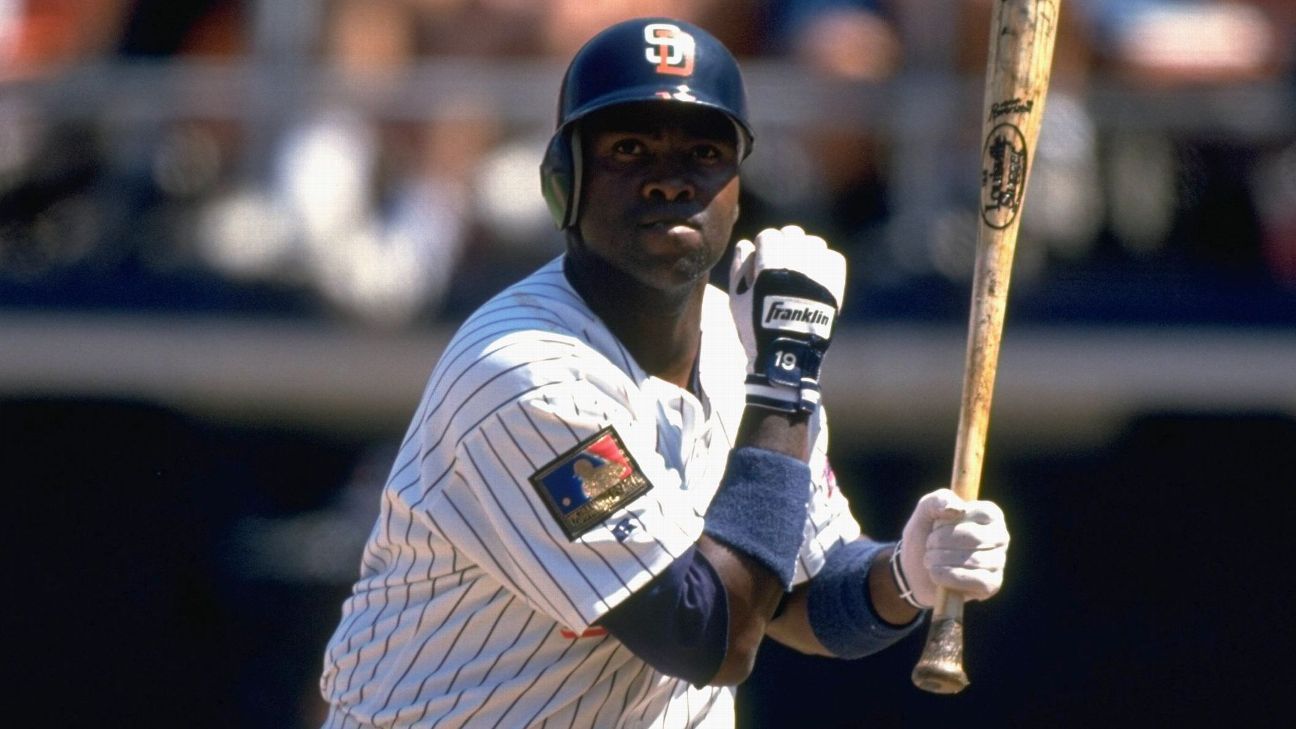
EmailPrintOpen Extended ReactionsIt was Sept. 14, 1994, the day the World Series was canceled, a day that commissioner Bud Selig called "terrible ... horrible ... terrible.'' There was, however, baseball being played: the Triple-A International League championship series between the Richmond Braves and the Charlotte Knights. Before Game 3, several players from the Knights were watching "Jeopardy!" in the players' lounge. The final Jeopardy answer was in the category "Poetry." One of the Knights came bursting out of the lounge, celebrating as if he had won a Powerball jackpot."Did he answer the final Jeopardy question?'' Knights infielder Tim Jones was asked."No,'' he said. "We're baseball players. We play if you guess the final Jeopardy category, you win!''A lot has changed in baseball, and in the world, since 1994 (although the final Jeopardy answer in poetry remains impossible to answer correctly for most players -- if not most people). But this hasn't changed: Baseball labor strife is upon us again. From all indications, there will be a work stoppage when the collective bargaining agreement expires Dec. 1. If the players' association doesn't agree to the owners' demand for a salary cap, there is a chance that some games in 2027 will be canceled, maybe the season.The game stopped on Aug. 12, 1994. Thirty-two years later, here are five lessons we learned from the 1994-95 strike:1. Do not use replacement playersIn the spring of 1995, with MLB players still on strike, teams filled their roster with replacement players, mostly a collection of minor leaguers, former major leaguers and anyone who could play at all. It was a time of anger, confusion and disgrace. Then-Tigers manager Sparky Anderson, a future Hall of Famer, was so disgusted he boycotted the entire exercise."It was the worst time of my career," said Buck Showalter, who was the manager of the New York Yankees in spring training 1995. "Everyone wanted to do what Sparky did. Everyone."The spring of replacement players was a circus."You could never assume anything, trying to run relays and bunt defenses, and rundowns, it was like, 'Oh my goodness!''' Showalter said. "There were some guys who had been drafted and been released, Independent League guys, when it looked like we were going to start the season, we sent a bunch of scouts to the Mexican League to sign a bunch of players."The lesson: Don't try insulting the fans by trying to pass that [replacement players] off as big league quality baseball.''2. Acknowledge what's at stakeA lost season, or even part of it, will cause irreparable damage to the game and its fans -- it certainly did in 1994. And this time, baseball will not have Cal Ripken's emotional chase of Lou Gehrig's consecutive game streak or a historic home run battle to help heal the wound. A work stoppage always has unexpected effects on the future and the legacy of certain organizations and players.The Montreal Expos were 74-40 at the time of the strike -- they were charging. "You guys put fear in us,'' then-Braves pitcher Tom Glavine told then-Expos manager Felipe Alou."If we had finished that season, and they kept that team together, Montreal would have a new stadium right now, and the Expos would be playing it in,'' Alou said 25 years later. "We had the best team in baseball. That really was the end of baseball in Montreal.''There is nothing comparable today to the Expos' situation in 1994. But consider the Rays, who have the best record in the American League. They still don't have a new stadium deal in place after their lease in St. Petersburg runs out after the 2027 season. The situation is complicated, and it is fragile. But imagine if the Rays win the World Series this year for the first time. In theory, wouldn't that help their chances of getting a new ballpark? And yet: What if there is no 2027 season? Would the momentum gathered from winning the World Series be lost if the season is lost?The Yankees also felt they were robbed of a chance at history."We were back, we were taking off for the first time in forever,'' Showalter said. "We had moments that we had not had forever. [First baseman] Don Mattingly would have been a shoe-in Hall of Famer if that season had been played. This affected a lot of people. It cost a lot of people their jobs. We came to camp the next year. We had the best team in the league the year before, and it took until August [1995] before we found our step again.''The player most affected by the 1994 strike was Padres outfielder Tony Gwynn, who was hitting .394 when the strike began. He never got a chance to become the first player to hit .400 since his baseball idol, Ted Williams, in 1941. Many years later, in retirement, Gwynn said without anger or bitterness, "I was swinging so well. I think I would have hit .400.''There is nothing comparable to Gwynn challenging .400. But a canceled season could eventually cost Aaron Judge a shot at 600 homers, or Kyle Schwarber, Shohei Ohtani, Bryce Harper and Mike Trout a shot at 500. It could derail Manny Machado's and Jose Altuve's pursuit of 3,000 hits, or Gerrit Cole's and Chris Sale's chase for 3,000 strikeouts.3. Remember the other guysIf there is a lockout, whenever the game resumes, the jobs of star players will be safe, and most will be set financially. It's the fringe players who will be affected. Fifty-seven players never played another game after August 1994; 19 players played their final major league game the day the strike began.Harold Reynolds was 33 on Aug. 11, 1994. He never played again."Spring training 1995, I couldn't find a job,'' he said. "I could still play. I had no interest in retiring. [Colorado Rockies manager] Don Baylor told me to come to their camp on a minor league contract. Then they sent me to minor league camp. I spent six weeks of spring training with the Rockies. I was in great shape, I was raking, I was killing it. The day before the season, Don called me in his office. I figured he was going to tell me I wasn't going to start. He told me that they couldn't find a way to keep me on the team. I was asked to go to [general manager) Bob Gebhard's office. He released me. That was it. The end of my career. It never entered my mind in August 1994 that I would never play again. Never.''Twins first baseman Kent Hrbek drove in three runs on Aug. 11, 1994, the final game he ever played."I had announced my retirement earlier that season, so instead of playing my last game at the end of September, it was the middle of August,'' Hrbek said. "There wasn't sadness for me. When the season was canceled, I took the cup that I wore all those years, grabbed a hammer and nailed it to the wall in my garage. My cup is still nailed to that wall.''4. There must be solidarityGene Orza was the general counsel/COO of the Major League Baseball Players Association in 1994, the right hand man to Don Fehr, the MLBPA's executive director."The players were fully prepared [to go on strike],'' Orza said 25 years later. "There wasn't a peep on the 12th from any players. In the weeks after that, there were some players who complained about not playing, but not many, a handful. All of the big guns in the sport -- the [Cal] Ripkens, the [Dave] Winfields, the [Eddie] Murrays, the [Kirby] Pucketts, the [Orel] Hershisers -- they were really really solid. It was an unheard-of level of solidarity.''There does not appear to be the same unheard-of level solidarity from the players today It might take a few, high-profile star players to get in front of a microphone to explain the situation, as Hershiser did in 1994, and as Braves pitcher Tom Glavine did in 2001. Is anyone even built for that role these days? The world has changed the last 32 years -- the players make more so much money and, said one former player, "the more they make, the more isolated they become.'' And, unlike 1994, every player can have a platform on social media, making remaining solid harder than it was in 1994. The players were very close to Fehr and Orza in 1994, as well as with Tony Bernazard, a former player who was instrumental in advising and educating the players. There doesn't appear to be the same closeness between the players and Bruce Meyer, the newly named executive director of the MLPA, and his staff.5. Protect the minor leaguersIn 1994, there were so many questions, and so few answers, for minor league players, who were not members of the union, making their position even more complicated and precarious. Infielder F.P. Santangelo was 26 years old, playing for Ottawa, the Triple-A affiliate of the Expos. He was in his seventh minor league season, still trying to reach his dream."We heard about replacement-player games, and we were going to be made to cross the imaginary picket line,'' Santangelo said. "I finally decided that it was not a good idea to play when big leaguers were sitting at home for a cause. I just didn't think that getting a hit off a truck driver -- nothing against truck drivers -- in a replacement-player game was going to show my manager that I could play in the big leagues. There were 200 guys there [in Expos' camp], I was the only one who left. I went home. Felipe told me, 'I've always respected you, and I respect you even more today because you stood up for yourself. When the strike ends, I am going to call you up when I can. I am a man of my word.' Felipe called me up Aug. 2, 1995. I got to the clubhouse at 12:30 p.m. for a 7 p.m. game. [Expos GM] Bill Stoneman said, 'Don't you think you're a little early to get here?' I told him, 'I've waited my whole life for this opportunity. There is no such thing as being too early.'''Minor leaguers felt immense pressure not to play -- so much so that the Yankees encouraged players to leave rather than face the ire of major leaguers."We took a bunch of guys and told them to leave camp -- [outfielder] Shane Spencer, [infielder] Randy Velarde," Showalter said. "We told them, 'You need to get out of here, or you'll be branded.' I saw Shane years later, and he thanked me, and I told him [Yankees owner George] Steinbrenner went apes--- when he heard about it."There will be no pressure on minor league players this spring to cross an imaginary picket line. The 120 minor league teams are now unionized, a huge change from 1994. They play under a different CBA than that of the major leaguers, but it still provides protection. That means that even if the major leaguers aren't in camp in spring training, the minor leaguers will be, and there will be games. In 2023, Minor League Baseball organized Spring Breakout, which included the game's top prospects playing against one another. Paul Skenes, Jackson Holliday and James Wood, among others, played in those games. Even if the major leaguers aren't at camp next spring, at least there might be another showcase. No replacement players, no truck drivers -- nothing against truck drivers.