
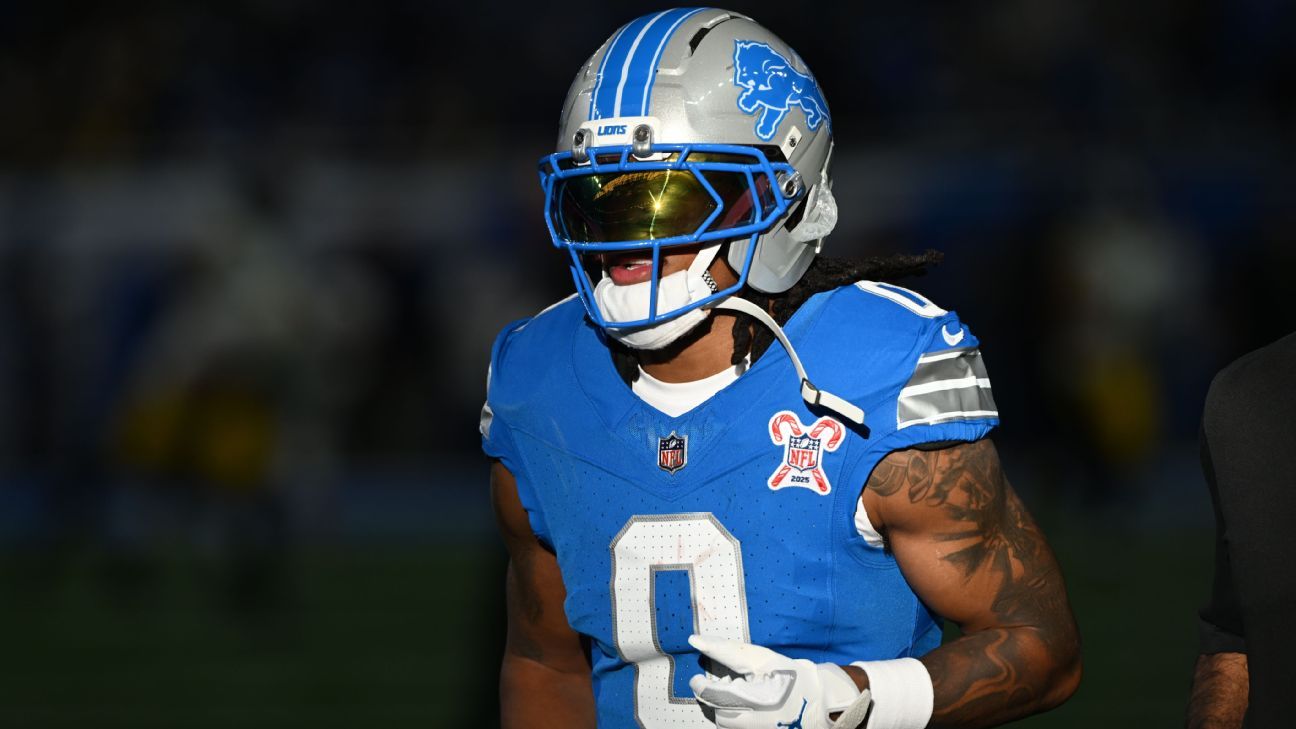
EmailPrintOpen Extended ReactionsContract extensions sometimes fall under the radar. It's not that they don't make news. It's that they tend to be treated as a checkbox. Is the extension done, yes or no?But there's a lot of middle ground. Should the extension have happened? And at what price? Because not every extension is a good decision.So with NFL teams seemingly inking players to new long-term deals almost every day in training camp (most recently Detroit Lions running back Jahmyr Gibbs agreeing to a three-year, $67.5 million extension Thursday with $51.5 million guaranteed), let's go through some of the most interesting deals and rank them from best to worst.As always, I'm evaluating the decisions teams make, considering the player in question, the price and the rest of the team's roster, cap situation and time horizon to contention.Jump to an extension:Bergeron | Carter | Flowers | GibbsOlave | O'Neill | RobinsonTaylor | Ward | Wright1. Brian O'Neill, OT, Minnesota VikingsExtension: Four years, $96 millionO'Neill has always performed very well and been consistent in pass block win rate. In fact, he finished in the 95th percentile or better for three straight seasons from 2022 to 2024 before dropping back to the 79th percentile in 2025. Conversely, his run block win rates weren't as strong until last season, when he popped into the 87th percentile among tackles.At age 30 with only one year left on his contract, extending O'Neill made a ton of sense. That's true for two reasons: (A) offensive tackles can continue to play at a high level well into their 30s, and (B) right now contract costs for good tackles are relatively cheap. Losing O'Neill would really hurt the offense, replacing him would be difficult, and his extension costs only $24 million per year.The structure of the deal is also favorable. It's a pretty salary-heavy contract with a smaller, fully guaranteed $11.2 million salary in 2027 and then no fully guaranteed salary after that, per OverTheCap.com. In other words, the Vikings bought themselves years of team control with limited downside. That's well worth it.2. Darnell Wright, OT, Chicago BearsExtension: Four years, $116 millionIt was a good sign when Wright posted above average win rates as a rookie in 2023, as most rookie tackles -- even first-rounders -- struggle in Year 1. He capitalized on that promise in pass protection last season, with a 96th percentile pass block win rate to become a key part of Ben Johnson's offense in Chicago. His run block win rate wasn't as good, but Wright got a huge vote of confidence from coaches and executives surveyed by ESPN's Jeremy Fowler this offseason, who ranked the 24-year-old as the sixth-best tackle in the league.Signing Wright to an extension makes all the sense in the world, as he should be on the Bears' offensive line for a long time. The Bears did have to pay up; at $29 million per year, Wright ranks second only behind Laremy Tunsil at tackle, per OverTheCap.com. But when adjusting for cap inflation, Trent Williams' 2021 deal would have cost almost $38 million per year in 2026's cap environment, and Andrew Thomas' 2023 deal (also entering its fourth year) would have cost $31 million per year today. Wright's deal is still high-end, though.But given his age, production and the tackle market lagging behind the value of the position, this was a good move by Chicago.3. Bijan Robinson, RB, Atlanta FalconsExtension: Three years, $66.75 million, per OverTheCap.comNinety percent of resource-intensive transactions involving running backs are going to earn critiques from me, but I'm making an exception here (and with Gibbs below). Robinson is a true difference-maker and the best player at the position. He is coming off a season in which he led all running backs in YAC over expected (and was more than double every player outside of Christian McCaffrey) while also ranking third in rush yards over expected, per NFL Next Gen Stats. He was second in ESPN's receiver score among running backs last season, behind only McCaffrey.And Robinson is only 24 years old. Running backs age quickly, but Robinson is young enough to be able to contribute to the team's next contending window, which is what truly matters. Atlanta has plenty of cap space going forward, so this is a logical way to use some of it.4. Chris Olave, WR, New Orleans SaintsExtension: Four years, $124 million, per OverTheCap.comExtending a player with injury concerns who is coming off a breakout season is generally a red flag. But Olave's contract is an example of how it can be done without putting the organization at too much risk.First and foremost, Olave is a heck of a player. He's coming off a 100-reception, 1,163-receiving-yard season (2.1 yards per route run). It was his third 1,000-yard season since being drafted in 2022, and perhaps more impressively, Olave has always shown an ability to get open.His open scores (from ESPN's player-tracking based receiver scores) in each of his four NFL seasons have been 82, 75, 80 and 81, respectively, on a 0-99 scale. That's the type of player a team should want to invest in. And at $31 million per year, the price is totally reasonable. If we adjust for salary cap inflation, Olave's deal puts him on par with Tee Higgins' contract from a year ago -- and I'd rather have Olave than Higgins.The concern with Olave is his concussion history, which he said had him thinking about retirement in 2024. But the structure of the deal gives the Saints a safety valve. After his $35 million signing bonus, only his 2026 and 2027 salary and roster bonuses are fully guaranteed.5. Jahmyr Gibbs, RB, Detroit LionsExtension: Three years, $67.5 millionPaying a top-of-the-market price for Gibbs works for the same three reasons it does for Robinson:He's a legitimately elite running back.He's particularly dangerous as a receiver, which is what matters most.He's only 24 years old.Gibbs' numbers last season weren't quite as good as Robinson's (168 rush yards over expected to Robinson's 249, and 126 receiving yards over expected to Robinson's 201, per NFL Next Gen Stats), but I think these are the best two running backs in the NFL.While this is top-of-the-market money for a running back today, it's less than what running backs were paid in the past. For example, in 2015, Adrian Peterson and Marshawn Lynch signed deals that were worth the equivalent of $29.4 million and $25.2 million per year, respectively, in 2026's cap environment. Gibbs ranks fifth on this list, but the gap between No. 3 -- where Robinson landed -- and No. 5 in these rankings is small.6. Zay Flowers, WR, Baltimore RavensExtension: Four years, $140 millionAt $35 million per year, the Ravens invested heavily in the deal for Flowers, but I don't think the price is totally unreasonable.Flowers has been excellent through three seasons, averaging 2.4 yards per route run, including 2.8 last year. He consistently gets open, recording at least a 76 open score each season. And that ability to separate and give Lamar Jackson open targets is what the Ravens should be paying for.Flowers' APY puts him just behind Drake London's extension signed earlier this offseason and on par with Garrett Wilson's deal from a year ago if we adjust for salary cap inflation. The one part that surprises me is that the Ravens still had Flowers under contract for two more seasons (as opposed to one each for London and Olave). That should have given Flowers less leverage, which is why I expected him to earn a million or two less per season. Still, at 25 he's a core part of the offense that the Ravens should want secured for years to come.7. Jonathan Taylor, RB, Indianapolis ColtsExtension: Two years, $44 millionDays after Robinson signed his extension, Taylor got one of his own, moving him back near the top of the running back contract table at $22 million per year, behind only Robinson and now Gibbs.Why the difference in their rankings? First, I don't think Taylor is on the level of the other two. Don't get me wrong, he's a good running back and his 190 rush yards over expected last season, per NFL Next Gen Stats, shows that. But his perceived value is buoyed by a good run blocking offensive line and the 18 rushing touchdowns he scored in 2025. He showed he can produce in the receiving game, too (46 receptions for 378 yards last season) but isn't on par with Robinson or Gibbs there. But most important, the 27-year-old Taylor is three years older than the other two. That's on the older side for a running back, so Indianapolis should be expecting some decline from Taylor.He had only one year left on his contract and might not have been happy without a new deal. But I don't think the Colts should pay this much on a deal for Taylor at this stage of his career. The saving grace? It's still not that expensive relative to other positions.8. Jalen Carter, DT, Philadelphia EaglesExtension: Four years, $152 millionHere are players with the five most expensive contracts for a defensive tackle since 2015 in terms of APY adjusted for salary cap inflation:1. Aaron Donald, 2022 ($45.8 million)2. Ndamukong Suh, 2015 ($40.1 million)3. Donald, 2018 ($38.2 million)4. Carter, 2026 ($38 million)5. Chris Jones, 2024 ($37.4 million)Are we sure Carter belongs on this list?On one hand, he has stretches where he takes over games and delivers impact plays. And he ranked third among defensive tackles in Fowler's survey of coaches and executives. But Fowler also called him "one of the toughest evaluations among the top 10" and reiterated that with criticism from an NFL coordinator.The numbers don't back Carter up as elite ... yet. After registering a 90th percentile pass rush win rate along with six sacks as a rookie in 2023, his down-to-down metrics have fallen off. He dropped to the 52nd percentile (with 4.5 sacks) in 2024 and rebounded a bit to the 66th percentile (and three sacks) last season, though six pass breakups in each of those campaigns help his cause. Similarly, his run stop win rate was elite as a rookie and then just above average in each of the following two seasons.Carter has reached the Pro Bowl in each of the past two years and was a second-team All-Pro in 2024. He's a very good player, especially if we're looking forward (which we should be). But is he worthy of inclusion in the list above? It makes sense for the Eagles to want Carter on their roster for a long time. But the price feels steep.9. Denzel Ward, CB, Cleveland BrownsExtension: Two years, $62.2 millionThe Browns handed Ward, one of their defensive pillars, a two-year extension worth $31.1 million per year to keep him in Cleveland through 2029. But it's not a deal I would have made. Ward is 29 years old and, critically, had two years left on his contract (at a reasonable $20.25 million per year). I would not have been in a rush to add more money to secure his rights in his age-31 and age-32 seasons.Ward is still well-respected and ranked seventh among cornerbacks in Fowler's survey of coaches and executives on the best players at each position. But Ward's Next Gen Stats coverage numbers took a nosedive in 2024, as he allowed 1.8 yards per coverage snap (last among outside corners with at least 300 coverage snaps that season) along with a higher-than-average 17.8% target rate.His yards per coverage snap returned to better than average in 2025 (1.0), though. But even if 2024 was a blip, Ward's age and the team's contractual control make this deal an unforced error.10. Matthew Bergeron, G, Atlanta FalconsExtension: Four years, $96 millionThis number caught me off guard. Bergeron is solid, but he's not even the best guard on his team. Yet he just tied Tyler Smith for the highest APY among NFL guards.Bergeron recorded pass block and run block win rates in the 41st and 57th percentile among guards last season, respectively. His numbers were a bit stronger the year before (75th and 48th percentile), but none of that screams top of the market. Even accounting for cap inflation, this deal is in the top 10 in APY for guards since 2015, according to historical contract data from OverTheCap.com.Yes, Bergeron is only 26 years old and was entering the final year of his deal, and the franchise tag is essentially a non-option for guards because it's set at tackle prices. And yes, the Falcons have plenty of cap space and will need to find ways to use it. So in a vacuum, extending Bergeron is reasonable.But I can't imagine the Falcons needed to go this high to get this deal done. And if Bergeron wouldn't budge on compensation, then they should have rolled the dice and let him play out his rookie contract. The Falcons are bringing in a new scheme, moving from being the heaviest outside zone team in the league to what will presumably be a gap scheme under Kevin Stefanski. Even if Bergeron played well in the new system, how much more could he cost them?We haven't seen the exact structure of the contract yet, but based on the top-line numbers, the Falcons bought themselves plenty of downside in exchange for very little upside.