
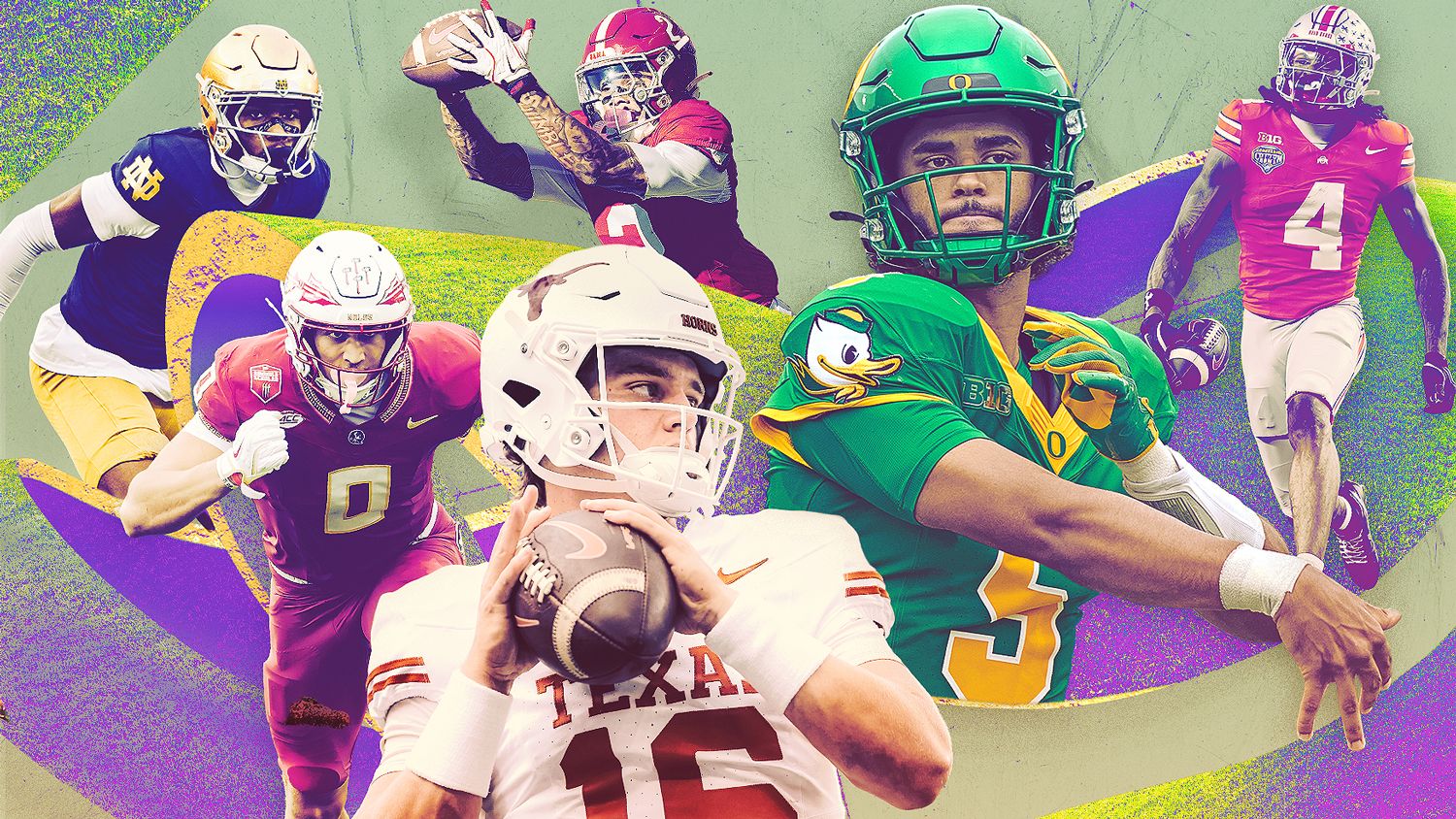
EmailPrintOpen Extended ReactionsHeading into the 2025 college football season, it was clear that new quarterbacks were going to tell the tale. Thirteen of the top 21 national title contenders had new starters, and nine of the top 15 names on my most important players list were either first-time starters or starting at a new school. (Another new starter, Fernando Mendoza, would go on to define the season.)A different story is taking shape in 2026. With a couple of extremely prominent exceptions in Tuscaloosa and Lubbock, most of this year's top-ranked schools will feature veterans. Ohio State's Julian Sayin, Texas' Arch Manning, Oregon's Dante Moore, Notre Dame's CJ Carr and Georgia's Gunner Stockton, among others, all have at least one year of starting experience at their current schools. Meanwhile, a couple of key, new starters -- Indiana's Josh Hoover and Miami's Darian Mensah -- have two years of starting experience elsewhere.This year's key passers bring far more experience to the table, while nearly every contender seems to be counting on key, new pass catchers and pass rushers to come through. Every season has its own different personality.It's time for my annual most important players list. Below are 40 players who could define the season with moments, or long spells, of greatness. Some play for contenders, while others play for the teams that might prevent contenders from reaching their goals. All of them will have a chance to make their mark on 2026.(As I write in this piece every year, there are birds in hand and there are unfinished products. This list is typically about the latter, and we'll say that Sayin, Stockton and Carr are ineligible for any "potential breakthrough" category after finishing in last year's Total QBR top 10.)Jump to:New QBs | Breakthrough candidatesSpoilers-turned-contenders? | Star turns| Important transfersTranscendental potential | Conference analysisNew likely QBs for potential contenders1. Keelon Russell, Alabama. I've been giving this answer away all offseason. Russell was one of 2025's top prospects and spent a redshirt year watching everything Ty Simpson had to do to carry the weakest Alabama offense in years to the College Football Playoff. Now he has to do the same with an even less proven skill corps and a brand-new offensive line. Recruiting rankings tell us there's plenty of raw talent here, and the Bama run game can't get any worse than it was in 2025. But while Russell hasn't even officially won the job yet, he might be the only guy with the upside to drive this offense to solid heights. If he's not awesome, Alabama probably isn't either.2. Josh Hoover, Indiana (No. 36 in 2025). It is a product of the transfer era that a guy can have 9,629 career passing yards, 19 career wins and massive shoes to fill. Hoover takes over in Bloomington after Fernando Mendoza's one-year trifecta -- Heisman, national title, No. 1 pick. Hoover has a live arm and takes fewer sacks, but Mendoza was almost robotic in his timing and decision-making, and Hoover will have to raise his game (and cut down on the interceptions a bit) to meet IU's new standard.3. Darian Mensah, Miami (No. 32 in 2025). After his controversial, late-in-the-transfer-window departure from ACC champion Duke, Mensah will now try to take Miami to the one place Carson Beck couldn't. Beck led Miami to within 47 yards of the national title and produced a higher level of efficiency, but Mensah makes more big plays and throws fewer picks. He'll have both Malachi Toney and Duke star receiver Cooper Barkate at his disposal. Can he handle a brighter spotlight and higher expectations?4. Will Hammond, Texas Tech. The first time he filled in for an injured Behren Morton last season, Hammond was super promising. The second time, he was partially responsible for Texas Tech's only regular-season loss, then tore his ACL. Now, thanks to the Brenden Sorsby saga, he's rushing back to take the reins of a potential top-five team. When healthy, he's a promising efficiency passer and dangerous scrambler. He'll have to be both healthy and good as soon as possible.Others: Sam Leavitt, LSU (No. 34 in 2025).QBs with a game-changing leap in them5. Arch Manning, Texas (No. 1 in 2025). We might have already seen this leap, of course. Manning led the nation in Total QBR from November onward last season, throwing 11 touchdown passes with just one interception while mixing in selective but devastating running. He must still shore up his fundamentals when throwing on the move, but we saw all the potential we were supposed to see late in 2025. Now, with a thinner but more high-upside supporting cast, will we see Manning's final form as a can't-miss quarterback?6. Dante Moore, Oregon (No. 5 in 2025). He would have been a top-two pick in this year's NFL draft, but Moore returned to Oregon for another season, both because the money was good and because he still had some work to do. His raw numbers were excellent in 2025, but he finished just 15th in Total QBR in part because, against the best defenses, he had little to offer: In five games against SP+ top-10 defenses, he averaged just 5.9 yards per dropback with a 36% success rate and four TDs to five INTs. His receiving corps should be more stable and experienced this fall, but he still has to prove he can make big-time throws to beat big-time defenses.7. John Mateer, Oklahoma (No. 13 in 2025). Mateer's most enjoyable qualities are also his most dangerous. He's unafraid to throw his body around, but he also spent a large portion of 2025 at less-than-100% health. He is willing and able to fire risky balls downfield in the name of big plays, but he ranked 89th nationally in interception rate and 78th in completion rate. Can Mateer balance his playmaker instincts with the stability and consistency required to lead a CFP run? Will tamping down mistakes also limit his upside?8. Marcel Reed, Texas A&M (No. 14 in 2025). Reed was like a more dangerous Mateer: His mistakes were just as cataclysmic -- he had an even higher interception rate and lower completion rate, but he also made more big-time passes and rushed for more yards in far fewer attempts (while taking far fewer hits). He made mistakes in bunches, seemingly struggling to move past one before making another. If he can iron that out with more experience, he should have everything he needs to make another CFP push.Others: Bear Bachmeier, BYU; Bryce Underwood, Michigan.QBs with spoiler and contender potential9. Demond Williams Jr., Washington. Williams' first season as UW's starter was a thrill ride: He completed 20 passes of 30-plus yards with 14 rushes of 20-plus, and Washington leaped from 6-7 to 9-4 and from 66th to 20th in offensive SP+. Against three top-20 defenses, however, he was dismal -- 4.5 yards per dropback, 9.0 points per game -- and he got starry-eyed and briefly entered the transfer portal despite re-signing with the Huskies. Assuming he has regained his teammates' trust (I bet he has), the biggest issue will be that "beating good defenses" thing: Washington is a projected favorite in nine games, but its fate will be decided by season-ending games against Indiana and Oregon.10. Faizon Brandon or George MacIntyre, Tennessee. Tennessee returns seven starters from an offense that surged back to seventh in offensive SP+ last season. The Volunteers' defense will be a work in progress under new defensive coordinator Jim Knowles, but the offense could still carry serious weight, and lead either some upset bids or a CFP push, if the new starting QB of choice -- either the redshirt freshman MacIntyre (the No. 109 prospect in the 2025 class) or the dynamic and particularly young Brandon (the No. 14 prospect of 2026) -- is able to steer the ship without too many mistakes.11. Aaron Philo, Florida. In four years at Troy and Tulane, Jon Sumrall won a conference title and at least 11 games three times; he almost certainly won't accomplish that in his first year at Florida, but he's a hell of a coach. If the combo of Buster Faulkner (last year's Georgia Tech offensive coordinator) and Philo (last year's Tech backup QB) can deliver a decent level of play, a solid turnaround, complete with a big upset or two, are possible. Philo was thrilling in a small sample, but obviously that doesn't automatically translate to a full season in the SEC.Others: Anthony Colandrea, Nebraska; Katin Houser, Illinois; LaNorris Sellers, South Carolina (No. 11 in 2025); Austin Simmons, Missouri (No. 15 in 2025).Potential stars in need of a breakthrough12. Ryan Coleman-Williams, WR, Alabama (No. 27 in 2025). The first non-QB on this list will desperately need to help the first player on this list. Coleman-Williams suffered the worst drop rate of any highly targeted receiver in 2025 (13.0%), and after averaging an otherworldly 5.0 yards per route in his first five collegiate games -- for reference, Ohio State's Jeremiah Smith has averaged 3.3 yards per route for his career -- Coleman-Williams has averaged an extremely mediocre 1.5 ever since. Nothing in the world would help Keelon Russell's cause more than a dynamic and confident No. 1 receiver.13. Brandon Inniss, WR, Ohio State. Even against double coverage, Jeremiah Smith is probably going to have a pretty good year in 2026. But if Ohio State has a properly dangerous No. 2 wideout -- last year's No. 2 Carnell Tate and tight end Max Klare are both gone -- then Smith could make a Heisman push. Inniss, now a senior, was a reliable if tame weapon in 2025, suffering zero drops but averaging just 7.5 yards per catch. Transfers and five-star freshmen such as Chris Henry Jr. will play roles, but bigger contributions from Inniss would be huge.Others: Mario Craver, Texas A&M; Micah Gilbert, Notre Dame; Andrew Marsh, Michigan; Kaiden Prothro, Georgia; Aneyas Williams, Notre Dame.Most important non-QB transfers14. Cam Coleman, WR, Texas. Texas head coach Steve Sarkisian traded depth for star power this offseason: Only two of last year's top six return in the Longhorns' receiving corps, but in Coleman, Sarkisian added the most sought-after receiver in the portal. Coleman averaged a decent, but unspectacular, 1.7 yards per route at Auburn last season, but he could benefit massively from the QB upgrade he'll see in moving to Austin. If Manning also benefits from Coleman's presence, Texas will be ridiculously dangerous.15. Isiah Canion, WR, Georgia. Georgia desperately needs a bigger big-play presence in 2026 -- it's virtually the only thing separating the Bulldogs from the national title-level form. But with five of Gunner Stockton's top six targets gone, the receiving corps will be asked to both maintain high efficiency levels and add more pop. That's where Canion theoretically comes in. The junior averaged 14.6 yards per catch at Georgia Tech in 2025, and 11 of his 39 career receptions have gone for 20-plus. But a lot will be asked of a guy with just 39 career catches.16. Adam Trick, LB, Texas Tech. An army of transfers helped to flip Texas Tech's defense from 95th to third in defensive SP+, but now Joey McGuire needs a brand-new pass rush with David Bailey and Romello Height (combined: 24.5 sacks, 35.5 TFLs) gone. Trick, Trey White (San Diego State) and Jamond Mathis (Kent State) have major potential and huge shoes to fill. Trick is particularly exciting -- his 8.5 sacks came from a massive 19.3% pressure rate (Bailey's was 20.2%) -- but he must meet expectations from Day 1.17. Damon Wilson II, DE, Miami. Miami returns experience at defensive tackle, linebacker and throughout the secondary after last year's surge to seventh in defensive SP+. But coordinator Corey Hetherman must replace the absurd defensive end combination of Rueben Bain Jr. and Akheem Mesidor (combined: 36 TFLs, 22 sacks). Wilson made nine sacks at Missouri last season and he'll need a dance partner on the edge, but if he's as good as advertised, the problem is half-solved.18. Terrell Anderson, WR, USC. Quarterback Jayden Maiava was incredible for USC last season, but four of his top five 2025 targets are gone, including Biletnikoff winner Makai Lemon. Sophomore Tanook Hines leads a massively talented set of young targets, but Anderson, an NC State transfer, will be a veteran leader by default. He caught 39 passes and averaged a healthy 2.1 yards per target in Raleigh, and if he thrives with Maiava, USC's playoff potential ignites.19. Jordan Seaton, OT, LSU. If Lane Kiffin fields the typical Lane Kiffin offense in his first season in Baton Rouge, his Tigers will have top-10 potential. That will obviously require big things from QB transfer Sam Leavitt and a number of new receivers, but in Jordan Seaton, Kiffin did grab one of the surest left tackles in the portal. If Seaton's a brick wall, Leavitt will likely do just fine.20. James Smith and/or John Walker, DL, Ohio State. Matt Patricia's first Ohio State defense was absurdly good, but he's now replacing nine of the 13 players who saw 300-plus snaps; that includes four of five defensive linemen. There are plenty of former star recruits in the pipeline, but Ryan Day and Patricia will need strong, veteran contributions from at least one transfer big man, be it Smith (24 tackles and 5.5 TFLs at Alabama last year) or Walker (38 tackles, 3.5 TFLs at UCF).21. Kenny Johnson, WR, Texas Tech. For as much pressure as Will Hammond will be facing at Tech, the receiving corps, which lost a pair of 50-catch receivers, needs new contributors, too, be it Johnson (Pitt), Donte Lee Jr. (Liberty), Malcolm Simmons (Auburn) or Jalen Jones (Alabama State). Johnson finished the 2025 season with a couple of duds, but he averaged 14.5 yards per catch with a pair of 100-yard games. He might be the most likely No. 1 of the bunch.Of the seven players I'm highlighting here, five are either wideouts or edge rushers. (For that matter, so are six of the 10 players in the "Others" section below.) That seems noteworthy. Just as new QBs told a major story last year, new pass catchers and pass rushers might do the same in 2026.Others: Cooper Barkate, Miami; Khalil Barnes, Georgia; Jayce Brown, LSU; Raleek Brown and/or Hollywood Smothers, Texas; Isaiah Horton, Texas A&M; Nick Marsh, Indiana; Tobi Osunsanmi, Indiana; Koi Perich, Oregon; Devan Thompkins, Alabama; Princewill Umanmielen, LSU.Pure transcendence potential22. Jeremiah Smith, WR, Ohio State (No. 24 in 2025). It might be one of the more exciting thoughts of the season: Smith caught 87 balls for 1,243 yards and 12 scores last year in an offense that took almost no risks whatsoever thanks to a nearly perfect defense and an inexperienced quarterback. What might he be capable of if Ohio State actually has to throw the ball every now and then?23. Malachi Toney, WR, Miami. Similarly, what might this sophomore be capable of once he has learned a full route tree? Despite nearly half his routes being screens, hook routes and easy short stuff, Toney still caught 109 balls for 1,211 yards as a true freshman in 2025. With experience and a more explosive passer at his disposal, look out.24. Leonard Moore and/or Christian Gray, CB, Notre Dame (No. 28 in 2025). You rarely see a cornerback duo this ridiculous at the college level. Despite each missing two games last season, Moore and Gray combined for seven interceptions and 20 pass breakups and allowed a QBR of 25.8. Moore is more active in run defense and allowed an unreal 8.1 QBR -- he's the marquee name. But as a duo, they're unfair. You better not ever have to pass on Notre Dame.25. Colin Simmons, OLB, Texas. It's really fun when a five-star blue-chipper lives up to (or threatens to exceed) his hype. In two collegiate seasons, Simmons has recorded 31 tackles for loss, 21 sacks, 16 run stops and six forced fumbles. He has made a tackle on 10.1% of his snaps -- usually only inside linebackers or particularly active safeties top 10% -- and he's still learning his craft. What happens when he masters it?Others: Rasheem Biles, Texas; Brandon Finney Jr., Oregon; Mark Fletcher Jr., Miami; Brice Pollock, Texas Tech; Ellis Robinson IV, Georgia; Tate Sandell, Oklahoma; David Stone, Oklahoma.Breaking down the other conferencesACC26. Kevin Jennings, QB, SMU (No. 29 in 2025). While Miami is a commanding favorite in the ACC race this season, SMU starts out the year No. 2, per DraftKings. The Mustangs have a spicy early schedule -- at Florida State on Labor Day in Week 1, at Louisville in Week 3 -- but they could have the maturity to meet the moment thanks to Jennings, a third-year starter who led them to the CFP in 2024. He's a high-volume passer and an A-grade sack avoider and scrambler, and though he struggles at times to move past mistakes, he is one of the more battle-tested players in college football at this point.27. Christopher Vizzina, QB, Clemson. My March SP+ rankings liked Clemson by a nose in the No. 2 spot, but that will require some good stuff from Vizzina, a longtime backup to quarterback Cade Klubnik and the favorite for the starting job in 2026. (He'll have to beat out true freshman Tait Reynolds, but he is expected to.) With juniors T.J. Moore and Bryant Wesco Jr. returning, he'll certainly have solid pass catchers at his disposal.28. Lincoln Kienholz, QB, Louisville. Jeff Brohm's Cardinals are my personal lean for the ACC No. 2 spot, but the return of only three offensive starters means the Cardinals will be leaning on quite a few high-upside transfers to score points. Granted, that's usually not a problem for a Brohm offense, but in Kienholz he has a passer with more athleticism and upside than last year's starter Miller Moss but also a player who has attempted just two non-garbage-time dropbacks in the last two seasons. Is he ready?29. Isaac Brown, RB, Louisville. Kienholz will at least have one of the most well-rounded running backs in the country sharing the backfield with him. Brown was the main reason Louisville ranked 10th in rushing success rate last season, but in just nine games he also ripped off runs of 78, 73, 68, 62, 53, 52 and 31 yards. Six of those went for touchdowns. He's a game changer and potentially a title-race changer.30. Duce Robinson, WR, Florida State. FSU has major ACC spoiler potential in 2026 thanks to a schedule featuring Miami, SMU, Clemson and Louisville. And if the new Ashton Daniels-to-Robinson connection is strong, the Noles might have some sleeper contender potential as well. Despite QB limitations, the 6-foot-6 Robinson gained 1,081 receiving yards and averaged 2.9 yards per route in 2025, and Daniels is a more prototypical passer than last year's starter, Tommy Castellanos.Others: Malcolm Alcorn-Crowder, SMU; CJ Bailey, NC State; Jackson Cantwell, Miami; Ashton Daniels, Florida State; Ethan Grunkemeyer, Virginia Tech; Beau Pribula, Virginia.Big 1231. Bear Bachmeier, QB, BYU. BYU had to unexpectedly hand the reins to Bachmeier, a true freshman, last season and had to keep the offense pretty cautious and low tempo because of it. The Cougars also went 12-0 against teams not named Texas Tech. Kalani Sitake's Cougars have proven size and physicality in the trenches, and they could unfurl a new level of upside in 2026 if Bachmeier is able to learn and develop further. That will require receivers, however: Last year's three primary targets are gone. That could be an obstacle, but as we look for the most likely team to challenge Texas Tech, BYU is an obvious potential choice.32. Avery Johnson, QB, Kansas State (No. 33 in 2025). In theory, it's pretty tantalizing: Take Johnson, a dynamic dual threat and former blue-chipper with a solid arm and excellent mobility and sack avoidance, and make him 10% more like Collin Klein, and you have something special. Klein's toughness and third-down perfection made him the perfect Bill Snyder quarterback, and his leadership abilities were strong enough to make him a power-conference head coach by age 36. His first year in charge at his alma mater could be a big one if he and Johnson form a strong partnership. (And a schedule that somehow doesn't include Texas Tech, BYU or Utah gives them some margin for error, too.)33. Daylen Austin, S, Arizona. Arizona more than doubled its win total in 2025, thanks in part to one of the best pass defenses in the country. The Wildcats' offense should be strong again thanks to veteran quarterback Noah Fifita & Co., but without last year's top five defensive backs, coordinator Danny Gonzales will need some huge contributions from transfers like Austin, a former blue-chipper and Oregon backup who certainly looked the part in a small sample. With another top-30 defense, Arizona is a Big 12 contender.34. Wayshawn Parker, RB, Utah. Utah surged from 96th to sixth in offensive SP+ last season thanks in part to a brilliant marriage between coordinator Jason Beck and quarterback Devon Dampier. We'll have to see if Dampier can create the same type of magic with new coordinator Kevin McGiven, but in Parker the Utes have one of the most well-rounded backs in the country. If he can carry a big workload and keep Dampier from taking too many hits, Utah should be a Big 12 contender once again.35. Jaden Craig, QB, TCU. After the combination of coordinator Kendal Briles and quarterback Josh Hoover brought Sonny Dykes a pair of nine-win seasons, Dykes is now turning things over to a very new and very unique -- and northeastern -- combination: Coordinator Gordon Sammis takes over the playcalling after leading an exciting and nearly mistake-free UConn offense, and Craig, a Harvard transfer, takes over behind center. The 6-3, 230-pound senior threw for 6,074 yards and 52 TDs with the Crimson, but going from the Ivy League to the Big 12 is a huge, and fascinating, leap.Others: Cutter Boley, Arizona State; Devon Dampier, Utah; Noah Fifita, Arizona; Wendell Gregory, Kansas State; Shadre Hurst, Houston; Drew Mestemaker, Oklahoma State.Group of 636. Maddux Madsen, QB, Boise State (No. 37 in 2025). Madsen and BSU had an odd 2025 season: They were every bit as good as they were supposed to be ... except when they were terrible. Injuries didn't help, but in the four starts Madsen lost, he completed 53% of his passes with a 1-to-6 TD-to-INT ratio and a 14.2 QBR. In seven wins, he had a 61% completion rate, 17-to-3 TD-to-INT ratio and 80.3 QBR. If Madsen is healthy and consistent again -- not a given with a pretty new receiving corps -- BSU is probably your Group of 6 CFP favorite again.37. Air Noland or Marcus Stokes, QB, Memphis. The American Conference got wrecked by major turnover among its more high-upside programs last season, and it's the major reason an experienced, high-floored Navy team starts out with the highest projected SP+ rating. The high-upside programs still have major potential, however, and if new Memphis head coach Charles Huff has a strong quarterback -- be it an unproven former blue-chipper (Noland) or a former Division II passer with 3,350 career passing yards (Stokes) -- his Tigers will contend.38. Jackson Arnold, QB, UNLV. It's Last Chance Saloon time for the former blue-chipper who couldn't really get things going at Oklahoma or Auburn. Arnold is speedy and has a solid arm, and if anyone can make the most of his skill set, you figure it's Dan Mullen, one of the better dual-threat QB whisperers of the 21st century. Arnold will have to beat out Alex Orji for the job, but he has more upside as a passer, and if he can make big plays while cutting down on disastrous sacks, UNLV otherwise has the depth and upside to threaten in the G6.39. Owen McCown, QB, UTSA. At first, he was a novelty of sorts -- hey, look, former NFL quarterback Josh McCown's son is playing college ball! We're so old! But two years and 6,400 passing yards later, McCown has become one of the most proven mid-major players in the country. And with running back Will Henderson III and receiver AJ Wilson, he has one of the most explosive skill corps duos in the country at his disposal, too. I'm not sure UTSA has the defense to contend for a CFP spot, but North Texas nearly made it with raw offensive firepower last season. The Roadrunners could make the same threat in 2026.40. Michael Van Buren, QB, South Florida. After a promising freshman season at Mississippi State and a mostly lost season at LSU, Van Buren lands in Tampa to take over behind center at another one of those high-upside American Conference programs. New head coach Brian Hartline will have an almost entirely new offensive two-deep, but Van Buren has an accurate arm and speedy legs and could make the Bulls awfully dangerous.Others: Micah Alejado, Hawaii; Will Henderson III, UTSA; MarcAnthony Parker, Navy; Dylan Riley, Boise State; Jayden Virgin-Morgan, Boise State (No. 39 in 2025).