
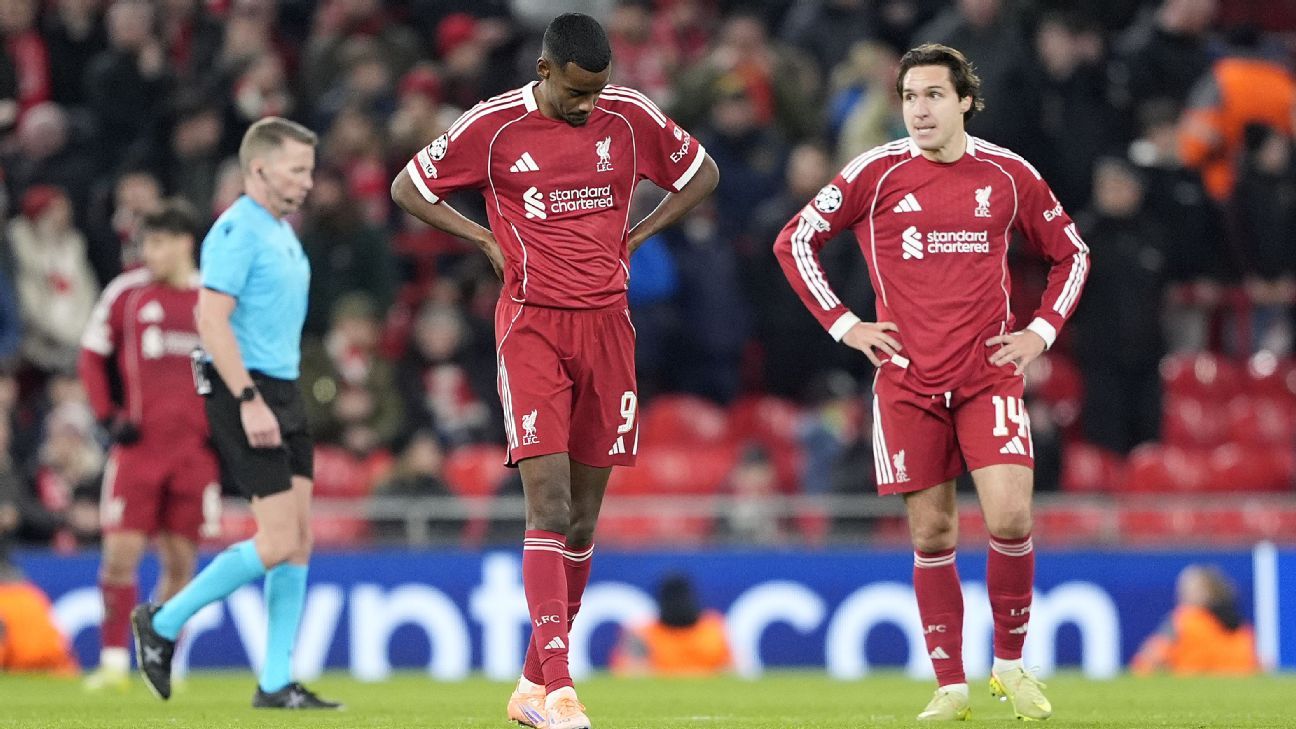
EmailPrintOpen Extended ReactionsCongrats, you just won the summer transfer window!What's next?You might not want to know -- just ask Liverpool.After winning the Premier League trophy in the 2024-25 season, Liverpool spent the following transfer window stocking up on multiple record-price signings, attacking superstars, high-flying fullbacks, defensive depth, and a bunch of uber-talented prospects. Liverpool were the best team in England, and -- if you looked at who they added on paper -- they got so much better.When it came time to play the actual games with this new-and-improved squad, well, Liverpool stunk instead. They finished fifth, and only qualified for the Champions League because of the new rule that gave the Premier League an extra slot. They won 24 fewer points than they had the previous season, and they fired coach Arne Slot a year after he won them their second-ever Premier League title.This, too, didn't happen to just any club: it was Liverpool, the big club with what's supposed to be the best decision-making apparatus in the sport. So, if Liverpool "won the transfer window" and got worse, then what might that mean for whoever we crown as the victor in this summer's window?It might not quite be a curse, but it turns out that "winning the transfer window" doesn't mean much if you're trying to win soccer games.The winners of the last 10 summer transfers windowsThis is an admittedly subjective exercise, and some summers have clearer "winners" than others. But I went through the last 10 years of summer transfers and identified which clubs various media outlets (including ESPN) declared the winner of the window.Then, I applied an advanced analytical metric to each year called "what I remember feeling at the time" to identify a single winner for each summer. You may not agree with whatever team I've chosen, but that's not really important. What is important is selecting 10 teams that were close-to-universally praised for the players they signed during the window.Here's the list:2016: Manchester United. They broke the transfer record to acquire Paul Pogba right after he'd taken Juventus to a Champions League final. They added one of the top young centerbacks in Europe in Eric Bailly from Villarreal and one of the best attacking midfielders in Henrikh Mkhitaryan from Borussia Dortmund. Oh, and they nabbed some guy called "Zlatan Ibrahimovic" as a free agent.2017: Paris Saint-Germain. While this was the summer that funded the best team in Premier League history, as Manchester City went on to win 100 points in Pep Guardiola's second season in charge, PSG remain the obvious answer for 2017's winner. They signed Kylian Mbapp ... as an afterthought. That's because they more than doubled the fee Man United paid for Pogba the previous summer and flipped the global hierarchy on its head in acquiring Neymar from Barcelona.2018: Liverpool: A day after losing the Champions League final to Real Madrid, Liverpool announced the signing of Fabinho from Monaco. And they'd already secured the services of the top young midfielder in Europe: Naby Keita from RB Leipzig. If overhauling the midfield wasn't enough, they replaced Loris Karius -- he of the multiple mistakes in the Champions League final -- with one of the best keepers in the world in Roma's Alisson Becker. And they signed the Power Cube, Xherdan Shaqiri, on a cut-rate deal for added attacking depth.2019: Arsenal. At ESPN, our headline declared Arsenal "the big winners" for the club-record acquisition of winger Nicolas Pp from Lille, along with widely respected left back Kieran Tierney from Celtic, midfielder Dani Ceballos on loan from Real Madrid, and center back David Luiz from Chelsea. This was officially the beginning of the post-Arsene Wenger era.2020: Chelsea. The pandemic screwed with everyone's finances -- unless you were owned by a Russian oligarch. Chelsea spent a combined 250 million on two of the best young players in the Bundesliga (Timo Werner from Leipzig and Kai Havertz from Bayer Leverkusen), star playmaker Hakim ZIyech from Ajax, stalwart left back Ben Chilwell from Leicester City, and new starting keeper douard Mendy from Rennes. They also signed superstar center back Thiago Silva as a free agent.2021: Paris Saint-Germain. Chelsea broke their transfer record to fix their one apparent weakness by acquiring striker Romelu Lukaku from Inter Milan. Manchester United signed Cristiano Ronaldo again, after bringing in perhaps the most coveted young attacker in the world in Jadon Sancho from Borussia Dortmund. But this was the summer that PSG signed the following players: Achraf Hakimi, Nuno Mendes, Gianluigi Donnarumma, Sergio Ramos, Georginio Wijnaldum Danilo Pereira, and Lionel Messi.2022: Manchester City. This would've been true with just one player -- they signed Erling Haaland from Borussia Dortmund for 60 million, or something like one-third of what might've been expected. They also added England starter Kalvin Phillips, Manuel Akanji from Borussia Dortmund, and officially integrated Julin lvarez from River Plate.2023: Chelsea. This was the second summer of BlueCo's ownership of the club, but while 2022 was a scattergun approach aimed at seemingly any player that the new owners recognized from watching their children play video games, 2023 was directed at players that everyone else wanted, too. They spent more on transfer fees than any club ever had in a single window. The most notable names were Moiss Caicedo, who was acquired for a Premier League-record fee from Brighton, teenage midfield veteran Romeo Lavia from Southampton, Manchester City's Cole Palmer, and RB Leipzig's attacking dynamo Christopher Nkunku.2024: Real Madrid. They signed Mbapp as a free agent after winning the Champions League. That's enough to be the summary by itself, but they also acquired the next Brazilian prodigy -- somehow people were actually comparing to Pele -- in Endrick from Palmeiras.2025: Liverpool. They broke the Premier League transfer record twice: first for Florian Wirtz from Bayer Leverkusen, then for Newcastle's Alexander Isak. They spent 95 million on the uber-talented Hugo Ekitike from Eintracht Frankfurt. Everyone agreed that Bournemouth's Milos Kerkez was a star-in-waiting-if-not-already at left back. The 40-million fee was nothing for Leverkusen wingback Jeremie Frimpong. And 18-year-old Giovanni Leoni was already a started for Parma and finally signaled a plan for life after Virgil van Dijk.So, after all 10 summers -- what happened next?Winning the transfer window gets you a whole lot of nothingIf "winning the transfer window" was actually a meaningful achievement, we'd expect there to be a pretty clear relationship between winning the window and, you know, winning soccer games. But is there?Here's how each of the previous 10 window-winners fared the season before they won the transfer window (points, goal differential, finish), and in the season after they won the transfer window:So, if you add that all up, what do you get if you win the transfer window?On average, across an entire season: Points: an improvement of 0.5 Goal differential: an improvement of 0.1 Table position: an improvement of 0.1Winning the transfer window is worth ... basically nothing. At least, in your domestic league.In European competition, things look somewhat better. Man United did win the Europa League in 2017. Liverpool won the Champions League in 2019 after winning the summer 2018 window -- and the same was true for Chelsea in 2021 and City in 2023.But those are knockout tournaments with volatile results and uneven schedules, so I'd be careful in attributing too much of those year-over-year changes to successful summer business. Really, the only team that I think you can do that for is Liverpool in 2019. At least, they're the only side over the past 10 years to win the summer window and improve in all phases: points, goal differential, table position, and European competition.But even there, how much of 2019 Liverpool's improvement was because of the players they signed over the summer? So much of it came down to things like Virgil van Dijk playing his first full season after arriving in January or Andy Robertson and Trent Alexander-Arnold blossoming into genuine superstar fullbacks at the same time.Why, then, doesn't best-in-show transfer success translate to on-field success?To start, we, the media, are not very good at identifying "good" transfers. We just look at what teams spent the most money and got the most famous players and declare them the winners.This doesn't make much sense -- especially since history tells us that most teams are bad at identifying talent and that the most expensive transfers tend to fail. The transfer window is an incredibly inefficient market, and so the teams that are spending the most money each summer are falling prey to that inefficiency more than anybody else.On top of that, for a team to be crowned "winner" of the summer window, there usually has to be something wrong with them. Manchester United and Cheslea have each won windows because they were compelled to fix things after disappointing seasons. Except, the people spending all that money are the same people who made all the previous decisions that led to the disappointment in the first place.Madrid and PSG both "won" windows because they were obsessed with famous players and not focused on building coherent teams. Arsenal "won" a window because they wanted to make a statement for their first manager after Arsene Wenger.And of course, Liverpool won the last transfer window because they signed so many new players who everyone loved -- and they did it after winning the Premier League. But the main reason why they signed so many players is that they lost four major contributors to the team that had just won the Premier League.So, with about a month left in the transfer window, let's try to remember all of this as we inevitably crown a winner at the beginning of September. Whoever spends hundreds of millions of dollars on fees to acquire all those flashy new names? Their most likely outcome is the same thing that happened before all of those new players arrived.