
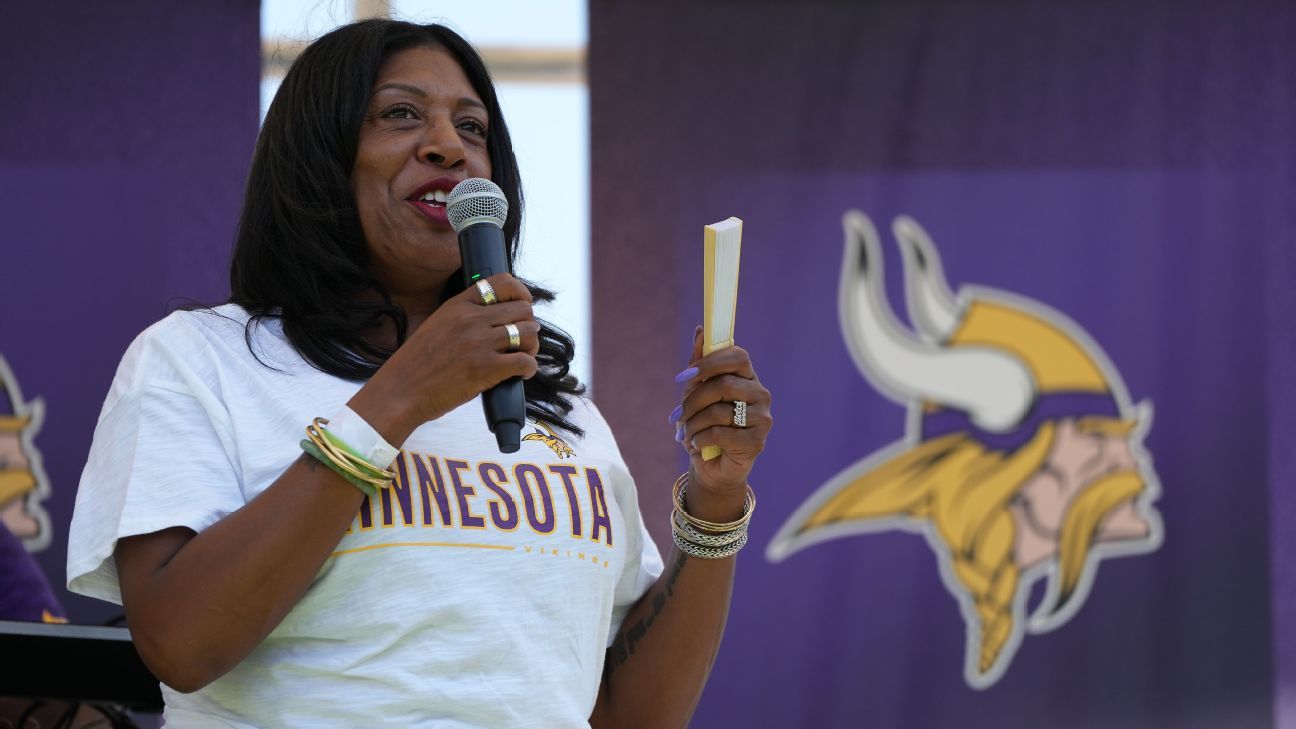
EmailPrintOpen Extended ReactionsEAGAN, Minn. -- Saturday marked the first time that Kelci Stringer didn't feel sad on the anniversary of her husband's death.As she awoke in a hotel adjacent to the Minnesota Vikings' practice facility, she felt an entirely different emotion."It's been 25 years," she said, "and we're still talking about him. So that's pretty cool. It makes me happy."Korey Stringer died on Aug. 1, 2001, from complications of heatstroke after collapsing at Vikings training camp. At the invitation of the team, Kelci returned to Minnesota this weekend along with her son Kodie, 28, and mother, Regina Jones, to remember Korey and celebrate all the good that has come from that tragic day. It was a symbolic capstone for what had once been a contentious relationship, punctuated by a $100 million wrongful death lawsuit.In a 30-minute interview with ESPN, Kelci laughed, cried and looked toward the future. She said the sole purpose of her lawsuit was to learn the full story behind Korey's death, through discovery and depositions. The resulting details -- most notably that the team's athletic trainers did not recognize the symptoms of heatstroke, and that Korey was not treated for it until he reached the hospital in critical condition -- inspired her to found the Korey Stringer Institute, which works to prevent sudden death in sports, the military and among laborers."I didn't care about the money," she said. "I mean, what was that going to do? [Settling] for a couple of million dollars, right? I mean, that wasn't the issue. With hindsight, I'm glad that it worked out the way it did, because it would have been pushed under the rug. Not to vilify anyone, but if people didn't know the details, all the things that have come since then in terms of awareness and people's willingness to embrace best practices probably wouldn't have been as powerful."Korey's death brought near-immediate change to the way NFL teams approached practices in the heat, and the KSI has worked to change regulations in 38 states to protect college and high school athletes with certified athletic trainers, cold tubs for quick cool-downs and other best practices."It's probably the single greatest example you can point to of turning a tragedy into a triumph," said Jeff Miller, an NFL executive vice president who oversees player health and safety and took part in Saturday's event.But Kelci grew emotional as she recounted the occasional stories she hears about heatstroke-related deaths in sports. Death from heatstroke is entirely preventable if treated correctly and in a timely fashion."It's gut-wrenching every time," Kelci said. "I've heard a couple in high school where the best practices weren't done. And the kid died. They're kids. When they come to us at KSI and tell that story, I honestly feel guilty. So sometimes it feels like it's not enough." Saturday, though, was otherwise a happy day for the Stringers and the team. Kelci and Kodie participated in the team's huddle breakdown after a midday walk-through. They spoke with current players, including the two most recent winners of the local media's Korey Stringer Good Guy award -- receiver Justin Jefferson and safety Joshua Metellus -- and met with coach Kevin O'Connell.Later, Kelci participated in a panel discussion led by Vikings radio analyst Pete Bercich, a teammate of Korey's from 1995 to 2000. Vikings owner Zygi Wilf and a dozen other former teammates, including Pro Football Hall of Fame inductees John Randle and Randall McDaniel, watched from the audience. Afterward, there were hugs and reunions with players, executives and even the neighbors who lived across the street from the Stringers during Korey's career."There were always two different sides to it," Hall of Fame receiver Cris Carter said during an earlier visit to camp. "I knew Korey and Kelci since they were at Ohio State together. His locker was right next to mine. I've had a lot of bad days, but none worse than the day he died."But I know the Vikings, too. It's been 25 years since I took off their uniform and they treat me the same as when I was making the Pro Bowl. They'll do anything for their players and I have witnessed that, and Korey was one of their favorites. I can understand how she felt that way for a long, long time. There's just nothing that ever prepares you for what happened. So for me, to both parties, I am really just hoping for the best."Indeed, it would have been difficult to imagine Saturday's scene 25 years ago, when the relationship between the family and team was toxic. Former owner Red McCombs had declined to pay out most of the $8 million remaining on Stringer's contract, which legally was voided by his death, despite the urging of many people inside and outside the organization. The Stringer family lawsuit, meanwhile, was filled with invective toward members of the organization. It ultimately failed in state court, and upon ruling for the Vikings on final appeal in 2005, a judge ordered the family to pay the team's legal fees.The Vikings never sent that bill, however, and the relationship began thawing under the Wilf family ownership."I can't believe the way the Wilf family has turned this around," Kelci said. "I mean, I was shocked when they took over and now they recognize Korey, because they didn't have to do that. They just did not. Under any circumstances. There was no legal pressure. There was nothing. There was no need. They just did. So I thought that to be super kind and super humane for Korey. Maybe that was just Korey's energy still being here. I would have never thought that it could come to this and just be open arms and I would have been participating."But I do feel it's all that Korey deserved."