
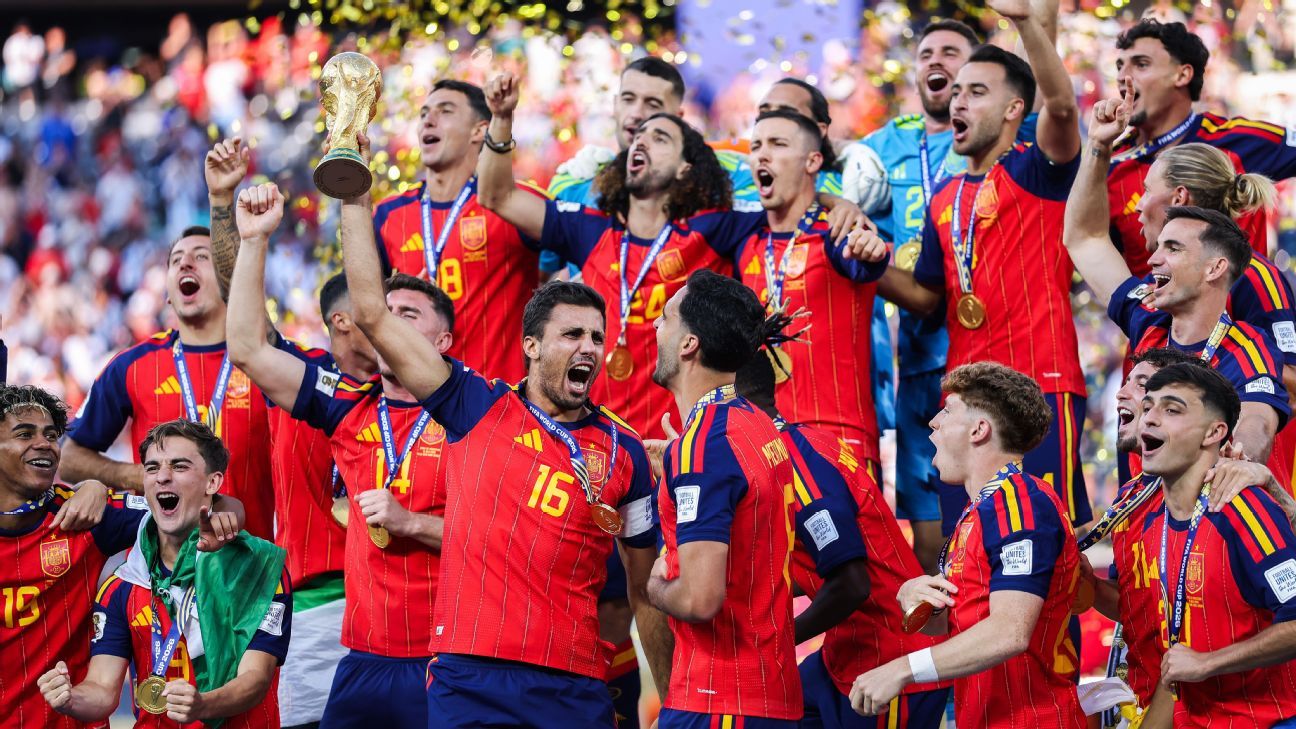
EmailPrintOpen Extended ReactionsSince the final whistle blew on the World Cup final in New York -- er, East Rutherford, New Jersey -- on Sunday, I've been trying to reconcile these two thoughts: (1) Spain were not the most talented team at this World Cup, and (2) Spain might be the best international soccer team we've ever seen.The latter isn't recency bias, either. We have Elo ratings going back to the first international match ever played. The system awards or subtracts points to every country for every game they play -- and Spain are the highest-rated team in the system's history. The main reason why: They haven't lost a game since March of 2024, the longest unbeaten streak in the history of men's international soccer.It's not like we didn't see it, either. France came into the semifinals as the World Cup favorites, with arguably the three best attackers in the world all on the same team, scoring goals for fun. And Spain smothered them, conceding 10 shots, no quality chances, zero goals.Just for good measure, they made the headlock even tighter against Argentina and Lionel Messi -- the defending champs and the best player of all time -- sucking the life out of them in the final.Spain, inarguably, had the best team at the World Cup, but why?Spain's two starting fullbacks, Pedro Porro and Marc Cucurella, were both average-ish Premier League players for Tottenham and Chelsea this past season, as both clubs suffered through nightmare seasons. The senior center back, Aymeric Laporte, had left for the much worse the Saudi Pro League. Even Pau Cubars, the young player of the tournament, has been more of a "great teenager" than a "great player who is also a teenager" for the start of his career with Barcelona.Then, take the attackers: lex Baena spent most of this past season coming off the bench for an Atletico Madrid team that finished fourth in Spain. And while Mikel Oyarzabal has scored a bunch of big goals for Spain in the past, it has been eight years since he reached even double-digit non-penalty goals in a LaLiga season. Lamine Yamal, of course, is already a superstar, but he finished the World Cup with one goal and zero assists. England and France had two players in the top six of the World Cup Golden Boot race, Argentina had Messi and Spain had none.Should that really have added up to this? Should a Spain side that lacked superstar contributors in both defense and the attack have won the World Cup and looked so much better than teams stacked with superstars?But the more I thought about it, the more I realized that Spain fit into a pattern that defines the modern era of the World Cup. We'll call it the Rodri Theory, in honor of this year's Golden Ball winner: The team with the best midfield is the team that wins the World Cup.How speed of play dictates the talent levels international teams needIn the modern club game, midfield is the least important area on the field.Don't believe me? Just look at where everyone spends their money. As I wrote about late last year, here's how much the average Premier League team spends on starters in each section of the field: Goalkeeper: $6.55 million Defense: $29.9 million Midfield: $27.9 million Attack: $28.6 millionAnd if we just look at stars -- players being paid like they're a starter on a top-four team -- then the gap grows even bigger: Goalkeeper: $11.6 million Defense: $54 million Midfield: $47.1 million Attack: $56 millionThis coincides with the analytical efforts to understand the sport better. The way we've come to understand value in the sport is in terms of goal probability: How much does something decrease a team's chances of conceding and increase a team's chances of scoring? And when you see the game this way, most of what happens in the middle of the field almost starts to look like, well, a waste of time.If you dribble past a defender in the penalty area, that's a massive increase in goal probability since you're likely now in a position to shoot or create a chance. Dribble past a defender in the midfield and a bunch of other things still need to happen before anyone can even think about taking a shot.Intercept a pass in your own box and you might have just saved a goal. Intercept a pass in the midfield and you've got a long way to go to score a goal. And if you fail to pick it off, you've still got your entire defense behind you.However, international soccer isn't club soccer. I've written a lot about how hard it is to press coherently or create dangerous attacking patterns at the international level because you don't get to pick your players and whatever players you do pick rarely get to practice together. But to simplify the difference between the two states of play even further, we can just say that international soccer is a lot slower.At the World Cup this past summer, the average possession lasted for 28.1 seconds -- a full 2.5 seconds longer than the average possession time in the most recent Premier League season. That was no doubt aided by the super-hot temperatures, but it's a continuation of a clear trend.But it wasn't always like this. Here's how that possession-time number has changed across every tournament since 1966:What you see here is, first, the gradual movement toward a possession-based game. In the early 20th century, passing was still considered cowardly or unmanly in parts of the world, and the earliest chunk of this dataset sees teams still crawling out of that ridiculous mindset. Tactics developed rapidly, as did the skill level of the average player, so possessions had longer lives.Then, things started to speed up after 1986. Why? FIFA outlawed goalkeepers being able to pick up back passes. But since 2006, things have been slowing down again -- and that's right around when the possession-based game of Barcelona and Pep Guardiola became the dominant tactical mode off which everyone else iterated. This is the version of soccer that gets taught to children across most of the Western world today.When the game is faster, though, the individual talent at both ends of the field tends to take over. Attackers have the room to be creative and athletic and spontaneous, while defenders are required to make plays in space rather than reacting as part of a system. The best players in the world over the past decade are the defenders who can cover space like rangy free safeties and the attackers who can exploit the space like explosive wide receivers or home-run-hitting running backs.But once the game slows down, the midfield takes on a much bigger role. Without the ball moving up and down the field so fast, these players are attacking around the opposition goal more often and defending near their own goal more often. The possessions move slowly, so they take the midfielders with them when they move forward, and they don't move past them when they go the other way.This all, perhaps, works out a little too cutely, but that doesn't mean it isn't true: The World Cup started slowing down again in 2006. Since then, the team with the best midfield has won every tournament.What do past World Cup winners have in common? Stacked midfieldsWhen they last won the World Cup in 2006, Italy were remembered for their defense because that's how we always remember Italian teams when they win. It's also because center back Fabio Cannavaro won the Ballon d'Or.Their defense, to be clear, was fantastic: one goal conceded in the group stages (an own goal against the U.S.) and one more in the knockouts (Zinedine Zidane's penalty in the final). No player from another team scored an open-play goal against the Italians in the entire tournament.But they also had the best midfield in 2006. Sure, France started the final with three legends in the middle -- Patrick Vieira, Claude Makell and Zinedine Zidane -- but Zidane was 34, Makell 33 and Vieira 30. Italy's midfield featured 27-year-old Andrea Pirlo and 28-year-old Gennaro Gattuso behind 29-year-old Francesco Totti. They were all in their primes.Though Pirlo didn't become the widely beloved, meme-able, deep-passing maestro until later in his career with Juventus, he was the only player in 2006 to win three Man of the Match awards. He and Gattuso would start in AC Milan's Champions League final victory over Liverpool the following season. Totti, meanwhile, would score 26 goals and add nine assists for Roma the next year, the best season of his career.Four years later, Spain gave us the de facto midfield-driven victory. Not only were they starting the famed Barcelona trio of Sergio Busquets, Xavi and Andrs Iniesta in the middle of the Guardiola years, but they also shoehorned in Real Madrid's Xabi Alonso, the only player of the past 20 years who could rival Pirlo's passing range from deep.In 2013, Guardiola had moved on to Bayern Munich, and Germany spent most of the World Cup the following year with his three starting midfielders in those same roles: Toni Kroos, Bastian Schweinsteiger and Philipp Lahm. The other midfielders who played major minutes were Sami Khedira, who had just started the Champions League final with Real Madrid, and 25-year-old Mesut Ozil, who had just moved to Arsenal and might have been the best non-Messi creator in the world.The 2018 World Cup gets remembered as Kylian Mbapp's coming out party, but the driving factor behind France's victory was an all-conquering double pivot in midfield. N'Golo Kant was at the peak of his powers, covering multiple positions at once and driving Leicester City and Chelsea to unlikely Premier League titles in the few seasons before the tournament.Kant's partner, Paul Pogba, might be the most talented all-around midfielder I've seen -- at least, I've never seen someone with his passing chops, creative vision, goal-scoring ability, defensive range, technical brilliance, size and athletic talent. It never really came together consistently for Pogba after he left Juventus, but Didier Deschamps always found a way to get him to fulfill his potential for France.Oh, and just for fun, this team also had Antoine Griezmann, perhaps the best two-way attacking midfielder of his generation, coming off the best season of his career with Atletico Madrid and playing in front of Pogba and Kant.When Argentina won the World Cup in 2022, they didn't win because Lionel Messi decided to finally fulfill his potential at age 35. No, this version of Messi was a lot worse than the previous versions of Messi we saw at previous World Cups. No, the big difference this time around was that he no longer had to drop into impossibly deep positions because no one could get the ball up to him.In 2022, Argentina's midfield featured 23-year-old Alexis Mac Allister, 21-year-old Enzo Fernndez and 28-year-old Rodrigo De Paul. Mac Allister and Fernndez would become two of the best midfielders in the Premier League after moving to Liverpool and Chelsea, respectively, while De Paul was already one of the better creative passers in Europe. Most importantly, they all were excellent passers and ball winners. Not only could they all move the ball up to Messi, they were all rangy enough to cover for his lack of defensive activity, too.Then there's Spain, who overpowered that trio on Sunday. Rodri won the Ballon d'Or two years ago. Fabin Ruiz starts for Paris Saint-Germain, the back-to-back winners of the Champions League. And after coming up through the Red Bull system and now playing for Hansi Flick's Barcelona, Dani Olmo is one of the best pressing attacking midfielders in the world -- the ideal foil to the elite passers behind him.But it doesn't stop there. Over the course of the final, Spain coach Luis de la Fuente subbed out his entire midfield -- and his team didn't miss a beat. That's because his backup options were Barcelon's Pedri, whom I rated as the best midfielder in the world before the tournament, and Mikel Merino and Martn Zubimendi, key players for Arsenal, who just won the Premier League and lost to PSG in a shootout in the Champions League final.To take this a step further, who did Spain struggle with the most in the knockout rounds? Portugal, whose midfield featured Vitinha and Jo�o Neves, two starters for PSG, and Bruno Fernandes, the defending Premier League Player of the Year. Unfortunately, the decision to start a 41-year-old striker, Cristiano Ronaldo, negated any potential advantages the midfield might have created.And what was France's biggest weakness in this tournament? Their midfield, where 31-year-old journeyman Adrien Rabiot started all but one game. That's where it all fell apart.So, when we do this again in 2030, I'm going to remember the Rodri Theory.It will be easy to be seduced by whichever country can stack the most goal scorers, who has the most attackers playing for Real Madrid and PSG, which teams are being coached by Jurgen Klopp and Guardiola, how there's only one country with two elite fullbacks, or how that other country has two world-class center backs and a great goalkeeper.But unlike what I do when I write about PSG and Manchester City and Bayern Munich, I'm going to forget what's happening at either end of the field or near the sidelines.I'm not going to predict the next winner right now, but if the past six tournaments are any indication, then it's going to be whatever country has the best players standing in the middle.