
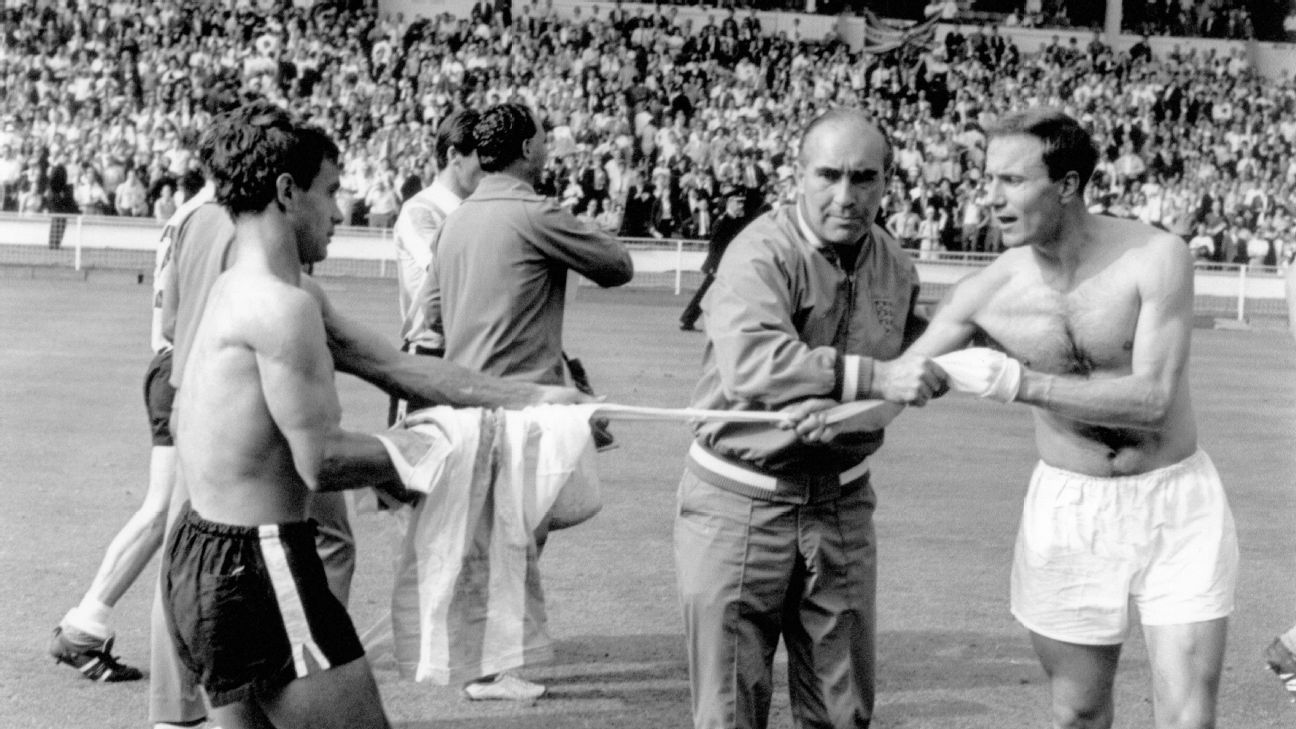
EmailPrintOpen Extended ReactionsATLANTA -- England vs. Argentina is not just your average World Cup semifinal. In addition to being two of the top-four ranked nations according to FIFA, it's arguably one of the most iconic World Cup rivalries of them all, extending over 60 years of controversy, hostility and era-defining moments involving some of the biggest names ever to play the game. When the two teams meet Wednesday, they will add another chapter to the rich and tempestuous story of two footballing giants.It is Diego Maradona and the Hand of God, David Beckham's red card humiliation and his redemption four years later and a Wembley sending off that sparked a diplomatic incident and the introduction of red and yellow cards.Since the 1980s, soccer games between the two nations have also been played with a political backdrop, following the 1982 military conflict between Great Britain and Argentina over the disputed Falkland Islands / Islas Malvinas. While hardly at the forefront of Wednesday's game, it has been an unfortunate but inescapable reality cited by players on both sides of this fixture.- Strauss: Why media are excited about "hydration breaks"- Connelly: How the four World Cup semifinalists score their goals- 2026 World Cup: All fixtures, results and feature coverageBut with one of football's classic rivalries resuming on Wednesday for the first time since a 3-2 England victory in a friendly in 2005 -- this will be their first World Cup clash since 2002 -- ESPN has spoken to players involved in previous meetings, combined with historical recollections, to illustrate just why England vs. Argentina is so compelling.Additional reporting from James Olley, Tom Hamilton, Damian DidonatoEngland 1-0 Argentina, 1966: Shirt-swapping banned after Wembley furorThe first World Cup meeting between the two nations was an uneventful 3-1 group stage win for England in Chile in 1962, but when they met again in a quarterfinal at Wembley Stadium in 1966, the game would go down in infamy.England manager Alf Ramsay described Argentina's players as "animals" after the game -- a 1-0 England victory -- that would be referred to as "el robo del siglo" ("the theft of the century") in Argentina because of captain Antonio Rattin's red card and claims that Geoff Hurst's winning goal was offside.Rattin, who died Saturday at age 89, was booked twice by referee Rudolf Kreitlin for fouls on Bobby Charlton and Hurst, but he refused to leave the pitch when ordered to do so by the official. When Rattin eventually left the field escorted by two police officers, he sat on a red carpet reserved for Queen Elizabeth II in protest.That incident led to FIFA introducing yellow and red cards to ensure clarity of decisions and to avoid confusion between officials and players without a common language. Regardless, Rattin's actions and Argentina's perceived rough play led to Ramsay's "animals" comment and his intervention to prevent his players swapping shirts with their Argentine opponents, a custom that is often followed after matches."It was probably the nastiest and toughest game we experienced at a time when we talk about what was a rough time in English football -- quite violent to an extent -- that that game against Argentina was probably one of the nastiest games we've all played in," Hurst said."But I think the use of 'animals' was a poor word. You can say dirty, nasty, vicious, whatever, but I think the word 'animals' wasn't particularly appropriate. He [Ramsay] did get his knuckles rapped for that."Rattin, whose defiant protest lasted 10 minutes before he left the pitch, reflected on the game and the incident in later years to Argentine newspapers La Nacion and El Grafico. "I saw that this German gentleman [referee] was calling everything in England's favor," Rattin said. "Well, not 'gentleman.' I take it back. This bad guy was giving them everything: corners, fouls. He was even inventing handballs. Everything for the home team."So I showed him my captain's armband and for several minutes I asked him for an interpreter to explain. I kept insisting the referee bring in an interpreter, and he sent me off. That World Cup was rigged for the English to win. And in the final against West Germany, they were awarded a phantom goal."The enmity between the two teams continued after the game. Argentina's Roberto Ferrero shoved the referee and Ermindo Onega spat in the face of FIFA vice president Harry Cavan, earning both players a three-match suspension, while another Argentina player reportedly urinated in the tunnel."I do not approve of the conduct of our players and officials," an Argentinian FA spokesman said, "But they were provoked by the referee. He was absolutely biased in favor of England. The referee and those who selected him were, in my view, responsible for the trouble."Argentina 2-1 England, 1986: The infamous Hand of GodIf one image sums up the England-Argentina rivalry, it came in the 51st minute of the World Cup quarterfinal in Mexico City's Azteca Stadium on June 22, 1986. There has arguably never been a more iconic or infamous moment in World Cup history.Diego Maradona, Argentina's captain and the world's greatest player at the time, leaps above England goalkeeper Peter Shilton and bundles the ball into the net with his hand to put his team 1-0 ahead. Photographs show the moment that Maradona beat Shilton to the ball with his left hand.Shilton and his England teammates were incensed, protesting to Tunisian referee Ali Bin Nasser, but Maradona ran away and celebrated. The goal was given and four minutes later, Maradona made it 2-0 with a stunning individual goal that is as great as his first goal is infamous.When asked later about the goal, Maradona created a legend with an unforgettable quote: "A little with the head of Maradona and a little with the hand of God," he said.But it is a multilayered quote. From an English perspective, it is an admission of cheating, but for Maradona and his Argentina teammates, it is rooted in the still raw memories of the Falklands / Malvinas conflict four years earlier. This was the first meeting of the two nations on a football pitch since that international incident, and it burnt deeply for the Argentinians."Before the match against England, Diego Maradona gave a pep talk in the tunnel," defender Oscar Ruggeri told ESPN Argentina. "'Come on, lads, they killed a bunch of our kids.'""We went out there with a huge energy. Even though we saw it as just a football match, you couldn't get that out of your head. We couldn't see the people in Argentina the way footballers can today. They were sending us videos from Argentina where the people were saying, 'We don't care what happens next -- just win this match.'"For the defeated England players, though, their sense of burning injustice was purely related to the game and it remains, 40 years later."I'll never forgive him [Maradona]," England defender Terry Butcher said. "At the end of the day, it's not nice when you lose a World Cup quarterfinal under those circumstances. It's very hard to forgive and forget."England keeper Shilton is another who cannot forgive Maradona, who died in 2020. "What I don't like is that he never apologized," Shilton said. "Never at any stage did he say he had cheated and that he would like to say sorry. Instead, he used his 'hand of God' line. That wasn't right."He challenged me for a high, looping ball, but knew he wouldn't get it with his head, so he punched it into the net. A clear offense. Cheating."The final word on this goes to the late Maradona."I knew it was my hand," Maradona said in 2019. "It wasn't my plan, but the action happened so fast that the linesman didn't see me putting my hand in. The referee looked at me and he said: 'Goal.' It was a nice feeling, like some sort of symbolic revenge against the English."Argentina 2-2 England (4-3 penalties), 1998: Beckham vs. SimeoneAt the time, David Beckham was the golden boy of English football and a future England captain, but he woke to newspaper headlines such as "10 Heroic Lions, One Stupid Boy" after being sent off for kicking Argentina's Diego Simeone during an epic round-of-16 tie at France 98.Beckham was blamed for England's defeat, for forcing his team to play with 10 players for an hour, and the former Manchester United and Real Madrid midfielder admitted that it was an incident that shaped his career."I remember Diego putting his hand on the back of my head, either rubbing it or pulling my hair a little bit, and then I just reacted," Beckham said. "With the sending-off, what led after it for the next few years, I think for me personally, that was the most difficult time for me in my career. The Argentines were always good at that -- in the moment -- and those things happen in games."In an interview with the Guardian in 2002, Simeone admitted to exploiting the situation to get Beckham sent off."I had tackled him, and we both fell to the ground," Simeone said. "As I was trying to stand up that was when he kicked me from behind and I took advantage of that. And I think any person would have taken advantage of that in just the same way."For the England players involved in the game in Saint-Etienne, though, memories of Argentina's passion and desire for victory are indelible. "For me, the Hand of God was a big thing because I was 12 years old at the time, so a real memory for me," Paul Scholes told ESPN. "But for Argentina, this game means a lot more because the historical stuff off the pitch."England's rivalry with Germany is big, but it feels a bit different, a bit more special with Argentina. What sticks in my mind from that game, and what really pissed me off, was the way the Argentina players celebrated afterward. They were on the team bus, with their tops off, swinging their shirts, singing their songs and goading us."Steve McManaman remembers how differently the Argentina players were motivated to beat England."I just think it's bigger unfortunately because of the political side of it," McManaman told ESPN. "It never crossed our minds about the Falklands when we played the game. But you knew how much it meant to them [Argentina]. It was seeing them celebrating and the way they looked at us and the way they f---ing hated us, even when they'd won."I know Argentinian footballers and they've always gone on about it [Falklands], so you think to yourself, "Wow.""It never affected the English players. We never ever thought of things like that, but it did to them."McManaman's view is supported by Simeone. "Quite apart from all the political history, the desire of the whole country is to defeat England,' he said. "So we knew that in 1998, and we knew that the hearts of the Argentine people were with us."Every time we meet, this desire to win is bigger and more heartfelt. This is a classic. And we play it as a classic because we are all conscious of how happy we can make our country by winning."England 1-0 Argentina, 2002: Beckham's revengeArgentina had triumphed in their two most recent World Cup meetings with England in 1986 and 1998, but 2002 was different. It was a game in which David Beckham avenged the red card four years and gained closure -- and forgiveness -- for the incident with Simeone. A 44th-minute penalty in Sapporo, Japan, gave Beckham the chance to make amends for France 98 and he took it with relish, sending his spot-kick past goalkeeper Pablo Cavallero."I knew that was my moment to step up, not to put the ghost to rest, but it was just the moment where I felt I was ready," Beckham said. "The moment we got the penalty, I knew I was taking it."With my celebrations after [scoring], I think everyone saw how much it meant to me, how much it meant to the players and it was one of those moments where the England fans and the public maybe forgave me."But this is England versus Argentina, so of course there was controversy. England forward Michael Owen won the penalty following a challenge by defender Mauricio Pochettino, now the USMNT coach, but it was a debatable decision."The penalty was nonexistent," Argentina midfielder Javier Zanetti said, but Pochettino has since said that he was "nave" for allowing Owen to win the penalty."It was a penalty because it was given," Pochettino told Four Four Two. "From the referee's angle, I probably would have given it. Without the tools we have today, I understand. But I never touched Owen."When I was managing Southampton, Owen was a TV pundit. I knew he was coming in one day and told my press officer I wanted him to come down and say hello. I had the photo ready -- the one that clearly shows I didn't touch him. He signed it and wrote, 'You definitely touched me' along with a smiley face. We had a good laugh about it. He was clever and I was a little bit naive."And perhaps unusually for this fixture, on this occasion, the motivation to win for arguably greater for the English."Listen, those of who played in 1998 were desperate to win this game," Scholes said. "I remember thinking that there was no way we were going to allow them to celebrate in front of us again. I had visions of them dancing around with their tops off, swinging them around their heads, so it was nice to win that one. Very nice."