Deprecated: trim(): Passing null to parameter #1 ($string) of type string is deprecated in /data/sites/takesporty/user_defined.php on line 308

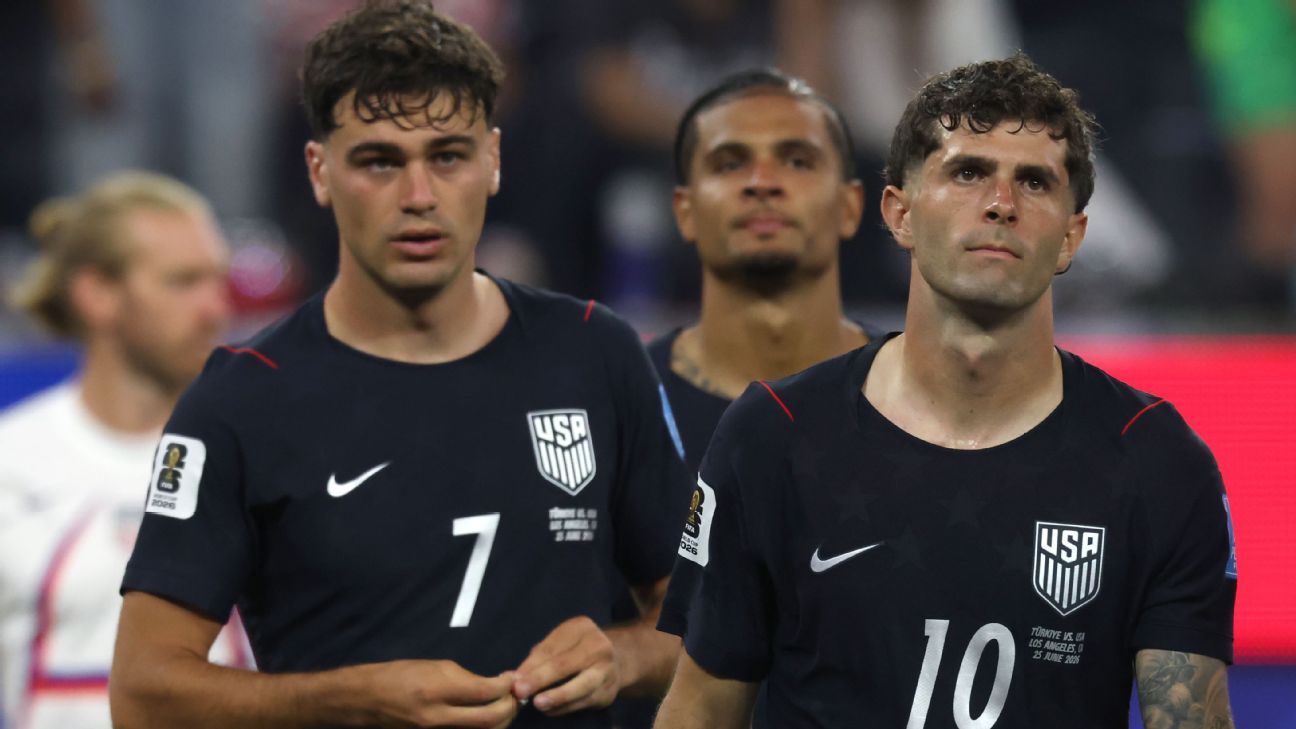
EmailPrintOpen Extended ReactionsThere are a lot of things that would make the U.S. men's national team better.If youth soccer wasn't so expensive in this country, compared with the cost in any of the countries still left in the 2026 World Cup, then perhaps more talented players would stay connected to the pipeline. And if both of those things happened, then maybe the national team would look more like the actual soccer-playing population in the United States, and players with Mexican heritage wouldn't be such a rare sight with the USMNT.The coaching could be better, too. Pick a random parent in a random American suburb, and they probably learned the fundamentals of dribbling a basketball or throwing a football at some point in their childhood. They can probably guide a group of children through enough basic pointers to allow them to do what's most important as a kid: play.But neither of those things happen with kids in the U.S. soccer system. They either spend their formative years under a well-meaning parent who has no idea what they are doing, or they play in some expensive academy where everyone cares too much about winning and not about cultivating the love and curiosity for the sport that, as research suggests, actually might lead to success in the sport as an adult.If we stopped forcing children into early-stage sports specialization, that would lead to happier kids and -- again, as research suggests -- a higher likelihood of professional success. If we made it easier for kids to leave soccer and then come back to it, that would prevent declining participation rates in the sport once someone hits their teenage years.If we somehow had better athletes, that would help. If we learned how to prioritize the softer skills that actually make you a great soccer player -- technical ability, spatial understanding, game intelligence -- then we would have more great soccer players. If we fixed college soccer, that would help. And sure, why not, I'll say it: If NBA legend Allen Iverson grew up loving soccer, then that could've helped the national team, too.I believe all these things, and I believe they all matter way less than one specific factor that's not as fun to talk about. There is currently one thing that is keeping the USMNT stuck inside the round of 16 and preventing the U.S. from becoming the kind of top-eight, fringe World Cup-contender that it feels like it should be able to be.That one thing? It's luck.Everyone is bad at identifying and developing talentYou can make a pretty good argument that the United States is especially bad at identifying sports talent. It's an argument I'd agree with, too. The sports we're best at are the sports we invented. The United States doesn't need to be good at developing basketball or football players because they're the two most popular sports in the richest country in the world.But even when they're competing against each other, the American basketball and football teams are terrible at identifying talent. In the NFL, plenty of research has found essentially no long-term difference in the skill of decision-makers at identifying the best players in the draft.It's why the optimal move in the draft is to trade down and give yourself more bites at the apple. And in the NBA, where individual performance is much less context-dependent, new research suggests that 6% of all draft picks become top-level contributors for the team that drafted them.In basketball, in particular, the rest of the world seems like it's catching up. From 2016 through 2018, all 15 of the league's All-NBA first-team players -- essentially, the five best players in the league -- were American. Over the past three seasons there were three Americans -- total -- on the All-NBA first teams.Modern soccer has basically always been something of a global market: players competing against each other from across the globe, youth prospects potentially worth millions of dollars in transfer fees to any club who can develop them, top teams hiring talent from whatever countries they want. So, it would make sense that the American approach to sports would take a long time to catch up. Right?Well, it's unclear if anyone else is any better at identifying talent, either. A couple of years ago, I found that more than two-thirds of the most expensive transfers -- 50 million in fees or more -- fail to play 70% of the minutes for the team that acquired them. And these are mostly for adult players who we have lots of data and footage for. Go earlier than that on the age curve, and it gets way worse.Earlier this summer, author and exercise physiologist Steve Magness outlined some of the largest-sample research:Is U.S Soccer's answer to focus on more players rather than better players?If everyone is bad at identifying talent, then the logical conclusion is that, at the national level, the way to get better players is to simply have more potential players.As long as you are able to provide a certain level of coaching and infrastructure, the more players that you have go through your system, the more players are likely to become professionals. The more pros you have, the more players are likely to become national team contributors. And the more national team contributors you have, the more players are likely to become superstars.The four semifinalists in the World Cup have massive youth soccer infrastructures connected to their massive professional soccer networks. But again, it's not clear that this is even the "optimal" way to develop talent. As David Epstein wrote about in his book "Range," early specialization in most skills tends to predict youth success but doesn't actually predict adult success. Plus, less than 1% of the kids who go into these academies become pros, let alone national team players, let alone stars.Then there's the question of whether we should even be optimizing youth talent -- and well, of course we shouldn't be doing that. These are children, whose possibilities in life shouldn't be siphoned off at age 12 because someone at Chelsea thought they were good at kicking a soccer ball.As my colleague Steve Fainaru wrote about last month, the Argentinean academy system is rife with abuse. And while the quality is improving, so many people who went through the Premier League academy system report mental health issues and feel totally unprepared for life after they've been spit out by whatever club no longer wants them.When we gnash our teeth about the USMNT's round-of-16 failure every four years, this part of the story never gets brought up. Pay-to-play isn't the only alternative to the European and South American academy system, but which one would you rather have your child put through?I don't even bring all this up because I'm tired of it not getting brought up; I bring it up because it's not what's going to save U.S. Soccer anyway.The USMNT has more talent than ever beforeAnother thing that feels like it has been forgotten in the aftermath of the USMNT's World Cup exit: Eight years ago, the USMNT didn't qualify for the World Cup. Eight years later, the team scored 11 goals, won its group and won a knockout game. If you ignore 2018, then 2026 feels like stagnation. But you can't ignore a massive systemic failure just because it was a massive systemic failure.If we went back to 2018, and you tried to identify the fastest ways to ensure it would never happen again, there would've been two answers: get more Americans playing at the highest levels in Europe and make MLS better.This summer, 13 of the 25 players on the USMNT's roster were employed by teams in one of Europe's Big Five leagues across England, Spain, France, Germany and Italy. And seven players played for teams in the Champions League. In the USMNT's preferred starting XI, only two players came from a side outside of the Big Five or the Champions League: Tim Ream and Matt Freese, the two players most at fault in the 4-1 loss to Belgium.This is new, but it isn't just a fluke of development, either. As the analyst Michael Caley outlined after the loss to Belgium, the USMNT's talent pool has massively increased since 2016. This is how the improvement of the team's top 15 players, by estimated market value from the site Transfermarkt, looks since 2014:More players are playing at the top level in Europe than ever before, and despite the struggles of Ream and Freese against Belgium, the quality of MLS continues to improve, too. Don't believe me? Outside of Europe's Big Five leagues, guess which league has seen its players play the most minutes at the 2026 World Cup? It's MLS.More young players are going to European academies than ever before, too. There's pretty much at least one American -- if not multiple -- in the academy of every big club in Europe. Former USMNT coach Gregg Berhalter, in particular, did a great job of convincing talented dual-nationals such as Antonee Robinson, Sergio Dest and Folarin Balogun to play for the USMNT.And the creation of academy teams in MLS -- and the second-tier USL -- has given the U.S. a still-way-too-small and still-imperfect system to prevent fewer players from falling through the cracks, providing quality and mostly free training to the players who get identified. Five of the USMNT's 11 starters this summer came through the academy system.So, if all that is happening, then why isn't this team as good as, say, every non-soccer publication's favorite overachiever from this summer, Norway? Is it because Norway emphasizes fun, makes sports affordable, ignores results and encourages kids to play multiple sports and we mostly don't do that in the United States?While, again, I have no doubts that those things don't help on the margins or in creating a high floor, that's not the biggest difference between the USMNT and Norway. The biggest difference is that Norway has two superstars and the USMNT has zero.How Haaland and degaard became superstars -- and Reyna and Pulisic didn'tNorway's two soccer prodigies became superstars.Back 2015, we were still comparing every somewhat small and somewhat skilled young prospect to Lionel Messi. And so, Martin degaard was dubbed the "Norwegian Messi." He made his Norway debut at 15 and moved to Real Madrid a year later in 2015 for a reported fee of 3 million.degaard's dad was a former pro, and he claimed that his son was practicing soccer for 20 hours a week from the age of seven. That sounds more like an overbearing American parent than a product of Norway's holistic, have-fun system, doesn't it?degaard didn't make it at Real Madrid, but after a series of loans he ended up at Arsenal, where he eventually became one of the best players in the Premier League and the world. He's the captain of the reigning Premier League champs and Champions League runners-up.Then there's Erling Haaland, who, like degaard, is the son of a former pro, while his mother is a former heptathlete, and many of his cousins also became pro soccer players. Genes are important, it turns out.Haaland genuinely is a 1 of 1 -- we have never seen a player with his combination of size, strength and skills. He simplifies a complex game by getting to the center of the box, over and over again, and doing very little else while he's on the field.In addition to his physical advantages, Haaland also benefited from smart career management. Rather than moving to the biggest club possible as a teenager, he first went to FC Salzburg for one season -- the dominant club in Austria and part of a network of the Red Bull-owned teams with an incredible development reputation.Then he took one step up, to Borussia Dortmund, who at the time were still Europe's premier last stop before joining one of the richest clubs in the world. This ensured that he played a ton and scored lots of goals at every stage of his career. After two-and-a-half years at Dortmund, he finally moved to Manchester City in 2022.Haaland was teammates with U.S. midfielder Gio Reyna at Dortmund. And Reyna, too, did flash his own superstar potential. Since 2010, across Europe's Big Five leagues and the Champions League, there are 10 players who have generated at least 5.5 expected assists before turning 19. The names: Lamine Yamal Florian Wirtz Jadon Sancho Jude Bellingham Gavi Warren Zare-Emery Lennart Karl Kylian Mbapp Jrmy Doku Gio ReynaSo, that's maybe the best player in the world, a then-club-record 100 million signing for Liverpool, an 85 million signing for Manchester United, one of the superstars of the 2026 World Cup, a Spanish midfield prodigy, a French midfield prodigy, one of Germany's best-ever prospects, the second-best goal scorer in World Cup history, the best dribbler in the world, and a benchwarmer for the USMNT.The best predictor of future stardom is quality playing time at a young age, and Reyna did have that. Based on the players around him -- the two guys after him on the list are Jamal Musiala and Pedri, two of the best young players in the world -- Reyna has achieved close to the worst-possible career outcome. Haaland and degaard, meanwhile, landed somewhere near their 99th-percentile potential outcomes.Christian Pulisic, who was at Dortmund before Haaland and Reyna, landed somewhere in the middle. He was already clearly the USMNT's best player as a teenager during the failed 2018 qualifying campaign. And then he was truly one of the best teenagers in the world while he was in Germany. Since 2010, just seven wingers have produced more expected goals+assists before turning 21 than Pulisic did. Some players he was ahead of at that point in his career: Raheem Sterling, Vincius Jnior and Ousmane Dembl.There were moments at Chelsea when Pulisic really did look like a superstar -- right before and right after the COVID-19 break -- but injuries and inconsistency prevented him from sticking around the highest level.Instead, Pulisic has become a very good player for an AC Milan team that's on the fringes of Champions League qualification. He's the best American men's soccer player of all time, and he has already accomplished more -- and played way more -- than any American non-goalkeeper ever has across the Big Five leagues and the Champions League. He just never became one of the best players in the world.What the jackpot of producing an individual superstar means for a World CupThe differing outcomes for these four players make up the difference between the two teams: one with high-highs and low-lows (the U.S.), and one that was one different whistle away from playing in the semifinals (Norway). If you remove the top two players from the USMNT and from Norway, their estimated squad values at Transfermarkt are almost the same.Perhaps the culture of sports in Norway made it easier for Haaland and degaard to fulfill their potential. Pulisic is getting ripped apart for no-showing against Belgium, and I haven't seen a single negative word about the egg Haaland laid against England. Based on that, you'd think that Haaland was the oft-injured AC Milan winger and Pulisic was the best striker in the world -- not the other way around.But that's all speculation. We've already established that development is mostly a numbers game, and the U.S. and Norway had two players who showed the potential to become superstars. That Norway went two for two in developing superstars and the U.S. went zero for two is mostly due to random chance.And that's what it takes for any country outside of the traditional powers (teams from the Big Five leagues, plus Brazil and Argentina) to compete at that level. Belgium, Portugal and the Netherlands have come close to consistently attaching themselves to that group, but they benefit from a direct connection to the Big Five leagues and multiple clubs in their countries qualifying for the Champions League every season.Outside of the nations with those inherent histories and advantages, Uruguay, Croatia and Morocco have all made it to World Cup semifinals since 2010. Uruguay had Luis Surez, Diego Forln and Edinson Cavani -- three of the best strikers of their generations, and in Surez, arguably the best player not named Lionel Messi or Cristiano Ronaldo of his generation. Without them, they didn't get out of the group stages this year.Croatia, of course, had the only guy to break up the Ronaldo-Messi Ballon d'Or duopoly in Luka Modric and a number of other stars around the same age. Without them all still in their primes, Croatia lost 4-2 to England in the group stage and were eliminated in the round of 32.Morocco recruited a team of players almost exclusively born in other countries. Their one true superstar, Achraf Hakimi, decided to play for Morocco instead of Spain, where he was born. Without that one decision, Morocco never make it this far.Even the teams at the top aren't immune to the vagaries of personal desires and development. As Ryan Rosenblatt wrote, Michael Olise's decision to play for France instead of England means that France are the favorite to win the World Cup. Had he chosen England, England would currently be the favorite to win the World Cup. Does that make French soccer healthier than English soccer? No, it just means one person made his own decision for his own reasons.Now, this is not to say that the United States Soccer Federation or MLS are doing a great job or don't need to change anything. Both groups have plenty of their own problems, and they both continue to make plenty of mistakes.But most national federations and soccer leagues are inefficient and ineffective in their own unique ways. What matters, more than anything, is the broader demographic sweep: How much talent isn't being identified, and how much talent is finding somewhere to develop?For American soccer, those questions have better answers than ever before. There's more American talent playing in Europe's top leagues and training with Europe's top teams than at any point in the history of professional soccer. The domestic league has more quality talent than we've ever seen. And that league's still-quite-young development initiative is starting to bear fruit.There are so many 21-and-under Americans playing significant roles in MLS right now. The first American superstar might be playing games on Apple TV this summer.The numbers are, finally, in the USMNT's favor. But whether the coins flip or the dice roll the way the U.S. needs them to -- and whether it all lines up for a specific one-month stretch during a World Cup in 2030 or 2034 or 2048? That's out of anyone's control.