
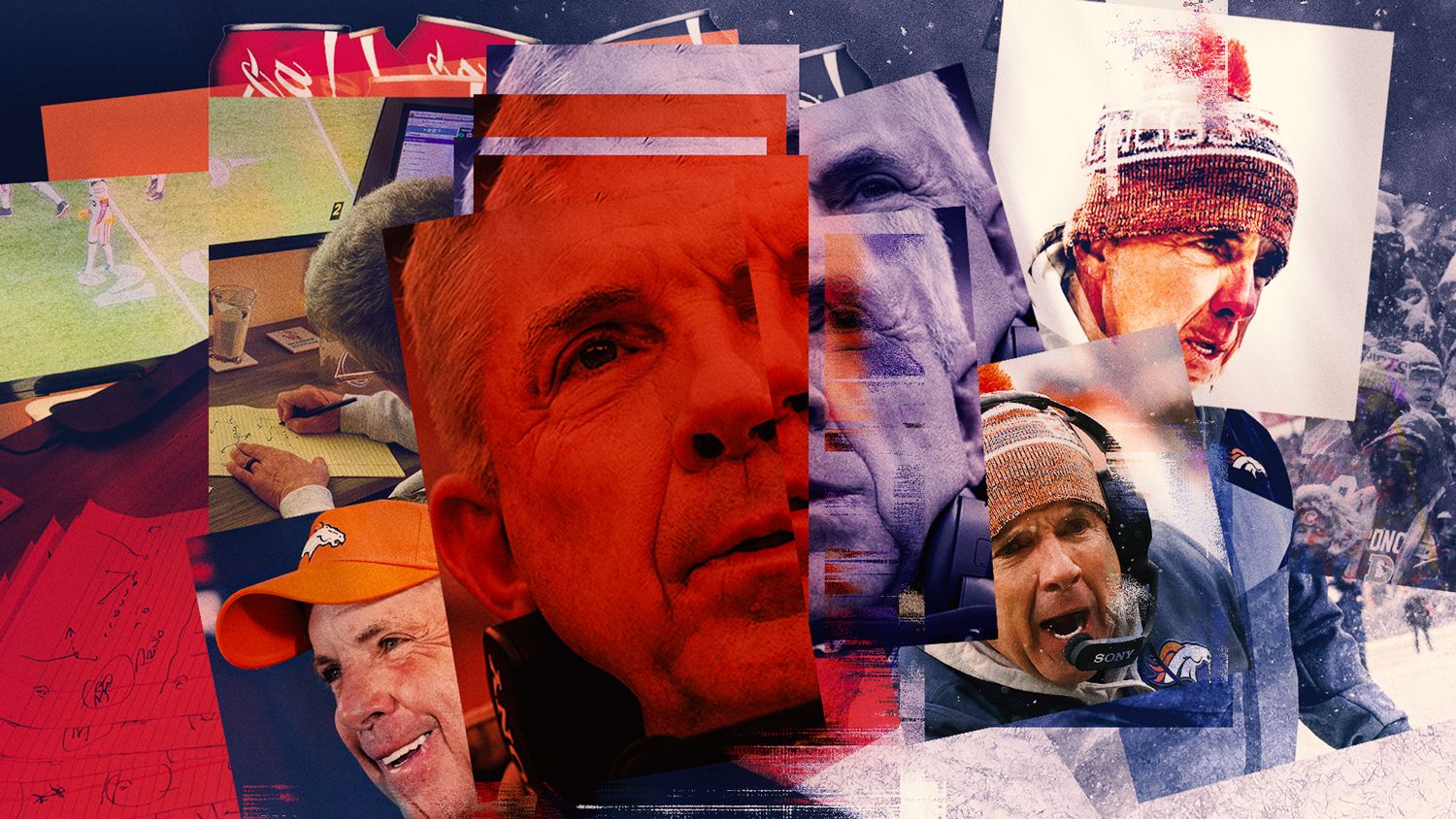
EmailPrintOpen Extended ReactionsPART IMonday, Six Days Before KickoffSEAN PAYTON FORGOT about today's 9 a.m. staff meeting, so he enters a few minutes late. He's in a bad mood, six days before his Denver Broncos will face the New England Patriots in the AFC championship game. He was in a bad mood yesterday, too, after reviewing film of Denver's overtime win over the Buffalo Bills in the divisional round. He hated that the Broncos couldn't run the ball, which ultimately falls on him, or stop it, which ultimately falls on him, too. But what's really set him off is invisible: that a practice squad lineman named Jordan Jackson didn't see the field against the Bills on defense. Not one play -- after the defensive coaches had fought for him to be active, arguing that Jackson could help against the run. NFL teams can only activate 48 players on game day. Dressing Jackson came at the expense of another player. Something nobody noticed about a player nobody has ever heard of has one of the most successful coaches in NFL history on edge with a Super Bowl at stake.Yesterday, Joe Vitt, a defensive assistant and one of Payton's oldest and best friends, stopped by Payton's office. He wanted to thank Payton for the opportunity before them: to be in the playoffs, to live with the intensity and energy of every minute, not knowing if the play at hand will end up being the play that decides the game and season, that defines a legacy. Payton wasn't feeling sentimental. He ripped into him about Jackson. Vitt gave it a second try, thanking him again. That was a mistake. "You're welcome!" Payton shouted. Vitt left.Payton takes his usual seat at the head of a conference table in the main meeting room for the Broncos coaches, a large and windowless space on the second floor of the building. Screens for watching game tape fill two walls; a whiteboard covers the third; portraits of Hall of Famers John Elway, Terrell Davis, and Shannon Sharpe playing in a Super Bowl win is the fourth. Payton sets the room temperature to 68 degrees, which he read somewhere is the ideal temperature to keep people alert. Coordinators, position coaches, and general manager George Paton sit alongside him at the table. Scouts, trainers, and operations staffers grab folding chairs around the perimeter. Seats aren't assigned, but everyone sits in the same ones each day. It snowed a few inches overnight; the room has a foxhole feel."Zero snaps," Payton says. "F---ing criminal. This kid sits on the sideline."Seconds pass."Did we stop the run? We didn't do that. We got our a-- kicked in the first half."Defensive coordinator Vance Joseph interjects, offering explanations. Payton cuts him off."I love the turnovers," he says, of the five the Broncos forced against the Bills. "Outside of the turnovers... we were worse than the worst defensive team this year in the NFL. I'll do the numbers if you want."Payton is just getting started, his eyes alternating between the words on his yellow notepad and the staff. During the meeting, he rails about communication issues. "Day One s---," he says. "It's a cluster on the headphones." At one point, the Broncos had to burn a timeout because the defense had too many men. "Twelve on the field," he says. "Why is that a problem?""Should not," Joseph says."It's been all year!""It won't be."Some coaches nod. Some take notes. Some stare and remain still. The faint hum of air purifiers is the only sound. Those who go back with Payton -- during his three years in Denver and even his 16 with the New Orleans Saints -- know that it's best to let his storms pass rather than debate him. Payton later tells Joseph that while he was legitimately angry, he was also sending a message to the staff. After all, the Broncos are in a kind of football crisis. In the meeting, Payton walks over to the wall-length whiteboard covered in magnets for a depth chart, with each player's name and number. He picks up the magnet under QB that reads NIX -- Bo Nix, Denver's star second-year passer, the player to whom Payton has tied his Broncos fortunes -- and slowly shifts it left, past the offensive linemen, past the receivers, past nearly everyone on the roster, to a category of unavailable injured players.Payton's eyes stay on NIX for a beat.He slides back to QB, to the tile that reads STIDHAM -- Jarrett Stidham, a 2019 fourth-round pick now on his third team in six years, with a total of four career starts and 197 passes thrown -- and moves it up. Stidham is Sean Payton's new starting quarterback.AFTER THE MEETING ends, Payton stands in his office, which overlooks the Broncos practice fields, and tries to find ways to remind the team that the game ahead isn't impossible. The week's first full-team meeting begins soon. What should he tell the players? He is 62 years old, in his 27th year coaching in the NFL, his 18th as a head coach. He has been to and won one Super Bowl. It's been seven years since he was this close to another. He takes out a long yellow legal-size notepad. He used the standard letter size all season, until last week. The sheets suddenly became messy to tear, which he considers bad luck."Now's the time to pump the team up," he says.Five months earlier, back in training camp, I sat with the entire Broncos coaching staff in a private area of a San Jose steakhouse. They were in town for preseason work against the 49ers. Training camp is for bonding. Payton took out the men and women who were at the early stages of a monthslong grind. It was warm and dark. Precious early season belief was in the air. Wine flowed; appetizers arrived without ordering; steaks and dessert followed. Levi's Stadium, site of Super Bowl LX, was nine miles and six months away, but felt closer. At one point, Payton tapped his glass with his fork and stood up."We're beginning our season in Santa Clara. And we're going to end it there, too."Denver ended the season as the AFC's top seed. Payton and I have known each other for years, and a running conversation between us is the paradoxical relationship between the NFL and America. The more professional football is watched and discussed, the less people truly understand what goes into winning a game, much less competing for a Super Bowl, what the practitioners of it are willing to trade, and what it does to those who define themselves against the results. I spent the playoff run with the Broncos: 14-, 15-, 16-hour days, every decision, meeting and meal. Almost nothing was off the record.Holding a pen in his office, Payton thinks about backup quarterbacks. "This happened to me four other times," he says.But no coach in modern NFL history has lost his starting quarterback the game before the Super Bowl. And Stidham -- "Stiddy" -- will be the first quarterback ever to start a conference championship game without a single attempt during that year's regular season. The difference between a starting quarterback and a backup isn't just about logistics and competence and comfort and efficiency. It's ruthless math. There are only ten or so good quarterbacks on the planet. Payton had one of them, until the third-to-last play against the Bills, when Nix ran outside, cut, and felt a bone in his right ankle pop.Payton isn't just battling forces larger than himself, of odds and time and legacy. He's also battling forces within himself: his own accomplishments and failures, his wounds and pride, his own sense that he knows best -- that he has to know best -- and his desire and hunger and willingness to sacrifice everything for a moment, a feeling of fleeting satisfaction that is ephemeral and maybe a hoax. Maybe that's why he wants company for the quiet desperation of this ride. To feel less alone.Payton writes on a pad in black Sharpie ink, holding the pen low and angled, listing the backup quarterbacks he's coached in games:BridgewaterTaysomWinstonSiemianHe's known for his record-setting Saints offenses with Drew Brees. But his winning record with backups when the starter is injured is what he writes in bold ink now. We don't need a season's worth of wins, he says."All we need is two."THE TOP FLOOR of the Broncos building -- the second floor -- is almost exclusively for coaches, scouts, and business staff. It's quiet, like any office, only with more coffee machines and everyone in variations of the same logoed sweatsuit. Payton takes a hard right and heads downstairs. He walks through the groundlevel locker room, a mess of noise and energy and throttled testosterone."Let's go!" he says. "Let's go!"Music blares in the auditorium. People tend to sit in the same seats each day, divided not by offense and defense but by position. Payton winds his way down the aisle, until he's at the front of the room. The music cuts off. He speaks without a mic."Morning.""Morning," the team replies."Congratulations, you're in the final four," he says.He starts with a story from 2019, when Brees tore a ligament in his right thumb. The Saints didn't just lose a first-ballot Hall of Famer, he explains. They lost a head chef. "He took over the kitchen," Payton says. "He was boiling the water, making the desserts, frying the chicken, and everyone else sat around in white shirts." The room laughs. The Saints went 5-0 without Brees. Why? Because everyone took it upon themselves to focus a little more, to do their jobs a little better.Payton looks at Stidham, sitting front and center, in a hat pulled backward -- his signature look."I'm not worried about Stiddy," he says, later adding: "I'm worried about the rest of you swinging d---s... "Guys laugh."I don't need supermen," he tells the team. "I need you."BACK AT HIS desk, Payton pulls out his phone. He rarely looks at it during the workday. It sits on a charging station, in sleep mode. He's barely aware of the news, within football and especially beyond. I'm jealous. He dials Bill Parcells, a friend and mentor for more than twenty years, dating back to his time on Parcells' staff in Dallas. Parcells now splits his time between Florida and Upstate New York, where he races horses. Payton is among the last of the Parcells coaching tree, a group of men who dominated football for decades and are hardwired with an ethic that's at once admirable and self-destructive. After Payton won the Super Bowl, Parcells left a voicemail that said "Welcome to the club."Parcells answers after one ring."Listen," Payton says with a smile. "Trying to get in touch with you, but your schedule's busy.""No, no, no," Parcells says. "I called you four times yesterday."Parcells reached out after the Nix news broke, and not just because he won a Super Bowl in the 1990 season with backup quarterback Jeff Hostetler. He's one of the few who knows what his former charge is feeling, and maybe more importantly, can articulate it. Talking about doubt makes it easier to live with and move beyond.There's a way to win, Parcells says. Gotta figure out how."Now, here's what I tell the team... " he continues. Present tense, despite being out of coaching since 2006. A coach doesn't ever stop, at least not in his head. "I'm not worried about Hostetler. I'm worried about the rest of you."There are no secrets left, only refreshers, and the encouragement that Payton has it within himself to pull this off. Parcells need not remind Payton that NFL history books don't carry asterisks for losses due to quarterback injuries. Nobody cares. There are no excuses. That's the working premise of both their adult lives."This feeling -- this exact feeling," Payton says at one point, of coaching in the playoffs. "How do you replicate it when you're done?""The horses help," Parcells says. "But there's nothing like it."Payton holds his phone after hanging up, sifting through messages. I notice that his hands are shaking and ask why. A mix of age and various medications, he says. They shake as he places his phone back on the charger. Shake as he holds a pen, making a quick note. Shake as he turns off the lights, closes the shades, pours a Coke into a cup of ice crushed small, which he does at all waking hours -- "I'll have 10 Cokes during the day, but I'll only truly drink three" -- and shake as he lights candles on his desk, making sure the glass casings touch, his routine and superstition, giving the room a meditative feel.On his computer screen is a file called Explosive Runs -- 20 yards or more -- against New England's base 4-3 defense, Base Okie (3-4 defense), and nickel. He grabs an XOS software clicker and cradles it in his palm.His hands stop shaking.MONDAY MORNINGS ARE marathon back-to-back-to-backs for Payton, scouting meetings on defense, offense, and special teams. Each last an hour. Payton is the only one who attends all three. A Broncos scout attended yesterday's Patriots win over the Houston Texans in New England, caught a redeye back, typed his notes, and combined them with other analytics and data into a thick packet.Defense is up first. Payton and Joseph sit at the head of the table, the rest of the staff settles around them.Payton dives into the packet as the scouts present their findings on Drake Maye, New England's MVP-runner-up quarterback.Data from 2025 Regular Season Weeks 1-18 and Post Season Week 1No 2 Minute, 4 Minute, or Garbage TimeOverviewMaye has been one of the most productive QBs in the NFL, he ranks in the top 2 in Expected Points Added, success rate, yards per attempt, and explosive rate on standard drop backsMaye has scrambled at the 2nd highest rate in the NFLMaye has been aggressive pushing the ball downfield, he has the 4th highest average depth of target in the NFLMaye's only slight negative is that he has taken sacks at a slightly higher than average rateSome situations where Maye has been less effective: against drop 8, against sim pressure, and against 2 high/MOFO with no rotation (show 2-high and play 2-high).Charts and advanced data follow, delving deeper into each of those bullets, assessing locations of passes thrown, Maye's numbers against blitzes and pressures, when he tends to leave the pocket, to what side, and what he tends to do ("When Maye scrambled left, he ran it himself more often"), and finally, how he fares against man-to-man, Cover 2, Cover 4, and Cover 6 defenses. As always, there are liabilities. Maye has been sacked 57 times, second most in the NFL. His hand size is an average 98 inches, which contributes to his league-high 15 fumbles. He isn't excellent in game-winning-drive situations. But he is dangerous on the move.If Maye slips free all afternoon, we will lose, Payton says.Payton asks most of the questions. Joseph listens and takes notes. Some of the best coaching of Payton's career has been done during his three years in Denver. He made the playoffs in his second year, with a rookie in Bo Nix and a third of the salary cap eaten up by players no longer on the roster. But the hallmark of his tenure here is Joseph's defense. "The strength of our team is the defense," Payton says. "Not us." Neither seems to show up on the same day, and lately neither has been up to standard. Before this meeting, Payton sifted through defensive statistics since the bye week. It was bracing. The Broncos are allowing opponents to convert 43.6 percent of third downs since Week 11, as opposed to 28.9 percent before. Worse, three of the opponents since the bye didn't play their starting quarterback.It not only worries Payton, it informs how he prepares. Calling a 14-10 game is completely different than a 35-34 one. In the former, punts and field goals are sound strategy. In the latter, they are the turning points in a loss."What kind of game do you want this to be?" he asks Joseph as the scouting meeting closes. "You don't have to answer now."Payton already knows: If it's a shootout, it's over."EVERY WEEK IS a new puzzle," Payton says a few hours later. "People think they understand, but they don't."His problem-solving is both ritualistic and spontaneous, formatted and inefficient, alone and among staff. Each Monday, he sits at his computer and watches every touchdown leaguewide from the weekend and divides them into two categories: Play or player?If it's player, he skips it; he can't replicate it. If it's play, he moves it into a folder of ideas to adapt.There are a handful of constellations of greatness that, when Payton's career is over, Hall of Fame voters will consider as markers of a coach who earned a link in a very exclusive chain. Championships are obvious. Beyond that, it's touchdowns. That's how Payton sees it -- and himself. He refers to himself as a playcaller as much as he does as a head coach. He has a computer file of every offensive touchdown he called with the Saints, 807 in all -- an NFL record over a 16-year span. What started in his forties as a stab not at immortality but to simply earn respect in his craft became a rsum of sorts, and now, as he combs gray hair, has led a life that's tested almost every organ, and is more helpless without reading glasses than he wants to admit, that file of 807 touchdowns is something more personal: a keepsake, a record, tangible proof of a vision brought to life, of men made and broken, indisputable evidence that he imposed his will on an untamable game and that it's possible to do so. And maybe, should his grown kids, Meghan and Connor, ever choose to study it, an explanation for his absences, even on birthdays and holidays. Or maybe not. But a testament, above all else, that their old man did something during his time here. And that he was pretty good at it.Today, he watches every touchdown scored this year against the Patriots. He sees a lot of play, specifically against quarters coverage -- four defensive backs spread evenly across the field. He likes it."I'm on a roll now," he says.Payton doesn't study film so much as use it as a mechanism to open his mind, like a psychedelic. He watches for angles and motion and space and habit. He will wind and rewind the first step that each defender makes, or which way their hips shift, then envision ways to exploit it. He defines himself by limiting his own mistakes and making the opponent pay for theirs. Sometimes a single step out of place is all he needs. After a running play from the Chargers-Patriots playoff game the week before, he notices something he's seen a few times this year: a particular Patriots defender tends to leave the game after he makes a tackle."This," he says. "This!"He wants to run at that defender, and if he exits, dial up a pass to target his replacement. He writes down DUOs, a type of inside run Payton's Saints all but invented that is now common leaguewide. He draws a misdirection off it. He marks it with five stars.For the pass, he wants extra eyes."Paul?" he shouts."Yes, Coach," Paul says.Paul Kelly -- "PK" -- is Payton's assistant. Every office has its sneaky power player, whose knowledge of the building exceeds their job title. In Denver, it's Kelly. He knows Payton so well that he can hear his footsteps from downstairs."Can you get Davis for me?""Yes, Coach."Davis Webb is the Broncos quarterback coach and, likely, a future head coach. He's what Payton was 30 years ago -- young and eager for a chance to make a statement. Payton misses that time of life dearly. He watches his old plays not just for a schematic reminder; it's to feel that sense of innocence and fearlessness again, back when Parcells would review the offensive call sheet before games and stop at some fancy new one and say to Payton, "Trying to make a name for yourself?"Webb enters within minutes. The two go back and forth in their own complex shorthand, talking ideas and drawing up a pass concept."I love it," Webb says."Okay," Payton says."That's one touchdown," Webb says as he exits. "Just gotta get three more."Tuesday, Five Days Before KickoffMONDAY WAS A long day, filled with game-planning meetings, with staff analyzing film individually and together until about 1:30 a.m. Tuesday is a longer one. Payton enters the main conference room around 10:30 a.m., holding his candles and Coke, feeling feisty -- proudly feisty -- at having stuck it to management during an earlier Super Bowl logistics meeting. Being a game away from the Super Bowl means that the league requires every team to prepare for a win. "The hardest part is making plans you might not realize," Payton says. Today's agenda was how many family members each coach will be allowed to bring on the team plane. Broncos brass suggested two per coach; Payton wants it tailored to the family situation. Payton wanted coaches with older children, including himself, to give up their seats to accommodate larger families. Coaching in the NFL is fundamentally different, and more important, than in any other sport. In the NBA, MLB, and NHL, the sheer volume of games forces limits on scouting and planning and preparation, making it more about managing workload and personalities. Those coaches also find ways to breathe, with a book or a round of golf, even in the playoffs. In the NFL, coaches breathe in the offseason. Payton believes he is among the best ever at his post and is proud of his program. He also picks the brain of any coach, regardless of sport or level, for insight. At home, he binges shows, both to quiet his mind and to find something worth drawing from. On the drive to work, he'll call Tom Brady, or John Elway, or Wayne Gretzky, or even people like me for crying out loud, hoping casual conversation brings inspiration. To find the handful or so of the plays that decide a game, he tends to think he has to create a world in which he rules matters large and small. It's silly. But professional football is also a $25 billion annual business. His volatility is both accepted and exhausting around the building.As the offensive coaches begin to plan Base Formation Runs and Passes, Stidham pokes his head in."Oh, you want to hang out with us now that you're playing?" Webb says.Stidham nods and smiles, as the coaches discuss ideas to get the run game flowing."You know what else will be flowing?" Stidham says. "The drinks after we win."ALL 13 OFFENSIVE coaches settle in, everyone in the same spot. Payton is at the head of the conference table. He has a standard for assistants: They either have to be, in his words, "among the best in the world" or have the potential to be. Most coaches have a laptop and iPad. Payton is the only coach without a screen. And without a phone.On one wall is a large retractable projection surface where video is shown. On the side is a projection of a spreadsheet that serves a running draft of Payton's call sheet, filled with seven tabs of various situations, from Base Run to Red Zone to Short Yardage-Goal Line to Two Minute. The spreadsheet is never blank; staples and uncalled leftovers temporarily fill it. There's an overwhelming amount of information to distill and curate.Quality control coach Logan Kilgore clicks on the tab for Base Run."Before we finish today, we'll trim the fat," Payton says. "But we have to control this game with the run game."He sets a goal of 120 rushing yards against the Patriots, which seems almost comical. Denver hasn't run the ball well for most of the year, and workhorse running back J. K. Dobbins is out. So is Nix, one of the Broncos' most effective rushers. Payton also tends to bail from the run if it's not working. On top of all that, New England will key on the run and force Stidham to throw. Payton knows that 120 yards is unrealistic, but as he later tells me, "otherwise the excuses will be built in." So the staff starts by showing runs that the Chargers deployed against New England. L.A. ran for only 87 yards but Payton sees opportunities, solid ideas lost in bad execution, and what unfolds over the next several hours is a kind of football laboratory. Payton does most of the talking.We're dealing with the right side here and it's going to be Power, right?... When I get Hollywood Sky, it's zone... Do they treat 22 as Slot or Pro? I think Pro.Football schematics is a hidden, wonky, weird world that most of us know little about, despite the explosion of social media X's and O's analysis. It's impossible to declare why a play succeeded or failed without knowing its intent, and it's impossible to know its intent unless you're in this room. And even if you know intent, there's still unknowable aspects, a fog-of-war chaos. When I ask Payton to explain a play, it takes him so long -- diving into basic design, matchups, blocking assignments, adjustments, called routes, conversion routes based on coverage, and finally, wild cards that nobody but the coaches know, such as which receivers cut off routes too short or struggle to catch certain types of passes -- that I feel guilty, as if he's teaching at the expense of preparation. Knowing intent not only brings us closer to the action. It adds to the collective theory that in fact football can be orchestrated.Early in a game week, Payton vacillates between clarity and simmering despair. "Every defense looks like the '85 Bears," he says. He needs to see plays and envision them, and process, and draw, and describe, and discuss, and sit, and reconsider. And then, because each play has an audible off it, he does it again for each one. The process of finalizing one of the 70 or so plays on the call sheet can take minutes or hours.Payton's at the whiteboard.Sky = 9 PowerShell = zoneHollywood = zoneHe stands at the board for minutes, piecing together a play, talking out loud, seemingly only to himself, before turning to Zach Strief and Chris Morgan, the offensive line coaches. He senses both are masking frustration. The running backs carried only 10 times for 41 yards against the Bills. Payton will write RUN IT on his call sheet for this week, not only because it's essential with Stidham but because he wants those coaches to stay engaged."What do we call this, Zach?""Beaver pitch.""Yes, good call. Touch Beaver."Around 5:30, they break for dinner. Payton calls his wife, Skylene, for about ten minutes -- their only conversation of the day -- and ends it with "Love you bunches." Some of the other coaches FaceTime their kids from the cafeteria. Some shower, trying to wake up in advance of the long night ahead. A few unfold the beds in their offices, a preemptive measure, so that when the meeting breaks at an ungodly hour, they don't have to think. They can just collapse.BEFORE THE PLANNING continues, Payton stands before the staff holding a printed copy of the Patriots media guide and a bucket of cold water."This is for Orny," he says.That would be the late Mike Ornstein, a former agent, executive for the Raiders and NFL office, and felon, infamous in sports circles for his temper and charm. Payton loved him, even though Orny turned up in the league's Bountygate investigation, the pay-for-knockout system orchestrated by then-Saints defensive coordinator Gregg Williams, which Payton wasn't directly involved in but helped cover up, Roger Goodell concluded -- all of which helped influence and inspire Payton's suspicion of the league office, then and now.Orny had a superstition for upcoming opponents, which Payton never fully understood but feels is appropriate now. Payton dunks the guide in the water, soaks it for a minute, until it's misshapen and bloated, and then puts it in the freezer in the meeting room fridge.Then he turns to Play Action Passes.IF YOU DON'T know the terminology, if you're not a Bronco -- if you're not fluent in Payton's playbook, which is to say fluent in Payton -- you can spend hours in game-planning sessions and barely understand a word.I want X Jet Flood Left Slot -- not Stack -- to give a classic look rather than tip the defense if it's in-routes or out-routes.Any thoughts on Poodle or Pylon?Free Right Tare Y Fly Pass 23 Bob Scissors Z Honda. What's the difference between a Honda and Husky?I find myself switching between trying to understand what's going on -- watching the tape, absorbing the terminology -- and noticing how this is mostly a meeting of one. Payton runs it. He asks questions of others. (Where would you put Sutton in this Smash Shade?) He makes decisions. (Let's burn minimal calories on a No-Brainer Freeze.) The assistants are a captive audience, sometimes only tapped for opinions. Payton stares at the screen for minutes at a time, in silence. He squints, spits dip juice into a cup, and bites his nails, dives into an ice cream bar, sips Coke, never taking his eyes off of the film. "What was the other one we had, when we were pulling -- the dart screen?"Joe Lombardi, the offensive coordinator, clicks on Dart Screen. Hours pass. Ten o'clock, then eleven... Unlike some coaches, Payton doesn't arrive to the office at 4:30 a.m. He's more likely to leave at 4:30 a.m. Because assistant coaches still have work to do after these meetings end, they're forced to be both morning people and night owls. They fight diminishing returns with all available methods: by standing, stretching, eating snacks, sipping drinks cold and hot, grabbing air, taking the long way to the bathroom and the longer way back, dipping real and synthetic snuff, by multitasking. They stifle yawns as Payton's eyes sharpen. When he's this focused, he's almost scary in his recall -- he remembers the minutia of a decades-old second-down play -- and yet might blank on something as basic as his home address."I think we're good," he says close to midnight. "I think we're real good."What sounds like a wrap-up is only the beginning of the end."How do these guys play Trickle Screens, Joe?" Payton asks Lombardi.Twenty or so minutes pass on Trickle Screens."All right," Payton says. "Good stuff."Coaches are fading, but few pack up. They know better."We didn't finish two things," Payton says. He goes to the whiteboard, with one of his favorite plays from the past 30 years."All Go Special," Payton says. "Stiddy would like this.""He'd like that," Lombardi says. "But he'd really like Spinner.""Okay," Payton says, irritated but deferential -- irritated because he's deferring. "Death of All Go Special."He erases and starts drawing again. "Here's what we're saying, if you're saying Spinner is one of the Fab Five... ""That would be Spindrift 1-by-3?" Webb says, referring to the formation: three receivers on one side and one on the other."Just put Spindrift," Payton says.Closing in on 1 a.m., he calls it. "All right. Let's break."Payton rounds the corner to his office, passing Paul Kelly's desk, which is neat and empty. He reviews slides for tomorrow morning's full team meeting. He'll detail scouting reports and punctuate them with this: The Broncos are 5.5-point home underdogs to the Patriots, the second time this postseason that Denver's road opponent opened as favorites. That's the third time in the past 22 conference championship games that the home team has been an underdog. The other two were the 2015 Broncos and the 2017 Eagles."Those teams won the Super Bowl," he says.In a few minutes, Payton will walk to his car and drive 19 minutes home. Between 3 and 4 a.m., he will go to the bathroom with his phone. His social media feed happens to serve up highlights from the 2000 NFC championship. A good memory. Giants 41, Vikings 0. Payton was New York's offensive coordinator, just getting started. One of the highlights is of quarterback Kerry Collins hitting receiver Ike Hilliard in the seam for a 46-yard touchdown.All Go Special! he thinks.Screw Spinner. Payton texts Kilgore: Put All Go Special in the plan. But before Payton leaves the office, he wants to review a play from the divisional round. He clicks around, surfing between files. He can't find it. He's stumped."Paul?"Paul is long gone.Payton stares off, fumbling through his mind, stuck on something. He turns to me."Who did we play last week?"PART IIBuffaloONE WEEK EARLIER, before the divisional round against the Bills, Payton had his quarterback -- and knew exactly how to kick off the Wednesday morning meeting, a reminder of the stakes."This is the most important team meeting of the season," he says, showing why the Bills are excellent but beatable. Josh Allen is the NFL's best quarterback, but Payton must balance awareness of his abilities and subtle deficiencies in his game. He shows a slide stating that 85 out of Allen's 97 career non-Hail Mary interceptions have occurred from the pocket. The message: Keep him contained, and the odds increase that he'll serve one up.Suddenly, there's a loud knock at the auditorium doors. Even though Payton knows it's coming -- even though he orchestrated it -- it still startles him."What the f---?" he says.Armed guards, dressed in fatigues, enter the room, wheeling a table. On it is a Lombardi Trophy -- and $500,000 in cash, bricks stacked high, like a skyline."I found it necessary to remind everyone: We're playing for a lot of cash in this tournament," Payton says.Guys laugh. Payton had conceived this yesterday. He told Paul Kelly to find the cash; as a boss for two decades now, Payton is accustomed to just ordering stuff, unbothered by the how. It was a scramble. The money arrived with minutes to spare. Kelly had lived a day's work before 9 a.m.The guards cart the money away.Payton turns to a slide titled "Playoff Myths."His friend Bill Belichick sent him bullet points that he used to give to his Patriots teams. Payton and Belichick go back decades, forged by mutual respect -- and mutual trauma from working under Parcells. When Belichick and the Patriots divorced in 2024, Payton considered presenting Broncos owner Greg Penner a proposal for the ages: Hire Belichick as head coach until he reached 15 wins, enough to break Don Shula's career record of 347. Payton would temporarily step down to assistant head coach and run the offense, then move back after Belichick became the all-time leader. In the end, it was too complicated -- and maybe too fanciful.Playoff Experience Matters"Bulls---," Payton says. "Our own experience matters."Bye Week Teams Are Rested and Ready for Fast Start"Being rested has nothing to do with how we start."Home Field Matters"History shows it doesn't."We'll Be Back Next Year"Nothing is promised."CANDLES LIT LATER that morning, Payton prepares for Josh Allen not by watching film of him, or of defenses that have faced him, but of a 2019 play from Detroit against the Raiders. The Raiders are lined up for a punt, but it's a fake. The ball goes to the upback, who hands it off to a tight end. A guard pulls left and clears the way for 27 yards."Rutgers Special," Payton says.He had first seen the play a year ago, January 2025, when the Broncos faced the Bills in Buffalo during the wild card round. It was going to take a miracle to beat the Bills that year. Payton watched 71 fake punts, looking for one to adopt and adapt. He entered the game with two of them. One was called Rutgers Special, tweaked from the 2019 Raiders, which Payton named after Broncos fullback Michael Burton, a Scarlet Knights graduate. In the other, Denver's punter threw an outside pass on Buffalo's Ja'Marcus Ingram. Payton had targeted Ingram after reading that he missed a practice that week due to the birth of his first child. Payton called it Baby Shower and ran it in the second quarter for a first down.But the game got out of hand, and Denver never called Rutgers Special.Payton wants it now for a specific situation: when the Broncos are facing fourth down late, up by a few points. Payton knows that if he punts to Allen, the game is over. The Bills won't expect a fake punt under those circumstances. That's how much respect Payton has for Allen."Worth the risk," he says.Payton considers confidence to be his superpower. He's done this job long enough to have a mostly tough skin from outside criticism. But he also wages a fight within himself to keep that essential aspect of his personality alive. He won a Super Bowl in part by calling the most famous onside kick in league history. The moment he chokes up on the bat, he knows he's done. How aggressive is too aggressive? If he ever figures it out, he'll tell you.On film, Payton counts the number of Bills "in the box" -- players tight and close to the line of scrimmage -- and watches the eyes and feet of number 14, reserve receiver Tyrell Shavers. Isolated on the left side, Shavers usually plays the return, not a fake. The way the Broncos run Rutgers Special will hit Shavers with a wall of blockers, clearing an easy path."Paul?" Payton says to Kelly."Yeah, Coach.""Can you have Rizzi come in?""Yes, Coach."Special teams coach Darren Rizzi enters a few minutes later. "Last night before I went home, I started looking at their punts," Payton says. "All seven boxes."Rizzi nods.Payton shows Rizzi a Bills clip from Week 1 against Baltimore. The Ravens faced fourth-and-3 with 1:33 left, up 40-38. The Ravens punted -- and paid the price."This is it," Payton tells Rizzi. "I'm not punting. I'm winning it."IT'S ALREADY BEEN a busy morning. Earlier Payton entered a full staff meeting, where the decision to activate Jackson was made, and said, "Two games to the Super Bowl. All hands on deck." He took two minutes to approve sweatsuits that the Broncos will wear getting off the plane in California, should they make it. He told the operations staff how he wants the green room for families to look at the Super Bowl, with 24-hour daycare and wallpaper of the Rocky Mountains. He wants to arrive a day early and have the team in pads practicing when networks go live to the opponent on the tarmac. "We're first there," he said.It's all coming together, as he envisioned in May. Payton had put three windowpanes in the auditorium and in the stadium locker room, inspired by a visit from a contractor to his house years ago to protect against storm damage. One pane can sustain wind of up to 130 mph. The second, 150 mph. The third, 189 mph. "We're 189," he told the players. And by god, they were. In Week 5, Denver trailed the defending champion Eagles 17-3 in the fourth quarter and won. Two weeks later, the Broncos trailed the Giants by 18 points with six minutes left. But Nix accounted for four touchdowns in the fourth quarter, and the Broncos deployed some nifty timeout management and won at the buzzer. Denver ripped off 11 straight wins, and 13 of 14 to close the year. Eleven wins were by 8 points or less. That doesn't happen every year. Patrick Mahomes, Lamar Jackson, and Joe Burrow all missed the playoffs. Nor does that. Justin Herbert and the Chargers -- the playoff team that Payton wanted to face least -- lost in the opening round. Everything came up Denver."Have we been battle-tested?" he says. "F--- yeah."All of it means nothing if Denver doesn't maximize today, this week, the next game, the playoffs. Payton stares at statistics for Buffalo. The Bills defense hasn't seen much nontraditional no-huddle this year -- only 59 snaps of non-two minute. Denver's thin air is a weapon. Payton smells blood."Hey, Paul?""Yes, Coach."Payton wants to know which Bills players struggle in altitude. Within minutes, Kelly brings a list, medical material left over from draft files. Payton decides that he will open the game in a hurry-up offense -- their NASCAR Package -- and use it intermittently, so that by the fourth quarter, the Bills are gassed. He plans to call three times more NASCAR plays than he ever has in a game."It's going to be an Oxygen Tank Game," he says.Then it hits him: He wants it to be known as the Oxygen Tank Game."Hey, Paul?""Yes, Coach."He tells Kelly to order 100 or so small oxygen tanks to give to the team prior to the game, with special labels. Pursuits like this, cheesy and earnest, are about more than giving the players an artifact to put in their bookshelves -- more than about " making memories," as Payton says. It's about trying to orchestrate a feeling even before the outcome can genuinely generate it. And he's not done. He tells the video team to pull clips from movies where people suffocate in thin air. A few hours later, a folder hits his computer. He sifts through them, then stops at one. It's from "Everest." At the summit, in swirling wind, a climber is about to die. His wife is called to say a final goodbye. Payton is sold. A few things: he wants head shots of little Broncos pasted on the mountain, with Levi's Stadium in the distance; he wants the dying climber to have Allen's jersey number 17 on his jacket; when they call home, he wants to splice in a clip of Hailee Steinfeld, the actress and Allen's wife, talking on the phone.Hours later, Payton watches the new clip. He likes it, but adds one more note: he wants "Harder to Breathe" by Maroon 5 to play as it fades to black."It'll be good," he says.THAT AFTERNOON, PAYTON shifts moods."Do you think we can win?" he asks me.Hang around a coach long enough, get this close to the flame, and you become more than an observer and confidant. You become a sounding board of sorts. Payton wants someone neutral to weigh in. It's easy to lose perspective when you're isolated. I answer a little later by not answering. "You've never lost coming off a bye.""I don't say that," he says.What has him pausing film and pondering right now -- what has him keeping the coaches at the office until 2 a.m. -- isn't what you might expect. It's not Allen. It's not a surprise strategy, a play for which the Broncos have no answer. It's... Payton himself. Will he find a zone as a playcaller, rolling off dagger after dagger? Will he have the answers?Will he operate at his best?"Playcalling is harder at 62 than at 42," he says. "As you get older, maybe you don't like driving in the rain at night."For years, he has had a recurring dream. Kickoff. Cameras, fans, lights, buzz, national anthem. He's late to the game... on a bike, in his underwear. He pedals, but the bike won't move. He pedals harder. Goes nowhere. The game kicks off. He's finally on the sideline. His offense is on the field. His quarterback is looking to him for the play. He shouts the play, still in his underwear, but nobody can hear him. His chest seizes up. He screams, "32 Lead! 32 Lead!"... Usually right then, Skylene will nudge him awake. He's calling plays in his sleep.Preparing for a football game is a series of mindwarps. The file with 807 touchdowns feels far away. The more expertise you gain, the longer you work, the more adept you get at seeing all possible outcomes -- including danger. It becomes a burden, until the burden is too much. He has always said that it'll be time to walk away from coaching either a year after Goodell retires, just so that Payton can outlast him, or "when the wins feel too much like relief and the losses like agony." It won't be an easy decision, but he'll know. Or thinks he'll know. Or hopes.Giving up playcalling is something else altogether. When will it be the right time?"It's coming," he says.It's not just because as he's aged, he cares less about style points. It's so hard to win in the NFL that he'll take a 13-10 score. If the offense struggles, that's a problem for tomorrow. And it's not just because he risks losing Davis Webb to other teams, where he'll have more opportunity. And it's not just because it'll free him to focus on managing entire games, rather than multitask in multisecond bursts. And it's not just because Payton and Nix had a minor blowup on the sideline last season against the Raiders, days after the quarterback had asked the coach how long he'd keep calling plays, and Payton said eight, nine years, and then they disagreed over whether to be aggressive near the goal line and shouted at each other, and Payton ended it by screaming, "You know the question you asked me the other day? Right now, it feels like one or two years -- if this continues!"Payton points to a small picture of a small house in the corner of his office, a nondescript water-color painting alongside prominent photos of him with presidents, with Kenny Chesney, with his kids, of holding his Lombardi Trophy.It reads 301 N 4th Ave.It's his boyhood home in Newtown Square, Pennsylvania. The Paytons emigrated from Ireland to Scranton. His grandfather on his father's side, Robert Thomas Payton, delivered milk and other dairy products. His job had a perk: Each night, he was allowed to keep half a gallon of chocolate ice cream. It became a near nightly tradition. He died when Payton's dad, Thomas, was a boy, and the specter of despair hovered over the family. Thomas grew up in Depression America, and went to fight the Germans in Europe for the Navy, and he left pieces of himself in both places. Thomas sold insurance. The family moved around a lot. Thomas would overspend at Christmas, then worry for the rest of the year how to pay the bills. As a kid, Sean -- third child to Thomas and Jeanne -- came home from elementary school one day and saw police in the neighborhood. Then, he realized that they were at his house. Dad had gone missing. Sean had no idea that such a thing could happen. Thomas eventually came home, but those types of episodes -- "cries for help," Payton says -- defined their life as much as Jeanne's optimism did. Years later, one of Sean's sisters pointed to a hole in the garage roof. That's where their dad had planned to hang himself, she told him. When Sean went off to college at Eastern Illinois as a quarterback and started his career, first in the NFL as a strike replacement player in 1987 and then as a coach at San Diego State in 1988, he always wondered when the phone rang if it was the call. That call never came. Thomas Payton died of pneumonia in 1998. When Sean looks at pictures of his dad now, he sees a young man who looked like an old man before his time.Payton lives with an existential fear that everything he's built will be taken away. That's his psychological inheritance. Calling plays, and the process of finding the perfect design, the impossible struggle of it all, was not just Payton's way out. It's the best and worst of Thomas and Jeanne playing out on a national stage, the paranoia that it'll all end coupled with the belief that it'll work out, that it can work out. He has never been personally fired in the NFL, an astounding fact after almost 30 years in a cutthroat league, when coaches are often sacrificed, if only for optics. In-season, Payton rarely indulges himself. He doesn't golf. Barely touches alcohol. Seldom eats out. But after some losses and every win... each precious and miraculous win, which allows him to keep going, if only for another week... he celebrates playing a child's game and wagering an adult's resources -- time, infinite budgets, meaningful presence in the world -- with ice cream."I GOT AN 84 sleep score last night," he says the next morning. Asleep around 1:05 am; awake at 7:17 a.m."It's good. Sometimes I'm afraid to look at it."He holds his phone and a pen and legal pad, deciphering a text to himself sent at 3:08 a.m.RUN6 BASE AND HEAVY FROM (2 FORM)4 RPOs3 SPECIAL6 SPONT 2... He tears the sheet -- clean, as he likes it -- and then exits his office for the team meeting. He likes the morning auditorium music to be from the upcoming opponent's city, so "Iris" from the Goo Goo Dolls blasts -- a Buffalo band. Twenty minutes later, he's back in his office. The Oxygen Tank Game theme solved two problems at once. Three, actually. One, it's a theme for the week. Two, it's aggressive -- players like to attack. And three, NASCAR will help loosen up Nix. He tends to be amped up early, leading to the occasional wild throw. Payton avoids calling shallow crossing routes the first few drives because Nix might throw the ball high and hard, leading to a tipped pass and interception."Bo wants to play street ball," Payton says. "So I'm going to create some street ball."Nix pops into the office. Payton has bet his tenure on Nix, who he drafted after the former Oregon passer graded out best on an analytics formula Payton conceived. Their success is intertwined. When Payton draws lines on the whiteboard, routes curving and bending into the ether, those lines seem unstoppable. Those lines make you believe. But they're just lines, theories, instructions, the first fantasies about the idea that coaches and quarterbacks can control the game. Yet it's almost impossible to win if the coach and quarterback don't both believe in the lines. Earlier this year, in preparation for Washington, Payton was frustrated during a red zone practice. The scout-team defense wasn't giving the look that he wanted for a play called Car Wash; if the play didn't work in practice, Nix would nix it in the game. Payton stopped practice and spent minutes with each scout-team player. The look needed to be right. In the game, Payton called Car Wash, a short inside route to receiver Courtland Sutton. Nix hit him for a touchdown. Those impulses are amplified in the playoffs. You never know which play will win the game. Or lose it."I'm in NASCAR mode," Payton says to Nix, "and we get the third down, I might look down at a NASCAR play that fits... " The conversation drifts into odd verbiage, the language of the offense, for a red zone play."Yeah, good," Nix says. "All right. I like it.""It's beautiful," Payton says.A FEW HOURS later, George Paton stops by. "Happy anniversary," he says."What?" Payton says.He looks at the date: Jan. 14."Minnesota Miracle," Paton says.He went there, in a playoff week. The Saints had a dynastic feel after winning it all in 2009, with a coach and quarterback entering their prime. But the playoff losses that followed: 2010, Beastquake in Seattle. 2011, to the 49ers. 2012, wasted due to Bountygate. 2013: Seattle, again. 2017: the Minnesota Miracle, which Paton lived as a member of the Vikings front office, when Stefon Diggs scored on a walk-off 61-yard touchdown reception. 2018: the Nola No-Call against the Rams, a tentpole NFL officiating disaster when the refs missed a pass-interference and hit to the head on a defenseless receiver on one play that would have iced a trip to the Super Bowl. 2019: Minnesota, again. 2020: a home loss to Tampa Bay, when the Saints had control of the game and fumbled in the third quarter, giving Tom Brady all the opening he needed...Six of Payton's nine playoff losses are by eight points or less.What do those kinds of losses do to someone? What has he learned from them? Can you learn from losses, in a game when dozens of invisible events impact obvious ones? If so, what are the lessons? Do hours in a windowless game-planning room safeguard against anything? Sometimes, he refers to "Bounty" or "No-Call," leaving the pain, self-inflicted or otherwise, half spoken. Sometimes, it comes out in brief bursts of anger, such as earlier this year against the Giants when he sprinted to the goal line to argue a pass interference penalty and got flagged for unsportsmanlike conduct, or on a rainy November night when he believed the league let Washington get away with an uncovered, soggy field -- giving the slower Commanders an advantage -- and he left NFL EVP Troy Vincent, a frequent target, an angry voicemail.After the Broncos had a potential game-winning field goal blocked in the final seconds against the Chiefs in 2024, Payton showed the team clips from five of his most devastating losses, everything from an upset of Kansas State thwarted when he was an assistant at Indiana State in 1991 to the No-Call. You'll never get over them, he told the team, but you have to find a way to move past them.Those losses are why right now, before Paton entered, Payton was staring at a particular coverage by the Bills, a coverage called Palms. The Bills play Palms so atypically that Payton couldn't tell if it was on purpose or accident. Most teams declare that they're playing Palms by putting a corner and safety on two receivers and covering them at 8-10 yards from the line of scrimmage; Buffalo brackets them past 10 yards. He called Broncos scout Kareem Jackson, who played in Buffalo in 2024, to help decode it -- to help confirm that, yes, it's intentional -- so that he can design a play against it. Maybe receiver Marvin Mims up the sideline on a Rail route, to be called just outside the red zone.And those losses are why Payton is able to laugh at the Minnesota Miracle, just enough, to turn to Paton right now and say..."Oh, f--- off."ON GAME DAY, Payton arrives five hours early. He drives from the team hotel in his black Benz EV, sometimes slowing down if he sees opposing fans, rolling down the window, and yelling, "You guys suck!" -- just to see their faces when they wonder if that was actually him doing that. He parks at the bottom of a tunnel entrance, a spot for one. It's a short walk to his stadium office, with a private bathroom and shower, around the corner from the team locker room.About two hours before kickoff, Payton changes into his game attire. As he's aged, he gets cold easier. He needs layers. He picks sneakers last, lined up in a row: white, blue, and orange."We've been winning with orange," he says. And off he goes.SOMETIMES GAMES UNFOLD as Payton envisions, just enough to reinforce the belief that all of those hours of thought and planning and work and crisis and 3 a.m. texts have a tangible output, beyond self-satisfaction, where it approaches something like art, not to mention produces a rush that he lives for and, after sitting out of coaching in 2022, learned exists in no other space. Buffalo's offense has its way, with one exception: Denver forces five turnovers, including four by Allen. On offense, the Broncos are one-dimensional, putting it all on Nix. He's sharp and clutch, in the air and on the ground, and with less than a minute left, he helps the Broncos to a 30-27 lead with a gorgeous throw to Marvin Mims, exploiting an injured Bill by running a Rail route.In overtime, the Broncos get the ball first and go backward. On fourth-and-11, they punt.From Buffalo's 36-yard line, Allen drops back. He sees single coverage deep and launches a post route to receiver Brandin Cooks, who's covered by safety Ja'Quan McMillian. The ball leaves Allen's hand with a finality to it, the look of a pass that will alter the field and end the game. Cooks extends and cradles it. McMillian knows the season is over unless he attacks the ball, so he launches into Cooks' arms, their hands interlocked and twisting as they fall to the ground. When they land, the stadium quiets. But when McMillian pops up, he does so showing off his prize, and what at first appears to be an unconvincing display of performance art turns into ecstasy when the official throws his arm in Denver's direction. The stadium shakes. It's Allen's second interception of the game, both from the pocket. Payton tells McMillian: "Best interception I've ever seen. I'm gonna be in a nursing home eating applesauce one day. I'm gonna forget your name, but I'm gonna remember that play."Nix leads Denver into field goal range. After an outside run left, he gets up fast but puts his hands on his hips, walking slightly slow to the huddle. He stays in the game, and two plays later, Denver kicker Wil Lutz wins it, 33-30.PAYTON ARRIVES AT his office. Locker room music pounds through walls. Coaches hug and cheer. There are few moments in sports more electric than sending the league's best player home. Payton closes his eyes and breathes in through his nose and out from his mouth, tasting the air. It's his first playoff win in 1,833 days -- five years, 71 games coached, all of those late nights, manic and desperate for an edge -- since the Saints beat the Bears on January 10, 2021."I need to sit. Nobody will remember this in four days."The Super Bowl is now real, and it took everything they had, plans executed and scrapped -- everything, I note to him after his press conference, except Rutgers Special."We called it," he says.When?"Fourth-and-11."Wait -- what? Payton called Rutgers Special -- in overtime?On fourth-and-11?"We had the right look."The players vetoed it at the line of scrimmage, maybe saving Denver's season. "I was so pissed," Payton says. "It was perfect." He grabs my notebook and starts drawing up how it looked on the field, which is how he drew it up all week, and although he's certain and clear and resolute, my mind drifts off, stunned and amazed and impressed and mildly terrified at his gall, at his ego, even recklessness. Imagine his offseason if they'd lost in overtime because of a failed fake punt. Just then, Beau Lowery, the team's vice president of player health and performance, enters -- as he does after every game. Payton keeps explaining Rutgers Special. Lowery looks oddly solemn. The whooping and music from the locker room seems louder. Lowery holds a scrap of paper with a list of injuries on it. Guys on the other side of these walls are dressed after showering, hugging their families, and heading out for the night. Lowery rattles off a few notes, then inhales."Bo... " Lowery says."Bo?" Payton says."Bo fractured his ankle and will have surgery Tuesday."Payton's eyes widen."His season is over," Lowery says.Everyone in the office looks nauseous. The thumping and cheering seems to fade. The room's dimensions seem to shift, at once spinning and still. Payton stares at the floor, eyes dead, head slowly nodding."Stiddy," he says.Deep down, Payton knows that his chances of winning a Super Bowl are over, dreams gone within minutes of advancing. No other coach in modern NFL history can relate to what's flashing through his mind right now. Lowery and Paton look at Payton, then away. The clock to the AFC championship is already ticking. Payton squints, in triage mode, wheels turning. A crack in his world order has opened and his job is to shut it as quickly as possible. There's a subtle twinkle.Denver will be a home underdog, again.Nobody will give them a chance, again.Pressure will shift to the opponent.Stidham can do this.His guys will be ready.Don't you see?"It'll be perfect," he says.PART IIIWednesday, Four Days Before Kickoff"DREAM ON" BY Aerosmith -- a Boston band -- greets the team in the auditorium."Morning," Payton says."Morning.""Raise your hand if your text messages are going up."Scattered response."Don't bulls--- me."Hands go up."I got 240. You know what? I haven't answered one. Maybe two. I did an A-lister. But this is when it only gets worse. Those closest to you become your biggest distractions... They all just want a couple minutes. But then when you add that up..."Four teams," he says at one point. "This game is gonna be won today, tomorrow and the next day. It's gonna be won in our meetings. It's gonna be won in handling our distractions... All hands on deck. We're one win away from the biggest game of your life."First slide: The Broncos are accomplishing their goals, as planned. Playoffs, check. Division title, check. Top seed, check. Divisional win, check. Up next: AFC championship. Coaches have told me over the years how losing a conference championship is in some ways worse than losing a Super Bowl. It's devastating to fall on the biggest stage, but you still feel like you accomplished something. If you lose in the conference championship, it's like the whole season was for nothing.Payton briefly introduces the Patriots, listing quarterback Drake Maye's gaudy stats, but also his sacks and fumbles. "When these sacks have taken place, the ball's coming out," Payton says. "If this guy's stepping up and rushing for 20 yards, we're not gonna win this game. That's just a fact."He lets that vibrate. "I'm talking to everyone in the room. Players and coaches: He can't beat us with his feet."He runs through the rest of the Patriots, in all three phases. But his top-line message is about how to handle the week. Ignore texts, except from the wives. Give vanilla quotes to the press. And finally, he wants them to know that for this week, their only friends are in this room. "I hate when I see our assistant coach talking to their assistant coach in pregame. If you have a problem with it, too bad."He ends with a slide of a postage tag. Payton bought each player Frette bedsheets for the hotel before the Bills game; the guys loved it. When in doubt, when doubted, Payton veers hard at inevitability. The slide is of boxed-up luxury bedding on the way to Santa Clara."It's laid out, the next few weeks. I got all that wired. Let's go. Have a great day."HE KNOWS IT'S a big game when he sees a Gatorade bottle -- a league sponsor -- taped to the podium for his press conference. "It means NFL Network is broadcasting it," he says. About 80 credentialed reporters and camerapeople are on hand today, four times more than usual. Media obligations bug him. Not the questions -- although he can be needlessly petty and combative, sometimes if the question is far from reality, sometimes if it's too close, sometimes simply if it's an easy target and he can get the dopamine hit of a quick slaying. Last week, Luca Evans of the Denver Post asked him if it was good to have linebacker Dre Greenlaw healthy and able to "attack downhill." Just to haze him, Payton replied, "What do you know about attacking downhill?"But the bigger the game, the more the league is involved, the more the mechanisms of it all piss Payton off. With so much media in town, veteran Broncos PR executive Patrick Smyth proposed moving the post-practice press conference inside rather than the usual spot outside. Payton vetoed it. Tomorrow, which is normally a day that Payton doesn't talk, is a league-mandated media conference call."Three questions," Payton tells Smyth. "That's it."Over a bowl of cereal, Payton ends up taking four -- and is vaguely annoyed about it when it concludes."A beacon of accommodation and access!" Smyth says, spreading his arms. Even Payton laughs.Payton often tells players that "we don't pay attention to [media] bulls---." But the flatscreens in the cafeteria are tuned to ESPN, muted but with chyrons in bold type explaining why Denver has no chance. At one point, Stidham chats with Payton in the cafeteria, with the shows behind him weighing his competence -- doubt literally hanging over his shoulder. Between meetings Payton pulls up a semi-viral clip of Patriots defensive lineman Milton Williams. When asked what he knows about Stidham, Williams said, "Nothing... They didn't like him over Bo, so... ""Why say that?" Payton says. "Belichick would have killed him."Williams also isn't wrong. But Payton isn't feigning faith in Stidham. Never in any planning sessions does he say that he wishes he had Nix. It's not because he thinks Stidham is better. And it's not just because in Stidham's first career start, for the Raiders in 2023, he threw for 365 yards and three touchdowns. It's because of he and them. Stidham has Payton dialing up plays. Those two belief systems are inseparable. Parcells protected Hostetler in 1990 with a running game and a willingness to punt. Payton will protect Stidham -- to a point. He wants him to throw because he knows he can. I ask Payton if he'll show the Williams clip to the team, for cheap inspiration. No need. His response comes after practice, when he polls the players for who they want to perform at their Super Bowl party. NBA YoungBoy wins. Payton refuses to allow them to consider that Santa Clara is anything but fate, if they do their jobs. He later personally books YoungBoy over FaceTime, then spins to his computer."Back to red zone... "AS AFTERNOON BECOMES evening, the locker room is loose and confident. Upstairs, something is off. Energy seems lower than usual. Yesterday's game-planning meeting blew past 1 a.m., again. A few fold-up office beds aren't folded up. Sheets hang off the side. Eyes are glassy and puffy. Fresh air and sun during practice usually recharges coaches for the long haul; less so today. When I see coaches in the hallway and ask how they're doing, one shakes his head and rolls his eyes. Another smiles and gives me s--- for bailing last night at 11 p.m."Couldn't hang... " he says.To know how it feels to be pushed to the brink every day, you must live it, and if you live it, you spend the rest of your life trying to sort out which parts of you it built and which parts it destroyed. The problem with football is that there are too many humans involved, from the dozens of coaches and staff to the 22 on the field. The odds of something going right are slim from the start. And when you've lost games like Payton has, in ways nobody could have foreseen, it multiplies and spreads throughout his mind. Payton hates it when an assistant coach shrugs off a loss by saying, "That's just football." No. It's never just football. Not the way Parcells taught him. Not the way Payton works. He's spent his entire adult life making crucial football decisions while running on fumes. It's led to 194 wins. Only 11 men have ever won more."I don't know any other way to operate," he says.Around 5:30, the daylight that seeps through Payton's shades disappears. He sits and rewinds and clicks in a deep darkness, calling in coaches to help decipher defenses, glancing at the wall clock, canceling the full staff 6 p.m., and launching right into third-down and red zone planning. Hours in, the offensive staff is working through a play called Bora Bora Big 20 Fazio Fun Bunch RT Tare."What are the routes?" Payton says."Uber," Webb says."Uber," Payton repeats."Cashier.""Cashier.""Bravo Square Out.""Bravo Square Out.""Freedom.""I think Stiddy will like that," Payton says.Ten at night blows past, coming up on 11, with too many unfinished spreadsheet tabs. Payton wants to find the perfect play that might win the game, but not at the exclusion of the other eight-to-ten that will probably determine it. Each second feels like five minutes. At least three coaches swivel away from Payton and close their eyes. Their chins slowly drop, then snap up. Drop, snap. Drop, snap. Payton is on Fringe Red Zone, plays for just outside the opponent's 20-yard line. He sits in silence, rewinding back and forth, doing what he lives for, trying to find answers. Then, it hits him."Yachty," he says.Yachty is a package of routes, an old design from a Saints-Vikings game years ago. Payton named the play after the rapper Lil Yachty, who has a song called "Minnesota." There are three receivers on one side, and the quarterback throws a quick screen if the defense brings heat; if not, he puts his thumbs up to check out of it. I want you to pretend if we stayed in this bunch, and I fast motion one of these guys and came back out and I could tell that he's coming. I wouldn't give thumbs-up. The Yachty's on. I want you to use your imagination and pretend that we threw the ball to one of these guys. The other two block. Watch what's left.Do you see the cavity? It's unsound. One guy blocks corner, the next has to block only the safety.He's at the board, drawing it up, then back at his seat, thinking, twisting, pouring Coke, rising for an ice cream bar. He's barely eaten today, like most days. A bacon sandwich for breakfast. Lunch, half-finished. Dinner, barely touched. Food is the thing that can always wait. He doesn't yawn and rarely blinks. Yachty is the right idea, but elements of it -- motions, alignment, cadence -- aren't quite finished. Answers are definitely not coming from the staff. Around 1 a.m., Payton calls it a night.He tries to turn his brain off at home, but Yachty swirls. At 1:34 a.m., in bed, it hits him. He texts Logan Kilgore. "Yachty: Let's show F number 13, then run faster in and back out, and we'll know the look for sure, just so that nickel doesn't start wide and creep."I love what we just did, he thinks.Thursday, Three Days Before Kickoff"I DIDN'T SLEEP well," Payton says that morning. "I don't even want to look at it."He does anyway. A 48. On his worst nights, he's usually in the 70s."Thirty-eight minutes of REM sleep," he says. His app recommends that he fall asleep tonight by 9:30."Good luck with that," he says.BELL BIV DeVOE'S "Poison" rocks the auditorium, until Payton enters."Morning.""Morning."Payton knows that the Broncos are now in the fifth day of living in a narrative that their season is over, so he tells them about a phone call he made on the drive in today. The final four coaches are Payton, New England's Mike Vrabel, L.A.'s Sean McVay, and Seattle's Mike Macdonald. "I called McVay," he tells the team. "I know him. He's a sharp coach. I said, 'Look, I saw this thing on Twitter -- the Super Bowl is going to be coached by Mike and Sean, Sean and Mike, Mike and Mike, or Sean and Sean. Make sure it's Sean and Sean.'"As Payton runs through third-down slides, he notices that one of the Broncos ballcarriers is wearing sleeves under his jersey."I hate the sleeves," he says. Too slippery, too easy to fumble.Twenty minutes later in his office, the sleeves are still bothering him. An old play pops to mind. He scrolls around and finds a clip of Jerry Rice from the 1986 season. Divisional playoffs, 49ers at the Giants. Rice in sleeves. First quarter, first drive, Niners ball at midfield, with a chance to take control of the game: Rice catches a slant and breaks into the clear... then fumbles, untouched. Goddamn sleeves. The ball bounces around and rolls into the end zone. Giants recover. New York would win 49-3."Hey, PK?" Payton says."Yeah, Coach.""Can you get Jerry Rice's number?""Yes, sir.""I don't pay him enough," Payton says to me.Kelly hands Payton a card. Payton leaves a voicemail: "Jerry Rice: Sean Payton, head coach of the Denver Broncos. Quick story: I'm sitting here. I've been on my players' asses about wearing these sleeves. And I'm watching the 1986 [playoffs]. You catch this slant, and you're going to score, but the ball slides out. And my understanding is you never wore sleeves again after that. Can you call me?"Minutes later, Rice calls. "It's exactly what you said," Rice says. "After that, I vowed that I would never do that again."Payton has a favor: Could Rice record a short video to show to the team tomorrow?Yes, he can.Sometimes, Payton's gestures, these grand ideas, entertaining and performative, demonstrate a kind of creative mania, if not desperation, an extravagant approach to preparation and psychology. This time, it's a box checked. He can't live with losing this game due to a fumble."Second-and-1," Payton says, turning to the screen. "Here we go."PRACTICE, MEDIA, FILM, dinner -- the day flies, even though practice ran long, even though the offensive coaches are trying hard to rally. At 5:15 p.m., they settle in for the final marathon skull session of the week. Payton wants them in early, and pledges to not keep them too late. Hours pass: 8 p.m... G Flex LT Stk Faster 3P F Chk Denver Rd It... 9 p.m... G Wd Flex Rt Faster 2p F Flut Esc Chk Stg (ALT Blak)... 10 p.m... Jog G Squadron Rt Rocker... 11 p.m... G Kg Jax Lt X Tap 3 Nud Del Go Comet (Alt Roger)... midnight... Jet G Flex Rt 2 Nud Henry (Alt BUT)... Good lord, how much longer can he go?... G Penguin Rt 52 Slugbug Spotify... By 1 a.m., the coaches are starting to crack. When Payton asks questions, their replies are curt. Which tells him that they want rest more than solutions. This isn't just the vestiges of the Parcells ethos, of being the tough ones, the superior ones, the differentiators, of not only outworking the other team but refusing to quit until the answers are found. Payton knows his process enough to understand that clarity tends to arrive late in the week. But that's academic now. What if this time clarity never arrives?"If you want to leave, go ahead!" Payton says. "It's only the championship game!"Nobody leaves.The meeting ends at 2 a.m. Payton stays until 2:30.Friday, Two Days Before KickoffNO POINT IN checking the sleep score. Looking at him tells you everything. His throat is scratchy at today's morning meeting, his words slower, lower, nasalized. He sounds like he has a cold, but he doesn't. He rarely gets sick during the season; every year, he almost always comes down with something nasty as soon as it ends, his body out of answers. He sets the agenda -- "We win today with details and focus" -- and then dives into the weekly report on the officials, with biographical information on each referee and data on what types of penalties they call. The day rolls on with Payton in a good, albeit fragile, headspace, stressed as the game nears and he feels that the game plan, technically on paper and actively being taught, isn't quite finished. But practice goes well, even though it runs long. Payton meets with CBS's top crew, which is broadcasting the game. These meetings exhaust Payton. Tony Romo can talk. But Denver is also undefeated with this booth, so Payton, dancing with paranoia and superstition, provides the goods. After an hour or so, it's over.By 5, the building is still. Offices are empty and dark. Coaches are at home. When Payton's kids were young, he'd be gone, too. "These are the most selfish jobs in the world," he says. "I'm lucky. My kids are grown."Something feels incomplete to him."We're a good Red 2 beater away," he says, soft and rough.He sifts through papers on his desk, then snaps. "If I can find my f---ing mouse!"John Morton, a longtime Payton assistant who's pitching in after the Lions fired him earlier this season, stops by. They trade ideas. After 20 minutes, Morton says, "I don't think you need this. We got plenty."That's not the suggestion Payton wants, regardless of whether Morton is right. He clicks and jots for another half hour after Morton leaves for the night."I'm starting to get tired," he says, his back to me, his eyes on the screen.The clock ticks. He swivels to me."If we win this one, I could walk away."He lets that idea sit out there, in the open."Helluva exit."He's so tired that I almost believe him. He's so tired that he almost believes himself."I just say that... "There's still a lot to do tonight, by necessity or by his necessity. He checks the weather report. Getting colder. He likes it. He scans an analytics chart. He watches New England's red zone defense, yet again, spotting a previously unnoticed tell about how New England checks to Cover Two. He starts to draw a play to counter it -- pulling from something Payton called during his Saints years against Tampa -- then turns to a third-and-goal from the 8, Atlanta against New England."Yachty," he says.He tinkers with a route, making it shorter and that fits within a 3-by-1 formation."Just looking at one thing here. I got one thought, but I want something a little better."He sketches on his pad."This is when I get these Float Robbers. I got the perfect call for it."He flips the page."All right, here's what we will do last... "He puts Patriots-Bills on the screen: "Their last loss."He glances at the clock. Skylene made lasagna and asked him to be home by 8, knowing the odds weren't in her favor. He's cutting it close. Another hour passes."I just found the second play I want."He draws it up, but his penmanship is imprecise. He can't end like this; he always admired his mother's perfect penmanship. He rips out the page and starts fresh.PLAY 122Z JOG FOX RT NASTY FAKE TOSS 9 NAKEDRT Y HUSTLERedzone 15-20PLAY 2 for Cover 2YACHTY RT ...... Yachty RT what? He wants to use a route concept called Indigo, but he can't call it Indigo. It's too common around the league; the Patriots will sniff it out.He pulls out his phone for the first time in hours. He ignores a screen full of alerts and missed calls and texts, asks AI for an I-word similar to Indigo. It spits back "Denim.""Ha," he says.He searches around, then it hits him. "Wait. I think I know what this is." It's not Indigo. "It's Stiddy!" -- a route combination that Stidham likes.Payton writes: YACHTY RT STIDDYHe walks to the copier and makes one for each coach. It's almost 8 p.m., which means it's 10 p.m. in New England. He's likely the only AFC coach still working, hurling himself toward an ever-receding horizon, for whatever it's worth, at peace that he will drive home on the dark, empty streets of a city that's counting on him. He strolls from office to office, dropping off a sheet on the desk. First are the quality control guys. He did that job once. Then the position coaches. Did that job, too. Then offensive coordinator. That, as well. His footsteps are light. His hands don't shake."This is therapeutic," he says.Saturday, One Day Before KickoffSATURDAYS ARE SUPPOSED to be a final review: walk-through practice in the morning, meeting before lunch, then a break until the early evening, when they gather at the Four Seasons for the night. But Payton feels behind. He is running late to meetings, tightening loose screws -- or perceived loose screws. He spends time with Rizzi going over another fake punt. He joins the coordinators in assistant coach Evan Rothstein's weekly game management meeting for a half hour, where they review situational football plans. He then reads some affirmations:Be ready for adversity. The team that handles it the best will give themselves the best chance to win.Fundamentals will make or break this game.Players will be emotional; coaches cannot be, we need clear heads.Careful of jumping guys early in the game ... if we're emotional then players will have too much to overcome in the game.Walk-through runs almost an hour longer than planned, with Payton in the weeds on each play, too many thoughts in his head and too little time to communicate them. Bo Nix watches from the sideline, foot in a cast, leaning on a kneewalker. A short team meeting follows. Players zip out for what's left of the afternoon.Upstairs, Paul Kelly is preemptively exhausted at the mountain of work to do in the next three hours."Sean hasn't even done the hotel tape yet," he says.OF ALL THE week's meetings, the hotel tape is among Payton's favorites: he draws up a touchdown for each skill-position player and runs through it on a giant screen in a hotel conference room, trying to make it entertaining along the way. Earlier in the year he had a parent from each player introduce the scoring play. It's the final large offensive meeting before the game, for both players and coaches.First is a full staff meeting. Weather update: colder -- and snow. Payton thinks it'll add to the pressure on Drake Maye. Defense update: "You good with keeping this guy in the pocket?" Payton asks Joseph. "Yeah," he replies. "We have a good plan." In a ballroom, Broncos legend Rod Smith speaks to the team, tearing up in his opening sentence -- "This game changed my life" -- and for 10 or so minutes, reminds players that if you bring Denver a championship, no matter where you're from or what you do, you'll never feel alone in the city again.And now the hotel tape."Let's lock in for a half an hour," Payton says. "It'll be worth it."Payton sits with his back to the room, in front of a big screen. There's no cute theme tonight. The stakes will have to suffice. He runs through plays, from every angle, explaining the key points of each route. He can't stop. Doesn't want to stop. A half hour comes and goes. Players are stretching, yawning, standing...Finally, after 51 minutes, Payton wraps up.Sunday, Game DayBREAKFAST THE NEXT morning, at 7:30. Payton carries a duffle bag and a pair of call sheets, both printed on foamcore. Dark circles are under his eyes."Slept well," he says.It's hard to buy, but if you're always running on fumes, rested and tired feel the same. He scarfs down some food, and we're on our way. It's an easy roll through town at this early hour, under I-25, and past the diehard tailgaters. He parks, grabs a coffee, then settles into his office. The door is closed. He sits and scans plays, marking his favorites with a blue dot. Paul Kelly comes in, with a weather update -- heavier snow, second half -- and to inform Payton of an issue with batteries in the coaches' headsets."I don't want to hear it," Payton says.Kelly knows that Payton just wants it solved, of course. But it isn't so simple. "Coach ... ""I don't want to hear it."Kelly tries to fin--"I DON'T WANT TO HEAR IT!"Kelly walks out."Love you," Payton says. Kelly doesn't turn around.THREE HOURS TO kickoff, Payton needs the fog to clear."I love this plan. I just gotta wake up. Gotta get the caffeine going."He has plenty of caffeine: coffee and Coke. He has a boxed lunch, so that he's not out there on an empty stomach. Coaches enter his office, in order, for the series of final reviews. John Morton is first."Can you do me a favor?" Payton says. "This is real important. This play: X Jet to Gunbox Nasty... ""Where are you at?" Morton says. "Red zone?"Yeah. Third down. Second section. If Sutton starts too tight to the Z, it's gonna look Snug, we'll get a two-check. We want man-to-man on this Surgeon, right?""You want him to start out outside the Z.""Well, I want him to start out that side to Z by 10 yards.""Yeah, he should get in the runway... "Half hour later, Joe Lombardi is up."That's Naked Pins Slide Check Hiccup," Payton says."If we get man," Lombardi says."If we get man. We got the faster, perfect."Then Zach Strief."Base run -- your five stars?" Payton says. "Go ahead.""I think, your Heavy Duo from the top," Strief says. "Your Flood Slot.""The faster Pine. Yep, like I showed them that last night.""Yep."Kelly enters. It's time to address the team before warmups. Payton tells the players to check their cleats, with snow expected. "We're the better team," he says. "When this game starts, we are the most physical."Back in his office, Payton meets with Evan Rothstein, a final -- final -- run-through. He studies his call sheet for a few more minutes. His lunch is untouched. He looks up.Two hours to kickoff. Gotta get dressed."What hat?" he says.He tries on two."Stocking."UNDER DRY CLOUDS, everything goes the Broncos' way for the first 21 minutes -- enough to make you think they just might pull this off, an affirmation of system and code. Denver looks faster and superior and most of all, better prepared. Stidham is calm and accurate. He hits Marvin Mims deep for 52 yards, and two snaps later, he throws a six-yard touchdown pass to Courtland Sutton. Joseph's defense is tight and relentless, limiting New England to 12 yards on its first three possessions. In the second quarter, the Broncos move 38 yards, with a mix of run and pass, down to New England's 19-yard line, so close to what could be a decisive blow.On third-and-6, New England blitzes cornerback Marcus Jones up the middle. Stidham sees him crash into the line and takes off right, with seemingly a clear angle to the first-down marker. Jones loses his footing in traffic, but hops up, sprints over, and closes the gap with Stidham, hitting him as he lunges, single-handedly knocking him just short. If Jones were one step slower, Denver gets the first down, maybe marches into the end zone, and probably to the Super Bowl.Instead, it's fourth-and-1.The Broncos have general guidelines on when to go for it on fourth and short, based on a mix of math and wisdom. If they are driving, they will probably go for it. If it's fourth-and-short after the opponent turns the ball over and gives Denver a gift, Payton will usually take the points. But in the end, it's Payton's call, to make and to live with. He's tempted to try to draw New England offsides, then take the three if they don't jump. He knows that with the storm coming, 10-0 might be insurmountable; he also knows that with the storm coming, 14-0 is surely insurmountable. "I wanted 14-0," he later told me.He radios in a running play called Nickel Duo, his top fourth-and-short run, then wants a time out. Expecting man-to-man coverage, he changes his mind and goes with a pass called Slipper Naked, a bootleg to the right. Stidham lines up under center. New England surprises Denver by playing a six-man front and Red 2, a zone defense, behind it. The play never has a chance. Stidham rolls right and throws incomplete into traffic.Denver's defense holds up, forcing another punt. On the sixth play of Denver's next drive, Payton calls a pass with options for man and zone. It's man. Stidham fades back. He's got an open receiver underneath, but is late seeing him. He looks to his outlet, but New England has it covered. The rush closes in. Right then, he needs to take the sack. Instead, he tries to throw it away. No volume of coaches' hours can fully overcome a quarterback who hasn't played all year, and Payton later regrets calling a pass right here, wishing he had run the ball and made peace with a punt. "I let him down," he tells me. What appears to be an incomplete pass is ruled a fumble. Patriots ball at the Broncos 12. Maye scores on a draw to tie the game 7-7.From there, Denver slowly loses control of the game. Lutz misses a field goal before the half. What could have been a 13-0 lead is a 10-7 deficit in the third quarter, after the Patriots put together a drive, their only one -- the key play a Maye 28-yard scramble, one of the few times the Broncos lost contain -- and kick a field goal. Payton calls Yachty in the third quarter; it's nullified so decisively that it's effectively off the table for the rest of the game. Hours of work, eliminated in mere seconds.Snow arrives, hampering both offenses. But midway through the fourth quarter, the Broncos are somehow alive, with the ball at the Patriots 33-yard-line.Thirty-three yards, for a Super Bowl.The Broncos lose three yards on first down, go nowhere on second, and can't convert on third -- an epically ineffective sequence. Lutz's 45-yard field goal attempt is tipped and flutters wide. The coaches later view that drive as more consequential than the one that ended on fourth down. With just under two minutes left, on third-and-5 for the Patriots, Maye bootlegs left for seven yards. Ballgame. He gets up and pumps his fist. On the other sideline, Sean Payton blinks away snowflakes as the Patriots line up in the victory formation. He looks cold, and more than a coach on the wrong side of a three-point game, he looks alone.SOUNDS OF LOSS precede Payton's arrival into his office: the slamming of a helmet, the echo of screamed profanities, the silent shuffling of coaches entering the locker room caked in snow. Payton enters. He moves slow. His hands are numb. He speaks in fragments and run-ons."Couldn't run the ball."Seconds later: "We had field position."He starts to unzip his coat, melting snow hitting the floor. Smyth enters to grab him for the press conference and reminds him of a league-mandated one-on-one network interview with the losing coach. That sets him off, trauma from 2018."Last time was the No-Call!" Payton says.After his press conference, he flips through the stat packet, history's first outline of another brutal loss. You can hear him turn the pages."Drake Maye: 65 yards rushing. Goddamn."He sifts through, looking for one thing, anything -- dropped passes, turnovers, snow, this or that call -- knowing that nothing will suffice. Football is never one thing. It's all the things you know and all you wish you didn't. A week ago, he needed to believe in order for his team to believe, and in the days that followed, he found a way, because he always finds a way, and by kickoff, dammit all, that belief was full and true. He looks at me -- or directs an empty gaze in my direction -- struggling with his choices, struggling with the feeling, struggling to remember what belief felt like in the first place."Man, we missed Bo in that game."JUST THEN, GEORGE Paton enters. They hug. Paton tries to help by zooming out: It's only the beginning, they were the better team, and now, with cap room and draft picks, they'll reload. "Pedal to the metal," he says."Gosh," Payton says. "Should have kicked the field goal. Go up 10-0."He slides his bag under his legs and pulls out his phone. He turns it on, and it lights up, messages piling up in succession."I don't even know who these texts are from..."God, I hate losing that game.""Helluva season," Paton says. "I know it feels s----y.""What did we finish?" Payton says."15-4.""Damn."HE SHOWERS AND changes into street clothes. A trainer stops by to collect his stuff. He tosses his call sheet into a pile of sweats and socks, all the color codes and notes and ideas and terminology and anger and exhaustion, a document that until four hours ago was the most important one in his life. He walks out of his office in no rush, through the empty locker room, past the 189 mph windowpane, which is on a cart, ready to be moved. His car is cold. He lets it warm up. We roll out of the stadium, into the frozen air, snow still falling. Family and friends wait in a private room at a downtown steakhouse. Last week, it was packed. Everyone stood and applauded when he entered. Random patrons did too, joining in from outside. He had delivered something precious, and something precious had been delivered to him. Payton worked the room that night, barely eating, catching up with old friends and his family. He played his clip from "Everest" on a flatscreen, and everyone laughed, the room and restaurant were warm and bright and eager for what lay ahead.He's numb now as he drifts through the white roads, under I-25, snaking through town. He turns toward the steakhouse and inhales, summoning the energy to be in public. "I hope they don't give me a standing ovation." He hands the valet his keys, enters, and veers left, passing diners. Few of them seem to notice. The private room is decorated orange and blue for what was supposed to be a celebration. It feels empty, maybe a third full. Balloons trapped on the ceiling. In the corner, King Cakes are boxed up. Payton finds his wife and kids and pulls up a chair next to them. He doesn't want appetizers, or salad, or steak, or wine. He wants ice cream.