
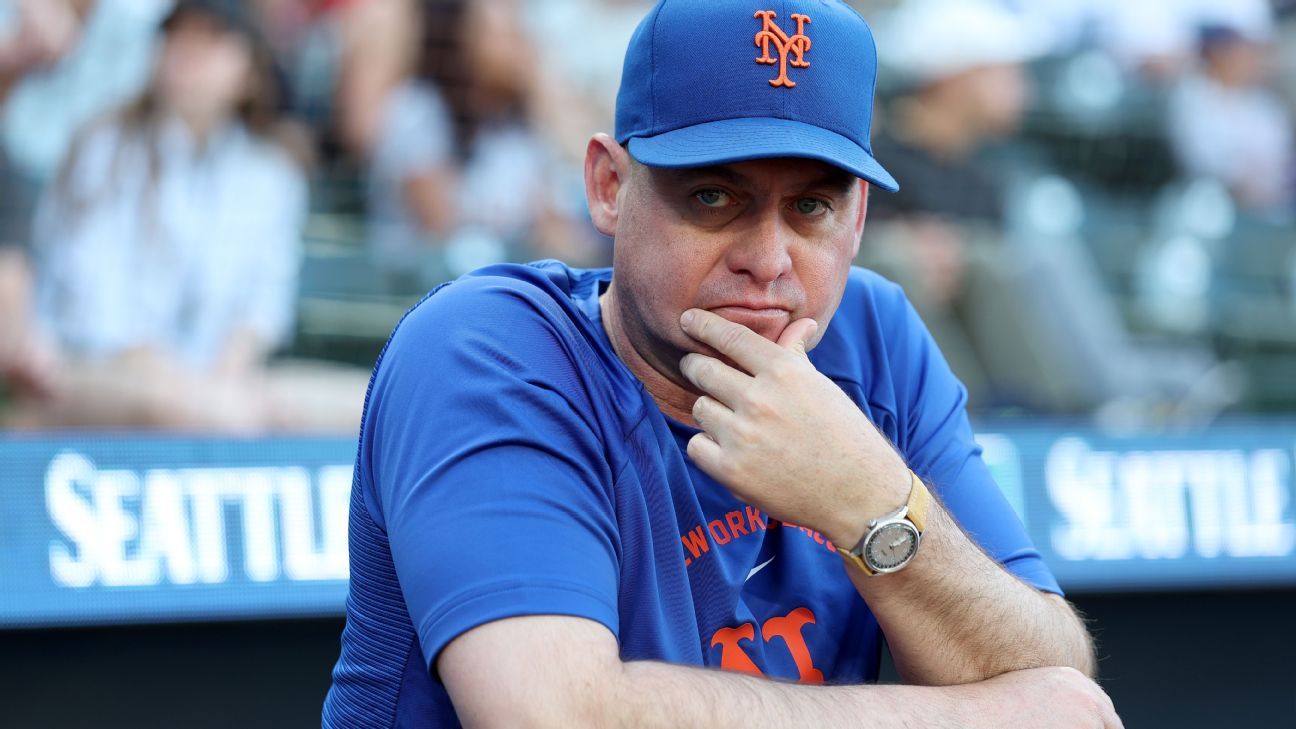
EmailPrintOpen Extended ReactionsA nightmare season for the New York Mets continued Friday with the firing of manager Carlos Mendoza.Despite a $375 million-plus competitive balance tax (CBT) payroll -- the second-highest total in baseball after the Los Angeles Dodgers -- the Mets are just 34-47 and in last place in the National League East. They are also in the midst of a six-game losing streak following an error-filled four-game sweep at home against the Chicago Cubs.The 2026 Mets have had worse stretches, so why fire their manager now? Is GM David Stearns on the hot seat, too? What can they do to turn things around? We asked ESPN MLB experts Jorge Castillo and David Schoenfield to tackle some of the toughest questions facing the franchise in Flushing.The Mets have been underperforming all season. But while their NL East rival Philadelphia Phillies fired their manager in April, the Mets chose to stick with Mendoza ... until today. So why now?Castillo: Because the last week has been an embarrassment. The Mets needed to rattle off a long string of wins. Eight straight, 10 of 12, that sort of thing. Instead, they've lost six consecutive games to fall to a season-worst 13 games under .500. Most damning, though, is they've looked lifeless. The Mets allowed 54 runs over those six losses. They gave up 15 runs to the Phillies last Saturday. Their infield made six errors in the second game of Wednesday's doubleheader against the Cubs, which the Cubs swept. They were overmatched in a way that a team with their payroll should never be. Yes, injuries are a factor. Yes, Mendoza wasn't the one making the errors or missing his location with pitches over and over again. But the team had sunk to a new level of ineptitude and the manager became the scapegoat.Schoenfield: No doubt, that six-error game was the final straw for owner Steve Cohen and GM David Stearns. That shouldn't happen in your rec league softball game let alone the majors. Just an absolutely shameful game of baseball. Physical mistakes can be excused -- in small doses and especially from young players, but these weren't young players. It looked like a team ill-prepared to play a major league game and, yes, the manager has to take some of the blame for that, fair or not.Andy Green will take over as manager for the rest of the season. Who is he? Who are the leading candidates for the permanent job?Castillo: Green is a former major league player with big league managerial experience, having managed the San Diego Padres for nearly four seasons until he was fired in Sept. 2019. He then became the Cubs' bench coach under manager David Ross before the Mets hired him as vice president for player development before the 2024 season. Green, 48, actually interviewed for the Mets' managerial vacancy that offseason before New York chose Mendoza. So he's familiar with the organization and understands the job.Perhaps Green will leave an impression and keep the job after his interim stint. It's interesting that the Mets didn't promote bench coach Kai Correa to manager. Correa is considered around the industry as a possible future manager. Another possibility within the Mets' organization is Carlos Beltrn. The Hall of Famer -- he'll be enshrined next month -- was hired to manage the Mets after the 2019 season, but was fired before that spring training for his role in the Houston Astros' sign-stealing scandal. He returned to the organization in 2023 as a special assistant in the front office.Other names to keep in mind include Ross, recently fired Boston Red Sox skipper Alex Cora, former Minnesota Twins manager Rocco Baldelli and Detroit Tigers bench coach George Lombard.The Mets have the second-largest payroll in baseball, trailing only the Dodgers. What has gone wrong?Castillo: It's been a perfect storm of instability, underperformance and injuries. The Mets didn't just blow up the roster over the offseason, they detonated Mendoza's coaching staff. Poor performance and injuries from the jump made finding a groove difficult.Jorge Polanco and Luis Robert Jr. spending time on the injured list isn't surprising and Stearns has admitted the front office will reassess how it evaluates players' injury histories, but Juan Soto and Francisco Lindor missing so much time was not on anyone's bingo card. The two stars have been as durable as they come, combining to miss 31 games over the past four seasons. Add Clay Holmes breaking his fibula on a comebacker in mid-May after being one of the NL's top pitchers and there has undoubtedly been some bad injury luck.Still, this team shouldn't be this bad. Soto (167 OPS+) and rookie outfielders Carson Benge (106 OPS+) and A.J. Ewing (100 OPS+) are the only regulars who have been at least league-average hitters. The starting rotation has the third-worst ERA in the majors. A $375 million roster should produce better results.Schoenfield: Umm ... everything? Soto has been the bright spot, second in the majors in OPS behind only Yordan Alvarez, but even he missed 15 games. The Mets are 24th in the majors in runs scored, they're 28th in rotation ERA and third in most errors. OK, the bullpen has actually been pretty good, ranking third in win probability added, and the defense somehow ranks ninth in defensive runs saved (although it's lower in some other defensive metrics and definitely lower via the eye test). Look, some of the offensive issues can simply be blamed on the injuries to Soto and Lindor, so let's focus on the rotation. Freddy Peralta (4.53 ERA) and Nolan McLean (4.03 ERA) have been mediocre while the just-traded David Peterson (6.09 ERA) and Kodai Senga (10.08 ERA in seven starts) have been awful. Sean Manaea is making $22 million and pitching in relief. Of note there: The Mets fired well-regarded pitching coach Jeremy Hefner in the coaching purge after the 2025 season. The Braves hired him. The Braves are fourth in the majors in ERA despite a string of injuries to their projected rotation.Is Mets GM David Stearns on the hot seat now, too?Castillo: Yes, but he isn't going anywhere for now with a contract through 2028. Stearns was Steve Cohen's prized target for years for his ability to guide the low-payroll Milwaukee Brewers to consistent success. He gave him a five-year deal to provide stability to a front office that had experienced nonstop turnover since Cohen bought the franchise in Nov. 2020.Still, Stearns has been a failure in New York. The 2024 team that made a surprising run to the NL Championship Series was mostly inherited and featured several players on one-year deals. It was considered a gap year before Stearns really dug into making changes. So far those changes have produced disaster. The thinking was that Stearns would thrive with Cohen's resources. That hasn't happened yet."I think the benefit of this job is we have access to the entire player universe," Stearns said Tuesday. "Anyone who's playing baseball anywhere, we have the potential to acquire. And that's very different than some other markets and certainly where I came from in Milwaukee. But that's a benefit. That is a benefit for us. It requires me and us as an organization to do our work a little bit differently. But that's a positive."Schoenfield: He should be, but his contract runs through 2028 so he's probably safe for now. Look, prior to this season, Stearns had a reputation as one of the best and brightest front office executives in the game, based primarily on his success in Milwaukee. He has tried simultaneously to win with the Mets while also building up a mediocre farm system that he inherited. While he has had success with the latter -- see McLean, Ewing and Benge making an impact in the majors -- the 2025-26 offseason for the Mets might go down as the worst ever for a general manager. That's not hyperbole.Stearns made a series of high-risk moves -- acquiring the injury-prone Polanco and Robert Jr., envisioning Polanco as the new first baseman even though he had never played the position before (both predictably got injured); trading for a declining Marcus Semien, only to see him decline even more; signing Devin Williams to replace Edwin Diaz as closer, only to see Williams struggle; trading prospects for Freddy Peralta, who has been mediocre; giving Bo Bichette a three-year, $126 million contract, and seeing him produce replacement-level WAR. Not to mention moving on from Pete Alonso. Those are six major moves -- a lot for one offseason -- and all have completely imploded. Wow.What does this mean for the Mets at the trade deadline?Castillo: Nothing yet. Stearns this week said he is going to wait to see if this team can make a run over the next month to put itself within striking distance of a postseason berth before deciding his deadline strategy. He called the Aug. 3 deadline the "cutoff.""You have to have a strategic direction at that point," Stearns said. "We can prepare on parallel paths as we go through this. And we know we have to play better than what we've played now. And we're going to give this team a chance to do that."Maybe that changes sooner if the Mets continue losing games in bunches in the next couple of weeks. Starters Peralta and Holmes and relievers Brooks Raley, A.J. Minter, Huascar Brazoban and Luke Weaver would figure to draw interest on the trade market. Another possibility is trading Bichette, who can opt out of his contract after this season. As of now, the Mets have a 5.2% chance to make the playoffs, according to FanGraphs. So ... there's a chance.Schoenfield: Even if the Mets do decide to eventually wave the white flag, who is there to trade aside from Peralta? And he hasn't pitched well enough to get a big return. Soto and Lindor will remain the building blocks, nobody will want Bichette and his contract the way he's playing, Williams is on the hook for $17 million the next two seasons so he looks untradeable. Maybe some of the relievers that Jorge mentioned -- relievers, after all, are always the easiest to deal at the deadline, but you're usually just getting a prospect lottery ticket in return.How would you grade Steve Cohen's ownership so far -- and what does he need to do to turn it around?Castillo: While the Mets have been a disappointment for most of his tenure, Cohen has invested more than enough money to generate winning teams and has sought stability after aggressive moves didn't pan out early on. Hiring Stearns was considered a home run. Mendoza was lauded for his work in his first season in 2024. They signed Soto to the largest contract in MLB history and he's been one of the best hitters in the majors in Queens. But there have been a number of bad signings and trades that he has approved -- remember Pete Crow-Armstrong for two months of Javy Bez in 2021? -- that can't be ignored. And fans are certainly miffed that the organization didn't re-sign Alonso and Daz on top of trading Brandon Nimmo during the offseason. That's under Stearns' purview, but those decisions ultimately fall on Cohen, who said during his introductory news conference that not winning a World Series in three to five years would be "disappointing." It's Year 6 and the Mets are going in the opposite direction. Grade: C-minus.Schoenfield: The Mets are 459-432 under Cohen's ownership since 2021, ranking 13th in the majors in winning percentage. That includes a 101-win season in 2022 and a run to the NLCS in 2024, but they also haven't made the playoffs in consecutive seasons. He no doubt has tried to win and spent a gazillion dollars trying to win, but there has still been a lack of a consistent plan here, with a lot of Band-Aid fixes through the years -- from Max Scherzer and Justin Verlander to this offseason's moves. They've spent more bad money in recent years than any other team. Bichette, Semien, Manaea, Williams, Robert and Polanco are making a combined $147 million, more than the payrolls of several teams, and have produced minus-1.5 WAR. The money spent has not produced the desired results and includes last year's collapse and this year's disaster. I'd give his tenure a D.