
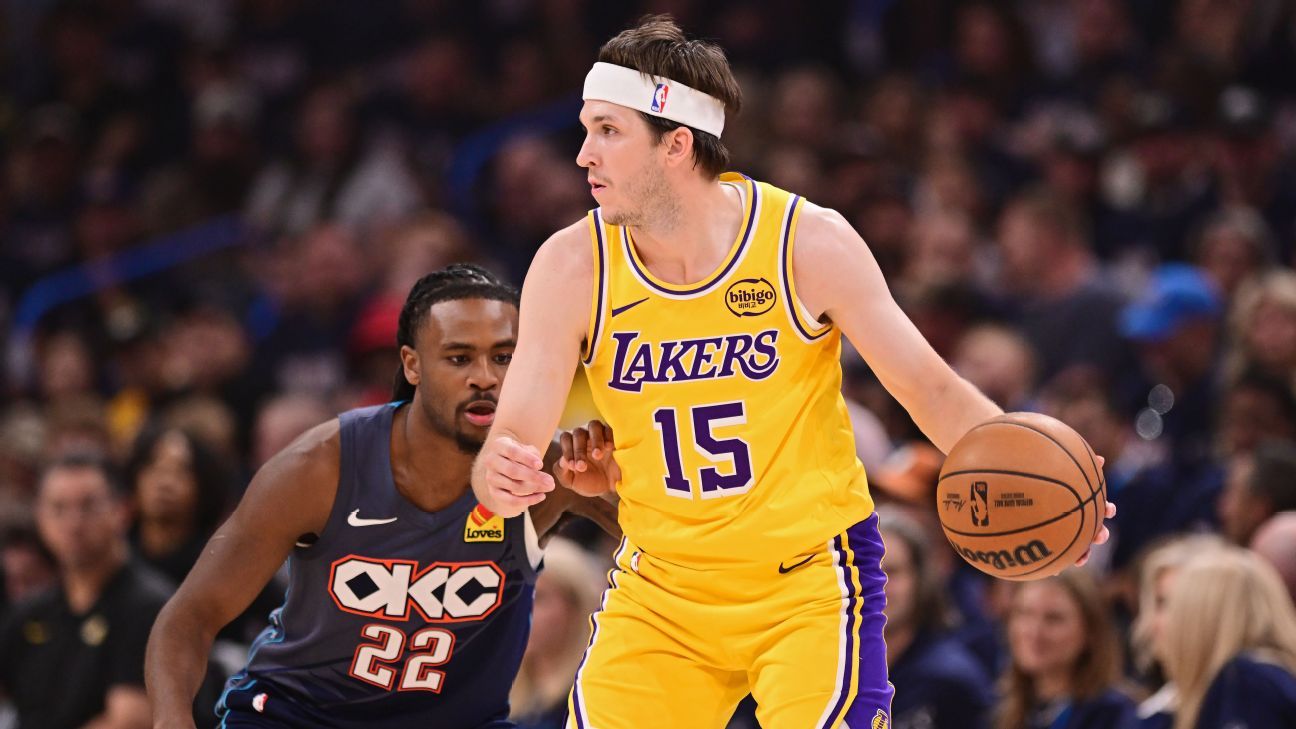
EmailPrintOpen Extended ReactionsThe NBA offseason is here, and teams across the league have been busy making moves ahead of the 2026 draft. (Watch the first round live on ABC, ESPN and the ESPN App).There should be more contract extensions soon, as June 30 is the last day for a player in the final year of his contract to extend that deal. June 30 is also the first day teams can negotiate with free agents outside of their franchise. In other words: That's when you should expect the free agency frenzy to begin.I'm grading every free agency signing and the most impactful extensions this offseason, breaking down the ramifications for all teams and players involved.To determine each grade, I'm looking at multiple factors, including the player's on-court impact and age, the contract's financial implications, and the context of the team's short- and long-term outlooks. How risky or certain is the move? And how much does it help or hurt the team's chance to win a championship, next season or beyond?Let's get into the latest moves:Quick links: Trade grades | Latest buzz | Trade machineDepth charts | Offseason guides | DraftJune 24: Lakers re-up Reaves on a max dealTerms: Four years, $185 million (with a player option in Year 4)Grade: B+It might seem impossible, given the intense media attention that the Los Angeles Lakers receive, but Austin Reaves might be underrated.Because he plays on a team with Luka Doncic and LeBron James, Reaves doesn't collect the counting stats he would if he were a different team's lead option. But look at Reaves' statistics in 2025-26 in 669 minutes without Doncic, per databallr, and how extraordinary they are.In fact, they're extremely similar to Shai Gilgeous-Alexander's stats:That's not to say that Reaves is as good as Gilgeous-Alexander, of course. He's more prone to turnovers, he's a much worse defender and he isn't as durable. But he doesn't need to equal the back-to-back MVP to be worth a whole lot of money, so the former undrafted player is cashing in during his first foray into unrestricted free agency.After Reaves signed a team-friendly bargain during his last contract negotiation -- a four-year, $53.8 million pact when he was a restricted free agent in 2023, with the final year a player option -- he didn't give the Lakers a home-team discount this time around. But after playing like a superstar for large stretches last season, and now at 28 years old, Reaves earned this expensive new deal. The Lakers couldn't afford to lose him.Building a championship team around two similar players in Doncic and Reaves won't be easy, however. There is some unfortunate overlap in the two stars' skill sets. Reaves' usage rate dropped from 34.5% without Doncic to just 21.4% with Doncic, for instance, suggesting the Lakers aren't maximizing his offensive potential when he's playing off the ball. Both players can be targeted on defense. And now they'll make more than half of the cap, combined, over the course of their contracts.But constructing a top-tier contender around two players who are either highly paid or stylistically similar isn't impossible. The Celtics are perennial contenders despite max deals for Jayson Tatum and Jaylen Brown, and Doncic himself reached the Finals in Dallas while playing next to another offensively oriented guard, in Kyrie Irving.That Mavericks team had enough high-quality complementary players to provide balance for Doncic and Irving, and that's where the remaining uncertainty lies for the Lakers: Can they build the same support structure?Beyond Doncic and Reaves, the Lakers' only players who are signed for next season without any options are Jarred Vanderbilt, Jake LaRavia, Dalton Knecht, Bronny James and Adou Thiero. To say they have an unfinished roster is an understatement; their roster-building around their star guards has barely begun.So in a vacuum, Reaves' new contract agreement -- he won't actually sign it until the Lakers finish the rest of their offseason spending, because of his relatively low cap hold in the meantime -- is logical, because he is still climbing the ranks of the NBA's best scorers. But this deal is only the team's first step this summer.Signing max players to max contracts is the easy part. Now the Lakers need to round out a winner with limited remaining financial resources.June 22: Wolves bring back Ayo Dosunmu after making tradeTerms: Five years, $112 million (with a player option in Year 5)Grade: B-The Minnesota Timberwolves didn't waste any time making use of the cap space they freed up by salary-dumping Julius Randle. On the same night they agreed to trade Randle to Brooklyn, they also agreed to re-sign Ayo Dosunmu, whom they'd initially acquired at the February trade deadline, to a nine-figure deal.The new contract means a massive windfall for Dosunmu, a former second-round pick who had earned less than $25 million in his career until now. He clearly aced his audition with his new team, with a strong close to the regular season and an eye-opening performance in the playoffs.It's fair to come to two overlapping conclusions about Dosunmu's new deal: First, the Timberwolves needed to re-sign him, and second, they probably overpaid for the privilege.The first part is easy: With Donte DiVincenzo sidelined by a torn Achilles and Minnesota's perimeter depth essentially barren behind Anthony Edwards and Jaden McDaniels, the Timberwolves were eager to bring back a positive contributor. Dosunmu turned in his best season in 2025-26, and his energy and shooting (44% on 3s last season, 38% in his career) fit especially well after his midseason trade.He'll either start next to Edwards in a dynamic backcourt, or be the Timberwolves' new sixth man -- with Naz Reid entering the starting lineup to replace Randle -- if they acquire another guard with their extra financial wiggle room. At 26 years old, Dosunmu's new deal will take him through the rest of his prime, and the team is counting on further development after his career year.It's unclear whether Dosunmu's ceiling warrants a nine-figure deal with a player option, however. He's a solid all-around player who doesn't have an obvious carrying skill: a fine passer, but overqualified as a lead creator; a useful defender, but with strangely muted steal rates (his career high is 0.9 per game); a knockdown shooter, but on relatively low volume.Dosunmu has never rated well by advanced stats because he had a negative on/off differential in every season of his career until this past season.Much has been made of Dosunmu's postseason breakout, highlighted by a 43-point outburst in a Game 4 win over the Nuggets. But while he averaged 21.8 PPG on 61% shooting against Denver, he fell to 9.4 PPG on 36% shooting as Minnesota was eliminated by San Antonio.To be fair, he was hampered by calf tightness, but it's also possible the Timberwolves are reading too deeply into a couple of hot games against a weak Denver defense that had done more preparation to stop the injured Edwards and DiVincenzo than Dosunmu.June 22: Trae Young, Wizards agree to four-year dealTerms: Four years, $212 million (with a player option in Year 4)Grade: DWhen the Wizards traded for Trae Young in January, it seemed like an opportunistic buy-low move for a franchise devoid of star power, as they didn't have to surrender any picks to add the four-time All-Star.But now we've learned the true price of Washington's acquisition, and it didn't turn out to be a buy-low endeavor at all. Young's new contract isn't the maximum that the Wizards could have given him -- that four-year deal would've been worth $222 million -- but it will still pay him an average of $53 million over four seasons and make him one of the 20 highest-paid players in the NBA.If Young was ever at that level in terms of his performance -- he's made one All-NBA third team in his career -- he's not anymore, as he prepares to enter his age-28 season following a marked decline on the court.While Young remains an offensive engine who has averaged double-digit assists in each of his past three full seasons, he has also lost some of what made him so special on that end in his early 20s.Young's penchant for highlight-worthy deep 3-pointers hides the fact that he has shot 34% or worse from distance in three of the past four seasons. Over that span, he ranks 49th out of 56 players with at least 1,500 attempts in 3-point percentage. The only point guard below him on that list is De'Aaron Fox, who faces major questions due to his own four-year contract that kicks in next year.Even more worrying, some of Young's burst has disappeared, which raises broader concerns about a decline in athleticism. In the 2020-21 season, which ended in Atlanta's surprising trip to the conference finals, Young averaged 29 drives per 100 possessions, per GeniusIQ, which ranked third behind Shai Gilgeous-Alexander and Luka Doncic.But over the past three seasons, Young is down to 21 drives per 100 possessions, a drop of more than a quarter. He ranks 14th in drive frequency in that span (minimum 1,000 total drives), which is still good, but nowhere near the elite level anymore.Trae Young's Drives Per 100 PossessionsAnd if Young isn't maximizing his offensive impact, then it's unclear how much he can help a contender because his contributions on the other end are so meager.The advanced stat xRAPM ranks Young in the 97th percentile for offensive impact, but below the first percentile in defensive impact. Estimated plus-minus, similarly, has Young in the 97th percentile on offense and the fourth percentile on defense.In every season of his career (until this last, injury-shortened one), Young's teams have been much better with him on offense, and in almost every season, they've been much worse with him on defense, according to Cleaning the Glass' on/off data.A player with that profile still has value to the right team in the right context. And Washington fits in some respects, as a franchise lacking a clear lead creator, with lots of present-day cap flexibility and young players on rookie contracts. Young will certainly raise the Wizards' floor as they seek to climb out of the NBA's basement after losing 67, 64 and 65 games in the past three seasons.But soon enough, some of those young players will start demanding contract extensions, and now they'll receive their raises at the same time that the Wizards are paying upward of $50 million per season to a small guard with huge flaws on the wrong side of the aging curve.Under the NBA's current financial regime, the worst mistake a team can make is committing superstar money to a good but not great player who's a rung below that level. The Wizards would have been OK if they had re-signed Young to fewer dollars or fewer years, ideally both. But they didn't pick either option.June 21: CJ McCollum returning to Hawks on one-year dealTerms: One year, $21 millionGrade: AMcCollum played an unexpectedly important role in Atlanta last season, as the Hawks surged after the All-Star break. And in retrospect, he might have been the most valuable player in the playoffs because he accomplished something that nobody else in the entire NBA could: With game-winning buckets in the final minute of consecutive games, he managed to beat the Knicks multiple times this postseason.That wasn't the expectation when McCollum came to Atlanta in the Trae Young trade, where he was seemingly included primarily to help match Young's salary. Any on-court contributions would have been a bonus.But McCollum meshed well with Atlanta's untraditional positional alignment. The Hawks' five-man lineup of McCollum, Dyson Daniels, Nickeil Alexander-Walker, Jalen Johnson and Onyeka Okongwu had a plus-21.4 net rating, per Cleaning the Glass, which ranked second among all lineups with at least 500 possessions. In a larger sample, the trio of McCollum, Alexander-Walker and Johnson -- the veteran guard alongside the Hawks' two best players -- had a plus-14.5 net rating, per NBA Advanced Stats.Next season, the Hawks will continue using those effective lineups, and McCollum's ability to play both on- and off-ball -- which he has successfully balanced throughout his entire career, starting when he was Damian Lillard's sidekick with the Portland Trail Blazers -- makes him an asset in Atlanta. He can run the offense himself, take a backseat to Johnson (the Hawks' assist leader after Young's departure) and help mentor a young point guard, if Atlanta goes that route with the No. 8 pick in this week's draft.And while McCollum is well past his peak and will be 35 years old at the start of next season, his extension qualifies for one of my favorite sports aphorisms: There's almost no such thing as a bad one-year deal.After making $30.7 million last season, McCollum's salary will drop to $21 million in 2026-27. That number maintains the Hawks' offseason flexibility, as ESPN's Bobby Marks wrote in his offseason guide that "Atlanta is in as good a financial shape as any playoff team." And it includes almost no downside, because the Hawks aren't committing to pay McCollum into his late 30s, when his gradual (thus far) decline should grow more pronounced.June 20 & 21: Suns agree to deals to bring back two guardsG Collin GillespieTerms: Four years, $48 millionGrade: A-G Jordan GoodwinTerms: Three years, $19 millionGrade: B+When I ranked the most underrated free agents of this class, Gillespie topped the list. He enjoyed a breakout 2025-26 season, averaging 12.7 points per game and sinking 40% of his 3-pointers. His 46% mark on catch-and-shoot 3s ranked third among 121 players with at least 200 attempts (behind Luke Kennard and Jamal Murray). And he rates well by advanced stats.For Gillespie, who went undrafted out of college and played three consecutive seasons on a two-way deal before 2025-26, a $48 million pact represents life-changing money.For Phoenix, Gillespie fills a much-needed role as a ball handler next to Devin Booker, who led the Suns with 6.0 assists per game but isn't the sort of playmaker who should dominate the ball on every possession. A four-year deal will cover the rest of Gillespie's prime (he celebrates his 27th birthday this week) and tie him to Phoenix at a fair price.Goodwin is also a 27-year-old point guard, but he's a much more unorthodox player for the position than Gillespie: He's not a remarkable scorer or creator (though his improved 3-point percentage, up to 37% last season, is notable), but he's a strong defender and -- most remarkably -- an incredible offensive rebounder.One of the most incredible statistics of last season is that the 6-foot-3 Goodwin ranked 15th among qualified players with a 9.4% offensive rebounding rate. All 14 players ahead of him were centers.In a vacuum, the Suns did well to re-sign both Gillespie and Goodwin for reasonable rates.The potential complication is how these deals affect the rest of the Suns' offseason plans, with starting center Mark Williams also due for a new contract as he enters restricted free agency. They entered the offseason just $18 million shy of the luxury tax line and $26 million shy of the first apron.And although the Suns greatly exceeded expectations last regular season, winning 45 games with a feel-good group and landing the West's No. 8 seed, they were uncompetitive in a first-round sweep against Oklahoma City and don't have any clear pathways to greater contention. Is Phoenix content to run it back while also accepting the penalties that come with exceeding the luxury tax and first apron?