
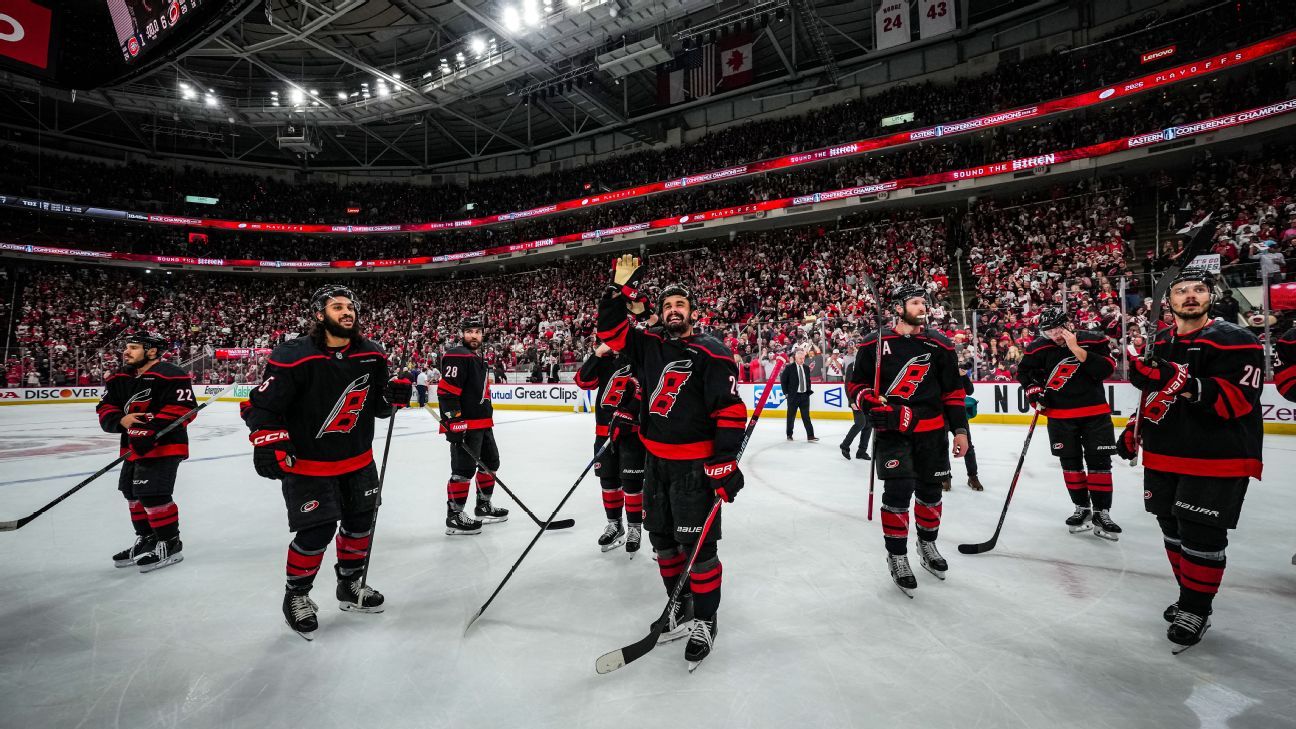
EmailPrintOpen Extended ReactionsThe Carolina Hurricanes will win the Stanley Cup.I had them in the Cup Final before the season, but I picked them to lose to Colorado, not realizing the Avalanche would fall apart against the Vegas Golden Knights.I've been high on the Canes for quite a while, but they've blown away my expectations after two series sweeps and one rust-covered loss from sweeping the Montreal Canadiens.Here are five reasons I believe the Hurricanes will win the Cup at the end of the Final.They solved their playoff Achilles' heelThe teams that Rod Brind'Amour previously coached to the playoffs were defensively superior but offensively challenged. Before this postseason, the Hurricanes ranked eighth in playoff scoring (minimum 50 games) since Brind'Amour took over in 2018-19 with 2.89 goals per game -- much lower than their average in the regular season (3.22) during that span.Their goal-scoring didn't show up in later rounds. In 13 previous games in the conference finals, the Hurricanes averaged 1.61 goals per game against the Boston Bruins (2019) and the Florida Panthers (2023, 2025). In five games against the Montreal Canadiens, they averaged 3.60 goals.But more to the point, they couldn't score a goal when they needed one the most.That's one of the most significant differences between this Carolina team and previous incarnations. The Hurricanes are 5-0 in overtime games, including two wins that swung the conference finals after their Game 1 loss to Montreal. Nikolaj Ehlers won Game 2. Andrei Svechnikov won Game 3. Those OT goals are illustrative of what has changed for the Hurricanes.Four of their top six scorers in the playoffs were acquired by general manager Eric Tulsky over the past two seasons. Three of them can be traced back to that ill-fated interest in Mikko Rantanen, whom the Hurricanes acquired from Colorado and traded to Dallas after 13 games and his refusal to commit long term to Carolina:Leading scorer Taylor Hall (16 points), traded by Chicago, who shared Rantanen's cap hitLeading goal scorer Logan Stankoven (nine goals), who came over from DallasK'andre Miller (eight points), their leading scorer among defensemen, who was acquired from the Rangers using the trade capital they got for RantanenIt used to be that if Svechnikov, Sebastian Aho or Seth Jarvis -- who still comprise the team's top line -- weren't scoring, the Hurricanes were in trouble. But in this run to the Stanley Cup Final, it could be argued that they were Carolina's third-best line."They've laid the foundation for everything that's gone on here, and we've kind of added to it," Hall said after Game 5.Hall's line with Stankoven and Jackson Blake, a fourth-round pick in 2021, is easily the playoffs' top offensive unit, averaging 4.87 goals per 60 minutes at 5-on-5. The Hurricanes' checking line of defensive stalwarts Jordan Staal and Jordan Martinook is bolstered by Ehlers, a big free agent signing last summer for Tulsky. That line has an expected goals percentage of 70.3% at 5-on-5. Heck, even the fourth line -- Eric Robinson, Mark Jankowski and William Carrier -- is churning offensively, having produced goals in two of Carolina's four conference final wins.The scary part is that there's still room for improvement. The Aho line has yet to really get going at 5-on-5. The Hurricanes' power play is chugging along at just 12.5%.None of this is a recent development. This was easily the best offensive team Brind'Amour had coached in the regular season. The Hurricanes averaged 3.55 goals, second to only the regular-season juggernaut Colorado Avalanche (3.63). Carolina's power play was fourth in the NHL (24.9). Those numbers indicated that this postseason would be different offensively for Carolina. That promise has been fulfilled.The Hurricanes are better offensively at 5-on-5 in goals per 60 minutes (2.83 to 2.57) and expected goals per 60 (3.51 to 2.67). They don't have Jack Eichel, Mitch Marner and Mark Stone. They might not have Pavel Dorofeyev, either. They just have four capable lines that crash over your team in waves until your defense succumbs.But they still defend like the HurricanesThe Hurricanes aren't boring. They just have a 2000 New Jersey Devils problem.That Devils team, which won the Stanley Cup, averaged over three goals per game in the regular season, powered by one dynamic line that featured Patrik Elias as well as elite offensive talents such as Scott Gomez, Alex Mogilny and the late Claude Lemieux. But because the Devils defended well (1.70 goals against per playoff game) and their reputation for tedium had been forged during the neutral zone trap years, they were called boring, too.The Hurricanes are a fun, fleet offensive team with a punishing forecheck and detail-oriented defensive zone play that smothers opponents like a coiled anaconda.The Canadiens' 11 shots on goal in the second period of Game 5 were the most they had in their previous 13 periods. As Hall said after the game, once the Hurricanes started dominating offensive zone time and figured out how Montreal liked to break the puck out, the series tilted in Carolina's favor.Frederik Andersen was waiting to face a shot like Bruce Cassidy waiting for the team that fired him to let him work again ...The Hurricanes have always been analytics darlings, and their underlying numbers help tell the defensive story. They have the best expected goals percentage (60.7%) and share of shot attempts (59.4%) at 5-on-5 in the playoffs.In the third period and overtime in Games 3 and 4 at Bell Centre, the Hurricanes held a 70-29 advantage in shot attempts and a 32-5 advantage in shots on goal. Montreal coach Martin St. Louis was reduced to explaining Hockey 101 tactics, saying the Canadiens had to get in positions to even attempt a shot before thinking about getting them on goal or creating a scoring chance.Brind'Amour's man-to-man system can be susceptible to rush chances the other way if anyone blows an assignment, which is what happened in Game 1 of the conference finals after the Hurricanes were out of sync following their 11-day layoff. But overall, their depth of talent and chemistry has held up their defensive front."They really play to their identity, and they have a lot of details inside that," St. Louis said. "You got to give credit to how well they played. They made it really hard on us."This is easily the best defensive team the Vegas Golden Knights will have faced in the playoffs. Coach John Tortorella's teams have never been known for their offensive prowess. We'll see how they fare against what captain Jordan Staal called "the machine."Frederik Andersen hasn't turned into a pumpkinThe anecdote from "Cinderella," about her glorious carriage turning back into a field squash when the clock strikes midnight, has typically applied to Andersen in the playoffs.Andersen has had dominant stretches. He's first among active goaltenders with eight career playoff shutouts, three of them coming in this playoff run. But what has plagued him in the past has been his health and bouts of ineffectiveness.It has become assumed that Andersen will miss time during the regular season because of injuries, and sometimes, they will carry over into the playoffs.It was also assumed that he'd "turn into a pumpkin" at some point in the playoffs, as a couple of ineffective games would have Brind'Amour turning to Pyotr Kochetkov, Antti Raanta or other former Hurricanes backup goalies.But similar to so many other things for Carolina this postseason, it has been different for Andersen. Part of that was his unusual regular season.Andersen, 36, signed a low-cost ($2.5 million AAV) one-year deal last summer, with no promises about his place on the depth chart. As he struggled early in the season (.871 save percentage at the Olympic break), Brandon Bussi was earning more starts and winning more games: He was 23-3-1 at the Olympic break.But after that break, Andersen started to find his form. By the playoffs, Bussi and Kochetkov were afterthoughts.In the playoffs, brevity has been his friend. He has played 13 games, the same number as last postseason, but with huge breaks between series to allow his mind and body to rest. The back-to-back sweeps and the five-game series win against Montreal also meant the players in front of Andersen were well-rested."One less game of your 'D' taking extra big hits and stuff like that, I think it's beneficial," he told ESPN.Andersen has been the foundation on which the Hurricanes have built this run. Not by stealing games -- although he has had his moments, such as Game 2 against Ottawa and Philadelphia -- but by being the last line of defense when the structure breaks down as well as the most important player on their penalty kill (92.5%).In the past, Brind'Amour has lamented about giving opponents "freebies" with mistakes in the conference finals. Andersen is the No. 1 reason goals have been at a premium for foes.But Andersen is playing with a heavy heart. His longtime agent was Claude Lemieux, who died by suicide Thursday, according to authorities. He was 60.Andersen was asked after the game what Lemieux's message to him might have been ahead of the Stanley Cup Final."Just go get it," Andersen said. "He's the ultimate competitor. He's got the biggest heart. He wanted this so much for me and for the team."Their path was harder than creditedI spoke with an NHL executive during the Eastern Conference finals about the Hurricanes' and Golden Knights' journeys to their Stanley Cup showdown.The popular perception is that the Hurricanes had an easier path, sweeping Ottawa, sweeping Philadelphia and beating Montreal in five games."OK, so who has Vegas played?" he asked.The Golden Knights needed six games to dispatch Utah and Anaheim before their shocking sweep of the Avalanche.Carolina faced the ninth-, 11th- and sixth-best teams from the regular season. Vegas eliminated the teams that finished 15th, 18th and No. 1 in the regular-season standings.But that wasn't really the Avalanche that the Golden Knights swept. Not when Cale Makar missed the first two games and clearly wasn't himself. Not when Nathan MacKinnon was injured and ineffective in the last two games. Not when Colorado was also missing Valeri Nichushkin, Artturi Lehkonen and Sam Malinski for stretches.Vegas was peaking at the right time and earned its ticket to the Stanley Cup Final, but Colorado was decimated by injuries by Game 4.Utah was a playoff neophyte, other than a few players. The Ducks were making their first playoff appearance since 2018, and advanced to the second round over a one-legged Connor McDavid and an exhausted Oilers team. The Ducks couldn't defend in the regular season. They still hadn't figured it out in the playoffs once they faced the Knights, who put up 21 goals against them in six games.Meanwhile, the Senators were a team many in the analytics community believed could be a disruptor in the East, and Rick Tocchet's stingy defensive system and Dan Vladar's outstanding goaltending helped the Flyers eliminate the Penguins before facing Carolina. The Hurricanes needed the minimum number of games to dispatch both.Against Montreal -- again, sporting the East's hottest goaltender in Jakub Dobes -- Carolina outclassed the Canadiens for long stretches of the series, eventually outscoring them 18-11 in five games.The argument is that the Hurricanes made it look easy -- but that's not because it was the easier path.Finally, Brind'amour hasn't ground them into dustThere's a certain irony that Brind'Amour has his team playing for the Stanley Cup, for the first time in 15 seasons as an assistant and head coach in Carolina, against a team coached by John Tortorella.Both coaches are known for demanding so much from their players during the season that they little left for when the games matter most. Tortorella was hired with just eight games left in the regular season. So, that's just 24 games of blocking shots and taking the physical grind he demands of his teams.In Brind'Amour's case, it's two-fold. First, the Hurricanes had many players miss regular-season games because of injuries, with just six players hitting the 80-game threshold. (Vegas had just five players appear in at least 80 games.) Second, their postseason journey has featured two sweeps and a five-game conference finals. They enjoyed the longest break between rounds in 107 years in the NHL: 11 days, separating their sweep of the Flyers and Game 1 against Montreal."Getting away from the rink and kind of letting your brain reset for a second," Miller said of the time off. "You obviously get into such high-intensity situations through these playoffs, just really getting the opportunity to take that rest is big for this team."They struggled in the first period of Game 1. But after that, it was clear that the rested Hurricanes were wearing down the Canadiens, who had played back-to-back seven-game series.Carolina defenseman Jaccob Slavin once told me that "rest is a weapon." It's no coincidence that the Hurricanes finally broke through the conference finals ceiling at their healthiest and most rested point under Brind'Amour -- and with their deepest roster of contributors.Prediction: Hurricanes win in sixCarolina and Vegas are peaking at the right time, from the goaltending out to the forwards. Stylistically, they are similar: take away what their opponents do well, flex their depth and use detail-oriented defense and goaltending as their foundation. It will be a fascinating series.But I like the Hurricanes.It wouldn't be an upset, as DraftKings has them at -155 to win the Stanley Cup. But it would mean they'll have overcome a few disadvantages in the series, such as championship experience and star power.Carolina is the most impressive team in the playoffs. The influx of high-end talent over the past few years achieved its goal, which is to take a very good team and make it one that can realistically lift the Stanley Cup. The Hurricanes will need that depth to thrive in the final, assuming the Stankoven line gets a healthy dose of Mark Stone & Co. It almost appears to be a series where Svechnikov or Ehlers will have to carry the offensive torch instead.But everything still comes down to goaltending.Carter Hart is playing his best hockey of the season. Andersen is playing the best playoff hockey of his life. Money Puck gives Andersen the advantage in goals saved above expected (11.5 in 13 games) over Hart (7.7 in 16 games), as well as expected goals-against average (2.22 to 2.69).For all the talk about the Hurricanes' offense and its importance during Carolina's run to the Stanley Cup Final, having this level of goaltending is as much a point of demarcation from past failures. If Andersen continues his form from the first three rounds, the Hurricanes win the Cup. If there's a wobble or, worse, a reversion to past form, the Knights have a lane.But I think Carolina gets the checkered flag at the end of this race. The Hurricanes are rested. They're tested. They're ready to finally win a Stanley Cup for Brind'Amour, cementing his place as one of the most important individuals to a pro sports franchise in history.The Canes have 100 playoff wins. Brind'Amour has been a player or a coach for 98 of them. And, in the end, both of their Stanley Cup wins.