
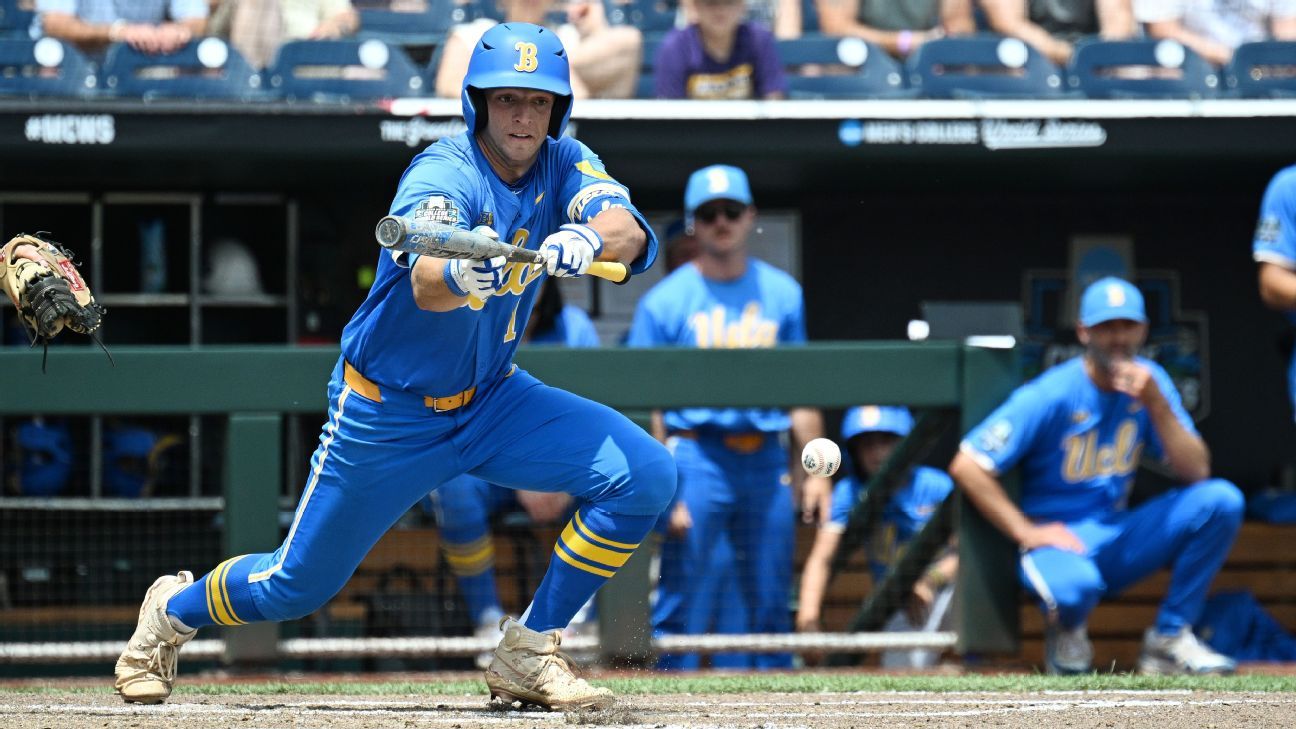
EmailPrintOpen Extended ReactionsNow that we've seen college players in action over the first week of the season, it's time for our first look at who could be high on MLB draft boards in July.This class is seen as above average at this point, in large part because of the first five players, and more specifically the top two. At this point last year, there were two players for me in the 50 FV tier, no one else higher, and both of those players (Jace LaViolette and Jamie Arnold) regressed a bit in the spring. The top of the board and the rest of the first round are strong with college position players. The collegiate pitching is more solid than spectacular, notwithstanding Jackson Flora's blistering opening day start. The high school position players are also strong, with a chance to take another step forward if a couple high variance players make the leap this spring.These players were ranked using the FV (future value) system that I applied for pro prospects. You can check out my offseason MLB prospect rankings to see where these players would rank if they turned pro now, though the grades will change (generally improve as we gain more information and certainty) as the spring progresses. The number in parentheses is the player's age on draft day, a key number in every team's draft model; in short, younger players allow for more projection.60 FV Tier (Prospects ranked 2-14 in the pro top 100)1. Roch Cholowsky (21.3), SS, UCLACholowsky was a late first- to early second-round prospect in the 2023 draft, but a high price tag pushed him to UCLA; that has obviously worked out well. He had a huge 2024, belting 23 homers with a 1.190 OPS, and he is off to a hot start this season with three homers (one of them was 111 mph off the bat, just short of a career-best exit velo) and three doubles through four games.Cholowsky is a roughly average runner, but he is quick and instinctual defensively; he's a plus defender with a plus arm. The concern out of high school was his offensive upside, but Cholowsky has grown into plus raw power that he has feel to get to in games along with the bat-to-ball and pitch selection to make that work. The hesitation would be that his contact rates and OBP might be more average against high-level pro arms (but he'd likely still get to his 25ish homer upside) and his build/speed limits his value on the bases, but that's splitting hairs. This is a Dansby Swanson- or Willy Adames-type package, and Cholowsky is still a pretty heavy favorite to go first this year and would be the favorite to go first in most years.55 FV Tier (Prospects ranked 15-45 in the pro top 100)2. Grady Emerson (18.4), SS, Fort Worth Christian HS (Texas), Texas commitEmerson has been the top player in the 2026 prep class since anyone can remember. He's a 6-foot-2, lefty-hitting shortstop with above-average tools across the board along with the soft skills, performance track record and the age that teams like to see at the top of the draft. The only real complaint here is that he lacks the plus-plus electric tools of Bobby Witt Jr., Bryce Harper or Justin Upton at the same stage, but that's an incredibly high bar to clear. Some scouts think Emerson could be a plus to plus-plus hitter with plus power that sticks at shortstop long-term, which is enough to make him the top pick if Cholowsky hiccups at all this spring. Emerson could easily end up in the 60 FV tier by draft time.50 FV Tier (Prospects ranked 46-120 in the pro top 100)3. Justin Lebron (21.7), SS, Alabama4. Jackson Flora (21.1), RHP, UC Santa Barbara5. Drew Burress (21.6), CF, Georgia TechLebron was comfortably second or third on this list most of the summer and fall, but now some scouts' concerns about his hit tool are leading to him slipping a spot or two for some teams. His other tools are plus, so a strong performance in SEC play will keep him here. I want to see a bit more of Lebron before moving him down, and I also may move up Flora on his own, but I want to see a bit more for him, as well. Flora sat 96-99 and hit 100 mph with above-average shape/movement on the pitch, helped by almost 7 feet of extension; there's front-line potential if he continues like this and keeps throwing strikes. Burress is 5-9 and takes a healthy hack at the plate, which is mostly what scouts don't like about his game. That said, he looks like a center fielder and has hit .356 with 44 homers and 41 doubles as a member of the Yellow Jackets.45+ FV Tier (Prospects ranked 121-200 in the pro top 100)6. Derek Curiel (21.1), CF, LSU7. Cameron Flukey (21.2), RHP, Coastal Carolina8. Gio Rojas (19.0), LHP, Stoneman Douglas HS (FL), Miami commit9. AJ Gracia (21.7), CF, VirginiaCuriel can hit, has medium power, and he might be a center fielder; sometimes that combination clicks quickly in pro ball and turns into someone like Mets OF Carson Benge. Flukey's fastball and starter traits are among the best in the draft, but his breaking stuff is fringy, and he doesn't throw his changeup much. I reported on Wednesday night that Flukey will miss his start this week, though the decision was precautionary, and the issue isn't with his arm.Rojas is older for the class, but has four above-average pitches and has been a standout prospect for years, like Emerson. Gracia's swing can get uphill at times, and he likely shifts to a corner outfield spot, but there's real offensive upside that keeps him up here. The feedback I got from scouts was to keep these nine players so far in the top group of players in some order, but then there were a lot of differing opinions on the players just outside the top nine.45 FV Tier10. Kevin Roberts Jr. (18.0), CF, Jackson Prep HS (Mississippi), Florida commit11. Tyler Spangler (18.8), SS, De La Salle HS (California), Stanford commit12. Rocco Maniscalco (17.2), SS, Oxford HS (Alabama), Mississippi State commit13. Blake Bowen (18.5), CF, JSerra Catholic HS (California), Oregon State commit14. Christopher Hacopian (21.9), SS, Texas A&M15. Liam Peterson (21.1), RHP, Florida16. Jacob Lombard (18.8), SS, Gulliver HS (Florida), Miami commit17. Eric Becker (21.2), SS, Virginia18. Will Brick (18.1), C, Christian Brothers HS (Tennessee), Mississippi State commit19. Carson Bolemon (19.3), LHP, Southside Christian HS (South Carolina), Wake Forest commit20. Sawyer Strosnider (21.0), RF, TCU21. Vahn Lackey (21.0), C, Georgia Tech22. Logan Schmidt (18.0), LHP, Ganesha HS (California), LSU commit23. Gabe Gaeckle (21.8), RHP, Arkansas24. James Clark (18.8), SS, St. John Bosco HS (California), Duke commit25. Caden Sorrell (21.3), CF, Texas A&M26. Trevor Condon (18.5), CF, Etowah HS (Georgia), Tennessee commit27. Tyler Bell (21.0), SS, Kentucky28. Chris Rembert (21.0), 2B, Auburn29. Jensen Hirschkorn (18.6), RHP, Kingsburg HS (California), LSU commit30. Ryder Helfrick (21.4), C, Arkansas31. Ace Reese (21.2), 3B, Mississippi State32. Coleman Borthwick (18.2), RHP, South Walton HS (Florida), Auburn commitThere's some agreement in the industry that Rojas is the top prep arm, Bolemon is second, Schmidt is usually third, and Hirschkorn is usually fourth, but then it really opens up after that. Borthwick has the most universal support in the fifth spot at this point due to his two-way athleticism and strike-throwing, but there are a few more candidates at the top of the next tier. The depth of this draft is college hitters, so there are all kinds within this tier. Hacopian might be the best hit/power combo among the infielders, Strosnider and Sorrell are power-over-hit types as tweener defensive fits. Bell and Rembert are hit-first, and Helfrick has the most defensive value. The top of this tier is stuffed with high-upside prep position players who are the best bets to break into the top nine players; Spangler and Maniscalco are the best hitters and defenders. Bowen and Lombard have the most power of that group, but both come with questions on their hit tool. Maniscalco reclassified from the 2027 class and is now one of the youngest potential first-rounders in a while; age is a giant factor in draft models for high school position players.40+ FV Tier33. Eric Booth Jr. (18.0), CF, Oak Grove HS (MS), Vanderbilt commit34. Joey Volchko (21.1), RHP, Georgia35. Joseph Contreras (18.2), RHP, Blessed Trinity Catholic HS (GA), Vanderbilt commit36. Zion Rose (21.1), CF, Louisville37. Kaden Waechter (18.9), RHP, Jesuit HS (FL), Florida State commit38. Connor Comeau (17.9), SS, Anderson HS (TX), Texas A&M commit39. Jared Grindlinger (17.2), LHP/RF, Huntington Beach HS (CA), uncommitted40. Cole Koeninger (18.9), SS/RHP, Keller HS (TX), Tennessee commit41. James Jorgensen (18.8), RHP, Jesuit HS (TX), Texas commit42. Tegan Kuhns (21.1), RHP, Tennessee43. Chase Brunson (21.0), CF, TCU44. Cole Carlon (21.1), LHP, Arizona State45. Keon Johnson (18.3), SS, First Presbyterian HS (GA), Vanderbilt commit46. Jake Brown (21.5), RF, LSU47. Brady Harris (18.5), CF, Trinity Christian HS (FL), Florida commit48. Matt Ponatoski (18.4), RHP/SS, Archbishop Moeller HS (OH), Kentucky commit49. Mason Edwards (21.0), LHP, USC50. Ethan Kleinschmit (21.2), LHP, Oregon StateWaechter (son of six-year MLB veteran pitcher Doug), Contreras (son of 11-year MLB veteran pitcher Jose) and Ponatoski (four-star quarterback recruit; a background similar to Bubba Chandler at the same stage) have the intriguing biographies in this tier. Jorgensen is the big helium name, rising multiple rounds since the new year as his stuff has spiked. Volchko is a riser from the opening weekend of the college season, sitting 94-97 mph with his cutter and leaning more on a sweeper and curveball than years past. Brown started the season red-hot, with four homers (including a personal high exit velo) through four games along with only five whiffs.Yesterday, Grindlinger was confirmed to be a 2026 draft prospect, quite unexpectedly. He joins Maniscalco as some of the youngest elite prospects in draft history. Grindlinger is a pro prospect as a corner outfielder, and it's too early to rule that out, but I think he's a superior one on the mound right now; a background similar to Cam Caminiti, who went 24th overall to the Atlanta Braves in the 2024 draft. Grindlinger is up to 95 mph on the mound with a changeup that flashes above average along with starter traits and a couple solid breaking pitches. There's some projection and precocious two-way feel for the game that allows scouts to project more to come as an abbreviated evaluation process begins. On the bright side, Grindlinger has been at a ton of high-end prep events, so he's among the easier players from the 2027 draft class for scouts to get up to speed on quickly.40 FV Tier51. Maddox Molony (21.8), SS, Oregon52. Carson Tinney (21.3), C, Texas53. Gavin Grahovac (21.5), 3B, Texas A&M54. Aiden Robbins (21.5), CF, Texas55. Archer Horn (18.4), SS/RHP, St. Ignatius Prep HS (CA), Stanford commit56. Jarren Advincula (21.5), 2B, Georgia Tech57. Jason Decaro (20.2), RHP, North Carolina58. Denton Lord (18.6), RHP, South Walton HS (FL), Mississippi State commit59. Bo Lowrance (18.8), 3B, Christ Church Episocal HS (SC), Virginia commit60. Ryan Lynch (21.1), RHP, North Carolina61. Ethan Norby (21.5), LHP, East Carolina62. Cade Townsend (21.2), RHP, Ole Miss63. Tommy LaPour (21.3), RHP, TCU64. Will Yow (18.6), SS, St. Anne's-Belfield HS (VA), Virginia commitThis group is quite diverse with a power-over-hit type that fits in a corner in Grahovac, then Advincula, who is almost the opposite kind of position player. Norby is a likely undersized starter, while Lynch (velo was up to 94-97, touching 98 mph in his first start of the season) and Townsend have lively stuff that is around the middle of the starter/reliever spectrum at the moment. Lord is a classic prep projection righty who stands at 6-8; he teams up with Borthwick for the best 1-2 in a high school rotation in the country. Yow was a huge riser in the fall who was basically unknown before that (the same story as Michael Oliveto in the 2025 class, who eventually went 34th overall), and teams are still playing catch-up. LaPour is missing this week's start with elbow soreness, which is obviously something to monitor.