
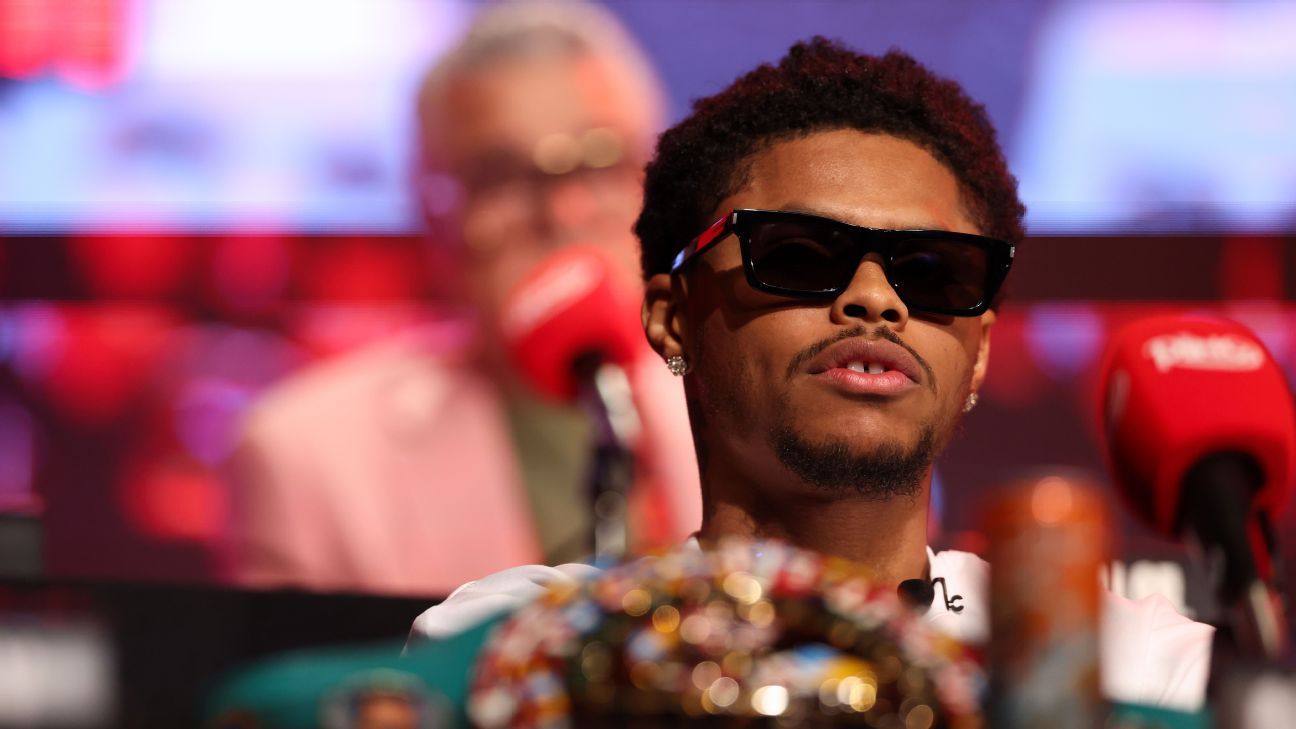
SHAKUR STEVENSON HAS been fighting for one thing for as long as he can remember. From the days of stomping around the concrete confines of Newark, New Jersey, as the eldest of nine siblings, Stevenson has chased respect. Respect from his family. The fans. And most importantly, his peers in the sport of boxing.
About five years ago, the sport of boxing anointed Devin Haney, Ryan Garcia, Gervonta "Tank" Davis and Teofimo Lopez Jr. as this era's "Four Kings," the next iteration of the legendary quartet from the 1980s that consisted of Sugar Ray Leonard, Marvin Hagler, Roberto Duran and Thomas Hearns. The four fighters were largely responsible for boxing's mainstream prominence after Muhammad Ali's retirement in 1981.
Although Stevenson was more accomplished as an amateur, with a sparkling career that culminated in a silver medal at the 2016 Olympic Games, and a supremely gifted ring tactician with tremendous upside, Stevenson wasn't included in the new quartet.
It may be apt to frame Stevenson (24-0, 11 KOs) as this generation's version of Wilfred Benitez, the uncrowned fifth king of the 70s and 80s, who possessed extraordinary defense and defeated Duran while also facing Leonard and Hearns. But Stevenson isn't trying to hear any of that noise. He believes he doesn't deserve to be on the periphery of boxing royalty -- he is boxing royalty. And the hunt is on to knock the crowns off those put ahead of him and stake his claim as the king of this era of boxers.
"I felt disrespected during that time," Stevenson told ESPN as he prepares to face Lopez, the WBO junior welterweight champion, on Saturday at New York's Madison Square Garden. "Even though I wasn't in the same weight class as them at the time, we were close enough to fight each other. I was doing tremendous things, and I felt then that I was better than all of those guys. I still feel that way. But I just used it as motivation."
While it weighed on him, Stevenson pushed along, capturing world titles in three weight classes and becoming just as, if not more, accomplished in his pro career as his peers. He didn't lose rounds, much less come close to losing a fight. Still, even with his accolades and his place as ESPN's No. 7 pound-for-pound boxer, he has grown weary of being overlooked and disregarded as one of the best fighters of the new generation.
And despite all of his accomplishments, the 28-year-old Stevenson is still fighting for respect. Whether it be from the fans who have called his style "boring" or his peers who refuse to face him for one reason or another, Stevenson is tired of asking and is ready to start talking, even if he has to put himself at a disadvantage to do so.
"I don't let that s--- bother me anymore," Stevenson said. "I just keep it moving and training hard. They haven't had any choice but to accept me. And after I win this fight, they ain't going to have no choice but to accept me and respect me."
TRAINED BY HIS grandfather, Wali Moses, Stevenson's boxing career started when he was barely out of diapers. "He had already learned how to box in terms of preparing with me, so he didn't start learning at age five; that's when his boxing career began," Moses told ESPN.
Between elite defense, ability to adapt and remarkable boxing smarts, Stevenson's outstanding amateur career culminated in 2016 as the highest-medaling U.S. male boxer since Andre Ward captured gold in the 2004 Olympic Games. His transition to the pro ranks has been seamless, with a spotless record as a three-division champion who is widely recognized as the most skilled boxer today.
The only downside of being so far ahead of the game is that his superior skills suck the drama out of his fights. And without prodigious power, many of Stevenson's fights have seen him cruise to decision and fans across social media have widely criticized his reluctance to take risks to bring excitement.
"He hears everyone say that he's boring, too small, too defensive-minded and doesn't have power," Moses said. "He hears everything and I think in the [William] Zepeda fight he proved what he's capable of. He is now out here to prove a point. He had a hell of a start to his career, but these are the legacy fights. Everyone will find out who he really is."
While Stevenson may appeal to boxing purists who appreciate his in-ring technique, it hasn't been enough to satisfy casual fans who desire violence inside the ring.
His opponent on Saturday is revered as a superb showman who has a knack for entertaining both in and out of the ring.
"Success is all about entertainment," Lopez told ESPN. Lopez, who calls himself "The Takeover," has gone viral with his highlight reel knockouts and postfight celebrations. When paired with his quirky persona, Lopez is widely regarded as one of the most exciting fighters in boxing.
"We've seen it in the past when Shakur fought at Prudential Center in front of his hometown fans and those people left his fights early because of his skill set. I think he has a lot of pressure on him to entertain, so maybe we're going to see something different out of him [against me]. But from what I've seen, he's not that exciting."
This has all led to an adjective that no fighter wants to have attached to them:
Boring.
Stevenson has heard the criticisms and adjusted. Following a flawless victory over Jeremiah Nakathila in June 2021 to win an interim junior lightweight title, Stevenson was criticized for not taking risks -- only throwing 304 punches for the whole fight, according to CompuBox. In his next fight six months later, he put on an offensive display against Jamel Herring, who Stevenson dismantled in 10 rounds.
"I wanted a fun fight: show my skills, my boxing, my power. I wanted to show everything tonight," said Stevenson after defeating Herring. "I want to be a superstar in the sport; I'm here to last."
STEVENSON HAS ALSO made changes to the way he approaches getting fights made.
After starting his professional career with Top Rank, Stevenson became a free agent. Less than two months later he signed a promotional deal with Eddie Hearn's Matchroom Boxing.
"I think the main thing now with getting older and understanding the business is that I have to brand myself the right way," Stevenson said. "And that's something that I'm really going to focus on where I can just be a superstar and not even have to worry about how they want to do these fights. At the negotiation table, I want to be able to have a certain amount of leverage to get the fights I really want made and nobody can say anything to stop me."
Stevenson realized that the only way to land the biggest fights would be by handicapping himself to some degree. Whether it be by taking less money (Oscar Valdez), accepting a fight as the co-main event (Zepeda) or conceding size (Lopez), Stevenson recognized that a level playing field wouldn't yield the opportunities he desired. Instead, he would need to add an element of risk to his fights that hadn't existed previously.
In his most recent outing in July, Stevenson delivered an all-action battle with Zepeda as the inexplicable co-main event to Hamzah Sheeraz's fifth-round stoppage of Edgar Berlanga. The rationale was that the event's promoter, Turki Alalshikh, wanted to make a statement that he wouldn't reward "Tom and Jerry-type boxing matches where one fighter is running around the ring and the other is chasing him." The normally outspoken Stevenson swallowed his pride and accepted the fight.
"If you call me Jerry, then I'm whooping Tom's ass," Stevenson told DAZN days before his fight against Zepeda. "That's what I'm coming here for, so Tom and Jerry, Jerry is whooping Tom's ass for sure."
Stevenson's performance was lauded by even his staunchest detractors. More importantly, it proved that Stevenson should never, ever be the co-main event again. And while that was by design for Stevenson, it wasn't the fight plan outlined by his team.
"I came in here to prove a point," Stevenson said after winning a decision against Zepeda. "It wasn't the performance I was looking for because I came in here trying to prove a point, I was trying to fight. So, I took more punishment than usual. But at the end of the day, I told y'all whatever it takes to get the job done."
WHEN MENTOR AND longtime Stevenson's sparring partner Terence Crawford moved up two weight classes to dismantle Canelo Alvarez for the undisputed super middleweight championship last September, Stevenson realized that his aspirations could be even bigger than what they already were. Crawford's ability to move from undisputed at 147 pounds to undisputed at 168 with just one fight at 154 pounds in between showed Stevenson that skill can offset size. And if Crawford could do it, why couldn't he do it too?
"[Crawford beating Canelo] told me a lot and confirmed what I already thought," Stevenson said. "These people tell you that size wins fights, but you realize skills really win fights. It wasn't Bud's size that beat Canelo. It was how good he was at his craft -- understanding when to box and when to step on the gas. It showed me that I can do it too because I know how great I am."
For the fight with Lopez, Stevenson will compete at 140 pounds, a career high. While some may think he may be biting off more than he can chew, the notion that he can't do something is more than enough motivation to prove that he can.
"My problem is if you tell me I can't do something, I can't control myself and can be talked into doing some dumb s--- sometimes," Stevenson said. "I'll go up to weight classes I should not be fighting in at all because of my competitive nature and somebody talking trash to me. I have to show them that no matter whatever advantages they have, they are not going to beat me."
Should he beat Lopez, moving up another weight class to welterweight, where two other "Kings" reside, could be next for Stevenson. Garcia will challenge WBC welterweight champion Mario Barrios on Feb. 21, while Haney is coming off a one-sided victory over Brian Norman Jr. to claim the WBO title last November. As for Davis, his legal issues may prevent him from stepping inside the squared circle for quite some time.
Stevenson said he has spent years calling for the biggest names in the sport. He's now willing to put himself at a disadvantage to prove that he's better than all of them.
"I still want those guys," Stevenson said. "I'm clearly not a 147-pounder but I know there are guys I believe I can beat that fight at 154 pounds. I don't plan on going to 147 pounds or 154 pounds, but I plan on doing what I gotta do at whatever weight class I end up in.
Stevenson is no longer asking for respect -- he is demanding it. And if it's not given to him, he'll find a way to beat it out of his opponents because the squared circle is his sanctuary and every fight serves as another sermon on his greatness.
"The boxing ring is my comfortable place where I do extraordinary things."