
There are 50 days until the NCAA tournament bracket is set on Selection Sunday.
We've learned a lot in the 80-plus days since the 2025-26 college basketball season tipped off, especially as conference play has hit high gear. Freshmen are dominating. Scoring is at a historically high pace. Nebraska and Miami (Ohio) are among the final three unbeatens. And that's just scratching the surface.
Whether you're just tuning in or enjoy the bird's-eye view, ESPN's Jeff Borzello and Myron Medcalf quickly break down the eight biggest storylines shaping the season so far below.
The biggest surprises so far
Indiana, the losingest program in college football history entering the 2025 season, just won the national championship. A miraculous run could be brewing in college basketball, too.
Undefeated Nebraska has orchestrated one of the top turnarounds in recent history. Miami (Ohio) hasn't lost, either. Clemson is off to a surprising start in ACC play (6-0). And in his first season, Kevin Willard has made Villanova a top-tier offensive and defensive team in the Big East.
Vanderbilt is in this conversation, too. Before the Commodores' current three-game losing streak, they had won 16 games in a row. Tyler Tanner (17.1 PPG, 39% from 3) is a projected first-round NBA draft pick in ESPN's latest mock. And like Vanderbilt, which was picked 11th in the preseason SEC poll, neither Georgia (14th) nor Virginia (fifth) was picked to finish in the top tier of its respective preseason conference poll -- yet both have emerged as early contenders for league titles as a result of surprising starts. -- Myron Medcalf
The biggest disappointments so far
A number of teams and players have unexpectedly disappointed.
Donovan Dent was one of the top available transfers in the portal after winning Mountain West Player of the Year last season. Yet he has struggled at UCLA, shooting just 17% from 3 for the bubble team.
Kentucky is on a winning streak right now, but the Wildcats don't look like the national contenders they were supposed to be after reportedly spending $20 million on their current roster. The same goes for Oregon, which already had a disappointing roster before recent injuries continued to derail its season.
In the Big 12, Baylor boasts two projected lottery picks, and yet the Bears still managed to kick off league play with a 1-5 record. Tennessee can't seem to find its footing, either, despite having five-star freshman and projected lottery pick Nate Ament in the fold. A top-three defensive team in SEC play for the past five years, the Vols are currently ranked eighth.
A chunk of the Big East -- see: Marquette, Providence and Georgetown, especially -- is struggling to meet preseason expectations, too.
All of that said, Memphis might be at the top of this list: The Tigers are just 9-9 on the season, following the best season of Penny Hardaway's tenure in 2024-25 (29-6). -- Medcalf
Scoring is on the rise
A confluence of factors -- NBA prospects returning to school, a historically strong freshman class, top Europeans coming to college -- has led to an enormous amount of talent in the sport and some of the most explosive offense in decades. Entering last weekend, Division I teams were averaging 77.2 points per game this season; that would be the highest number for a single season since 1971-72, when teams put up 77.7 points per game.
On a similar note, teams entered last weekend shooting 45.4% from the field. That would be the highest collective field goal percentage since teams shot 45.7% in 1991-92.
Only one team finished last season averaging better than 90 points per game (Alabama at 90.7 PPG). There are 15 teams right now hitting that threshold.
From an efficiency standpoint, there's been an upward swing, too. There are 11 teams currently with an adjusted offensive rating of 125.0 or better at KenPom, compared with just five last season. -- Jeff Borzello
Star players managing injuries
When he's on the floor, Kansas star freshman Darryn Peterson is among the elite players in college basketball. The potential No. 1 NBA draft pick would rank in the top 10 in the country in scoring, averaging 22.2 points per game -- if he had played enough games to qualify, that is. Peterson entered the week with just nine games under his belt, having missed seven with a hamstring injury in November and December, and another two right before Christmas after apparently reaggravating the injury. He has played all six games in January, although not with a full allotment of minutes. And now he is contending with a sprained ankle, putting his status for the immediate future in doubt.
Peterson isn't the only projected lottery pick to have missed time with injuries and also have a vague timeline for return. Louisville's Mikel Brown Jr. hasn't played since the Cardinals' Dec. 13 game against Memphis, missing the past nine matchups with a lower back injury. Head coach Pat Kelsey admitted last week that, although he expects Brown to return at some point this season, he doesn't know when that will be.
Meanwhile, Kentucky's Jayden Quaintance missed the first 11 games of the season while recovering from a torn ACL he suffered last February. He returned on Dec. 20 and was outstanding against St. John's before scoring just 10 points over his next three contests and then being ruled out for Kentucky's past three games. -- Borzello
More former pros in college ranks
Has anyone checked on Tom Izzo? He and other power brokers in the game sounded the alarm in October after two G League players (Thierry Darlan and London Johnson) were cleared to play college basketball, a first-of-its-kind move by the NCAA. Then, James Nnaji -- the 31st pick in the 2023 NBA draft who played only in summer league and EuroLeague games but never an official NBA contest -- was cleared to compete for Baylor in late December. He had never played college basketball, so his case rivaled that of the former international pros who have been allowed to play Division I basketball with the exception of his draft status.
On Wednesday, an Alabama judge gave former Crimson Tide standout Charles Bediako -- who had signed a two-way contract with the San Antonio Spurs after going undrafted in 2023 -- a temporary restraining order allowing him to return to play college basketball for the following 10 days. Prior to Bediako's case, no player who had actually played in the college and professional ranks had been given an opportunity to return to college. His Tuesday hearing for a preliminary injunction to play the rest of the season, if successful, could open the floodgates for other young two-way and NBA players to make their case for NCAA eligibility. -- Medcalf
The strongest freshman class in recent memory
The recruiting class of 2025 had been circled by college coaches and NBA scouts for multiple years -- and these freshmen have collectively exceeded all expectations.
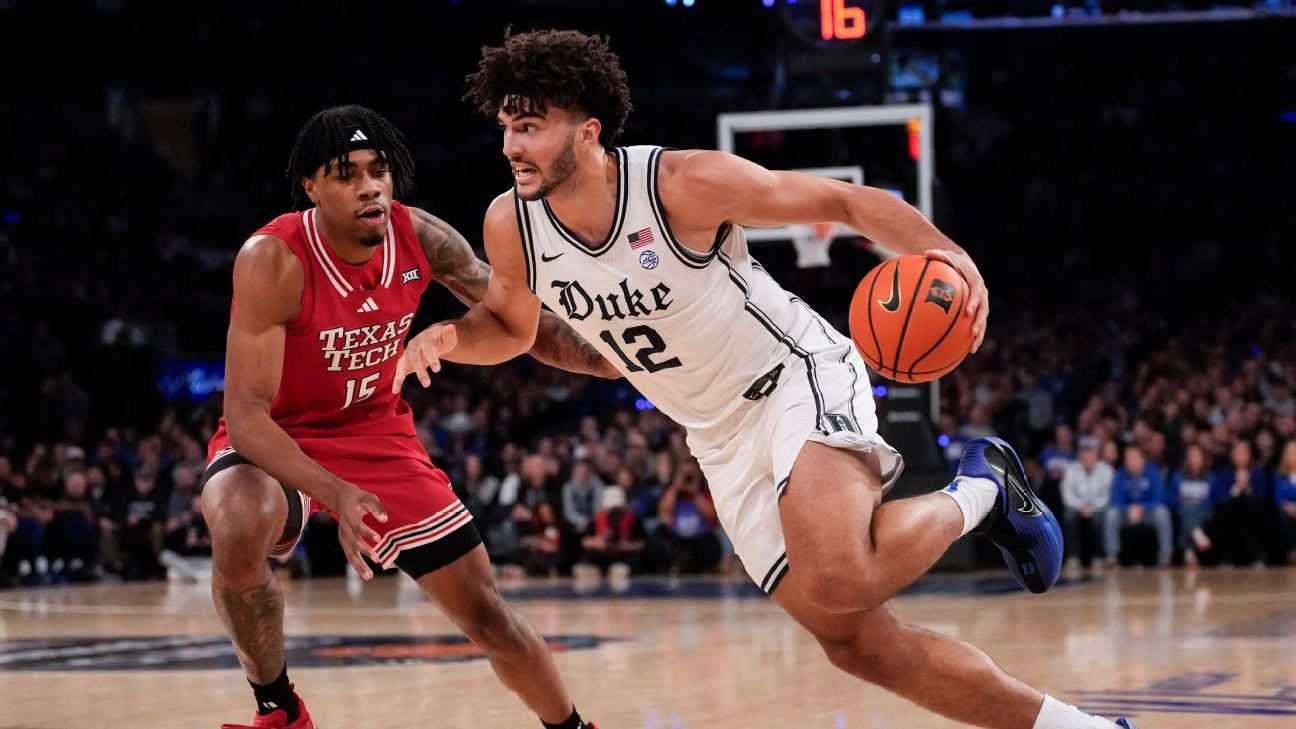
Kansas' Darryn Peterson, BYU's AJ Dybantsa and Duke's Cameron Boozer entered the 2025-26 season as the three big names in the class; they've become three of the best players in college basketball, with Boozer and Dybantsa running 1 and 2 in most National Player of the Year discussions. But it's about more than just those three.
Nine freshmen were named to the Wooden Award midseason top 25 watchlist, with Arkansas' Darius Acuff Jr., Tennessee's Nate Ament, Louisville's Mikel Brown Jr., Houston's Kingston Flemings, Arizona's Koa Peat and North Carolina's Caleb Wilson all finding their way onto the list.
That doesn't even include UConn's Braylon Mullins or Arizona's Brayden Burries, who are starting for the top two teams in the country. Or breakout stars Keaton Wagler of Illinois and Ebuka Okorie of Stanford. Nor does it include the former European pros who are classified as freshmen, such as Virginia's Thijs De Ridder and Washington's Hannes Steinbach. -- Borzello
Strength of high-major conferences
The 2025-26 season is anchored by a deep field of contenders in the nation's top leagues. The Big Ten has 10 teams ranked in the top 40 on KenPom, including top-15 Michigan, Michigan State, Purdue, Nebraska and Illinois.
The Big 12's claim to fame this year is its star power: AJ Dybantsa (BYU), Joshua Jefferson (Iowa State), Darryn Peterson (Kansas), Kingston Flemings (Houston), JT Toppin and Christian Anderson (Texas Tech), and Koa Peat (Arizona) are all capable of leading their respective teams to the Final Four -- and earning national accolades, too.
The ACC has also demanded respect in a bounce-back season. Duke is Duke, of course. And North Carolina, Clemson and Virginia have added to the depth of the league with strong overall starts.
Having said that, the SEC remains KenPom's top-ranked conference a year after its record 14 NCAA tournament bids. It might not match that number again, but reigning national champion Florida is shaping up to defend its title. Alabama's defense is still phenomenal. Kentucky is improving. John Calipari might have the best point guard in the country at Arkansas. And Vanderbilt already has six top-50 KenPom wins. -- Medcalf
Big lineups are dominating
It wasn't long ago that three-guard lineups were the preferred setup for high-level teams -- think Villanova's perimeter-oriented championship teams in 2015 and 2017, or Baylor's 2021 title team that started four players 6-foot-5 or shorter. According to KenPom's average height metric, only four NCAA tournament teams were in the top 20 in height in 2021.
This season, the top three teams in average height are ranked in the AP poll. Six other top-25 teams aren't far behind.
Just look at the top four teams in this week's AP poll. Arizona's eight-man rotation features six players 6-6 or taller. UConn doesn't start anyone shorter than 6-4. Michigan starts three players 6-9 or taller. Duke is No. 2 in average height and doesn't have a single player in its nine-man rotation shorter than 6-4.
The NBA has valued positional size more and more, and unsurprisingly, college basketball is following suit. -- Borzello