
College football's transfer portal is about as popular as a flooded basement. It's been blamed for nearly every problem in the sport. No loyalty. All about money. Chaos! Confusion!
It's not all unfounded. There is room for improvement, although legislating against adults making bad decisions has never really worked in any segment of society.
Yet sometimes, such as Monday in Hard Rock Stadium, the portal also delivers, perfectly in this case.
The 16-0 Indiana national champions weren't just a fun, glorious team to watch, and they don't just change the possibilities for teams across the sport. They also highlighted the benefits of a meritocracy that mirrors the ethos of the American dream.
This is a national title for the everyman.
Consider Fernando Mendoza, who grew up 2 miles from the campus of the University of Miami, the son of two graduates, and dreamed of playing for the Hurricanes.
But the two-star quarterback recruit couldn't get a scholarship from the former coaching staff.
He committed to Yale, then signed with Cal. He redshirted his first season, then didn't see the field until midway through his second, when he threw nearly as many interceptions (10) as touchdowns (14).
He developed into a promising prospect even as the Cal program continued to struggle (posting five consecutive losing seasons). He then brushed off Miami's overtures last winter to transfer into what he believed was the ideal developmental situation, this rocket ship known as Curt Cignetti's Indiana.
Or think of Mikail Kamara, who grew up in Ashburn, Virginia, and spent his high school years attending football camps looking to catch the eye of anyone who might believe in him. Almost no one did.
A zero-star recruit, he wound up signing with James Madison, which played FCS football at the time. He buried his head in work, became stronger and faster, overcame an injury and helped lead the Dukes into FBS football.
Before his redshirt junior season, he followed his head coach and transferred to once-forlorn IU.
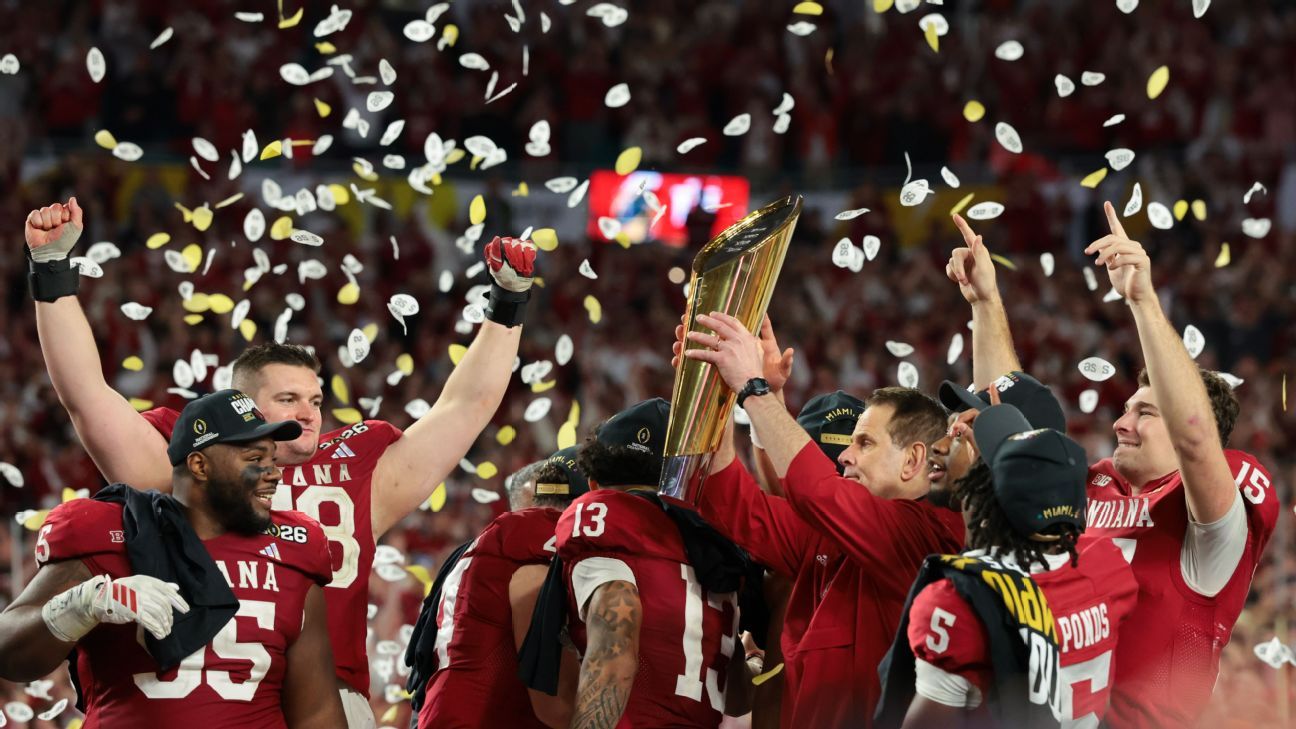
On Monday night, in a national title game no one ever saw coming, the once-ignored Mendoza and the once-unknown Kamara delivered two of the most memorable plays (an outstretched QB sneak touchdown and a blocked punt that was recovered for another score) as Indiana defeated Miami 27-21.
It was Indiana's first national title, and it's the first time college football has had a first-time champion since 1996, when Florida broke through.
This was a sport of the gate-keeping bourgeois, where how good you were 40 or 60 or 80 years ago mattered, where established brands and facilities attracted so many top recruits that a handful of schools could overwhelm the rest on sheer depth. Get enough talent (and starve the other schools of it) and the margin for error is considerable.
If an upstart program actually started making waves, the coach would be quickly hired away and order restored. The coaching transfer portal, after all, was long ago established and accepted.
Who's your daddy mattered, at least until these Hoosier Daddies.
"You get it done with the right people, properly led," Cignetti said.
The portal has changed everything, and if the people who run college football actually wanted to promote college football rather than complain, lobby Congress and tell the public how awful and unsustainable everything is, then maybe that would be better appreciated.
The sport is now about the players who work the hardest, who develop the most, who seize opportunities to get better until they are better. How many stars you had at 16 no longer counts for much. Making the Elite 11 not long after turning 11, carries little value.
Were you overlooked because you weren't at the right high school, or in a big city, or everyone missed your potential, your heart, your dedication? Late to bloom doesn't mean you are doomed. You just have to go prove it.
Who is against that? Yes, players leave the lower programs for the bigger ones (often swapping places with the hyped recruit who didn't pan out). Nearly every player, though, grew up wanting to be in the biggest games in the biggest conferences, chasing championships.
That's part of the deal. Bigger checks as well.
Cignetti didn't get a Power 4 head coaching job until he was 62. He worked his way up from D-II to FCS to arguably the worst program in the Big Ten. It stands to reason that his grind contributed to his understanding of not just how the portal can work but who it can work for best.
"There's a lot to be said about what the guy is made of," Cignetti said. "His intangibles and his moldability or coachability, what kind of teammate he's going to be ... you get the right group of guys together that combine as a team."
This Indiana team was full of grinders and chips on shoulders. They were a relentless group of discards and misfits. It had just 8 players who ever ranked four stars or better in high school. Five years ago, that mix was a one-way ticket to a bowl game in Shreveport.
Not anymore, not with the transfer portal.
Cignetti is an astute evaluator of not just talent, not just pricey additions. He put together a roster of two-stars and Sun Belt transfers, each hungrier than the next. They beat Ohio State to win the Big Ten title. They beat Alabama, Oregon and Miami to win the national one.
The transfer portal has no public relations team or marketing campaign, nor even very many public supporters.
The portal does have a national champion though, a perfectly imperfect Hoosiers team that couldn't have existed without it, but had the chance to prove its individual and collective merit on the field because of it.
All the supposed blue bloods are looking up at them now.