
Although last week's Trae Young deal was the first trade of this NBA season, Thursday marked an important milestone on the league's calendar. That's when nearly every player -- Bradley Beal and LeBron James, who have no-trade clauses, are two notable exceptions -- became trade-eligible.
The league's three-week sprint to the Feb. 5 deadline is here, with front offices making calls, discussing trade scenarios and crunching numbers on salary cap aprons. But plenty of contenders are still deciding on a direction.
Our weekly trip around The Association focuses on those teams trying to add to their rosters, those looking to subtract and, perhaps most impactful, those still pondering.
Jump to a team:
Bucks | Warriors | Raptors
Wolves | Grizzlies | Mavericks
Nets | Hawks | Lakers | Celtics
Which teams will look to add at the deadline?
Milwaukee Bucks
What we're watching: How aggressively they pursue help for Giannis
Among league executives contacted by ESPN, the Bucks were a near unanimous pick to be major players at the deadline. General manager Jon Horst and his front office's creativity in stretching assets is well known and, frankly, well respected throughout the league. Horst has canvassed the league in recent weeks for talent at basically any position, again looking to bolster the supporting cast around two-time MVP Giannis Antetokounmpo.
"Milwaukee still has a first-round pick they can trade, and they're $14 million under the luxury tax," an Eastern Conference executive said. "I've seen teams make chicken salad with less."
The Bucks are a staggering 21 points per 100 possessions better when Antetokounmpo is on the court -- roughly the difference between the Oklahoma City Thunder and the Sacramento Kings. That's why the Bucks remain hopeful for a deep playoff run in the wide-open East.
Despite the team's struggles, including Wednesday's blowout loss to the short-handed Timberwolves, during which the home fans booed and Antetokounmpo booed back, the expectation from a wide range of sources is that Milwaukee remains far more likely to add than to entertain trading the best player in franchise history.
Golden State Warriors
What we're watching: The end of the Jonathan Kuminga saga
The twists and turns, which have lasted nearly as long as the forward's four-plus-season career, seem to be nearing a conclusion. Kuminga's $22.5 million deal this season with a $24 million team option for 2026-27 was designed to be moved, but the front office faces a challenge: With the Warriors just $264,000 under the second apron, they can't take on any additional salary in a Kuminga trade.
"For a while there was an uncertainty of what it would take to get [Kuminga] under contract, and now there's clarity there for next season," a Western Conference executive said. "The negative is neither the team or the player have done a good job of increasing his value." The Warriors also have four tradable first-round picks.
"It's no secret they'd be aggressive with the picks to maximize the Steph [Curry] window," one executive said, "but they have to have something to want to spend them on."
Between Jimmy Butler III, Draymond Green and Kuminga, the Warriors could theoretically have more than $100 million in expiring contracts this summer to remake the roster around Curry. Golden State's current eight-game homestand could be a key barometer to how the team approaches the deadline.
Toronto Raptors
What we're watching: Whether they go all-in for a star
After three straight missed postseasons, and with new governor Edward Rogers ready to take full control of the franchise later this year, there is a sense of urgency in Toronto. The Raptors have been on the phones in recent weeks gauging the trade value of some of their players, including RJ Barrett and Immanuel Quickley, numerous sources told ESPN.
ESPN's Shams Charania has reported Toronto's interest in the Mavericks' Anthony Davis and the Grizzlies' Ja Morant, and although other teams could have reservations about taking on long-term money, the Raptors would be swapping out their own long-term contracts to take on those players, removing an impediment to a deal.
Toronto owns all its first- and second-round picks for the next seven years. Two factors rival executives note: A franchise that has been an infrequent taxpayer is about $1 million into the tax, and having all that long-term money to move could dissuade potential trade partners.
"Toronto will have to incentivize real offers with draft capital," one East executive said. "They're going to have to work to avoid the second apron next year with their current roster."
Minnesota Timberwolves
What we're watching: Their ongoing pursuit of a point guard
Rival teams have believed the Wolves have had interest in point guard help for months. Coach Chris Finch has often not played a pure point guard at all, relying on off guards Donte DiVincenzo and Anthony Edwards for the job.
So far, the strategy has helped deliver the league's No. 6 offense, largely due to excellent health among Minnesota's core players and superior offensive seasons for Edwards and Julius Randle. But when the Wolves made a bold move to trade into the lottery in 2024 for point guard Rob Dillingham, the expectation was he could grow into a long-term contributor to play alongside Edwards in their backcourt.
Instead, Bones Hyland -- another former draft pick of Timberwolves president of basketball operations Tim Connelly, back when he was running the Nuggets -- is playing over him.
Still, it is believed the front office wants to add guard talent but also reduce payroll, multiple league executives say. (The Wolves face a $24 million luxury tax bill after ownership paid more than $90 million in tax last year.)
But with no tradable first-round picks, meaningful roster change would require moving on from a key rotation player -- the same issue lots of teams are facing, and why several executives said this week they believe minor moves will dominate this trade deadline.
Which teams will look to subtract?
Dallas Mavericks
What we're watching: Whether the AD saga spills into summer
Although the biggest allure in trading for Davis, per multiple rival executives, is the potential to have him for the playoffs, several other sources tell ESPN they believe the best course of action for Dallas would be to wait until the summer.
"This should allow them to sit back and be patient and see what happens," one Eastern Conference executive said.
Part of the reason a Davis trade has generated so much discussion is the fact the Mavericks are currently slated to be nearly a $400 million team in combined payroll and luxury taxes in the 2026-27 season -- a figure no one around the league expects them to pay.
But Dallas has said it will continue to take calls leading up to the deadline, and could potentially look at other ways to cut future money and lower those bills beyond a Davis deal.
That would allow the Mavericks to then decide who is going to run their front office, and then decide on a direction for not only Davis but also Kyrie Irving, as they build around both Cooper Flagg.
Memphis Grizzlies
What we're watching: The trade market for Ja Morant
Last week's news that Memphis is entertaining a Morant trade sparked leaguewide reaction similar to when the Hawks opened Trae Young negotiations earlier this month.
As with Young, the interest in Morant is tepid.
The Miami Heat, in particular, have been overstated as a potential destination, sources said. The Heat have been laser focused on avoiding taking on money for the 2027-28 offseason -- a season when, as of right now, Antetokounmpo, Nikola Jokic and Donovan Mitchell, among others, could all be unrestricted free agents.
It's highly unlikely the Heat would deviate from that plan to go after Morant, sources said.
After the Hawks opened negotiations on a possible Young trade, the Wizards were the only team to register legitimate interest, sources said.
Will there be more interest in Morant, who has often been unavailable and has two years and more than $80 million left on his contract? Several sources didn't see much of a market, with Milwaukee repeatedly surfacing as a possible option.
Brooklyn Nets
What we're watching: What they do with Michael Porter Jr.
The biggest trade target among tanking teams this year resides in Brooklyn. The 6-foot-10 Porter has had an excellent season after being acquired from the Nuggets this summer, along with a future unprotected Denver first-rounder, in exchange for Cameron Johnson.
Porter is owed $38.3 million this season and $40.8 million next, which is a large number to match in a deal. Despite his success in Brooklyn, his injury history (three back surgeries and associated foot issues) limited his trade value before he was traded for Johnson, and he won't be getting anything close to this usage for a potential contender if he is moved again. That could make it more challenging for Brooklyn to get back significant value in a deal.
The Nets have $15 million in cap space available, though, the most in the league. That space will be for rent (in return for draft capital) for teams that might need a partner to warehouse a contract or two to make another deal work. They already have 13 first-round picks and 19 second-round picks over the next seven years and will be on the hunt to acquire more in trades they can make between now and Feb. 5.
Which teams are still deciding?
Atlanta Hawks
What we're watching: A potential encore to the Trae deal?
The Hawks accomplished a significant goal of theirs by moving Young and his $50 million player option for next season. However, team sources say they still have ambitions for the season.
Atlanta has $42 million in expiring contracts with Kristaps Porzingis and Luke Kennard, and a $13 million trade exception with four tradable first-round picks -- although inquiring teams can forget about getting the unprotected swap rights the Hawks have with the Pelicans in June's draft. Their books are relatively clean, too, as only Jalen Johnson will earn more than $25 million next season.
That's why Atlanta has been connected to Davis trade rumblings, but the front office values its young core, which will likely gain another high-upside player in the draft with that Pelicans pick.
Los Angeles Lakers
What we're watching: A deadline dilemma in L.A.
The Lakers have been making calls to acquire perimeter help and rim protection, league sources said. And between Rui Hachimura, Gabe Vincent and Maxi Kleber, the front office has about $40 million in expiring contracts to send out in trades.
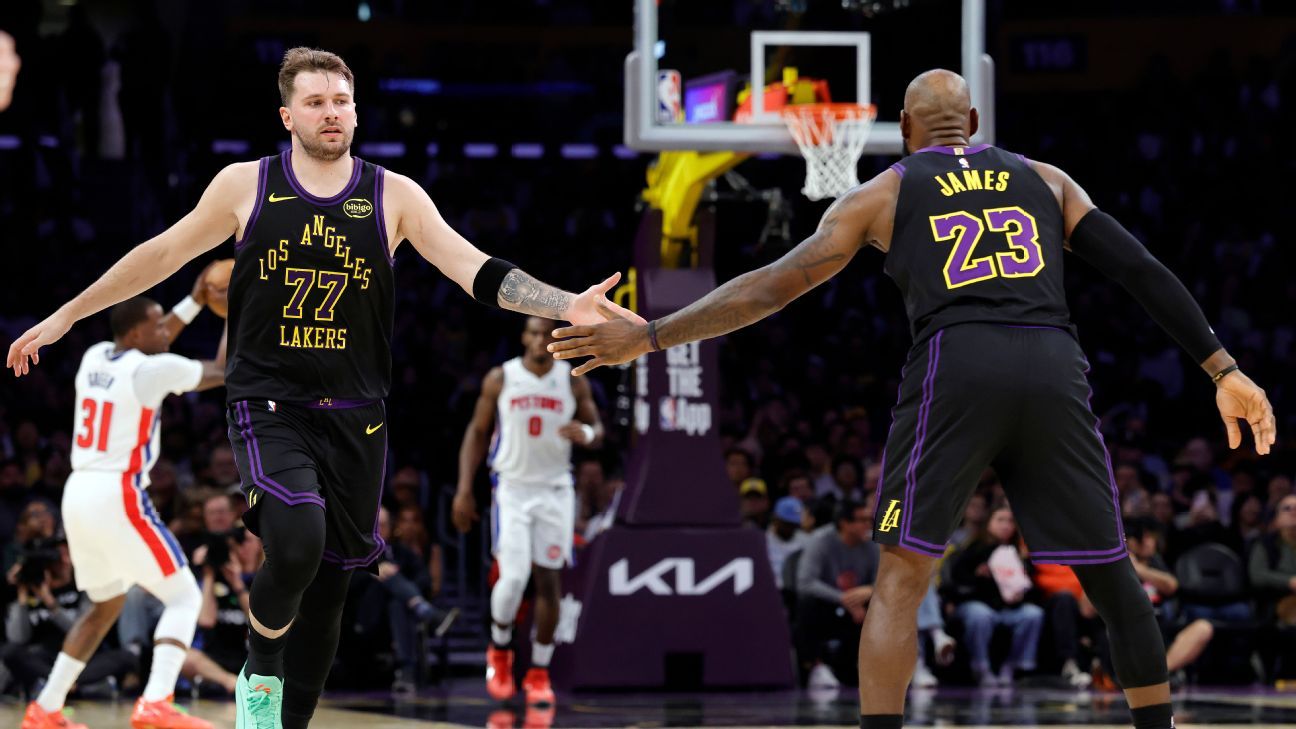
But the Lakers are operating in two timelines. They want to maximize the end of 41-year-old LeBron James' career, but swapping out expiring contracts for short-term help could hinder their ability to reshape their roster around Luka Doncic. If James moves on or retires after the season, the Lakers could re-sign Austin Reaves and still have $50 million in cap space.
The Lakers have one tradable first-round pick and can trade up to five pick swaps, but they sit just $1.1 million below the first apron and aren't permitted to exceed it, leaving them little maneuverability to take on short-term money. If L.A. waits until July, it will have three tradable first-round picks, cap space and salary flexibility.
"They're going to be looking for bargain deals and they might be able to find one if they're willing to take on long-term money," one West general manager said. "But they probably need to make sure that player is a good fit with Luka to justify it."
Boston Celtics
What we're watching: Two options for the surprise contender
When last season ended, the Celtics were staring at the possibility of being a $500 million team. And despite a series of moves, between not retaining Luke Kornet and Al Horford and trading away Jrue Holiday and Porzingis, the Celtics still are in the luxury tax by about $12 million.
The expectation of rival teams before the season was that the Celtics would try to continue to move out of the tax and reset their repeater clock while Jayson Tatum recovers from his Achilles injury. But that was before the Celtics found themselves tied for second place in the East.
So now, the Celtics have a fascinating question to ask themselves: Try to get out of the tax, or take the $27 million expiring contract of Anfernee Simons and use it to add a long-term player?
The answer probably lies somewhere in the middle. Celtics president of basketball operations Brad Stevens has repeatedly made deadline moves to try to improve the team -- if only incrementally or as roster insurance, such as adding depth players Mike Muscala in 2023 and Xavier Tillman in 2024.