
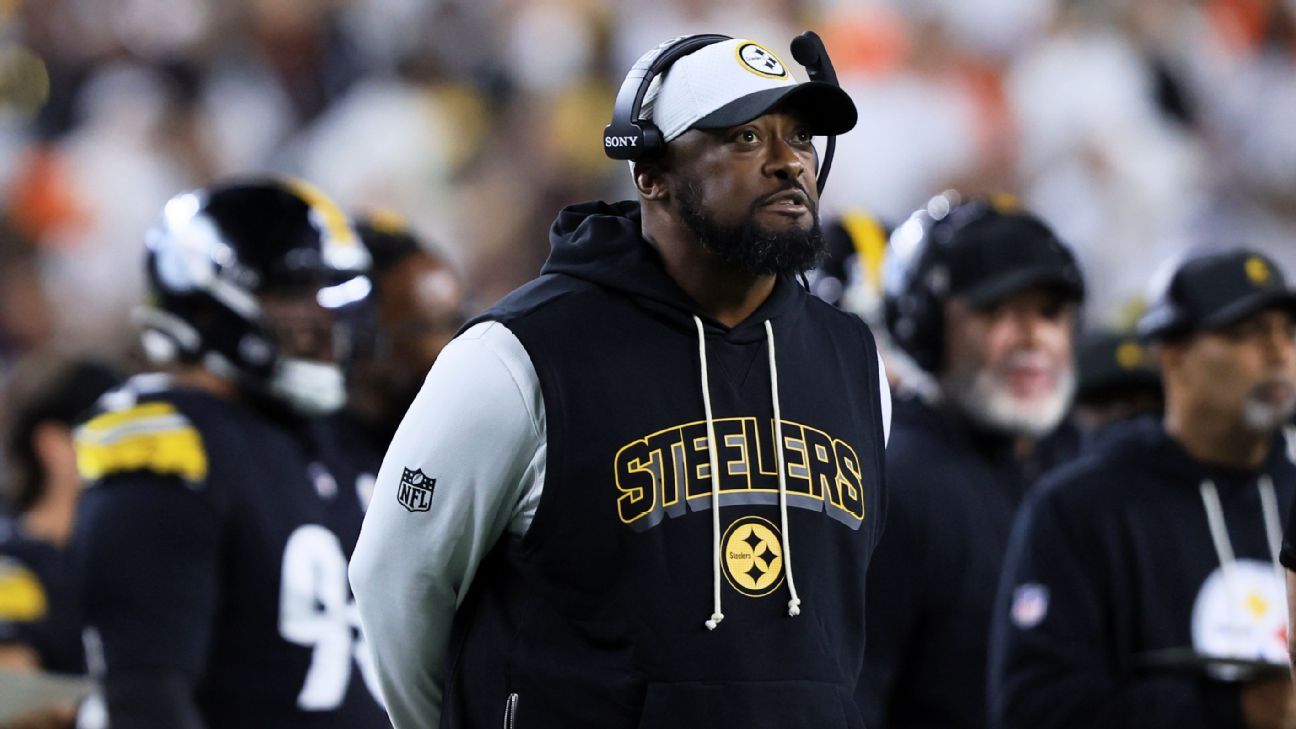
Everything changes with time. The NFL that Mike Tomlin was watching as he accepted Art Rooney's offer to take over as Steelers head coach on the evening of Jan. 21, 2007, doesn't look all that similar to the league we just saw run through a frantic wild-card weekend, one that ended with the Steelers being blown out 30-6 by a sloppy Texans team. It was the final game of his Pittsburgh tenure, as Tomlin stepped down Tuesday.
Tomlin evolved over those 19 years in charge of the Steelers. Faced with a disconnect between the Tampa 2 system he had learned under Tony Dungy in Tampa Bay and the zone blitz-heavy 3-4 the Steelers were already running with Dick LeBeau in Pittsburgh, Tomlin deferred to the legendary assistant. The young coach chose wisely. The Steelers were second in scoring defense during Tomlin's first season and then led the league the following year, when they won the Super Bowl. Pittsburgh ran through a generation of talent on defense during Tomlin's tenure and still fielded aggressive, successful, turnover-happy defenses for the majority of that run.
In other ways, perhaps Tomlin didn't evolve as much as necessary. Tomlin lagged behind the league's trend of going for it on fourth down in favorable situations, although that might have been partially a product of playing with one of the league's worst offenses and one of its best kickers. The Steelers cycled through offensive coordinators after forcing Bruce Arians out, with the veteran assistant finding new levels of success as a head coach elsewhere around the league. The Steelers vacillated between committing to the run and recognizing that they weren't good at running the football. Their offensive philosophy after Ben Roethlisberger's elbow injury in 2019 seemed to add up to not turning the ball over or getting the quarterback hit, leading to a series of seasons where the Steelers would win the turnover battle often enough to make the playoffs but then get blown out by better competition once there.
Subscribe: 'The Bill Barnwell Show'
That, in the end, meant it was probably time for a fresh start for all parties. The Steelers haven't won a playoff game since 2016, when they made it as far as the AFC Championship Game before being blown out by the Patriots. A seven-game losing streak in the postseason would be a tough enough pill to swallow, but Tomlin's teams haven't even led in one of those games for a single snap in the second half.
Something had to break that cycle, and perhaps Tomlin's departure will do that. What's also simultaneously true, though, is that the Steelers themselves are very different organizationally and philosophically than the team Tomlin took over in early 2007. They were one of the league's model franchises. In some ways, they still are. But in others, they've lost what made them so unique and special.
As a result, this becomes one of the more fascinating head coaching jobs to come available in recent memory, and it opens the door for a potentially transformative change for the Steelers moving forward. What's next for the Steelers? And could that inform who's next to take over what might be the league's best head coaching opportunity?
Jump to:
How attractive is the Steelers' job?
Where are the homegrown Steelers?
How can the Steelers get back to their roots?
What comes next in Pittsburgh?
Who should the Steelers hire?
Is this a great head coaching job?
NFL head coaches have climbed through the ranks, worked late hours and spent years toiling for little or no money to reach the pinnacle of their profession. They all generally want the same things once they get there. Power is one factor, of course: Every coach wants to hire their preferred staff and have at least some say over which players get brought into the building. They also want money, although every NFL head coach is getting paid what would be considered a life-changing salary, especially relative to the days when those coaches were making pittances as quality control coaches or student assistants at the lower levels. And if they get to coach a superstar quarterback, of course, they wouldn't mind that very much at all.
But the one factor that matters to coaches that isn't quite as prominent to fans is stability. The hardest thing to do in coaching is to get an NFL head coaching job. The second-hardest thing to do is keep it. There are only 32 of those opportunities available, which is why you see coaches take jobs that seem doomed to fail, but nobody wants to see that dream come to an end after a season or two. The dream, after years of moving from city to city as an assistant coach, is to settle down and win in the same place, year after year.
By that paradigm, the Steelers job is the best opportunity in professional sports, let alone the NFL. In the Super Bowl era, the Rooney family has employed a grand total of three head coaches. Chuck Noll was hired in 1969 and kept the job until 1991. The Steelers hired Bill Cowher in 1992, and he held the job until the gruff, intimidating coach resigned after the 2006 season. Tomlin took over and held the job until he left on Tuesday afternoon. That's 57 seasons of Steelers football and just three coaches -- an average of 19 years per coach.
That's just not normal. Some coaches are concerned that they won't have an ability to implement their ideas and find players who fit their system before they get fired. With the Steelers -- assuming Pittsburgh sticks with precedent -- they'd have enough time to bring multiple generations of players through the building. By that definition, this is the best job opportunity to come available in many years, perhaps since Tomlin took over for Cowher.
Noll, Cowher and Tomlin weren't just afforded time out of the kindness of the Steelers' hearts, of course. They won. The Steelers proudly have the best winning percentage of any team (.612) since the AFL-NFL merger in 1970, and they're tied with the Patriots for the most Super Bowl victories of any team with six. We don't know whether the Rooneys would tolerate any extended period of losing, in part because there simply hasn't been one in Pittsburgh.
That's where my question about whether this job is actually as tantalizing as it seems pops up. The Steelers have won because they've had great coaching, of course, but there was something else at hand. There's a major disconnect between the great Steelers teams of the past and the teams Tomlin oversaw at the end of his run in Pittsburgh, and that's a product of an organizational shift. And I keep coming back to it as the thing that might decide whether the next coach in Pittsburgh is as successful -- and long-tenured -- as his predecessors.
Where have the homegrown Steelers gone?
For decades, the Steelers were a developmental machine. Nobody was better at drafting promising players and molding them into upper-echelon, starting-caliber talent. Other franchises had good drafts, but the Steelers were the envy of the NFL.
That has changed. For several years now, the Steelers have ceded that developmental factory reputation and have been just like any other team in football, using meaningful doses of free agency and trading for veterans to cover over holes on their roster.
In some ways, these Steelers emulate the great Steelers teams of generations past. No team in the league has been better at drafting and developing outside linebackers over the past few decades, and the current Steelers are no exception. T.J. Watt (2017 first-round pick) and Alex Highsmith (2020 third-rounder) have formed one of the better edge rushing duos in the NFL. Behind them, 2023 fourth-round pick Nick Herbig had a breakout year and led the NFL in pass rush win rate, and rookie fourth-rounder Jack Sawyer forced a fumble in the loss to the Texans. A recent effort to restock the offensive line has also brought along several promising young players, including 2024 draftees Troy Fautanu and Zach Frazier. But those two positions are the exceptions to the rule.
It's unfair to compare this team to the Steel Curtain, the Terry Bradshaw- and Jack Lambert-led teams of the 1970s. That was a different era with different rules. With no salary cap or free agency, teams really had no choice but to build through the draft and hope that they landed the right players. So much of those great Pittsburgh teams was homegrown, but that was the same for most franchises.
Now consider what we saw from the Steelers on Monday night in their lopsided loss to the Texans. Let's take the 11 players they used most often on offense and defense and just chart how they were acquired. In this case, nearly half of the players the Steelers relied on during their most important game of the season came from other organizations, either via trades or free agency:
Draftees (11): Mason McCormick, G; Troy Fautanu, OT; Zach Frazier, C; Pat Freiermuth, TE; Calvin Austin III, WR; Joey Porter Jr., CB; T.J. Watt, edge; Cameron Heyward, DT; Alex Highsmith, LB; Derrick Harmon, DT; Keeanu Benton, DT
Undrafted free agents (1): Dylan Cook, OT
Veteran free agents (7): Isaac Seumalo, G; Aaron Rodgers, QB; Marquez Valdes-Scantling, WR, Kenneth Gainwell, RB; Patrick Queen, LB; Brandin Echols, CB; Chuck Clark, S
Veteran trade acquisitions (3): DK Metcalf, WR; Jalen Ramsey, CB, Kyle Dugger, S
While this doesn't include Jaylen Warren, a homegrown undrafted free agent who played slightly fewer snaps than Gainwell, the likes of Adam Thielen, Jonnu Smith and Asante Samuel Jr. all played meaningful snaps without breaking into the top 11 -- and all three were veterans added this season. In years past, those roles would have often gone to homegrown players who were breaking through into the starting lineup. Darius Slay also started at cornerback before being released for subpar play.
Let's contrast that to Steelers teams from the past. Let's go back to 2016, essentially the midway point of the Tomlin era, and look at the lineup from the venerated coach's last playoff win, an 18-16 victory over the Chiefs. Was it equally dependent on imported talent?
Draftees (15): Marcus Gilbert, OT; David DeCastro, G; Antonio Brown, WR; Maurkice Pouncey, C; Ben Roethlisberger, QB; Le'Veon Bell, RB; Jesse James, TE; Stephon Tuitt, DT; Ryan Shazier, LB; Lawrence Timmons, LB; Bud Dupree, edge; Artie Burns, CB; Sean Davis, S; Javon Hargrave, DT; William Gay, CB
Undrafted free agents (4): Alejandro Villanueva, OT; Ramon Foster, G; Eli Rogers, WR; James Harrison, edge
Practice squad/waiver wire additions (2): Cobi Hamilton, WR; Ross Cockrell, CB
Veteran free agents (1): Mike Mitchell, S
Nineteen of the 22 primary contributors were brought into the organization via the draft or as undrafted free agents. (Harrison started with the Steelers, was signed to the Ravens practice squad, then returned without ever playing a game in Baltimore.) The exceptions weren't players such as Metcalf and Ramsey, stars acquired on massive contracts. Hamilton and Cockrell were signed after playing a combined 11 offensive or defensive snaps for other organizations. Mitchell was signed after impressing in his first full season as a starter with the Panthers. This was, essentially, a fully homegrown team.
Go back a little further. What about the team Tomlin won the Super Bowl with in 2008? Some of those players also won the Super Bowl with Cowher in 2005, giving them two titles in four years. We don't have snap counts for that game, but let's roll with the 11 starters on offense and defense:
Draftees (15): Ben Roethlisberger, QB; Hines Ward, WR; Matt Spaeth, TE; Heath Miller, TE; Max Starks, OT; Chris Kemoeatu, G; Willie Colon, OT; Brett Keisel, DT; Aaron Smith, DT; Casey Hampton, DT; Larry Foote, LB; Ike Taylor, CB; Bryant McFadden, CB; Troy Polamalu, S; LaMarr Woodley, edge
Undrafted free agents (3): Willie Parker, RB; Darnell Stapleton, G; James Harrison, edge
Veteran free agents (4): Sean McHugh, FB/TE; Justin Hartwig, C; James Farrior, LB; Ryan Clark, S
Eighteen of the 22 starters were players developed in-house. The Steelers started three tight ends to open the game against the Cardinals, but it would seem appropriate to replace McHugh here with Santonio Holmes, who would make the game-winning catch with 35 seconds to go. He was a first-round pick, which would bring the total for homegrown players to 19.
There were moments where the Steelers leaned a little more toward the veteran acquisition market. Go back to the 2001 AFC Championship Game, which took place during Tomlin's first year in the NFL as an assistant coach, and there were seven Steelers starters who were acquired from other organizations. One of those seven was Jerome Bettis, who started his career with the Rams before becoming a Hall of Famer for his work with the Steelers. On the whole, though, the Steelers were remarkably homegrown during the Cowher era and through the most successful years of Tomlin's run in Pittsburgh.
The 2025 Steelers, though, are not a one-year trend. In the secondary alone, Pittsburgh has cycled through veterans such as Joe Haden, Patrick Peterson, Donte Jackson, DeShon Elliott and Levi Wallace in recent years. After Shazier's career-altering injury and while navigating Devin Bush's torn ACL, the Steelers have imported Joe Schobert, Myles Jack, Cole Holcomb, Elandon Roberts and most recently Queen as veteran starters. And of course, at quarterback, the post-Roethlisberger years have included a stream of players from outside the organization, including Rodgers, Russell Wilson, Justin Fields and Mitchell Trubisky.
That ability to draft and develop at a high level, year after year, was just as important to the Steelers' engine as their coaches. Noll and Cowher never returned to the NFL after leaving the Steelers, so we never got to see whether they were the same caliber of coaches without the steady stream of in-house talent. It's only fair to assume that Tomlin, 53, will eventually return to the league somewhere else one day, but I wonder whether that will actually happen when push comes to shove.
Without that steady flow of young talent, this isn't the same opportunity it was for Cowher when he took over for Noll or Tomlin when he replaced Cowher. It will still be an appealing job, of course, but it won't offer the same consistency that came throughout the prior decades. Tomlin showed that he could still win with that more modern and Steelers-atypical sort of roster construction, but his ceiling was capped. The Steelers never had the sort of super-contender built around a bevy of young talent throughout the roster on rookie contracts that they did in the earlier days of the Tomlin era. And while there are always going to be exceptions, building a team around players on rookie deals providing significant surplus value is going to be the easiest way to win a Super Bowl.
How does Pittsburgh get the pipeline open again?
To answer that question, we have to figure out why it closed. There have obviously been personnel changes in the front office. Longtime general manager Kevin Colbert, who joined the team from the Lions in 2000, retired after the 2021 season and was replaced by Omar Khan, but the shift toward using more outside talent started before that change.
I don't believe there was some espoused philosophy shift or desire to abandon the practices that had worked for the Steelers for so long. The reality is much more pernicious and frustrating. The 2010 Super Bowl team was full of key players in or past the prime of their careers under Tomlin, including Roethlisberger (in his age-28 season), Heath Miller (28), Polamalu (29), Taylor (30), Harrison (32), Keisel (32), Hampton (33) and Ward (34). Outside of Pouncey, who was a Pro Bowler as a 21-year-old rookie, and Mike Wallace, who was the team's leading wide receiver at 24, most of the starters on that team were closer to the end of their careers than the beginning. Antonio Brown was already on the roster, but the Steelers were going to need to find replacements for those players as they aged out.
While the Steelers obviously landed hits here and there, many of those players weren't ably replaced. Pittsburgh simply had a bad stretch of drafts, especially in the top 100 picks and relative to their usual expectation of landing difference-makers and potential Pro Bowlers. Let's run through those drafts:
2011: Here's a class where the Steelers did land a Pro Bowler and future franchise legend in Cam Heyward, who came off the board in the first round. After that, though, the only other selection who became a regular starter was tackle Marcus Gilbert, who managed only two full seasons without getting injured during his time in Pittsburgh. Third-round pick Curtis Allen never made it at cornerback.
2012: Another very good pro in the first round, as the Steelers drafted guard David DeCastro, but he was the exception. Mike Adams, Sean Spence and Alameda Ta'amu, their next three picks, had only brief runs in the starting lineup. The saving grace was seventh-round pick Kelvin Beachum, who spent his rookie contract as a starting tackle before heading elsewhere.
2013: Le'Veon Bell was the star of this draft as Pittsburgh's second-round pick, but the Steelers famously weren't able to work out a second contract with him. First-round pick Jarvis Jones managed six sacks in four years, while third-round wideout Markus Wheaton didn't make it to a second contract in Pittsburgh. There was a useful player later in the draft in sixth-round pick Vince Williams, who eventually emerged as a starting inside linebacker.
2014: Shazier looked excellent early in his career before his career-ending neck injury. Second-rounder Stephon Tuitt delivered, but the next two picks were Dri Archer and Martavis Bryant, who didn't last long in Pittsburgh. There also weren't any Day 3 picks to emerge from this class with any sort of notable career.
2015: Bud Dupree delivered one season with a double-digit sack total across six years in Pittsburgh, which is fine, but he probably ended up as something close to an average first-round pick. Second-rounder Senquez Golson never played an NFL game, while third-rounder Sammie Coates lasted two years on the Pittsburgh roster. On Day 3, the Steelers nabbed tight end Jesse James and backup linebacker Anthony Chickillo, but this class never really came together.
2016: First-round pick Artie Burns got off to a solid start in black and yellow, but he was benched during his third season and never really regained his confidence. Second-rounder Sean Davis was a starter, but after suffering a shoulder injury early in his fourth season, he didn't regain his starting role the following year and went elsewhere. Third-rounder Javon Hargrave turned out to be the hit of the class, but the Steelers got little from their Day 3 picks.
2017: OK, here's a great class, led by a future Hall of Famer in Watt. JuJu Smith-Schuster was a standout wideout early in his career before injuries sapped his explosiveness. Cameron Sutton eventually grew into a starting role at cornerback, and third-round pick James Conner was a solid running back who took Bell's role in the lineup after he held out and eventually left for the Jets. No issues here.
2018: A whiff. Terrell Edmunds started for five seasons, but he never developed into anything more than an adequate safety. He has bounced around the league since leaving at the end of his rookie deal. Second-round pick James Washington didn't pan out at wide receiver, and third-rounder Mason Rudolph has been nothing more than a serviceable backup at quarterback. Chukwuma Okorafor did start for three-plus years at tackle, but this class has to be considered a major disappointment.
2019: The Steelers traded up for Devin Bush, who was limited to early-down work before tearing his ACL and failing to really ever live up to expectations in Pittsburgh. Their second-round pick was sent to Cincinnati as part of the trade up, and while Diontae Johnson was a hit in the third round, he was the only player from this class who became a long-term starter.
2020: This was much better. Pittsburgh's first-round pick went to the Dolphins for Minkah Fitzpatrick, a trade they would be happy to make again. Colbert landed future starters in Highsmith and Kevin Dotson, although the latter would only emerge as a star after being traded to the Rams. Second-round pick Chase Claypool got off to a promising start, and after he stagnated, the Steelers shipped him to the Bears for the pick that eventually became Joey Porter Jr.
2021: Hoping to spark a moribund run game, the Steelers used their first-round pick on Najee Harris, who never emerged as anything more than a low-efficiency volume rusher and had his fifth-year option declined. Second-round pick Pat Freiermuth has been a solid tight end, but third-round pick Kendrick Green lasted only one season in Pittsburgh, and fourth-rounder Dan Moore Jr. left in free agency.
2022: Pittsburgh finally drafted its quarterback of the future by going local and selecting Kenny Pickett, but the first-rounder made just 24 starts before being dealt to the Eagles. George Pickens was a success in the second round, but again, the Steelers traded the wideout rather than signing him to a second contract, with Pickens producing a career year for the Cowboys. Third-rounder DeMarvin Leal, fourth-rounder Calvin Austin III and the rest of the players selected haven't emerged as essential players.
That's over a decade of drafts, and while the Steelers were often able to land one player who ended up as a solid starter or more, 2017 and 2020 were the only classes where they managed to find multiple starting contributors. There were several drafts that failed to produce anything substantial, and even when they did land on players like Hargrave, Smith-Schuster and Pickens, those players were allowed to leave in free agency.
With the drafts failing to deliver, the Steelers essentially squeezed whatever they could out of the veteran talents, keeping players such as Polamalu, Miller and Harrison on the roster long past their shelf life. When those guys eventually moved on and there weren't ready-made replacements, the Steelers got by with picks like Davis, Burns and Moore, who never really emerged as even average starters. And when those guys didn't earn second contracts, given the presence of veterans like Roethlisberger, Heyward and Watt and an experienced, successful coach in Tomlin, the front office targeted free agents and made trades for veterans to fill the holes on the roster.
Did the Steelers just forget how to draft? Did they lose some of their scouting superpower? Did college football evolve and pass them by? Were there changes on the coaching staff that limited how effective the Steelers were at developing their picks? Was there bad luck that led to players such as Shazier, Golson and Bush failing to live up to their predraft expectations?
I suppose there could be some semblance of truth to those questions. But their recent drafts have been more successful. The 2023 class has delivered a star cornerback in Porter, the team's next great pass rusher in Herbig and useful contributors in Broderick Jones, Keeanu Benton and Darnell Washington. Fautanu and Frazier, the organization's top two picks in the 2024 draft, were Pro Bowl-caliber linemen in their second seasons. The jury is still out on the 2025 draft, when the second-round pick went to the Seahawks and third-round pick Kaleb Johnson endured a disastrous rookie season, but 2023-24 was the best two-year cycle the Steelers have had in quite a while.
And the reality is that we're often too confident about whether a general manager or a franchise have lost their touch. When the Seahawks traded two first-round picks for Jamal Adams in 2020, one of the arguments I heard repeatedly from Seattle fans justifying the deal was that John Schneider simply wasn't very good at drafting players in the early rounds and that those first-rounders would have accordingly gone to waste anyway. Schneider had enjoyed success early in his tenure, but those picks were chalked up to Scot McCloughan, who had left the organization after 2013.
Well, his first-round pick that year was Jordyn Brooks. And while he didn't emerge as a standout in Seattle, Brooks was a first-team All-Pro for me in Miami this past season. In 2022, after the Russell Wilson trade, Schneider selected Charles Cross, Boye Mafe, Kenneth Walker III and Riq Woolen. The following year added Devon Witherspoon, Jaxon Smith-Njigba and Derick Hall to the mix. In 2024, Schneider's first-round pick was Byron Murphy II, who was another borderline Pro Bowler for me. And last year, he used a first-rounder on Grey Zabel, who was in the Offensive Rookie of the Year conversation in my awards columns for most of the season.
Schneider and the rest of his organization had forgotten how to find stars until they suddenly started hitting on picks again, and the Seahawks subsequently became the top seed in the NFC.
What's next?
There are two clear paths the Steelers can take as they figure out what life is like post-Tomlin. I'm not going to advocate for one over the other, but I'll lay out what those paths might look like and how they might be executed in the years to come. Of course, there might be different coaches who make more sense for one of the plans versus the other, but I'll get to that in a minute.
Plan 1: Stay the course. While dealing with this roster construction and young talent gap, the Steelers have been aggressive in using free agency and trades to add veterans to plug holes in their roster in the short term. Some of those moves have been better than others, naturally, but the Steelers have been living in that world for several years.
While Tomlin is gone, the Steelers could still justify trying to win while Heyward and Watt (the latter of whom is still yet to win a playoff game after nine seasons in the league) are on the roster and still playing at a high level. Imports such as Ramsey and Queen haven't lived up to expectations in a Steelers uniform, but Pittsburgh might hope that a new defensive-minded head coach gets more out of the expensive recruits on that side of the football.
The Steelers don't have many meaningful free agents beyond Seumalo and Gainwell, who was voted team MVP. They'll have $65 million or so in cap space, so there's plenty of money to work with. Of course, with that money, they'll also hope to find a starting quarterback, a No. 2 wide receiver, a couple of starting cornerbacks, replacements for Seumalo and Gainwell, and depth across the board.
It would be both surprising and a little bit frustrating if the Steelers brought Rodgers back, given that the 42-year-old quarterback is coming off what might have been the worst playoff start by any quarterback since 2013. Rodgers was a reasonable fit for Tomlin's version of what the Steelers wanted to do on offense in recent years, but the upside that made Rodgers such a devastating quarterback at his best is gone.
We don't know much about what the offense will look like or if it'll still be under Arthur Smith's purview, but the keep-trying-to-win-now path would presumably involve another veteran quarterback. Malik Willis would be an interesting fit for Smith's offense given his ability to operate within the quarterback run game, though I worry because he was simply unplayable during his time with the Titans and emerged only under the tutelage of Packers coach Matt LaFleur (who also happened to be Smith's predecessor in Tennessee).
The biggest name likely to be available would be Kyler Murray, and the Steelers might be more motivated to make that one work than the vast majority of other teams. Murray is not necessarily appealing at a $42.5 million price tag in 2026 given his injury history and inconsistency, but a league-average veteran on a somewhat significant salary who remains in the prime of his career would be a meaningful upgrade for the Steelers. Murray is still young enough at 29 to plausibly remain in place for another contract extension. I'm not sure he's a great fit for Smith's offense, but Murray would feel like an exciting addition for Pittsburgh. He also shouldn't cost a ton in terms of draft capital to land.
If it's not Murray on the proven end or Willis in terms of untapped upside, the other options are decidedly underwhelming. Another go-around with Fields seems unlikely. Kirk Cousins will be a free agent, but he wasn't able to consistently push the ball in his return from a torn Achilles. Geno Smith has taken a major step backward over the past two seasons. Trading for someone like Mac Jones or Tanner McKee could be a play toward some upside, but they're both free agents after 2026, and the Steelers might be better off just waiting a year and seeing if they hit the open market.
Landing the 21st pick leaves the Steelers in no man's land when it comes to quarterbacks. Khan could try to package multiple first-rounders as part of an all-in move to jump up the board and finally get Pittsburgh's QB of the future, but it's unclear whether there's a guy worth that trade in this class, and the Steelers need those draft picks to keep rebuilding their roster. Pittsburgh does have an extra third-round pick in this draft, but it came as a result of the Pickens trade, which looks like it was a big win for the Cowboys.
Essentially, this path would continue what the Steelers have been doing over the final few seasons of the Tomlin era. The organization will obviously hope to continue drafting well, but it'd be aggressive in filling holes with external solutions via trades and free agency, even though the additions might be just short-term fixes.
That philosophy hasn't led to a playoff win in many years, but if the Steelers can land the right pieces, the right quarterback and the right coach to replace Tomlin, maybe things would be different pursuing this strategy in 2026. And even if there's not a deep playoff run, the Steelers have enough talent to ensure that they won't be bad.
Plan 2: Get back to classic Steelers roster-building. Most conversations about teams in the middle of the pack tend to devolve into overly simplistic paths. One side is about going all-in and the other is about tanking. The plan I just laid out for the Steelers isn't going all-in, and the plan I'm about to lay out shouldn't be construed as tanking, either.
In taking a closer look at where the Steelers are and what they've done over the past few years, though, it's very clear that they've artificially kept some semblance of playoff hope alive with their philosophies on and off the field. That team has made the playoffs multiple times, but even if Pittsburgh had been able to pull off an upset in the wild-card round, there has been no Steelers team since 2016 that has had any prayer of making a deep run, no matter how many big names in their mid-30s the organization has added to the roster.
Plan 2 would be willingly abandoning those short-term fixes, at least in terms of meaningful investments. The Steelers might take shots on younger players or give underappreciated talents around the league opportunities through free agency, but they wouldn't go out and sign the likes of Queen, Seumalo or Slay in the hopes of finding adequate to above-average veteran play at a position of need.
Crucially, the Steelers also wouldn't trade draft capital to acquire veterans like Metcalf and Jonnu Smith. If they are going to get back to leaning as heavily into drafting and developing as they were in their glory days, they need as many premium picks as possible. The Steelers traded significant capital to move up and grab Bush in 2019 and used a fourth-round pick to go get Broderick Jones in 2023. (The Patriots moved down in the Jones deal and landed a superstar cornerback in Christian Gonzalez.) Moving up a few picks is fine, but unless it's about landing a quarterback, the Steelers aren't going to be trading away significant draft capital.
Instead, they are simply going to trust that they can develop young players into key contributors, just as they did in years past. That's going to hurt in the short term, and playing time doesn't guarantee that a Payton Wilson or a Jack Sawyer will turn into a superstar, but opening up opportunities has a way of helping good organizations land on key contributors.
Think about the Rams in 2023, when they were essentially eating their cap vegetables and moved on from many of the veterans who had been part of their disappointing 5-12 team in 2022. Even without a first-round pick, GM Les Snead landed key youngsters in Steve Avila, Byron Young, Kobie Turner and Puka Nacua, the latter of whom stepped into the starting lineup and became a star after being drafted in the fifth round. Would Nacua have gotten the same opportunity if Cooper Kupp and Allen Robinson had been ahead of him in the lineup? Not signing a running back opened up the door for Kyren Williams, who emerged in his second season. The Rams traded for Kevin Dotson from these very Steelers late in 2023 camp, and by the end of the season, he was one of the best guards in football. Sometimes teams have to simply get guys on the field to prove that they can play.
With plenty of money to retain the young players who have already impressed, the goal would be to build a young core capable of competing for a Super Bowl as opposed to a team whose ceiling is a wild-card loss. That would require a QB, and if the Steelers want an upper-echelon prospect as opposed to a Pickett-level option, the best place to find that guy is going to be in the top 10 of the draft.
That doesn't mean the Steelers should tank to get the best possible pick, but they need to be willing and open to a world where they have a disappointing record for a season or two as they develop young players, knowing that one of the benefits to doing so is landing better-quality selections in that ensuing draft. Even if they don't fall to the bottom of the standings and end up with a top-five pick, it's a lot easier to move from No. 10 into the top five than it is to jump from No. 21 to the top of the board.
If the Steelers are willing to take this leap, it will lead to some tough conversations. Heyward, about to turn 37, will probably have played his last playoff game in a Steelers uniform. The fans will need to accept that things will get worse, at least for a year or two, before they improve. There will need to be patience with the new coach, who will likely do what Tomlin never did and post a losing record.
The most difficult conversation might be with Watt, who just signed a three-year, $123 million extension last July. Watt is still playing at a high level and gets chipped or double-teamed at one of the highest rates in the league, but he'll be 32 next season, and his production has dropped dramatically over the past two seasons. Herbig is ready for a starting role, and at 24, the third-year pro is more likely to be on the next great Steelers team than Watt. He needs to play.
Trading Watt would be unpopular, to say the least, but it would get the Steelers out of a significant contract and add draft capital as they embark on a soft rebuild. Watt is guaranteed $32 million in 2026 and 2027, which wouldn't be an unreasonable contract for a team to take on. There would and should be no shortage of suitors, and after nine years without a playoff victory, Watt would surely end up in a place where he has a better shot of winning some postseason games over the next two years.
Either plan could work. Either plan could fail. There are no guarantees in football. But after years of riding the middle of the road with Tomlin and living in football purgatory, the Steelers should make a more aggressive move toward one direction or the other as part of their leadership change, even if that doesn't involve going all-in on one side or tanking for draft picks on the other.
Who should they hire?
Another fascinating thing about the few hires the Steelers have made is that the team has generally had a very distinct type when it has made changes. Noll was a 37-year-old defensive backs coach when the Steelers hired him in 1969. Cowher was 35 and had been the defensive coordinator in Kansas City for three seasons when he became the Pittsburgh coach in 1992. And Tomlin was a 35-year-old with one year of experience as a defensive coordinator with the Vikings when the Steelers unexpectedly chose him as the coach in 2007.
There's a common thread there: first-time head coaches, all under 40, all with defensive backgrounds. Picking another defensive coach would also allow the Steelers to hold onto Arthur Smith as their offensive coordinator and maintain some continuity on one side of the ball. Smith's offense can be frustrating, and he was overmatched as a head coach in Atlanta. But he has one of the more modern run games in the league, and he has been ahead of the curve in using multi-tight end sets and jumbo packages to create problems for defenses that want to play light boxes. His offense needs a quarterback who can stretch the field on play-action to thrive, and Smith hasn't really had that since Ryan Tannehill in Tennessee, but I don't think Smith has been a net negative since taking over as offensive coordinator.
Of course, Dan Rooney hired all three of those coaches, and the legendary Steelers owner died in 2017. Just as the Steelers have changed their roster-building philosophy in recent years, the organization could go in an entirely different direction and hire, say, Mike McCarthy as its new coach. Anything's possible. If we go off the traditional Steelers template to try to identify the next coach, though, some obvious candidates come to mind, even if we have to bend the rules a tiny bit.
Jesse Minter (age 42), Chargers defensive coordinator. Minter is not quite as young as the coaches the Steelers have hired in the past, but if they're looking for a defensive mind with the potential to run his own ship, there isn't a better candidate in the NFL. Minter took over the defense at Michigan when Mike Macdonald left to join the Ravens, and the Wolverines won a national title with him in 2023. Minter then followed Jim Harbaugh to the Chargers, where he has massively improved their defense over the past two years. Minter has consistently been able to exceed expectations by getting more out of players than draft position or prior stops would suggest. Donte Jackson, notably, went from being a solid corner with the Steelers in 2024 to a Pro Bowl candidate for the Chargers this season. Odafe Oweh, Teair Tart, Elijah Molden and even Derwin James Jr. have leveled up after Minter's arrival in Los Angeles. He'll likely be a head coach somewhere by the end of this cycle, whether that's in Pittsburgh, Baltimore or elsewhere.
Chris Shula (age 39), Rams defensive coordinator. Shula is another coach with a famous last name, but he has done excellent work with a young, cheap Rams defense. Shula has quickly emerged a modern defensive coach, using post-snap rotations, muddled coverage looks and sim pressures to create problems for opposing quarterbacks. He has brought through a number of young stars in Los Angeles and developed Emmanuel Forbes Jr. and Nate Landman into useful contributors this season. Coming from the Sean McVay tree doesn't hurt.
Jim Leonhard (age 43), Broncos defensive pass game coordinator. A former Ravens and Jets safety, Leonhard's work at Wisconsin as a defensive coordinator was highly respected at the college level. He then joined Vance Joseph's staff as defensive backs coach in 2024 and earned a promotion to assistant head coach after one season. Leonhard has never been a head coach, but he has played under a wide range of successful defensive coaches and spent the past two years learning under a respected set of veterans in Joseph and Sean Payton. The Broncos also improved significantly after his arrival.
Zach Orr (age 33), Ravens defensive coordinator. Hiring a coach away from the Ravens might be verboten for the Steelers, but in terms of young coaches with coordinating experience, Orr fits the bill. After retiring prematurely because of a neck injury, Orr joined the coaching staff in Baltimore. He was promoted to serve as the team's defensive coordinator after Macdonald left for the Seahawks in 2024, and while there have been some rough starts for the Ravens each of the past two years, Orr's defenses have rounded into form and excelled by the end of each season.
Nate Scheelhaase (age 35), Rams passing game coordinator. If the Steelers were going to mix things up and take a swing on a young offensive coach, Scheelhaase's name comes to mind. He has served in the same play-drawing role that coaches such as Zac Taylor and Liam Coen filled for McVay in the past, helping the former Illinois quarterback master one of the league's most successful schemes. Offensive coaches under McVay enjoy meteoric rises by any standard, but this would feel like it's probably too early for a head coaching role given his limited pro experience.
Marcus Freeman (age 40), Notre Dame head coach. And then, if the Steelers do decide that they want to do something outside the box by their standards, going for a head coach with no experience at the NFL level might qualify. Freeman has enjoyed a big rise since taking over for Brian Kelly after the head coach left for LSU. Freeman was already a highly regarded defensive coordinator, but he has held his own since taking over as a first-time head coach, going 38-10 and leading the Irish to the national championship game in 2024. However, ESPN's Adam Schefter reported that Freeman is expected to stick in South Bend in 2026.
There are now nine jobs available. The Steelers job, given the time and patience afforded to their head coaches, is likely to be the most appealing of the bunch. The identity of whom the Steelers hire will be fascinating, and once they make a decision, it might unlock a series of moves elsewhere, as coaches holding out for the Pittsburgh role then take opportunities with other teams.
For their new coach to succeed, though, the Steelers will need to be more decisive about where they're going and what their goals are than they were during the last few years of the Tomlin era. Tomlin had earned the right to keep his history of winning records afloat and try to piece together that miracle playoff run, even when it was clear that he didn't really have the players to get there. Now the Steelers can move forward with both a new coach and a new vision. Just don't be surprised if the same fans who were chanting "Fire Tomlin" a few weeks ago are hoping he changes his mind by the end of 2026.