
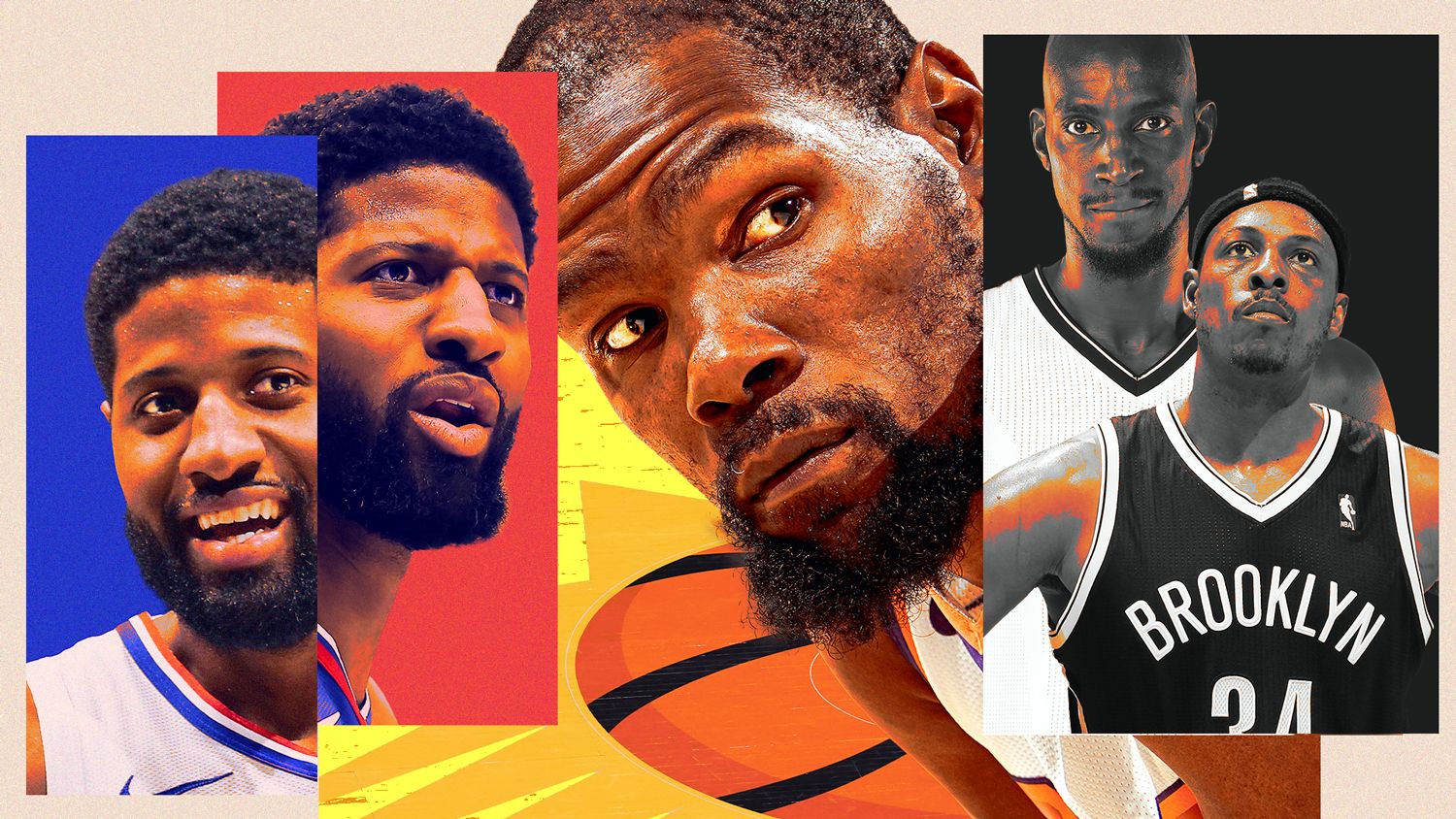
The trade value for superstars continues to rise. Still, NBA front offices might be reassessing this form of inflation, even as stars such as Giannis Antetokounmpo potentially become available.
Last month, ESPN's Brian Windhorst said on the "Hoop Collective" podcast that when he has talked to team executives, "The mood in the NBA right now is not to give up four first-round picks for anybody." Due to concerns about the new salary aprons and previous star returns, Windhorst said, the notion of bundling so many picks in a trade "is not matching what people in the league are telling me the value is, even for a superstar player."
Such deals are a relatively new phenomenon in the NBA. Other than the Brooklyn Nets' memorable trade for Paul Pierce and Kevin Garnett in 2013, typical superstar swaps involved a couple of picks at most. But that changed in 11 days in 2019, when Anthony Davis, Paul George and Russell Westbrook all moved for massive hauls. In every year since, at least one blockbuster trade has been completed that involved four or more first-round picks and swaps.
That flurry provides enough of a sample to analyze the outcomes, to see if going all in for a player is worth it, or if teams are correct to back away from such excessive spending. Let's assess each one of these blockbuster trades from recent history, and we'll provide some broader lessons at the end.
Note: Only key players and picks are included in this list; second-round picks and players primarily added to match salaries are not.
Jump to a trade:
Nets acquired Pierce, Garnett | Lakers gain AD
PG heads out West | Rockets acquired Russell
Holiday heads to Milwaukee | Harden stops by Brooklyn
Hawks acquired Murray | Gobert heads to Minnesota
Mitchell joins Cavs | Durant drops into Phoenix
Beal joins Durant, Suns | Bridges joins Nova-Knicks
Fox sets up with Spurs | Bane heads to Orlando
The final verdict
Nets acquired Paul Pierce and Kevin Garnett, 2013
Nets traded:
2014 first-round pick (landed at No. 17)
2016 first-round pick (landed at No. 3)
2017 swap rights (swapped No. 1 for No. 27)
2018 first-round pick (landed at No. 8)
Under former owner Mikhail Prokhorov, the Nets went all-in for a group of veterans, finished with a 44-38 record and reached the second round of the playoffs. They then stopped spending on the aging, expensive core they had assembled. Pierce left Brooklyn in free agency after one season, and Garnett was traded half a season later.
In acquiring Pierce and Garnett, Brooklyn gave up future picks that the Celtics turned into Jaylen Brown and Jayson Tatum (after the Celtics landed the No. 1 pick in 2017 before trading down to No. 3). Since this trade, the Celtics have the second-most wins in the NBA, behind only the Golden State Warriors, while the Nets rank 24th.
Verdict: Major failure
Lakers acquired Anthony Davis, 2019
Lakers traded:
Brandon Ingram
Lonzo Ball
Josh Hart
Rights to De'Andre Hunter (just picked No. 4)
2022 first-round pick (landed at No. 8)
2023 swap rights (not exercised)
2025 first-round pick (landed at No. 25)
Any set of transactions that results in a championship is by definition successful; as Windhorst likes to say, "Winning a title means never having to say you're sorry."
So, even though the Lakers arguably underachieved during the Davis-LeBron James era -- they advanced past the first round just once after their 2020 title in the Orlando bubble -- this is an easy verdict to deliver. As a bonus, Luka Doncic wouldn't be a Laker if Los Angeles hadn't acquired Davis.
Verdict: Major success
Clippers acquired Paul George, 2019
Clippers traded:
Shai Gilgeous-Alexander
Danilo Gallinari
2021 first-round pick (via Miami, landed at No. 18)
2022 first-round pick (landed at No. 12)
2023 first-round pick (via Miami, landed at No. 18)
2024 first-round pick (landed at No. 26)
2025 swap rights (swapped No. 24 for No. 30)
2026 first-round pick
Although this trade registers as a disaster in hindsight, it made sense at the time: George was coming off a third-place MVP finish in 2019, and his arrival in Los Angeles meant the Clippers could also lure Kawhi Leonard -- coming off a heroic postseason run and Finals MVP award with the Toronto Raptors -- in free agency. With those two apex wings aboard, the Clippers entered the 2019-20 season as championship favorites. And even though they didn't reach the Finals, they still advanced to the conference finals the next season for the first time in franchise history.
Meanwhile, despite trading so much to acquire George, the focus at the time was more on the picks; Gilgeous-Alexander, the No. 11 pick a year earlier, had averaged a respectable but unspectacular 10.8 points per game and made the All-Rookie second team.
Of course, Gilgeous-Alexander later blossomed into an MVP and a Finals MVP, and the No. 12 pick in 2022 was Jalen Williams, who developed into an All-NBA player by his third season. Though that latter part was outside the Clippers' control -- and this deal wouldn't look quite so bad if the Thunder had taken Ousmane Dieng, whom they grabbed one spot ahead of Williams, at No. 12 instead -- trading a future MVP makes this trade a major failure.
Verdict: Major failure
Rockets acquired Russell Westbrook, 2019
Rockets trade:
Chris Paul
2021 swap rights (not exercised because of top-4 protection)
2024 first-round pick (landed at No. 12)
2025 swap rights (not exercised)
2026 first-round pick
Westbrook played well in his lone season in Houston, as the Rockets embraced a super-small-ball style that allowed James Harden and Westbrook to become one of the highest-scoring duos in NBA history -- they combined for 61.5 points per game. But the Rockets were uncompetitive in a second-round loss to the Lakers in the bubble, and they flipped Westbrook for John Wall after the season.
Meanwhile, Paul still had plenty left in his tank, so the Thunder nabbed the best player and the picks in this deal, clearly winning the trade. But because the Rockets got lucky in the 2021 lottery by keeping their protected pick, and successfully rebuilt soon after, the best pick they ultimately surrendered from this deal was only the No. 12 selection in a weak draft. (Oklahoma City used it on Nikola Topic, who has yet to play an NBA game.) That's not a terrible outcome.
Verdict: Minor failure
Bucks acquired Jrue Holiday, 2020
Bucks traded:
Eric Bledsoe
Rights to R.J. Hampton (just picked No. 24)
2024 swap rights (swapped No. 21 for No. 23)
2025 first-round pick (landed at No. 19)
2026 swap rights
2027 first-round pick
See the Windhorst rule: Winning a title, as Milwaukee did in Holiday's first season in town, means never having to say you're sorry. Holiday supplied the most clutch highlight of the Bucks' Finals triumph, with his game-sealing strip and alley-oop assist in Game 5 against the Suns.
Verdict: Major success
Nets acquired James Harden, 2021
Nets traded:
Jarrett Allen
Caris LeVert
Taurean Prince
2021 swap rights (not exercised)
2022 first-round pick (landed at No. 17)
2023 swap rights (not exercised)
2024 first-round pick (landed at No. 3)
2025 swap rights (later traded back to Brooklyn)
2026 first-round pick (later traded back to Brooklyn)
2027 swap rights
With Kevin Durant and Kyrie Irving already on the roster, the Nets added Harden to complete their Big Three. They were unsurprisingly dominant when all three stars shared the court, with a plus-16.9 net rating during the regular season and playoffs, per Cleaning the Glass.
But those moments were rare because of numerous injuries. With Irving out and Harden hobbled, Durant toed the 3-point line on his clutch jumper in Game 7 against Milwaukee in the 2021 playoffs. Instead of a series-winning 3-pointer that could have propelled the Nets to the title, Durant had only tied the score, and Milwaukee won in overtime to ruin Brooklyn's best chance at a championship.
Everything collapsed soon after: Irving skipped home games in the 2021-22 season because of New York City's COVID vaccine mandate, and all three stars requested -- and received -- trades by February 2023.
Verdict: Almost a major success, but a major failure nonetheless
Hawks acquired Dejounte Murray, 2022
Hawks traded:
2023 first-round pick (via Hornets, didn't convey because of protections)
2025 first-round pick (landed at No. 14)
2026 swap rights
2027 first-round pick
The Hawks hoped Murray would help them recapture the magic that thrust Atlanta into the 2021 conference finals. However, the one-time All-Star's defense regressed, and he never meshed with Trae Young; the Hawks were a play-in team in both of his seasons.
Atlanta salvaged much of this trade thanks to another deal two years later, though. In sending Murray to New Orleans, the Hawks received Dyson Daniels on the cusp of a breakout, the first-round pick that allowed them to acquire Kristaps Porzingis and a 2027 first.
Verdict: Minor failure
Timberwolves acquired Rudy Gobert, 2022
Timberwolves traded:
Malik Beasley
Patrick Beverley
Jarred Vanderbilt
Rights to Walker Kessler (just picked No. 22)
2023 first-round pick (landed at No. 16)
2025 first-round pick (landed at No. 21)
2026 swap rights
2027 first-round pick
2029 first-round pick (top-5 protection)
Minnesota hasn't won a title since its shocking trade for the now-four-time Defensive Player of the Year. But a championship isn't the only criterion for success, and Gobert has been a major contributor to the most successful era in franchise history -- the Timberwolves have won twice as many playoff series in the past two seasons (four) as in all of their previous seasons combined (two).
Though adding Gobert compromised the Timberwolves' front office flexibility -- leading to the Karl-Anthony Towns trade -- the picks haven't cost Minnesota much: three non-lottery selections, a swap that almost certainly won't be exercised this spring and two more future picks, both of which will come with Anthony Edwards still in his prime.
Verdict: Major success
Cavaliers acquired Donovan Mitchell, 2022
Cavaliers traded:
Lauri Markkanen
Collin Sexton
Rights to Ochai Agbaji (just picked No. 14)
2025 first-round pick (landed at No. 29)
2026 swap rights
2027 first-round pick
2028 swap rights
2029 first-round pick
The Cavaliers gave up a lot to acquire Mitchell, and much of the return has yet to come due. This deal might look much worse in 2029 if Cleveland has surrendered a juicy pick or two in the interim.
But for now, the Cavaliers would likely make this trade again. Mitchell has been an All-Star in every season as a Cavalier, and last season, he became just the third player in franchise history -- along with LeBron James and Mark Price -- to make an All-NBA first team. Though the Cavaliers have yet to experience much playoff success with Mitchell, there's still value in the regular season, and the 2024-25 Cavaliers won 64 games, the second most in team history.
Verdict: Minor success
Suns acquired Kevin Durant, 2023
Suns traded:
Mikal Bridges
Cam Johnson
Jae Crowder
2023 first-round pick (landed at No. 21)
2025 first-round pick (landed at No. 10, later traded back to Phoenix)
2027 first-round pick
2028 swap rights
2029 first-round pick
This trade would be a failure just from the Suns giving up five first-round picks and swaps. The fact that they also gave up Bridges and Johnson, only to watch Brooklyn trade them for first-round picks, makes this arguably the most expensive trade in NBA history.
And for all that investment, the Suns' return was one playoff-series victory in three years with Durant.
Verdict: Major failure
Suns acquired Bradley Beal, 2023
Suns traded:
Chris Paul
2024 swap rights (not exercised)
2026 swap rights
2028 swap rights
2030 swap rights
The Suns didn't lose their pick in 2024, and they likely won't in 2026, either. Depending on how the rest of the decade goes, the Suns might never give any draft capital to Washington.
And yet, Beal's fit in Phoenix was such a debacle, in terms of roster fit and the franchise's finances, that this trade still isn't redeemable. The Suns waived Beal and bought out the remainder of his contract last summer.
Verdict: Major failure
Knicks acquired Mikal Bridges, 2024
Knicks traded:
Bojan Bogdanovic
2025 first-round pick (landed at No. 26)
2025 first-round pick (via Bucks, landed at No. 19)
2027 first-round pick
2028 swap rights
2029 first-round pick
2031 first-round pick
It's too early to judge the outcome of this trade, in which New York surrendered a considerable number of picks for a non-All-Star. But the measure of success appears fairly simple, looking forward. If this Knicks core never reaches the Finals, and if the front office can't further improve the team because trading those picks for Bridges means, say, the Knicks don't have the assets to complete a trade for a bigger star like Antetokounmpo, then this trade will be a failure.
But if Bridges -- who's enjoying a strong second season as a Knick -- helps lead New York to its first Finals appearance of the 21st century, then this trade is a success, almost no matter what else happens.
Verdict: To be determined
Spurs acquired De'Aaron Fox, 2025
Spurs traded:
Tre Jones
2025 first-round pick (via Bulls, landed at No. 12)
2025 first-round pick (via Hornets, didn't convey because of protections)
2027 first-round pick
2031 first-round pick (via Timberwolves)
It's not too early to judge this trade as a win for the Spurs. Fox is scoring 21 points per game for the second-place team in the West, and the Spurs look like a championship contender well ahead of schedule. Acquiring Fox didn't cost as much as stars on this list, in large part because three of the four picks the Spurs traded weren't their own.
Verdict: At least a minor success, with room to grow into a major success
Magic acquired Desmond Bane, 2025
Magic traded:
Kentavious Caldwell-Pope
Cole Anthony
2025 first-round pick (No. 16)
2026 swap rights
2028 first-round pick
2029 swap rights
2030 first-round pick
Bane is settling in after a rough start in Orlando, but the Magic are performing below expectations. It might take years to make a definitive determination on this deal.
Verdict: To be determined
The final totals
The final tally is (excluding TBD trades):
Major success: 3
Minor success: 2
Minor failure: 2
Major failure: 5
That's a 42% success rate and 58% failure rate, meaning that in a small sample, the odds of a blockbuster trade working out are the same as the odds of Stephen Curry making a 3-pointer. That's not bad!
Why, then, might teams be scared to trade blockbuster packages for stars? Because the major failures, which are concentrated among the Nets and Suns, are so severe. (Nevermind that two recent champions lifted the Larry O'Brien Trophy because they, too, went all in.) Loss aversion means that it's natural to focus on the cautionary tales rather than the success stories.
It's also worth noting that even Phoenix, which looked to be in the worst shape of any team in the league last summer after the failures of the Durant and Beal trades, already has a winning record again this season. Even the failures aren't forever.
One common theme among the trades is that they've largely ended up costing only mediocre picks because the teams going all-in are contenders that draft later in the first round. Though the Nets have traded three future selections that landed in the top three picks, none of the other picks from this list of blockbusters landed in the top seven. Instead, 70% of the picks and swaps that have matured to date either landed outside the lottery or didn't convey.
Taken all together, the future picks traded in these blockbuster deals have returned roughly the No. 18 pick in average value, according to my draft pick value chart.
With swaps specifically, only three of 10 possible swaps from these trades have exercised so far, and just one of those -- the Nets/Celtics swap in 2017 -- was especially valuable; the others were minor moves from No. 23 to 21 and No. 30 to 24. This outcome aligns with previous research I've conducted that shows that more than 60% of possible first-round swaps in draft history have proven worthless.
The larger problem for the teams targeting stars, then, isn't the draft picks they give up, but the roster-building flexibility they surrender by adding stars with high-priced contracts -- particularly under the new, more punitive CBA. That constriction might be a sufficient reason to back away from this sort of all-in trade, especially when it's for a secondary star who won't catapult a team into championship contention by himself.
But for a top-tier superstar like Antetokounmpo, the results of the past several years of blockbusters aren't definitively discouraging. Trading for a star isn't a sure thing. But it's not a guaranteed disaster, either.