
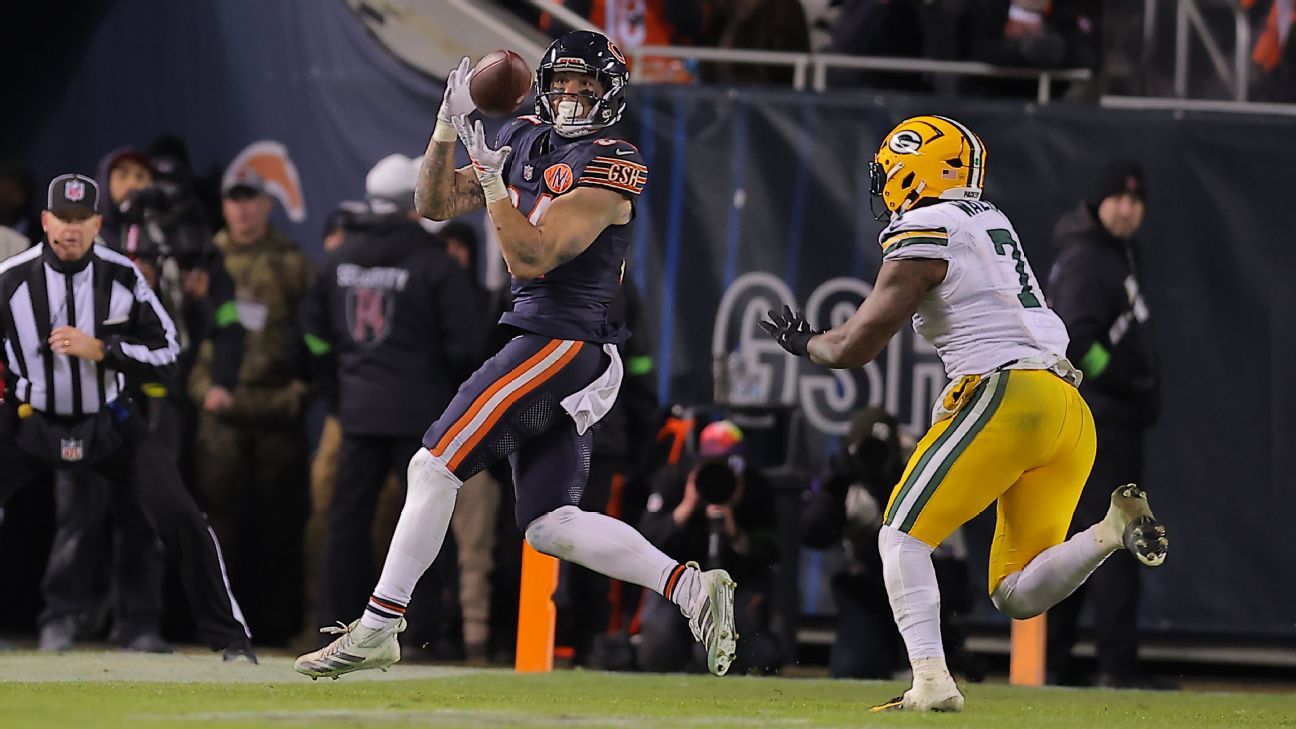
In the Bears' postgame locker room after their 31-27 victory over the Packers in the NFL playoffs' wild-card round, running back Kyle Monangai celebrated the team's seventh comeback win of the 2025 season. On one hand, they've done it seven times. But on the other, surely this one -- the Bears' first home postseason game in eight years -- felt a little different in the halftime locker room.
"Nah," Monangai said. "Same old."
Down 21-3 to the Packers at halftime, the Bears covered an 18-point deficit -- the fourth-biggest in franchise history, and the largest in the franchise's postseason history. They're only the fourth team to ever win a postseason game when entering the fourth quarter trailing by 15-plus points.
But these Bears don't feel the difference of the moment but rather the familiar embrace of an old friend: adversity. After the game, head coach Ben Johnson recalled a day in training camp during which the team watched the film of the Patriots' legendary Super Bowl comeback against the Falcons, down 28-3. "That was my message to the group," Johnson said of his halftime speech. "Just reminding them that this has been done before. Rather than saying, 'Oh, woe is me,' or 'Oh crap, we're in a hole,' it's more 'this is a great opportunity to turn this around into a game we'll never forget. And that's what they did.'"
The halftime locker room is a special place for Chicago -- it's where adjustments are made. League-leading adjustments. In the second half, the Bears' offense tops the league in EPA per play. Their yards per play jumps from 5.3 in the first half to 6.1 in the second half (second-best in the NFL). And their points per drive jumps from 2.05 in the first half to 2.88 in the second (fourth best).
In three games against the Packers this season, the Bears averaged 0.5 points per drive in the first half ... and 3.85 in the second.
This isn't all coaching adjustments, of course. Just as every Bear was unfazed by the deficit, quarterback Caleb Williams was unfazed by the unlikelihood. Facing a fourth-and-8 with the game on the line and quarterbacking a Bears offense that was 1-for-5 on fourth down to that point in the game, Williams made one of his most spectacular throws in a season defined by magic tricks.
That's not coaching, That's uncoachable. That's the sort of franchise-defining, future-altering talent that gets drafted first overall by a listless franchise in need of a savior QB. These were 27 hard-earned yards of Williams' 361 on the night -- the most by a Bears quarterback in a playoff game in franchise history.
Williams wasn't the only offensive standout Sunday night, though. Rookie tight end Colston Loveland had 137 receiving yards, just shy of the record (142 yards) for a rookie tight end in a postseason game. Much as the Bears are a second-half team, Loveland is a second-half player. Since Week 9, Loveland has averaged 66.7 yards per game, which is 20th among all pass catchers and third only to George Kittle and Trey McBride among tight ends. Good company.
Against the Packers, 115 of Loveland's 137 receiving yards came in the second half, including three corner routes which were all oh-so-effortlessly open against the Packers' defense. (Hello, halftime adjustments.)
Loveland was also the target on the successful two-point conversion try, which gave the Bears a four-point lead late in the fourth. This was an isolation route given to Loveland against backup linebacker Nick Niemann in the front corner of the end zone. These isolation routes are plays typically given to star receivers. The Bears gave it to their rookie tight end.
"I know Caleb has an immense amount of trust in [Loveland]," Johnson said postgame. "He's one of the first ones in the building every single day. He's always studying his playbook while he's eating breakfast. He's always the last one off the practice field doing the JUGS machine. He's been a model of consistency, which for a rookie, speaks volumes. As a coaching staff, we really lean on him."
There is not a second-half comeback without second-half stops, and the Bears' defense found them somehow. On four first-half drives, the defense gave up three touchdowns and a field goal attempt as the half expired. Johnson's aggressive fourth-down decisions were panned because of the vulnerability of that defense.
To start the second half? Three-and-out, three-and-out, five-and-out, three-and-out. Those drives collected only one first down, never reset the field position and took only six minutes and 13 seconds off the game clock. As the offense labored to find its footing, the defense gave it chance after chance after chance.
The Bears' defense hasn't been a second-half unit this season so much as an opportunistic one, leading the regular season in takeaways (33). But the turnovers never came in this game. Packers sixth offensive lineman Darrian Kannard fumbled a ball (you read that right) into wide open space, but it bounced out of defensive tackle Gervon Dexter Sr.'s hands. Cornerback Tyrique Stevenson forced a heroic fumble at the inch line on an airborne Christian Watson, but the ball landed right at Romeo Doubs' feet. Corner Nahshon Wright, who tied for second in the league in interceptions with five, had one in his sights until Jayden Reed interfered with the catch.
Instead, it was the consistent run defense, which allowed only 6 yards on seven carries in the second half. It was the presence of Kyler Gordon, the slot corner who returned from injury, didn't play a snap on the first two drives, took over for Nick McCloud and brought renewed physicality to the position. It was the dearly-needed appearance of the pass rush, which pressured Love on 32% of his second-half dropbacks, as compared to 18% in the first half.
"Obviously [Dennis Allen] got really aggressive: corner blitzes, sending Brisker." safety Kevin Byard III said postgame. "And in coverage, we just covered a little bit better, got some PBUs ... we just executed better. The belief in this team, going in halftime not where we wanted to be. But there was no panic. We just knew it was gonna take one play at a time, and that's what we did."
Byard is the veteran voice on the young squad, one of a precious few Bears with postseason experience. He knows what it's like to play win-or-go-home football; Dennis Allen, the Bears defensive coordinator and longtime Saints defense coach, knows what it's like to play win-or-go-home football. But Williams, Loveland and the Bears' offense know what it's like to play second-half football.
Put it together, and you get a statement postseason win -- an emphatic stamp of belonging. Lucky or not, improbable or not, young or not, the Bears are here. They won a postseason game -- and against the Packers no less. Eight teams will remain in the NFL playoffs by the time the dust settles on wild-card weekend, and the Bears are one of them.
That, no matter what Monangai thinks, is not "same old" at all.