
There are lots of ways to end a season disappointed. Expectations can play a role, of course, but they don't have to. Sometimes a first-year head coach gets off on the wrong foot, and sometimes a well-established coach loses his footing. Sometimes you start out the No. 1 team in the country, and three losses take you down. Sometimes you start out expecting 3-9 and still fall far short.
Regardless, as we move toward one of the most unexpected and, frankly, thrilling College Football Playoff semifinals imaginable -- three first-time semifinalists, two potential first-time national champions, no team that has won a title in the past 24 years -- let us first commemorate those who fell short.
Be it because they face-planted in a title chase or they just plain stunk, here are the teams most disappointed with how 2025 played out, loosely ranked in eight categories.
National title expectations
Four preseason top-10 teams either finished the season with seven or fewer wins or rallied too late to save themselves. Any list of disappointments probably has to start with that.
1. Clemson. Penn State put too many eggs in the "Beating Oregon early in the season" basket and collapsed when that didn't work out. LSU needed a thinned-out offensive line to hold up (and its receivers to not drop a ton of passes), and it didn't happen. Texas needed Arch Manning to be the best player in the country to paper over some cracks at receiver and on the offensive line; that didn't happen either.
I can at least explain why the other top-10 disappointments didn't live up to expectations, even if that doesn't make them less disappointing. But Clemson's systemwide collapse in 2025 remains baffling. Injuries certainly contributed to problems in the skill corps and on the offensive line, but quarterback Cade Klubnik was ineffective for most of the season, whether those around him were healthy or not. And the defense, despite returning plenty of NFL-level talent and playing against zero elite offenses all season, improved only from 29th to 24th in defensive SP+ under Tom Allen. I was openly skeptical of the Tigers' national title potential heading into the season, but I still expected them to play like a top-15 team, and they instead suffered their worst season in 15 years.
2. Penn State. The Nittany Lions were never the team they were supposed to be, but following their two-week, post-Oregon implosion -- a pair of losses as heavy favorites against UCLA and Northwestern -- they plummeted to 18th in SP+ ... and then basically played like the No. 18 team in the country from there, nearly beating Indiana and Iowa (in Iowa City), giving Ohio State problems for about a half and beating everyone else. They somehow emerge from the most disappointing season in ages with a few positive feelings.
3. LSU. My SP+ ratings just never caught up to how awful this team was offensively. The Tigers overachieved against offensive projections just once, and it was against an FCS opponent (Southeastern Louisiana). Otherwise it was a cascade of awful performances, injuries, drops and a team that wasted a great defense and got its head coach fired.
4. Texas. Manning never really looked the part of a preseason Heisman favorite (at least not until it was too late), and when he and the offense perked up late in the season, the defense slipped a bit. But if not for a single, awful defeat at Florida in early October, Steve Sarkisian's Longhorns still could have sneaked into the CFP.
Playoff expectations
It wasn't just top-10 teams falling short of hype. Five more teams began the year ranked between 11th and 17th and, for a variety of reasons, came nowhere close to sniffing the CFP bids they were hoping for.
5. South Carolina. Shane Beamer's Gamecocks can thrive only in even-numbered years, it seems. In five seasons with Beamer, they have gone from 48th in SP+ to 19th to 51st to 14th to 48th. Hyping them as a top-15 team always felt pretty tenuous; they had potential stars in quarterback LaNorris Sellers and defensive end Dylan Stewart, but neither had played consistent ball yet, and nearly the rest of the team was retooling. Still, it was fair to expect better than 4-8. New offensive coordinator Mike Shula was gone within a year, and the pass defense wasn't nearly good enough.
The bad performances were awful, and the excellent performances -- they did nearly beat two playoff teams (Alabama and Texas A&M) -- resulted in gut-wrenching losses. But hey, next season is even-numbered again! Pencil the Gamecocks in for nine wins!
6. Florida. Quarterback DJ Lagway's offseason injuries doomed the Gators from the start, as he began the year looking rusty and only sporadically found a rhythm. A painfully young and frequently shuffled receiving corps didn't help. The defense wasn't bad but never dominated. Firing Billy Napier after a 3-4 start wasn't entirely surprising, but unlike Penn State, the losses only mounted under an interim.
7. Kansas State. Whoever loses in Ireland is evidently doomed. (You've been warned, TCU and North Carolina.) Unlike Florida State in 2024 and Nebraska in 2022, Kansas State only briefly collapsed following its loss to Iowa State in Dublin, but by the time the Wildcats found their footing they were 2-4 and just hoping for a .500 finish. They got there, but an exhausted team passed on a bowl bid, and coach Chris Klieman retired.
Honorable mentions: Arizona State and Michigan.
A post-2024 funk
For three 2024 playoff teams and another that had surged to nine wins, 2025 just never looked like it was supposed to.
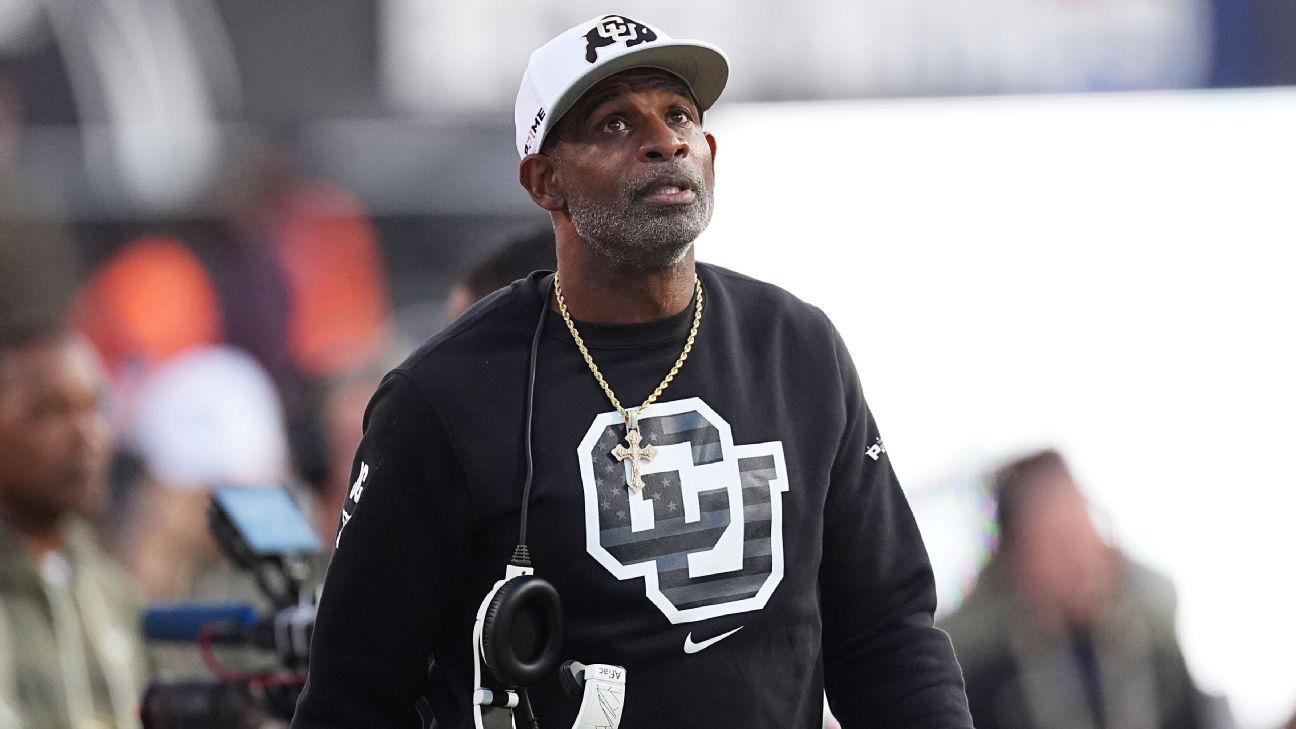
8. Colorado. In 2024, Deion Sanders' Buffaloes won nine games, with Travis Hunter winning the Heisman. After losing Hunter and quarterback Shedeur Sanders, there was plenty of reason to assume some level of drop-off, but it was far worse than that. The QB position was a disaster, Sanders demoted his offensive coordinator for the second time in three years, and the defense fell far off course. The Buffaloes upset Iowa State in Week 7 and then basically packed it in, losing their last five games by an average of 40-15 to finish 3-9. Sanders faces yet another roster rebuild in 2026, and it's hard to build optimism about where this is headed.
9. Boise State. Even without Ashton Jeanty, BSU looked like the Group of 5's standard bearer heading into 2025, but known stars such as pass rusher Jayden Virgin-Morgan and quarterback Maddux Madsen didn't take a step forward (Madsen was average, then hurt), the new RBs fumbled way too much, and against three SP+ top-40 opponents they lost by a combined 100-24. The Broncos rallied to win a competitive Mountain West, but falling from the CFP to outside the SP+ top 60 wasn't the vision for 2025.
10. Tennessee. It could have been worse -- Tennessee still went 8-5 -- but if you had told Volunteers fans that their offense would surge after losing Nico Iamaleava, they would have probably guessed a major playoff run was in the works. Instead, the defense disintegrated, and the Vols went 0-5 against teams that finished with winning records.
11. SMU. Again, it could have been worse -- SMU won nine games after a 2-2 start. But the offense didn't really figure things out until midseason, and the Mustangs failed to defend their ACC crown. Of course, they also lost three games by a total of seven points. With just a couple of bounces, they'd have been right back in the playoff mix.
Major expectations? No, but yikes
You didn't have to be ranked in the preseason to have your hopes shattered in 2025. The six teams below were projected, on average, to win a combined 41.5 games, per SP+. They won 22.
12. Arkansas. Arkansas nearly pulled off one of the more remarkable feats imaginable: going 2-10 with a top-50 SP+ ranking. The Razorbacks really looked awful only once -- in the 56-13 loss that got Sam Pittman fired and brought us "interim head coach Bobby Petrino" -- but their defense was atrocious enough that they went 2-6 in games in which they scored 30 or more points. Going 0-6 in one-score finishes can almost be spun as a positive for incoming head coach Ryan Silverfield. If the Razorbacks actually close out a game or two next year, the record is almost guaranteed to improve.
13. Wisconsin. One of the SP+ projections I was most nervous about was Wisconsin at 38th. Massive offensive improvement was required, and when starting quarterback Billy Edwards Jr. got hurt almost immediately in Week 1, the Badgers officially had no chance. Four QBs started games, and none threw for even 700 yards. After the school announced it would not be firing Luke Fickell despite the team suffering through its worst season in 35 years, the Badgers perked up and upset Washington and Illinois. But they still finished 4-8.
14. Virginia Tech. The Hokies were the Wisconsin of the ACC: Living up to their No. 42 preseason projection was going to require a ton of new players (and two new coordinators) clicking. They did not. Brent Pry was fired three games in after the Hokies allowed 89 combined points to Vanderbilt and Old Dominion. They were competitive for a bit, but lost their last four games by an average of 31-14 and finished outside the SP+ top 100 for the first time since 1978.
15. North Carolina. My go-to line in the offseason was that, while it was hard to figure out what Bill Belichick might be capable of in college football, the roster he had compiled positively screamed "6-6" to me. I was incorrect: It screamed 4-8. The defense figured some things out for a while, but the offense stunk out loud, and the "We consider ourselves the 33rd NFL team" line from general manager Michael Lombardi last winter turned into one of the most easily mockable quotes of 2025.
16. Auburn. When you have a terrible record in close games one year, you evidently aren't guaranteed improvement the next. Auburn suffered a losing record despite a plus-77 scoring margin in 2024, a difficult combination that requires a ton of gut-wrenching defeats. And in 2025 ... the Tigers suffered a losing record despite a plus-73 scoring margin. They were 0-6 in one-score finishes, and Hugh Freeze was shown the door.
Honorable mentions: Baylor, Liberty, Louisiana and Rutgers.
We weren't expecting much, but damn
A lower-expectations version of the last category. These five teams combined for just 21 wins and an average SP+ ranking of 93.2 in 2024; most took on a bunch of new transfers in the hopes of lighting a fire. Instead, we got total implosion: 11 combined wins, an average ranking of 112.2 and four fired head coaches. When things fall apart in this new, transfer-heavy era, they can really fall apart.
17. Oklahoma State. After suffering his worst season as OSU's head coach in 2024, Mike Gundy threw a Hail Mary and brought in 41 new transfers, including many in the spring window. But most Hail Mary tries fall incomplete. The portal produced almost nothing of value, and the Cowboys' first six games against power-conference opponents produced losses by an average of 48-13. Gundy was fired after three games. I like the Eric Morris hire, but with 45 players already in the portal, this is going to be a total overhaul.
18. Georgia State. Losing 73 transfers over a two-year period evidently left GSU with only a couple of stellar players on offense and virtually none on defense. The Panthers beat only Murray State this fall and only once allowed fewer than 27 points to an FBS opponent (and it was against James Madison, of all teams). Shawn Elliott left with awkward timing in February 2024, and Dell McGee has been unsuccessfully swimming against the tide ever since.
19. UCLA. Those three weeks in October were pretty cool, huh? UCLA suffered home losses to Utah and New Mexico by a combined 78-20 early in the season, and DeShaun Foster was quickly fired. The Bruins rallied to shock Penn State and beat Michigan State and Maryland ... and then lost their last five games by an average of 42-12. Bob Chesney inherits a program at one of its lowest ebbs.
20. Michigan State. Jonathan Smith didn't really generate traction at Oregon State until his fourth season; he didn't get even a third season in East Lansing. He inherited a Spartans team that had gone 9-15 in its previous two seasons and ranked 88th in SP+ before his arrival; his two State teams went 9-15 with rankings of 90th and 83rd. I didn't like the Pat Fitzgerald hire, but the bar for showing improvement is ridiculously low.
21. Oregon State. Oregon State went 1-11 and ranked 120th at the end of the Gary Andersen era in 2017, and it took Jonathan Smith a while to rebuild. Within two years of Smith's departure, the Beavers fell right back to 2-10 and 124th. Recent conference realignment trends were cruel to OSU, and Trent Bray had no chance. Will JaMarcus Shephard fare better?
Rebound season? Psych!
22. Florida State. On paper, improving from 2-10 and 83rd in SP+ to 5-7 and 41st is solid work. But when you're Florida State, you're still only two years removed from a 19-game winning streak, and you begin 2025 by pounding a soon-to-be playoff team (Alabama), this was improvement in name only. The Noles started 3-0 and rose as high as seventh in the AP poll, but a run of tight losses threw them off course, and their road form was so awful that they even lost to Stanford.
23. Maryland. Maryland fans are used to watching early promise dissipate, but the Terrapins are turning it into performance art. In Mike Locksley's seven seasons in College Park, he's 21-5 in September and 15-39 thereafter, and the Terps pulled off a perfect 4-0 and 0-8 combination this fall. Holding on to blue-chip freshman quarterback Malik Washington for another season brings hope, but hope tends to produce only one thing for Maryland.
24. Kansas. Granted, even sniffing bowl eligibility is still a pretty new thing for Kansas after the epic futility of the 2010s. But after falling to 5-7 with a 1-5 record in one-score games in 2024, Lance Leipold's Jayhawks looked poised to rebound this fall and started 3-1. But thanks in part to another couple of tight losses, they again stumbled to 5-7.
2024 was a mirage
These four teams went a combined 33-19 in 2024, each either improving significantly over 2023 or, in Northern Illinois' case, improving a little and beating Notre Dame. A sign of great things to come? Not so much. They went 10-38 in 2025.
25. Syracuse. The Orange were on their way to 3-1 when quarterback Steve Angeli was lost for the season with injury. No other QB on the roster was even remotely ready, and they averaged 11 points per game the rest of the way. Backup Rickie Collins performed so poorly that head coach Fran Brown gave three desperation starts to freshman lacrosse player Joseph Filardi. Maybe Angeli's return cures what ailed the Orange, but a collapse of this magnitude hints at massive structural problems.
26. Boston College. BC was a salty 7-6 in Bill O'Brien's first season, but 2025 was a disaster. The defense gave up at least 36 points seven times, and the offense scored 13 or fewer four times, and while the Eagles improved late in the season, that basically meant more competitive losses. With 22 players already in the portal, it's looking like a pretty hard reset heading into 2026.
27. Colorado State. After going 8-16 in Jay Norvell's first two seasons, CSU perked up to 8-5 in 2024. But as with Syracuse, starting QB Brayden Fowler-Nicolosi got hurt early in the season, and everything fell apart in his absence, including Norvell's employment status. This was, per SP+, the Rams' lowest-ranked team since the winless squad of 1981.
28. Northern Illinois. A good defense became average, a bad offense became awful, and after a memorable eight-win campaign in 2024, Thomas Hammock's Huskies just never got things figured out in 2025. They beat only Holy Cross (by two) and two of FBS' five worst teams, per SP+ (Ball State and UMass). They maintained a tough, physical identity, but there was just no upside.
Honorable mentions: San Jos State and South Alabama.
First-year face-plants
One team hired a young, successful former defensive coordinator. Another hired a veteran offensive coordinator. Another hired a successful MAC head coach. Three different approaches with basically the same result: These three teams went a combined 3-33 with the three worst SP+ ratings in FBS.
29. Massachusetts. UMass' minus-36.7 SP+ rating in 2025 (meaning they were 36.7 points worse than the average FBS team) was nearly nine points worse than even the second-worst team. It was worse than winless Kent State's awful minus-33.0 rating in 2024, and it was the worst in FBS since ... UMass had a minus-38.3 rating in 2021. This is becoming the hardest job in FBS.
30. Sam Houston. After winning 10 games in 2024, the Bearkats lost head coach K.C. Keeler to Temple and 30 players to the portal. They lost their home stadium to renovations, too, playing their "home" games in Houston. The deck was stacked against Phil Longo, and only one of their 10 losses was by fewer than 14 points.
31. Charlotte. At Ohio, Tim Albin inherited a great culture from Frank Solich and knew what to do with it. In Charlotte, he inherited a blank slate and didn't come up with many answers. The 49ers had some competitive moments early on but beat only Monmouth and lost their last eight games by an average of 40-12. There's lots of work to be done here.
Honorable mentions: Middle Tennessee and West Virginia.