
LOS ANGELES -- Sean McVay has seen the video clip that went viral.
In a game against the New Orleans Saints during the 2023 season, quarterback Matthew Stafford stood in the huddle listening to the playcall from McVay. And kept listening. And listening.
"I got it," Stafford said, gesturing toward his head coach on the sideline. "I got it. I got it. Please. Stop. Yes. Please stop. Oh my god, he's still going. He's still going."
"I mean, this is unbelievable what I'm getting right now. Holy s---, boys."
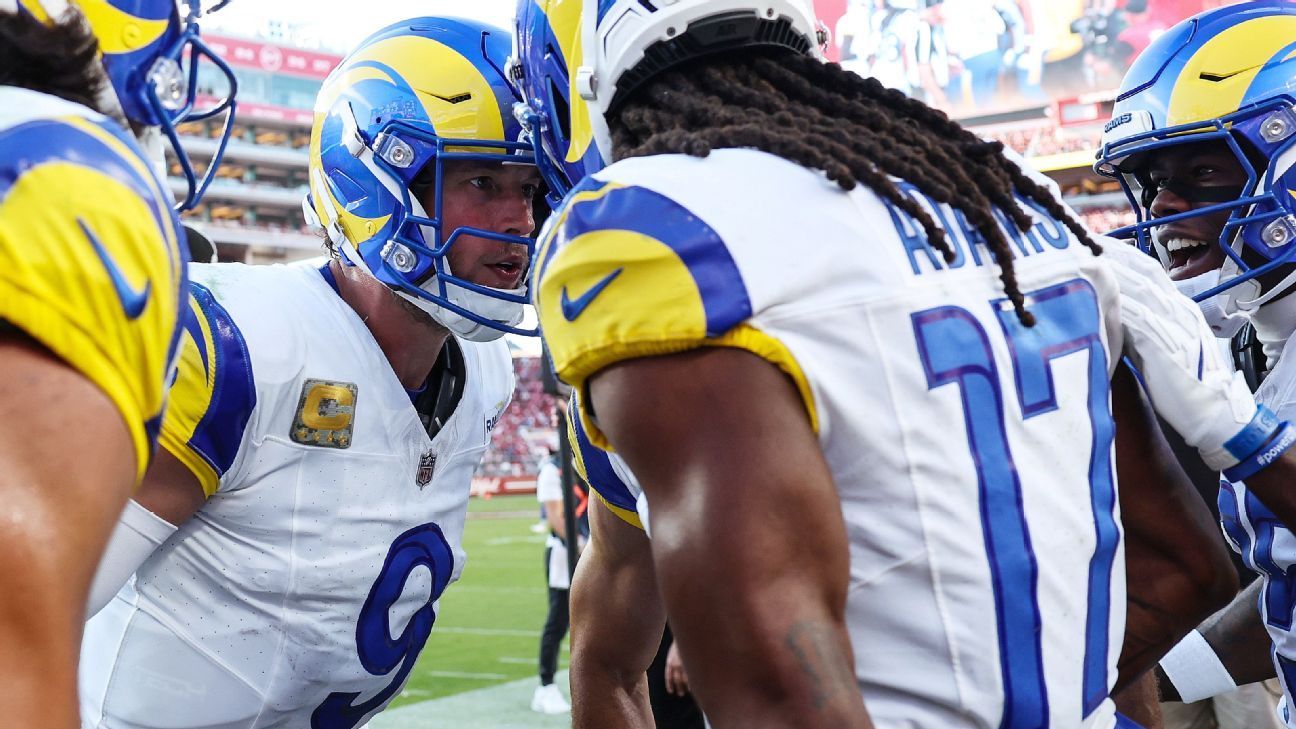
That video, while funny -- "I'm screwing with him a little bit too because the best part about it is he can't talk back to me," McVay said -- also gives a peek into what Stafford is doing before every snap. The length of the playcall, one Stafford transmits from McVay to his teammates in the huddle, shows how the quarterback's mental abilities on the field give the Rams what McVay called "a real edge."
Stafford ended the 2025 regular season as the odds-on favorite to be named the NFL's MVP. Stafford threw for a league-leading 4,707 yards with 46 touchdown passes and 8 interceptions. His 46 touchdown passes also led the league, throwing for 12 more than Detroit Lions quarterback Jared Goff, who was second. Now, the Rams begin what they hope is a long playoff run, starting with Saturday's road game against the Carolina Panthers (4:30 p.m. ET, Fox).
And though Stafford has no doubt shown the physical abilities during the 17 seasons he has played in the NFL -- "the guy can put the ball anywhere," Pro Football Hall of Famer and former Detroit Lions wide receiver Calvin Johnson told ESPN last year -- his teammates and coaches say it's also his mental acumen that stands out.
"He's the smartest football player I've ever played with," center Coleman Shelton said.
It was during the first walk-through the Rams had in the spring of 2023, Mike LaFleur's first season in Los Angeles, that the offensive coordinator saw that intelligence in Stafford.
"I'll never forget that first day," LaFleur said. "[And just seeing] how fluid that walk-through went and how he was able to rattle off plays. Obviously it wasn't like a game plan or anything, but it still was pretty intense, if you will. And so in that moment, even though I knew he was pretty dang smart, that was just very eye-opening to like, 'Hey, we better be on it too.'"
Stafford handles the long playcalls from McVay without wearing a playsheet on his wrist. Wide receiver Davante Adams, playing in his first season with Stafford, said one of the most "underrated things" he has learned is the quarterback's "ability to assess and regurgitate some of the calls that we have without using a wristband."
There are times, left guard Steve Avila said, when he can tell Stafford hears the formation and first route in the playcall and immediately knows what the play will be.
As Stafford hears the call -- or as he's repeating it -- he "can see it," McVay said. That allows him to "make eye contact with his teammates and give little coaching points as you're going up to the line of scrimmage."
"This is next level s--- that he does," McVay said. "It's really special. ... I think it's a real edge and difference for us."
DURING HIS ROOKIE season, Rams running back Kyren Williams was in the huddle when Stafford told him to look for the nickel cornerback on the play.
"He told me the nickel's coming," Williams said. "I'm like, 'Dang, how do you know that? But I appreciate you because he ended up coming.'
"It takes a lot off of me because I don't got to look too many different places. I look, scan here and scan here. Oh he's coming? OK bet, that's my guy. And he makes that clear and obvious."
On a long playcall, Shelton said, Stafford is "almost telling everybody what to do." It's something that is unique, Rams tight end Colby Parkinson said.
Parkinson, in his second season playing with Stafford, said if the quarterback sees "any sense of confusion on your face, he'll be like, 'Hey, this is what you have on this play.'"
"And he can do that for the entire offense," Parkinson said.
If there's a piece of information that will help his teammates "go out there and execute," wide receiver Puka Nacua said, "it's definitely going to come out of his mouth."
"He's very clear when he's talking," Williams said. "If it's to Puka [Nacua] and they got a read onto something, he's like, 'Puka, you and I, watch me. Watch what I give you.'"
By handling the longer playcalls, McVay said, Stafford puts more on himself, "but it takes some of the stress off other guys."
"There might be 25 words in a playcall, but if you're a certain position you're only listening to: What's the cadence? What are those couple key things that really talk to me?," McVay said.
Stafford, 37, said he's happy to take on that responsibility.
"The more I can help communicate and let those guys play fast and free, and if it doesn't slow me down or bog me down, then why not?" Stafford said.
Every play, Shelton said, there's "some nuance" that needs to happen at each position. Stafford will give the offensive linemen reminders in the huddle, such as, "get in a three-point stance."
"It's like having your position coach right next to you the whole time while he's doing everything else," Shelton said.
McVay said he has seen Stafford use as much time as is needed of the play clock to be an effective communicator in the huddle, while balancing the offensive advantage of deciding when the ball is snapped.
"That's where he's really special," McVay said. "It's one thing to be able to coach it, it's another thing to be able to take the onus and the ownership and really the accumulation of knowledge that has built up over time because of how intentional he is."
McVay said for as long as the playcalls seem now -- and sometimes there are two before a play -- they were even longer when the pair first started working together in 2021. McVay also said he thought his "mic etiquette is better now and more considerate" to Stafford as their time together has increased.
"The vernacular has been trimmed," McVay said. "It used to be absolutely absurd. I don't know how we weren't taking delay of games all the time because of how long the damn playcalls were, but we're getting better. They're still pretty ridiculous."
THERE ARE TIMES during a game, Adams said, when he looks over to Stafford and the receiver realizes he needs "to chill out and take a deep breath and move on to the next play."
Adams, who described himself as "an emotional dude," said the calmness with which Stafford carries himself during a game is "different, but it's awesome." And that mentality makes a difference for his teammates.
"He's the chillest dude," Adams said. "... Any time your fearless leader can go out there and show you better than he tells you, that's obviously going to affect the rest of the team."
One of those times came in Week 2. Or at least, Adams thought so. After the Rams' 33-19 victory over the Tennessee Titans, Adams was asked what impressed him about the way Stafford played that day.
"To be honest, the most impressive thing to me watching him today was his demeanor after he threw that pick," Adams said of Stafford's first-half interception. "I told him during the game, 'Bro, you are just the coolest dude I've been around.' He's not cussing, he's not blaming anybody, he [just kind of acted] like it happened in practice. There's obviously another side to it where you can not care enough, but you could just tell he's dialed in, locked in, and not going to let stuff like that rattle him.
"That kind of radiates throughout the rest of the team, that type of poise and confidence."
Except, what Adams missed, Stafford said with a smile later in the day, was that the veteran had slammed his helmet after the play.
"Glad he wasn't looking," Stafford said. "But we'll act like it didn't happen. I was pissed at myself because, I mean, that's just the one thing you can't do, right? ... But the only thing to do is keep playing. I can't just sit there and be pissed about it all day. Got to get mad about it, figure it out."
Avila described Stafford as "a straight line" during games, although he said there are some moments on the field after a good pass or a big play "where you get to see his personality show."
"I've never, ever, ever, ever seen him down," Avila said. "And the good moments are good with him. So yeah, it's pretty cool to see."
That mental resiliency is "one of the hardest things and one of the biggest attributes you can have at quarterback," Stafford said. He said he doesn't "actively think about being calm," but rather, "that's just who I am."
"Just because I'm not yelling and screaming doesn't mean that I'm not giving it everything I have," Stafford said.
THAT CALMNESS MIGHT never be as apparent as in those got-to-have-it moments.
Since he was drafted in 2009, Stafford has 40 career comeback victories in the fourth quarter or overtime, the most in the NFL over that span. According to ESPN Research, that ranks fourth since the merger in 1970, behind Tom Brady (54), Peyton Manning (43) and Ben Roethlisberger (43).
Though Stafford has excelled in those moments in his career, he pointed out after a comeback victory in 2024 that while it was "humbling" to be on a list with the other quarterbacks, he also joked that it meant his team was losing going into the fourth quarter.
"Fourth-quarter comebacks are great," Stafford said last season. "[It] means your team can count on you in those moments. They're also not so great [because it] means you're down, so play better than the first three. It's funny. Football's a funny game."
LaFleur said when Stafford is on the field, "you just know he's going to deliver."
"You just always had confidence in him," Brian Allen, a former Rams center and current offensive assistant, said. "There was never anything that we couldn't overcome.
"And there's people who play that position, who rehearse the plays and say the plays in the huddle. And I don't want to say you don't believe him, but when 9's behind you or 9's under Coleman [Shelton], it doesn't matter what the situation is, there's a chance to win. So I think everyone has that belief and Matthew's earned that just with who he is, what he does, how he goes about things. So that's definitely a real tangible thing for our team. Just when he's there, everything's better."
Stafford said he's "always liked" being up in those moments.
"I'd rather have the ball or be at bat than be sitting on the sideline watching somebody else do it," Stafford said. "I'd rather put myself out there and if I fail, I fail, but I'd rather it be me.
"I try to be myself. I'm thinking about a million different other things as well. I'm trying to do everything I can to get our team in the best play and then go execute it. I guess I feel like staying calm, at least before the play, is a good thing."