
The 2026 Winter Olympic men's hockey tournament begins on Feb. 12 in Milan, Italy. Provided that the ice and the arena are ready, which is something the nations competing in his tournament have been assured about.
"We've taken some steps to make sure that we have backup plans should we need them, but we've heard from the IIHF and the IOC that the arena will be built and it will be ready and that's our expectation," Hockey Canada executive Scott Salmond said when his team revealed its roster Wednesday.
Assuming it happens, this tournament promises to have some great games, battles for medals and of course the potential for another round in the USA vs. Canada rivalry, which might be the most antagonistic feud in professional sports today.
But before these teams hit the ice, they needed to officially lock in their rosters at the end of 2025. Which means we now have a clear picture of the strengths, weaknesses, surprises and snubs of the Olympic hockey rosters.
Here's how the rosters grade out -- at each position group and overall -- and which NHL players might be feeling snubbed by their home nations after these roster reveals.
Note: Players are listed alphabetically within each position group. Players listed with an asterisk were on the original selection lists in June.
United States of America
Forwards
Matt Boldy, Minnesota Wild
Kyle Connor, Winnipeg Jets
Jack Eichel, Vegas Golden Knights*
Jake Guentzel, Tampa Bay Lightning
Jack Hughes, New Jersey Devils
Clayton Keller, Utah Mammoth
Dylan Larkin, Detroit Red Wings
Auston Matthews, Toronto Maple Leafs*
J.T. Miller, New York Rangers
Brock Nelson, Colorado Avalanche
Tage Thompson, Buffalo Sabres
Brady Tkachuk, Ottawa Senators
Matthew Tkachuk, Florida Panthers*
Vincent Trocheck, New York Rangers
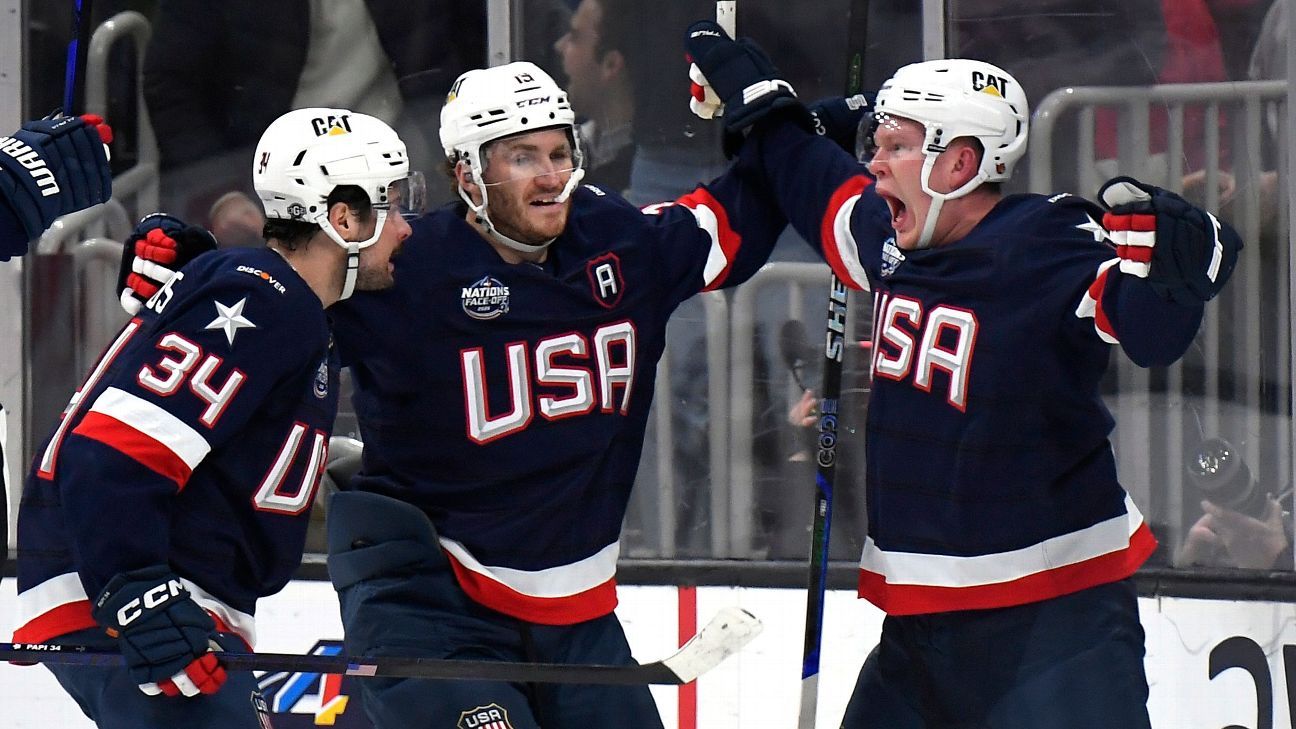
Even with a couple significant snubs, this might be the greatest assemblage of forward talent the U.S. has ever had in the Olympic tournament.
The one-two punch of Eichel and Matthews gives the U.S. two all-world centers in their primes, which is something they've never experienced. No doubt Team USA was relieved to see a vintage Matthews performance for the Leafs this week -- they desperately need him in dominant form to win this tournament.
Matthews will be the captain, but as they showed at the 4 Nations Face-Off, the Tkachuks are the heart and soul of this team. Matthew Tkachuk is still working his way back from preseason surgery but is skating again. Brother Brady also missed time this season, but has been great for Ottawa with 18 points in 19 games.
At 4 Nations, they had players with a finishers' scoring touch in Boldy, Connor and Guentzel. Adding Thompson to that group adds another threat, with 64 goals in his last 115 games. Dylan Larkin was a revelation at 4 Nations, playing some of his best hockey. And while many aren't happy to see them selected over other younger scoring options, Miller and Trocheck bring a 200-foot game and tenacity to the roster.
One name to watch: Jack Hughes. He's still being impacted by a hand injury he suffered in November, wearing a brace on his right hand during the roster reveal on The TODAY Show on Friday. Hughes was used primarily on the wing at 4 Nations. He looked out of sorts and overmatched, generating just one assist in four games. Where does he fit here?
"Jack is a unique player with his ability to drive offense. One of the things we liked about the way we constructed our lines at the 4 Nations was the size we had down the middle, we thought was the strength of the group," coach Mike Sullivan said. "But having said that, we have had conversations around using Jack in the middle at this Olympic experience, and we'll continue to have those conversations leading up to the first game."
Overall forwards grade: A-
Defensemen
Brock Faber, Minnesota Wild
Noah Hanifin, Vegas Golden Knights
Quinn Hughes, Minnesota Wild*
Seth Jones, Florida Panthers
Charlie McAvoy, Boston Bruins*
Jake Sanderson, Ottawa Senators
Jaccob Slavin, Carolina Hurricanes
Zach Werenski, Columbus Blue Jackets
While most of these defensemen played at 4 Nations, there are a few notable changes to the group. Rangers star defenseman Adam Fox didn't make the cut. Enter Jones, who revived his career with Florida last season.
But the biggest addition was a player that was supposed to be a difference-maker at 4 Nations but couldn't due to injury: Quinn Hughes, the dynamic all-around star for Guerin's Minnesota Wild, who has 30 points in 35 games this season.
He's playing with Faber in Minnesota, and that could shake up the pairing from 4 Nations. Faber had played a bunch with Slavin in that tournament.
Team USA GM Bill Guerin said "there's a lot to like" with this group.
"I mean, it's a pretty incredible group of defensemen, combining skill, skating ability, the ability to defend, the willingness to defend, puck moving," he said. "We have a number of guys that can play in the power play. They can all kill penalties. Versatility, mobility, all those things ... when you look at them, it's a pretty damn good group."
Overall defensemen grade: A-
Goaltenders
Connor Hellebuyck, Winnipeg Jets
Jake Oettinger, Dallas Stars
Jeremy Swayman, Boston Bruins
The trio that backstopped the Americans at the 4 Nations Face-Off will do the same at the 2026 Olympics.
Hellebuyck, who won the Hart Trophy as league MVP and the Vezina as the top goaltender last season, had a .932 save percentage and a 1.59 goals-against average in three 4 Nations Face-Off games. He was outplayed by Jordan Binnington in the gold medal game, but that was more about Binnington having the game of his life than Hellebuyck being at fault.
Please note that Hellebuyck had minor arthroscopic knee surgery on Nov. 22, 2025, to address a nagging issue. That's one reason his numbers aren't as dominant (.907, 2.51 goals-against in 22 games). Another reason is that Jets aren't very good, which is why he has 4.8 goals saved above expected this season.
Oettinger has 8.2 goals saved above expected this season, to go along with a 16-7-3 record and a .907 save percentage. A little friendly competition never hurts: Oettinger said last May that "other than winning the Stanley Cup, my No. 1 goal" is being Team USA's starting goaltender.
The American goaltending pool being extraordinarily deep, there was some talk that Swayman might get pushed out by the likes of Vancouver's Thatcher Demko, Calgary's Dustin Wolf or Spencer Knight, who's finally broken through in Chicago. After all, Swayman didn't see any game action at 4 Nations. But Team USA put a premium on players who showed up and thrived at the 2025 IIHF world championships in Sweden and Denmark.
Thrive, Swayman did: He played seven games, won them all, and posted a 1.69 goals-against average and a .921 save percentage in leading the U.S. to gold. He punctuated that with a strong start to the season for the Bruins, with a .904 save percentage and 15 wins in 28 games.
Overall goaltending grade: A
Surprises
Has there been another NHL trade that laundered a player's reputation more than the one that sent Seth Jones to the Florida Panthers last season?
Jones was a defenseman who would get Norris Trophy votes. Then he was traded to Chicago in 2021, signed a long-term deal, and saw his esteem buried under the weight of their multi-year rebuild. When Florida acquired him last season, the biggest headlines were about how much salary the Blackhawks were retaining on his deal through 2029-30. And then he formed the Panthers' most effective defensive pairing (with Niko Mikkola), helping Florida to its second straight Stanley Cup championship and Jones' first ring.
It was a performance that reminded everyone how good Jones can be when motivated and surrounded by elite talent. He produces offensively, brings size to the blue line, plays fundamentally sound defensively and devours minutes -- leading Florida in postseason average ice time (25:30).
Jones had some history with Team USA management. Panthers GM Bill Zito not only acquired him from Chicago last season but was an assistant GM in Columbus when the Blue Jackets traded for Jones in 2016. Oilers GM Stan Bowman was running the Blackhawks when they traded for Jones and signed him to an eight-year deal. It never hurts to have support in the room.
It was expected the Americans would run it back with essentially the same roster they had at 4 Nations with a couple of augmentations. Tage Thompson was obviously going to be one of them, having been in the building for the 4 Nations championship game as a potential injury replacement. With 20 goals in 39 games, Thompson closed that deal this season, if there was every any doubt.
But with Chris Kreider not returning, there would be another forward spot opened up, and that spot went to Keller, despite significant competition for it.
Keller made his case over the last two seasons in Utah, scoring a career-high 90 points (30 goals, 60 assists) last season and then following that up with 36 points in 41 games this season. But what separated Keller from the pack wasn't just the fact that he played for Team USA at the IIHF world championship in May, but that he captained the team that won gold for the U.S. in that tournament for the first time in 92 years.
Team USA management heavily weighed participation in worlds as a factor in making the Olympic cut, as proof of concept that those players can thrive on "the biggest stage," as Guerin put it. Keller had 10 points in 10 tournament games for the U.S., which might have clinched this for him.
Snubs
Connor McDavid ended the 4 Nations Face-Off championship game 8:18 into overtime, but people forget that the Americans had a 2-1 lead at 7:32 of the second period. In both scenarios, one more goal from the U.S. changes everything. Which is why Team USA was criticized for not having Kyle Connor in the lineup for the gold medal game -- and why they took grief for not having Cole Caufield on the roster at all.
Caufield has 57 goals in his last 122 NHL games. He's an electrifying performer, hard to defend and plays like he has a GPS system to find the back of the net. But he's listed at 5-8 and the analytics say he's not a dependable defensive player -- despite protestations from Montreal fans who claim otherwise.
Also keep this in mind: Caufield played in IIHF worlds two years ago, but opted not to play after last season, despite Montreal bowing out of the playoffs in five games.
As Guerin told ESPN's Emily Kaplan at orientation camp: "We're doing things differently now, and the world championships are absolutely connected to this. If you're saying no and you don't have a legit excuse, it will hurt you."
Only five American players have scored more goals than DeBrincat (87 in 206 games) over the last three seasons. But his size (listed at 5-8) and average defensive acumen meant there were better options on the wing.
After Canada won the 4 Nations Face-Off, several sources around Team USA indicated that management wasn't happy with Adam Fox. They didn't feel he had a strong tournament, having failed to register a point in four games and struggling at times with the pace of play. But it was his blown defensive assignment on McDavid's "golden goal" -- deftly broken down here by analyst Frank Corrado -- that drew the most ire. In fact, there were those who felt that sin was so egregious that Fox basically played himself off the Olympic team in that overtime.
I asked Guerin about that theory, and Fox's snub, on Friday:
"Well, I think it's exactly that. It's perception. And that's for you guys to wrestle with and talk about. That's not for us. If you think we made a decision on one play, then you must not think we're very smart. So other than that, I'm going to keep those conversations private. Our decision was made and we're moving forward."
He was one of the first players selected for the 4 Nations roster. Now he can't even crack the top eight for the Olympics. We're going to pretend that his tournament performance didn't play a role here?
Understandably, a lot of Team USA and New York Rangers fans aren't ready to let this one go quite yet. Fox is a Norris Trophy-winning, elite defenseman who has been nothing short of exceptional when he's been healthy for the Rangers this season. The idea that Rangers GM Chris Drury and coaches Mike Sullivan and David Quinn were part of the Team USA brain trust and Fox didn't make the team boggles the mind.
Guerin always deserves credit for putting his neck on the line when he makes audacious calls like this. Obviously, if the construction of the D corps leads to gold, no one's breathing a word about Adam Fox during the parade. But if the Americans fall short? Then he becomes the poster boy for a shoddily constructed roster.
Based on the Fox snub, it's pretty clear Team USA feels they have all the power-play quarterbacks they need and that the overall defense can generate enough offensively.
But leaving Hutson off is leaving off the most dynamic offensive defenseman the national team program has generated since Quinn Hughes. Hutson has 106 points in his first 122 NHL games, winning rookie of the year honors last season. True, he doesn't have the size of Jones or Hanifin, but they don't have his dynamism. Please note that like Caufield, Hutson didn't play at worlds, either.
Kane, 37, would have been the ultimate "old guy still got it" pick for Team USA. He played in Vancouver in 2010 and Sochi in 2014, as well as for the U.S. in the World Cup of Hockey in 2016. He trails Brett Hull by 24 points for the all-time mark for American-born players (1,391). The Detroit Red Wings winger was a surprise invitee to U.S. Olympic orientation camp in the summer, putting him on the radar as an option. The team decided to go young, albeit less accomplished.
Knies, 23, has something a lot of other players on this roster don't have: Olympic experience, having played four games in the 2022 Beijing Games, in which the NHL did not take part. He's the kind of power forward that Guerin values: Big, productive, fearless around the net-front and a forechecking terror. Plus, seeing as how Auston Matthews is fairly important to Team USA's success, wouldn't it make sense to draft his linemate to the roster?
Kreider was the only 4 Nations forward that won't return to play in the Olympic tournament. He was a healthy scratch for the Americans in the first two games of the tournament, and then drew in after Matthew Tkachuk's injury. They both dressed for the gold medal game, with Kreider limited to 6:25 of ice time in the overtime loss. After a hot start for the Anaheim Ducks this season -- 13 goals in his first 26 games -- his production cratered, as Kreider hasn't scored a goal since Dec. 1.
The Ducks defenseman was invited to the U.S. Olympic orientation camp and played 10 games on Team USA's gold-medal winning team at IIHF worlds. He's a great young (24) blueliner who can log big minutes, averaging over 25 per game for the Ducks. LaCombe hasn't been all that exceptional for the Ducks, but his underlying numbers are better than those for Hanifin, the left-side defenseman whose spot he'd probably have taken.
Just a baffling snub. Robertson is eighth in the NHL is points, with 48 in 41 games. That includes 24 goals, which ties him with McDavid for fourth in the league. He is exactly the kind of offensive player down the lineup that Team USA has lacked in previous Olympics and, frankly, at a 4 Nations tournament that saw them lose gold by a single goal. He's a pure finisher. He's not a liability defensively.
In the end, the Americans are leaving one of their best and brightest back home because of Team USA's philosophical choice to cede roster spots to veteran "role players" like J.T. Miller and Vincent Trocheck rather than pure offensive talents; and the fact that this philosophy, and a slightly down year for Robo in 2023-24, left him off the 4 Nations roster, which means he never had a chance to share in the "chemistry" that led to the majority of that roster continuing on to the Olympics.
The Buffalo Sabres winger has size (6-4, 220 pounds) and physicality, to go along with being one of the NHL's most productive goal-scoring power forwards (36 goals in 82 games last season). He's also willing to literally put his body on the line for his team, setting an NHL record for blocked shots by a forward (113) last season.
But again, if performing in international tournaments was a point of emphasis for Team USA -- and in particular showing up to last season's IIHF worlds -- then it should be noted that Tuch has appeared in worlds only once, in 2023, despite missing the playoffs for four straight seasons in Buffalo.
Overall team grade: B+
This roster was constructed to beat Canada but not be Canada. And it's high time Team USA starts acting like they're just as talented as their heated rivals.
It's the frustrating part as an American hockey fan. The Miracle on Ice has red, white and blue-pilled the brains of hockey executives for decades that heart and grit and work rate are the fundamental difference between USA Hockey and the Canadians and the Russians, to use two elite talent examples.
For years, it was the blue-collar aesthetic of the Americans, trying to grit their way to another Miracle. Some of this was due to a talent disparity with other hockey nations. But that's since been corrected thanks to USA Hockey's growth and the roots put down by NHL expansion. There was also a team-construction mindset that we need rosters with veterans who humbly accept roles rather than young stars who might -- emphasis on might -- not be able to do so.
And that's how you go nearly five decades without Olympic men's hockey gold.
This is the first time in nearly 30 years that it felt the talent gap between the U.S. and Canada had significantly closed. The 2026 Olympics were going to be the moment when Team USA wouldn't do what it always seems to do: Leave dynamic offensive talents home due to perceptions about defensive lapses or compete levels or because they didn't attend the right offseason tournament, in favor of less effective veteran players whose greatest virtues are nebulous "intangibles." The Americans' pool is finally deep enough to go skill vs. skill with anyone in the world; a moment to let our freak flag fly with an all-star team of superior hockey talents.
And yet five of the top 10 American-born scorers in the NHL aren't on this team.
This feels like a roster built to mitigate risk at a moment when Team USA should be taking more of them with its team construction.
Look, I'm not going to be a total Debbie Downer here. As we saw at 4 Nations, this team has what it takes to beat Canada and win Olympic gold. Heck, the defense and goaltending alone might be enough to land the plane in Italy. I would like nothing more to be totally, completely and utterly wrong in my criticism of some of these roster choices. I would like nothing more than to apologize to Bill Guerin for my lack of confidence in his vision. I would like nothing more than to see the Americans send Canada home in a crisis of faith while our anthem plays and Matthew Tkachuk chews on his medal to make sure it's real gold.
To paraphrase the late Herb Brooks in the movie "Miracle":
"I'm sick and tired of hearing about the Miracle on Ice. This is your time. Now go out there and take it."
Finland
Forwards
Joel Armia, Los Angeles Kings
Sebastian Aho, Carolina Hurricanes*
Mikael Granlund, Anaheim Ducks
Erik Haula, Nashville Predators
Roope Hintz, Dallas Stars
Kaapo Kakko, Seattle Kraken
Oliver Kapanen, Montreal Canadiens
Joel Kiviranta, Colorado Avalanche
Artturi Lehkonen, Colorado Avalanche
Anton Lundell, Florida Panthers
Eetu Luostarinen, Florida Panthers
Mikko Rantanen, Dallas Stars*
Teuvo Teravainen, Chicago Blackhawks
Eeli Tolvanen, Seattle Kraken
Does the absence of Aleksander Barkov, whom the Panthers lost to a preseason knee injury, drop this group a full letter grade? It might. Barkov is arguably the best 200-foot center in the world, with two Stanley Cup wins and previous Olympic experience in Sochi. Finland could confidently put him out against a top scoring line for Canada or the U.S. and know there was a decent chance he could neutralize them -- while scoring for the Finns in the process.
All the more pressure on Rantanen to be the team's superstar leader, who is more than ready for it. The Dallas forward showed last postseason what can happen when he goes Beast Mode, and he's been a terror at previous IIHF tournaments. The opportunity exists to reunite the Stars' Finnish Mafia line, which ceased to exist after Granlund left for free-agent riches with the Ducks. Roope Hintz was the other member of that trio at forward.
Barkov's absence puts the focus on Sebastian Aho to be an offensive engine. He's had extensive world championships experience to go along with lengthy playoff runs with the Hurricanes. Artturi Lehkonen will also be heavily leaned on for offense.
Just like Jon Cooper imported two Lightning linemates to Team Canada, Finland gets the benefit of having two longtime linemates from the Panthers: Center Anton Lundell, and forward Eetu Luostarinen, two thirds of their dynamic checking line from last season's Stanley Cup run. Any chance their other linemate can change his name to Brd Maarchrnda and join them on the Finnish team?
Overall forwards grade: C+
Defensemen
Miro Heiskanen, Dallas Stars*
Henri Jokiharju, Boston Bruins
Mikko Lehtonen, ZSC Lions (NLA)
Esa Lindell, Dallas Stars*
Olli Maatta, Utah Mammoth
Nikolas Matinpalo, Ottawa Senators
Niko Mikkola, Florida Panthers
Rasmus Ristolainen, Philadelphia Flyers
The biggest change here from the Finns' 4 Nations roster: Miro Heiskanen is back, baby.
The Stars' top defenseman suffered a knee injury on Jan. 29, 2025, in a game against the Vegas Golden Knights and was ruled out of the 4 Nations tournament. At the time, the loss was treated with the same magnitude as the Finns losing Barkov. Heiskanen and Lindell are one of the NHL's top defensive pairings, as Dallas scores 62% of the goals at 5-on-5 when they're out there. Heiskanen has found his offensive groove again, with 35 points in 41 games, including 20 points at even strength.
Ristolainen is another big addition to the blue line after missing 4 Nations with an upper-body injury. He actually just returned to the Flyers after missing several months of game action with surgery on a ruptured right triceps tendon, his second such procedure in two years. He's a solid defender and lends a much-needed physical presence in a tournament where that'll be required against the likes of Canada and the U.S.
Maatta, 31, is an old pro at this point. Matinpalo was a minus-5 in three 4 Nations games, pressed into action due to injury. One player we're excited to watch: Niko Mikkola, who had a breakout season with the Panthers in their second Cup run and showed some unexpected offensive spark.
Easily their most improved area.
Overall defensemen grade: B+
Goaltenders
Kevin Lankinen, Vancouver Canucks
Ukko-Pekka Luukkonen, Buffalo Sabres
Juuse Saros, Nashville Predators*
The same trio that backstopped Finland in the 4 Nations Face-Off, where Saros and Lankinen both made two appearances. Saros relieved Lankinen after he gave up four goals on 13 shots against Canada, but Lankinen was great in their OT loss to Sweden. Saros gave up six goals on 32 shots in a loss to Team USA. Again, take this with the caveat that they were playing behind a blue line decimated by injuries.
All three goalies are underwater analytically this season, with Lankinen's minus-5-23 goals saved above expected the worst mark of the three. Saros has had an uptick in quality in the last month, helping the Predators climb out of their early-season abyss and into playoff contention. While Alex Lyon has gotten a lot of love for the Sabres' recent winning streak, Ukko-Pekka Luukkonen had three straight wins giving up just one goal in each.
Of the three, Saros has the greatest potential to steal a game against one of the tournament's titans. But all three are capable. It's not the glory days of Tuukka Rask and Pekka Rinne, but it'll do.
Overall goaltending grade: B
Surprises
Kapanen wasn't on the 4 Nations roster last season. In fact, he was played in the SHL at the time of that tournament, having been loaned to Timr IK by the Canadiens. In his rookie season with the Canadiens in 2025-26, the 22-year-old forward has 12 goals and 21 points in 40 games, playing his way onto the national team radar and, in the end, the roster.
Snubs
Too little, too late? The 25-year-old Maple Leafs winger was brought in to help fill the offensive void created by Mitch Marner's departure but had just nine points in his first 22 games. He's been better and more impactful lately (six points in seven games), but Finland opted for other options up front. He's the highest-scoring Finn not on the Olympic roster.
Even with Barkov's absence creating an open spot at center, the 23-year-old Canuck didn't make the cut. He has 11 points in 31 games this season.
The Rangers defenseman played three games in the 4 Nations Face-Off, skating to a minus-5. He's been a frequent scratch this season for the Blueshirts, which probably didn't help his Olympic standing.
Overall team grade: C+
The one true thing about Finland is that no one wants to play Finland. This roster upholds the tradition of being a pesky team with a handful of elite skilled players and an underlying nasty streak that makes every game against the Finns as brutal as a winter evening in Lapland.
This Olympic roster didn't offer many surprises or shocks -- outside of a few tweaks and big injury returns, it's who they danced with at 4 Nations. But there's no overcoming the loss of Barkov. When you think about the centers on Canada and the U.S., not to mention players like Germany's Leon Draisaitl and Sweden's Leo Carlsson, to not have the dominating defensive force in the NHL seriously limits Finland's chances to punch up in Italy.
Canada
Forwards
Macklin Celebrini, San Jose Sharks
Anthony Cirelli, Tampa Bay Lightning
Sidney Crosby, Pittsburgh Penguins*
Brandon Hagel, Tampa Bay Lightning
Bo Horvat, New York Islanders
Nathan MacKinnon, Colorado Avalanche*
Brad Marchand, Florida Panthers
Mitch Marner, Vegas Golden Knights
Connor McDavid, Edmonton Oilers*
Brayden Point, Tampa Bay Lightning*
Sam Reinhart, Florida Panthers*
Mark Stone, Vegas Golden Knights
Nick Suzuki, Montreal Canadiens
Tom Wilson, Washington Capitals
It's palpably unfair that Canada has the two best hockey players on the planet centering its top two lines: MacKinnon, with 32 goals and 66 points in 38 NHL games this season; and McDavid, who has 69 points in 40 games, including 24 goals. Seriously, there should be international sanctions or something for having that kind of arsenal.
MacKinnon's fellow Cole Harbour, Nova Scotia, native Crosby is expected to be on one of his wings. Reinhart projects as the other wing, although Cooper had Stone up with Sid and Nate during the 4 Nations Face-Off. Horvat also has experience playing with MacKinnon and could offer a presence near the net.
It'll be interesting to see what Cooper wants to do with McDavid. Early projections have him playing with Celebrini, the 19-year-old San Jose phenom. Marner and Reinhart played with him at 4 Nations as well. Can Marchand keep up with Connor? That would be fun, given their battles in the Stanley Cup Final last season.
Suzuki, a new addition, likely centers the third line. Cooper will have Cirelli and Hagel as a duo down the lineup and on the penalty kill.
The three changes here from 4 Nations are swapping in Horvat, Wilson and Suzuki for Sam Bennett, Seth Jarvis and Travis Konecny. Though there can be quibbles about those decisions, there's no debating that the forward group is the backbone of this team.
Overall forwards grade: A+
Defensemen
Drew Doughty, Los Angeles Kings
Thomas Harley, Dallas Stars
Cale Makar, Colorado Avalanche*
Josh Morrissey, Winnipeg Jets
Colton Parayko, St. Louis Blues
Travis Sanheim, Philadelphia Flyers
Shea Theodore, Vegas Golden Knights
Devon Toews, Colorado Avalanche
There was an opportunity for Team Canada to change its mix on the blue line, but Armstrong said the team decided to run it back with the same group of eight used at the 4 Nations Face-Off.
Some of that makes sense: There's no reason Canada would want to split Makar and Toews, while NHL stars such as Doughty, Morrissey and Theodore were considered locks.
If there were changes to be made, it might have been with Parayko and Sanheim. But Armstrong noted those two are tough to play against defensively. "We call it like going through a car wash. They're all arms and legs. It's hard to get to the net. It's like swimming in seaweed. I love those big players," Armstrong said.
Makar's the star here, one of the most dynamic offensive defensemen the NHL has ever seen. He has 44 points in 38 games and can run the power play. It is a little surprising that Team Canada didn't opt for another numbers-generating offensive defenseman here, someone such as Evan Bouchard of the Oilers or Jakob Chychrun of the Capitals as an insurance policy, but it's hard to argue with a group that was good enough to win 4 Nations gold.
Overall defensemen grade: B+
Goaltenders
Jordan Binnington, St. Louis Blues
Darcy Kuemper, Los Angeles Kings
Logan Thompson, Washington Capitals
The most dramatic change from the 4 Nations roster is in the crease.
Gone are Adin Hill of the Golden Knights, who has been out since October with a lower-body injury; and Sam Montembeault of the Canadiens, whose numbers this season (.863 save percentage, 3.52 goals-against average) certainly challenge Armstrong's statement that no one played themselves off Team Canada.
Enter Kuemper, a Vezina Trophy finalist last season who has had two great seasons with the Kings and earned a Stanley Cup ring with the Avalanche in 2021-22; and Thompson, who has shown that last season's startling numbers with Washington weren't those of a one-hit-wonder. He has a .915 save percentage and a 2.33 goals-against average while winning 15 of 28 games.
One of the biggest points of debate heading into the Team Canada decision: Would the gold medal game mastery of Binnington at 4 Nations make a strong enough case that his putrid numbers this season could be ignored? Binnington is 7-9-6 for the Blues with an .870 save percentage and a 3.44 goals-against average. No goalie with at least 20 games played this season has worse numbers. His underlying numbers are even more brutal: minus-17.31 goals saved above expected.
Armstrong, the general manager of the Blues, said his team hasn't played well enough in front of Binnington. But he also said that Binnington "never came up as a question mark" within the Team Canada management group.
It's a slightly improved group from 4 Nations but still easily Team Canada's most vulnerable position.
Overall goaltending grade: B-
Surprises
Let's say there's a Canadian player with 60 points in 39 games, including 21 goals. Now let's say that player is just 19. Would you still want him in the biggest pressure-cooker hockey tournament in the world? Of course you would if he's Celebrini, mature beyond his years and playing some of the best hockey you'll see this season.
What really gave the San Jose Sharks star a boost was playing at the 2025 IIHF world championships for Team Canada, a squad that included Crosby and MacKinnon. After Crosby basically knighted him as the real deal after that tournament, you could have started stitching his Olympic sweater immediately.
Wilson's suspension history and occasional on-ice antics have always obscured how much skill he brings to the Washington Capitals. No doubt the start he had this season -- 19 goals, 18 assists in 38 games to lead his team in points -- opened some eyes to the fact that this guy can play. Wilson's an underrated skater, too. The fact that the Olympic ice surface is slightly smaller than an NHL rink didn't hurt his chances, given his size.
Then there's one other obvious benefit to having Wilson on the roster: To deploy him as an anti-Tkachuks countermeasure if Canada plays the U.S. again.
Team Canada had several options at forward but went with Horvat, who wasn't a member of the 4 Nations roster. The Islanders center had three things going for him: He can get inside and score in the tough areas, as he has 21 goals this season; he's awesome on faceoffs, winning 57.7% of the time; and as Armstrong noted, Horvat has a history playing on MacKinnon's wing.
Snubs
Easily the buzziest snub of the roster announcement. Bennett won the Conn Smythe Trophy as playoff MVP in helping the Florida Panthers to their second straight Stanley Cup championship. He has earned his reputation as a player who elevates his game in pressure situations with a win-at-all-costs style of play, which is what earned him a spot on the 4 Nations roster. With a priority on scoring in the high-danger areas, one assumed Bennett would have been an obvious choice ... and yet, he's not on the initial roster.
The fact that Cooper selected two of his Tampa Bay Lightning role players and Team Canada left Bennett home probably isn't bringing down the temperature in the Battle of Florida anytime soon.
Celebrini, at 19, made Team Canada but Bedard, 20, did not. That's despite an incredible start of the season for the Chicago Blackhawks with 44 points in 31 games, including 19 goals. There's some plausible deniability for Team Canada as Bedard is out with a shoulder injury, and his timeline to return to Chicago doesn't have a ton of clarity.
Did the fact that Bedard didn't play for Canada at the world championships like Celebrini did play into this? Perhaps. Bedard is still in the mix, however, if the Canadians have some injuries.
Speaking of dynamic young players, the New York Islanders' 18-year-old rookie phenom was left off the Team Canada roster despite playing his way onto the radar this season with nine goals and 16 assists in 40 games.
Armstrong didn't talk much about the snubs, though he made time to discuss Schaefer.
"He's a fantastic talent. He brings you out of your seat every night. He's got maturity beyond his years on and off the ice," he said. "And so I was shocked at how quickly he worked his way into our conversations, and that's a credit to him."
Like Bedard, Scheifele is going to be one of the next forwards in line as an injury replacement before the tournament -- which was the same position he was in at the 4 Nations Face-Off. The Winnipeg Jets center has 18 goals and 27 assists in 37 games this season.
Two of McDavid's teammates were left off the Team Canada roster. In Bouchard's case, some believed that Canada might take the defenseman with the booming shot, who has seen goals and 30 assists in 40 games this season. But his reputation for defensive lapses didn't do him any favors.
In Hyman's case, the 33-year-old winger has 11 goals and 10 assists in 21 games since returning from injury. For a team constantly stressing over who can play effectively with McDavid, it's a little surprising they didn't take someone whose proven he can. (See also: Chris Kunitz, Crosby's wing man, at the 2014 Olympics).
A justified snub and a real bummer for Jarvis, who played for Canada at the 4 Nations Face-Off. The tenacious Carolina Hurricanes winger is week-to-week after crashing into the goal post at a high velocity against Florida on Dec. 20. Said coach Rod Brind'Amour: "It's not good. He's going to be out for a while." Jarvis had 19 goals on the season.
Mackenzie Blackwood and Scott Wedgewood
The Avalanche have the league's best goals-against average this season but neither of their goalies got the call. Wedgewood (17-1-4, .919 save percentage) was probably a long shot to make the team, but many believed that Blackwood (12-1-1, .924 save percentage) had a shot. The lack of big-game experience for both of them was likely a factor, given the history that Binnington and Kuemper both have.
Overall team grade: A-
Even with specious goaltending and some questionable roster decisions, Team Canada is the tournament favorite in the 2026 Winter Olympics for two reasons.
The first is the unmatched offensive talent that they have up front, particularly at the center spot. The second is that this is a roster loaded with champions at every level. International tournaments. Stanley Cup Finals. And in the case of some of the veterans such as Crosby and Doughty, at the Olympics themselves.
You can't truly act like you've been there until you've been there. Team Canada has been there and is primed to win a third straight gold medal in Olympic best-on-best tournaments.