
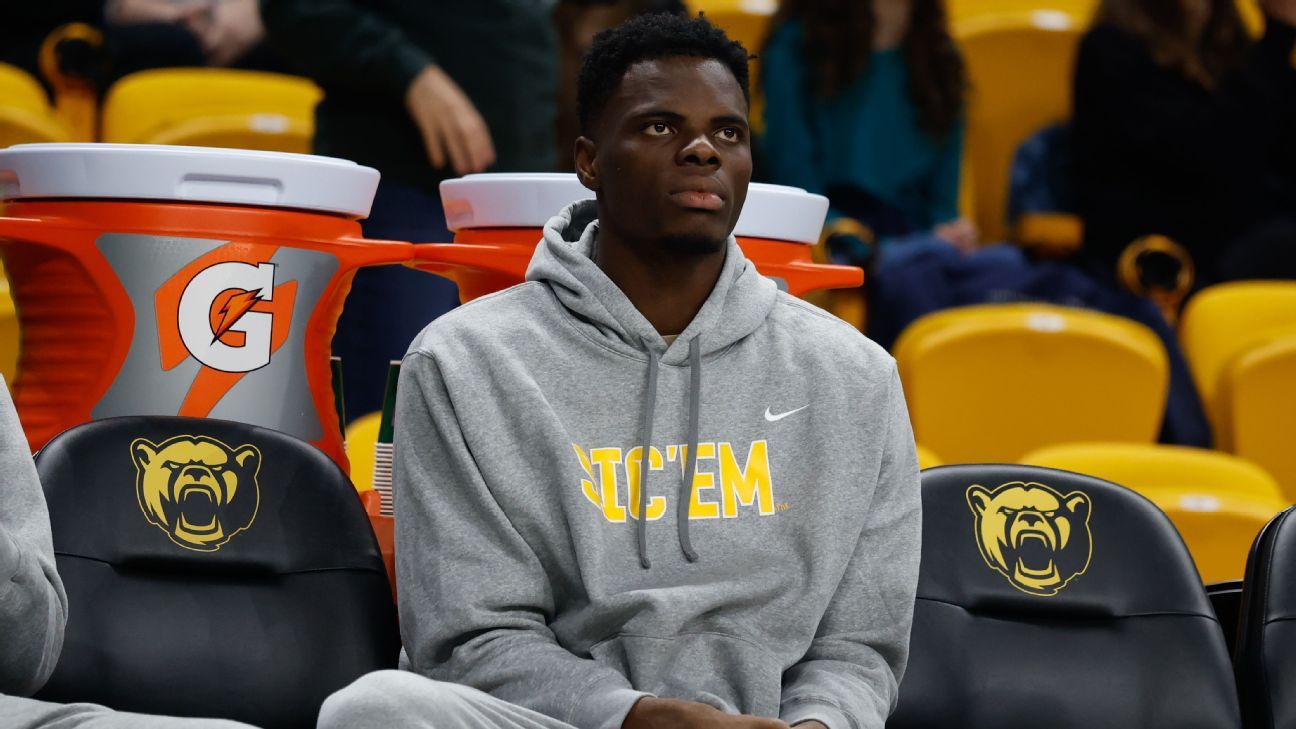
As the calendar flips from 2025 to 2026 and the college basketball schedule turns to conference play, the biggest story in the sport isn't about what's happening on the court. It's about James Nnaji, who became the first former NBA draft pick to be cleared by the NCAA and signed with Baylor on Christmas Eve.
While Nnaji never played in an official NBA game, the 31st overall pick in the 2023 draft did participate in that year's Summer League, and was later part of the three-team trade that brought Karl-Anthony Towns to the New York Knicks (the Knicks still own Nnaji's draft rights). Now, after playing the past couple years in Europe, Nnaji could suit up for Baylor as soon as this Saturday when the Bears travel to TCU.
Ultimately, Nnaji is just the latest example in a growing trend of professional basketball players opting to pursue college basketball due to the lucrative opportunities that come with revenue sharing and NIL.
How did we get here? And what could happen next? ESPN's college basketball reporters Jeff Borzello and Myron Medcalf break down the biggest talking points.
Why was James Nnaji granted NCAA eligibility?
While Nnaji's situation is unprecedented in men's college basketball, there is precedent on the women's side: Nastja Claessens was the 30th overall pick in the 2024 WNBA draft and is now playing for Kansas State.
Nnaji checks a lot of the same boxes as Claessens: He never previously enrolled in college, spending the last five years with the FC Barcelona organization; he never played in an official NBA game despite being drafted; and, as NCAA eligibility rules dictate, he's within a five-year window of what would be his high school graduation.
From a letter-of-the-law perspective, the NCAA's logic in clearing Nnaji isn't that much different from its logic in clearing many other former European pros who came to the United States last offseason to play men's college basketball. Virginia's Thijs De Ridder, Ole Miss' Ilias Kamardine, North Carolina's Luka Bogavac, Illinois' Mihailo Petrovic, Louisville's Sananda Fru and Texas A&M's Rubn Dominguez are the headliners on a long list of 22-year-old international pros who were auto-eligible for the 2025 NBA draft, went undrafted and are now playing college basketball. Technically, all 30-40 players on that list are undrafted free agents and can sign with an NBA team at any time.
You can nitpick and say that Nnaji was an early entrant into the draft, while the above players were auto-eligible due to their age, but the main tenets of NCAA eligibility remain the same: no previous college enrollment, no NBA experience, within the five-year window of a high school graduation.
It's the same reason a trio of former G League players -- Santa Clara forward Thierry Darlan, BYU center Abdullah Ahmed and Louisville guard London Johnson -- have been cleared to play college basketball. Darlan has been playing for Santa Clara all season, while Ahmed and Johnson recently joined their programs. Darlan and Ahmed fall into a similar bucket as the aforementioned players from overseas, while Johnson was born in the United States but never enrolled in a college before going straight to the G League. None of the three played in an official NBA game, and all are within their five-year window of the equivalent of a high school graduation. -- Borzello
If his situation is comparable to other former pros who have transitioned to college, why has Nnaji's case become a tipping point?
Coaches who have expressed their dismay with Nnaji's signing aren't only worried about his eligibility -- they're worried about how many doors it could open.
While other players with professional experience have been added to rosters in recent years, the addition of a former NBA draft pick midway through the season has spawned fears about teams orchestrating midseason moves to significantly alter their rosters with professional players before conference play begins.
NCAA president Charlie Baker's statement indicated that players who have signed NBA contracts -- including two-way deals for players who flex between the NBA and G League -- are not eligible to play college basketball, but the NCAA has lost cases in courthouses across the country trying to draw similar lines in the sand before. The coaches who have spoken up know that if an NBA or two-way player takes the NCAA to court to gain eligibility, there is no guarantee the NCAA would prevail.
That's why Arkansas coach John Calipari's rant proposed a ban on any players with professional experience. UConn coach Dan Hurley joked that "Santa Claus" had come in the form of midseason additions. And Michigan State coach Tom Izzo was unhappy, too, saying "shame on the NCAA" for allowing the signing of former pros.
Their collective discontent isn't about Nnaji specifically, but they view the circumstances of his addition as another example of the NCAA's blurred eligibility lines and the limitations of its authority to enforce its own rules. -- Medcalf
Should we expect more former NBA draft picks and/or G League players to join the college ranks this season? What about future ones?
It seems unlikely this season. There is a finite amount of players who have participated in the G League's Ignite program or Overtime Elite without playing college basketball or signing an NBA contract and are still within five years of the equivalent of a high school graduation.
The list of former NBA draft picks without actual NBA experience or contractual ties, comparable to Nnaji, is longer, but the window for players to enroll before a school's second semester or third quarter and compete in the second half of the 2025-26 season is closing quickly.
In the future? That's a different conversation.
Ultimately, outside of the NBA, college basketball teams now can offer some of the biggest paydays in the world. The average G League salary is around $40,000. The average EuroLeague player, per europrobasket.com, makes anywhere from $500,000 to $800,000. Even a player on a two-way contract in the NBA makes about half of the rookie minimum, or $646,000. There are players on Kentucky's roster this season who are making more than those three figures combined.
Earnings are the appeal of college basketball, where schools have found ways to offer both rev share packages and legitimate NIL deals. Players in Nnaji's position -- Johnson and Darlan, too -- will continue to seek the financial opportunities available at this level. But will the clearance of their eligibility stop here? -- Medcalf
Is there any chance a current NBA player could ever return to college?
Baker's statement was clear: A player who has signed an NBA contract will not be allowed to play college basketball.
But what happens if someone takes that up in court?
A few years ago, college players weren't allowed to be paid for their name, image or likeness; the NCAA lost that battle in court. Then college players couldn't play immediately after transferring schools; the NCAA lost that in court, too. And not that long ago, schools weren't required to compensate their athletes directly; the NCAA lost another case, clearing the way for the new rev share model.
This is important context, because on paper, the paths of the European players who have been paid to compete overseas before joining D-I programs sound a lot like those of two-way players and young NBA players who have signed contracts but played sparingly at the next level. With the money available to college players right now, it would not be a surprise if the NCAA faced another monumental legal case from a player currently ineligible to play at that level. --Medcalf
As Myron outlined, the NCAA has consistently lost meaningful court decisions that have chipped away at amateurism and eligibility rules. What if a current NBA player or two-way player tries to fight the NCAA's stance in court?
We might not have to wait very long to find out. Trentyn Flowers, who is on a two-way contract with the Chicago Bulls and the Windy City Bulls, is exploring the possibility of going to college, sources told ESPN. Flowers played in two NBA games earlier this month. Based on Baker's statement, Flowers will not be granted college eligibility. But given the NCAA's recent history in court, that will be up for debate. -- Borzello
Has the NCAA indicated whether it could close the loophole that granted Nnaji eligibility?
In the NCAA's eyes, it's not a loophole, so there's nothing to close. With Nnaji and the G League players, the NCAA believes it is simply applying the same guidelines that have allowed European pros to come to the United States to play college basketball in droves. Moving forward, players with similar backgrounds who meet the other eligibility requirements are fair game to recruit. -- Borzello
It's important to focus on the "actual and necessary expenses" portion of NCAA rules for players who have competed professionally outside the NBA. Per the D-I manual, a player who has competed and received cost of living support -- which can include meals, lodging, apparel, health/medical insurance and "other reasonable expenses" -- can be eligible to play at this level. Sometimes that may require a player to repay an amount above those expenses before they can play Division I basketball. That's the situation for the multitude of European players who have been signed by college programs.
That's where the gray area is. What is the exact scope of "actual and necessary expenses"? D-I teams have signed players with EuroLeague experience, as well as G League players who have been compensated to play basketball for multiple years. The "actual and necessary expenses" category is what provides the NCAA with the latitude to give players like Nnaji the opportunity to play college basketball.
That's the door that's justifying the NCAA's eligibility decisions for those players -- and it could one day be the door that's challenged in another legal proceeding. -- Medcalf