
In June 2023, the Suns acquired Bradley Beal from the Washington Wizards, a deal that came on the heels of Phoenix landing Kevin Durant from the Brooklyn Nets before that year's trade deadline. After the moves, new owner Mat Ishbia hailed the creation of the NBA's next superteam.
Three months later, the Milwaukee Bucks swapped Jrue Holiday for Damian Lillard to add a superstar sidekick for Giannis Antetokounmpo in his chase for a second title. The move impacted the title race, but for the Boston Celtics, who wound up with not just Holiday, but also Kristaps Porzingis as they constructed an elite roster that claimed the franchise's 18th championship.
Those trades rattled the NBA landscape. The league is in a far different place two years later.
"The new [Collective Bargaining Agreement] caused a market correction," an Eastern Conference executive told ESPN. "Teams had to wise up."
Trade season kicks into gear Monday, when most of the league's players become eligible to be moved. As teams take a closer look at their rosters and as trade buzz builds around Antetokounmpo and Anthony Davis, our weekly trip around the Association examines the changing concept of superstar value, why teams are now thinking twice about taking on gigantic deals and what it could mean for the lead-up to the Feb. 5 deadline.
Why is the value of star players changing?
Brian Windhorst: For many years, when teams chased star players via free agency or trade, the more years they had on their contract, the better. Now, as teams consider roster-building and strategy, values seem to be different.
"There are two major shifts happening," a Western Conference general manager said. "We have everyone being very mindful of the aprons and carefully slotting their players to fit. Then you have the nature of the game, where you need deep rosters to play this volume of games at the speed the league is playing."
Stars win titles in the NBA. To be very clear, that will continue to be the case. But the messaging is that if the star players have availability concerns, are a little later in their careers and have the "big maxes" -- deals that pay either 30% or 35% of the salary cap -- they are facing more scrutiny than ever.
"When you look at big deals with star players," an East vice president said, "you start to see these checklists. Are they on the right side of 30? How old will they be when they might want an extension? Do you have the apron space to do a deal regardless of what the cost is? How does the player fit into your apron now and when you have to pay your younger players?
"It's not just how talented the player is today."
Tim Bontemps: There is a familiar sentiment across the league, specifically on player availability and depth being so critical to how teams are tackling the new restrictions.
"The max-level guys who make tons of money can't play as many minutes as they could before, so they become less valuable," an East executive said. "You can't be committing that much of your money to guys who won't play at all or cannot sustain the same number of games and minutes."
The Suns have become a case study. Last season, Phoenix's top-heavy roster featured Durant and Beal, stars in their 30s with extensive injury histories, and little depth around them and fellow star Devin Booker. They missed the play-in entirely, leading Ishbia and his front office to move on from Durant and Beal this summer. (Wednesday's NBA Cup quarterfinal obliteration by the Oklahoma City Thunder aside, the new-look Suns built around Booker have become a surprise riser in the West.)
The LA Clippers, after constructing a roster full of high-priced, big-name, aging veterans, are off to a horrendous start with few options to improve. "The rubber is hitting the road for these older teams," a West scout said. "[They] have nowhere to go."
How much is the CBA really to blame?
Windhorst: Last summer, Denver Nuggets governor Josh Kroenke created a buzz when he put the words "trading" and "No. 15" (aka three-time MVP Nikola Jokic) next to each other in a sentence.
He was discussing the daunting possibility of the Nuggets entering the salary cap's second apron, a complex rule that confuses fans and keeps billionaire owners up at night.
"For us as an organization, going into that second apron is not necessarily something that we're scared of," Kroenke said moments before he stated something that implied the exact opposite of that sentiment.
"There are rules around [the second apron] that we needed to be very careful of with our injury history. The wrong person gets injured, and very quickly you're into a scenario that I never want to have to contemplate, and that's trading No. 15."
Kroenke's point, while it might have put a scare into Nuggets fans, was clear. The second apron and its fangs, not just luxury taxes penalties but also team-building penalties, can kneecap a franchise and quickly change how it evaluates player value.
"Now more than ever, you cannot overpay for past performance, either in salary or draft picks," a West executive said. "The cost of a mistake is too high."
Bontemps: Since the second apron was introduced in the 2023 CBA, there's been a misconception that teams were repeatedly stampeding through that high salary threshold. That was not the case; generally, just a few teams would rotate in and out of that territory. But the clear and stated goal of the first and second spending aprons, and the various triggers that hard cap teams below them, were designed to force difficult choices.
It has almost immediately impacted the value of superstars on max-level contracts.
"You're going, 'Yeesh,'" another East executive said. "You just can't paper over a guy on your roster that isn't delivering value at the highest levels. You can manage missing the lower-end guys, but the long-term salaries making $30, $40, $50 million? There's no getting over that.
"Those guys bury you in this system."
That's why league insiders predict an expanded focus on teams moving off long-term salary between now and the Feb. 5 trade deadline. A veteran agent told me recently that, for most front offices, signing a player to a long-term extension is preferable over waiting for free agency. Because, the agent said, there's always the ability to get a player elsewhere if they want to leave.
That theory could be tested in the coming months and years. Consider the small-market Utah Jazz (Lauri Markkanen), Sacramento Kings (Domantas Sabonis) and Memphis Grizzlies (Jaren Jackson Jr.). All three franchises locked up big men to renegotiated long-term contract extensions that will pay each player close to $50 million by the final year of the deal.
None of those players are currently available on the trade market, but each has been bandied about as a name to watch because their teams are either potentially headed to a rebuild or already there.
"On their last contracts, they had good value," a West executive said of Markkanen, Sabonis and Jackson. "[Now] they are all at a whole new threshold, where you look at them totally differently."
Does this apply to superstars such as Giannis?
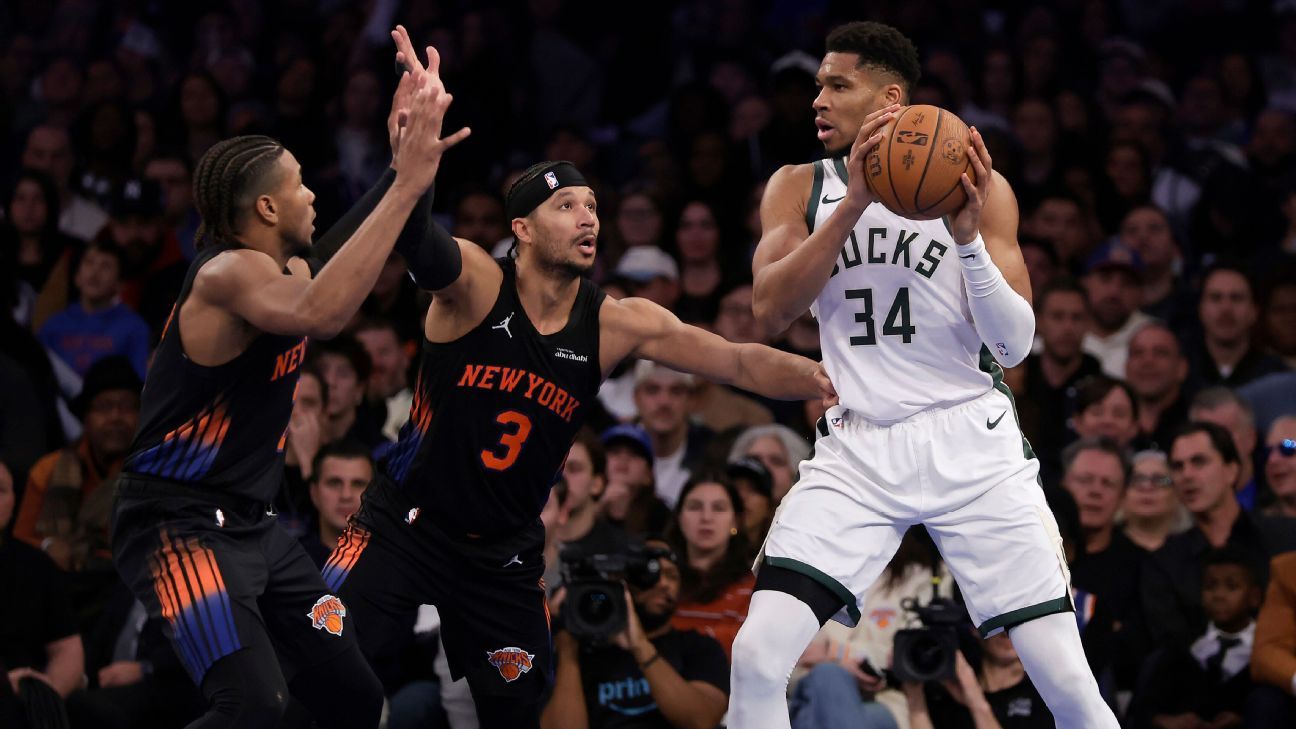
Windhorst: Here is the exception. Antetokounmpo is universally regarded as a top-five player -- some would say top three, and we're not arguing -- still in his prime. I've surveyed executives on their views on Antetokounmpo since the summer, and there's definitely a bit of trepidation about committing potentially $300 million through his mid-30s, which is probably going to be on the table next summer in Milwaukee or elsewhere.
But any Giannis talks are still played by the old rules, according to executives and coaches.
"I don't think you'd see 29 teams make an offer like if, say, Victor [Wembanyama] was available, but there would be plenty of interest and probably two to three teams would be willing to go all-in right now," an East executive said. "Every player has risk, and he'd have some risk, but this is one you don't have to work too hard to talk yourself into."
"I'm sure the front office would have pros and cons and all that," an assistant coach said. "But if you're asking me, I'd want him on my team in less than a second. He plays hard every night and clearly wants to win and can be unstoppable. This is the kind of player you need to win it all."
Bontemps: There are many variables to consider. High among them is Giannis' potential next contract, a four-year extension worth a staggering $275 million, per ESPN's Bobby Marks.
"You are going to gulp and do it," an East executive said when asked if they would be comfortable signing Antetokounmpo to that number through his age-37 season. "But you have to be good enough where the beginning of the deal is worth it, because you are baking in the back end.
"If you're a play-in team? Or a six seed? Then, you shouldn't be doing it."
Antetokounmpo might end up controlling his own market. If he isn't traded before this summer, he'll enter the final year of his contract and could have some leverage over where he wants to go. But that doesn't mean Milwaukee has to abide by those wishes if other teams are willing to step up. The Bucks have their own history to fall back on and know that's a possibility. After all, Lillard had preferred a trade to the Miami Heat before Milwaukee swooped in.
"The thing that people will overlook, and was overlooked in the Dame situation, was that the Bucks are not going to just send him wherever he wants to go for a bad return," an East executive said.
"Whatever you want to say about Portland, they negotiated and did a great job getting Dame somewhere else. The Bucks will all but certainly do the same thing [with Antetokounmpo]."
What about Anthony Davis?
Bontemps: The situation facing Davis and the Dallas Mavericks, on the other hand, is one of the best examples of the risk teams must now weigh. When healthy, Davis is a potent threat at both ends of the court and could be the missing player of a title contender.
But that availability can't be guaranteed at this point in the 32-year-old forward's career, which turns the roughly $120 million remaining on Davis' contract and potential extension into a decision too risky for some front offices.
"For a guy like Anthony Davis," a West executive said, "it's hard to justify them getting a 35 percent max when they aren't playing a ton of minutes and games."
That's why sources I've spoken to have expressed skepticism in a robust market for Davis this trade season, particularly as teams around the league are shifting to younger, faster and deeper rosters.
Windhorst: Plus, one aspect that isn't covered often enough: The Mavs are, as of now, slated to become very expensive next year. With P.J. Washington and Daniel Gafford's extensions signed earlier this year, Dallas will be a second apron team if it nets a lottery pick in the deal. It already has more than $300 million committed, a legacy of former GM Nico Harrison putting together and paying a team that he planned to chase a title next season.
"They have to be very careful with what they do with AD," an East executive said. "They could set themselves back years with the wrong deal."
Speaking of Gafford, he has been mentioned as a possible trade candidate this season and into the future, especially if the Mavericks have to cut payroll. He's a quality big man, and the three-year, $54 million contract he starts next season is viewed as reasonable. But with center Dereck Lively II playing just 43 games over the past two seasons -- he will miss the rest of 2025-26 with a foot injury -- it should no longer be assumed that Gafford is expendable in Dallas.
How will this impact the 2026 and future trade markets?
Windhorst: For teams looking to make trades, every dollar spent is being studied. The Suns, for example, might not have found a trade partner for Beal -- even without his no-trade clause -- when they decided to waive and stretch the more than $100 million remaining on the final two years of his deal.
And while Desmond Bane and Mikal Bridges, two players who have never made an All-Star team, have been swapped for draft pick hauls the past couple of seasons, Durant went for a solid starter in Dillon Brooks, a young player with what's seen as a negative contract in Jalen Green and the 10th pick in the draft. A few months earlier, Karl-Anthony Towns was swapped for Julius Randle and Donte DiVincenzo and what became the 17th pick. The difference? Towns and Durant's contracts are around $50 million, while Bane and Bridges make around half that.
"If you look at Bane, yes [the Magic] gave up four picks, but he was a perfect fit for their roster and he makes $12 million less than Zach LaVine," an East executive said. "That matters."
Bontemps: It sure feels like this is the new reality as teams reckon with the financial limits being placed.
That said, one West scout told me they believed there will always be teams willing to take a swing on a player who fits their timeline, be it like what the Knicks did with Towns, the Cleveland Cavaliers did with Donovan Mitchell or the Minnesota Timberwolves did with Rudy Gobert, to name a few examples.
There will just be far fewer moving forward. And you better be right.
"The aprons are causing people to think and act differently," the scout said. "But there will always be teams that decide to strike while the irons are hot. ...
"It's an even bigger risk-reward calculation than it has ever been."