

Liverpool's hopes of retaining the Premier League title in 2025/26 are all but dead and buried - and it's only December.
The team have been on a torrid run of late, losing nine of their last 13 matches in all competitions, with the likelihood of being crowned back-to-back champions now decidedly slim.
Liverpool's set-piece disparity leaves Arne Slot scratching head
Liverpool's recent run has been punctuated by statement victories in Europe, over Eintracht Frankfurt and Real Madrid, however, the team have also been beaten heavily by PSV Eindhoven at Anfield.
Plenty of theories have been posited by fans, pundits and armchair experts as to why Liverpool's drop-off has been so pronounced.

While there is no one correct answer, there are myriad factors to consider.
They include Trent Alexander-Arnold's departure for Real Madrid, taking his elite-level ball-progressing capabilities and link-up with Mohamed Salah with him, in addition to the popular verdict that Slot's tactics have been 'found out' by opposing managers after his first year in English football.
Liverpool's decision to spend heavily on the likes of Florian Wirtz and Alexander Isak - both of whom yet to deliver - and replace their starting full-backs with players less suited to defending, is also likely to have contributed.
One area, though, that has not received the scrutiny it perhaps deserves is Liverpool's performance at set-pieces.
In the modern era where marginal gains are king and set-piece coaches are commonplace among top clubs, Liverpool's underperformance at both ends of the pitch is as stark as it is surprising.
Competition | Set-piece genre | Rank |
Premier League | Attacking | 18th out of 20 |
Premier League | Defending | 19th out of 20 |
Champions League | Attacking | 1st out of 36 |
Champions League | Defending | 2nd out of 36 |
This season, only winless Wolverhampton Wanderers have scored fewer Premier League goals from set-plays than Liverpool. Similarly, only Wolves and Fulham have attempted fewer shots from set-pieces than Slot's side.
Contrastingly, league leaders Arsenal, who have developed a reputation for being particularly effective at making dead ball situations count, have scored 10 goals from such scenarios this term and as a result are reaping the benefits.
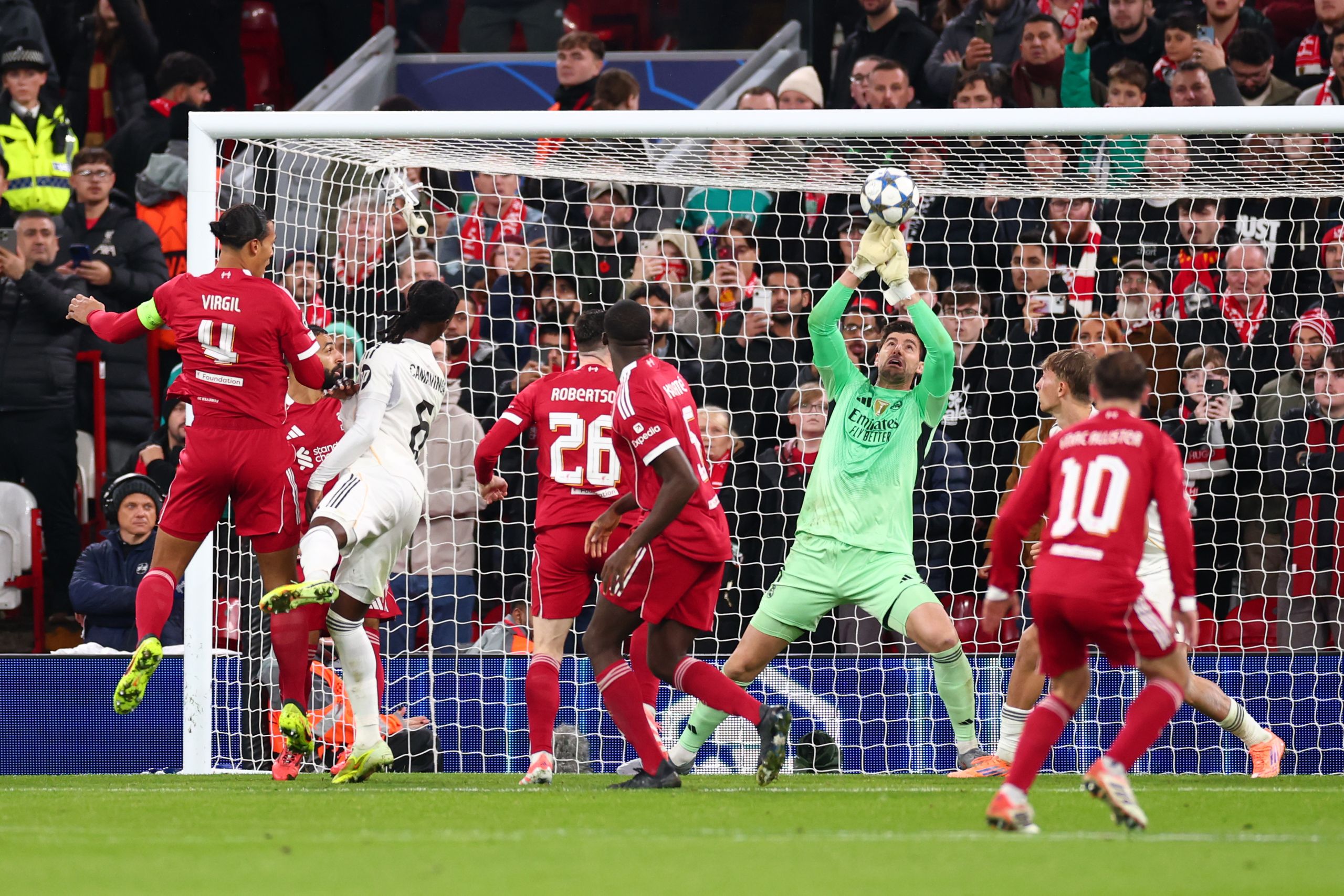
Ironically, in the Champions League, Liverpool have scored five times from set-pieces, which is more than every other team in the league phase. They have also averaged seven shots per game from set-plays; their total of 35 is greater than any other side has managed.
At the other end of the pitch, Liverpool's performance at set-plays, specifically in Premier League fixtures, is just as concerning, with West Ham United the only team to have conceded more than the Reds' nine set-piece goals.
In fact, Liverpool's concessions from set-plays make up 45 per cent of the goals they've conceded in the league this season.
Once more, Liverpool's performance at set-pieces in Europe is remarkably different, allowing their opponents just six shots from set-plays in five matches - the second-lowest in the league phase.
The Reds' impressive set-piece efforts in Europe are likely to have been influenced by those employed at the club whose focus is on maximising Liverpool's set-play opportunities. Set-piece coach Aaron Briggs and set-piece analyst Lewis Mahoney are the men tasked with that particular responsibility following previous set-piece analyst James French's departure for Manchester City.
How then, can the team's underperformance in this particular area of the game, solely in Premier League fixtures, be explained?
Is it something to do with the greater intensity and physicality of the Premier League that nullifies the Reds' set-piece prowess in domestic football? Perhaps. But, then surely other English teams would notice a similar drop-off and that has not been the case.
Is there something in the way Liverpool have chosen to prepare for matches and in their planning of set-pieces that makes them more effective in the Champions League? That is also a possibility.
A potential fix would be to employ the same set-piece tactics in the Premier League, as they have in Europe, but that seems an overly simplified solution that surely has been trialled by now, assuming the set-piece disparity has already been identified in-house.
The discrepancy between Liverpool's set-piece performance in European and domestic football is one of the 2025/26 season's great mysteries, it would appear.
Resolving it would not turn Liverpool into title contenders overnight, because there are other contributory factors as to why the team have struggled for form, but improved set-piece efficiency would certainly go some way to improving recent results.